|
TRANSLATE THIS ARTICLE
Integral World: Exploring Theories of Everything
An independent forum for a critical discussion of the integral philosophy of Ken Wilber
 Dr. Joseph Dillard is a psychotherapist with over forty year's clinical experience treating individual, couple, and family issues. Dr. Dillard also has extensive experience with pain management and meditation training. The creator of Integral Deep Listening (IDL), Dr. Dillard is the author of over ten books on IDL, dreaming, nightmares, and meditation. He lives in Berlin, Germany. See: integraldeeplistening.com and his YouTube channel. He can be contacted at: joseph.dillard@gmail.com Dr. Joseph Dillard is a psychotherapist with over forty year's clinical experience treating individual, couple, and family issues. Dr. Dillard also has extensive experience with pain management and meditation training. The creator of Integral Deep Listening (IDL), Dr. Dillard is the author of over ten books on IDL, dreaming, nightmares, and meditation. He lives in Berlin, Germany. See: integraldeeplistening.com and his YouTube channel. He can be contacted at: joseph.dillard@gmail.com
SEE MORE ESSAYS WRITTEN BY JOSEPH DILLARD A Realist Perspective on Putin's Calculations and Western ProvocationsA Counter-Argument to Frank Visser's EssayJoseph Dillard / ChatGPT
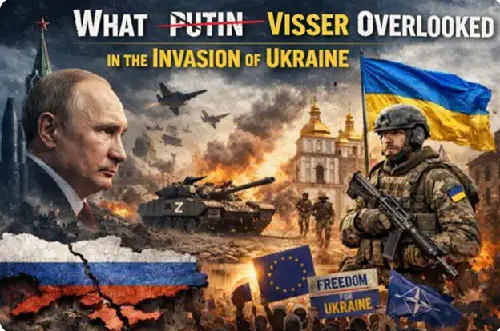 While Frank Visser's essay, “What Putin Strategically Overlooked in the Invasion of Ukraine” provides a compelling critique of Vladimir Putin's strategic misjudgments in the 2022 invasion of Ukraine, framing it as a series of ideological, operational, and epistemic failures, it largely adopts a liberal-internationalist lens that emphasizes Ukrainian agency, Western adaptability, and Russian authoritarian flaws. A counter-argument, drawing from realist international relations theory that is, as articulated by scholars like John Mearsheimer, shifts the focus to structural factors: great-power security dilemmas, NATO's eastward expansion as a perceived existential threat to Russia, and Western actions that escalated tensions rather than de-escalating them. This view doesn't excuse the invasion, but it does argue that it is justified under Article 51 of the UN, which argues not only for the sanctity of sovereignty but for the right of defense, just as does US and Western law. It argues that Putin's decisions were rational responses to perceived encirclement, not mere blunders. It highlights Putin's repeated diplomatic overtures to avoid full-scale war, Western provocations (from the 2008 NATO pledge to shelling in Donbas), the sabotage of peace efforts like Minsk II and the 2022 Istanbul talks, and a pattern where the West interprets Russian restraint as weakness, only to label decisive actions as unprovoked aggression. Realists contend that states prioritize survival and security in an anarchic world, where one power's defensive moves can appear offensive to another. Russia's actions, in this light, stem from fears of NATO's proximity to its borders, historical invasions that is, Napoleon and Hitler, and the loss of its post-Soviet buffer zone. Data shows NATO expanded from 16 members in 1990 to 32 by 2024, incorporating former Warsaw Pact states despite early assurances to Gorbachev, of which there is extensive documentation. Putin's pre-invasion diplomacy included proposals for security guarantees that is, December 2021 treaties demanding no further NATO enlargement, which the West dismissed as non-starters. ‘Putin Misread Ukrainian National Identity’Visser claims Putin underestimated a hardened Ukrainian nationalism post-2014, mistaking cultural ties for loyalty. This overlooks how the US and the UK fueled Nazi-allied nationalist groups in Ukraine for decades, viewing fascism as a defense against communism. In the late 1940s, MI6 linked with Bandera in the British Zone of Germany, where he provided intelligence on UPA activities inside Soviet Ukraine. Viewing him as organizing a potential rebellion, MI6 parachuted UPA agents into Ukraine, that is, a drop near Kiev in July 1949, followed by others over the next year, using RAF aircraft to support guerrilla operations. The context was explicitly anti-communist: MI6 treated OUN-B as the “enemy's enemy,” overlooking Bandera's Nazi collaboration, that is, his forces' role in the 1941 Lviv Pogrom in which thousands of Jews and Poles were butchered, in favor of their utility against Stalin's regime. In Operation ANYFACE, the US Army's Counter Intelligence Corps (CIC) shielded Bandera from Soviet extradition requests in the American occupation zone of Germany. From the late 1940s to his assassination in 1959, Bandera lived openly in Munich, plotting Ukrainian independence, as US intelligence feigned ignorance of his location to Soviet allies. This was motivated by fears of Stalin's expansionism and the need for anti-communist operatives in Central Europe. The Army delivered other war crimes suspects but protected Bandera, viewing him as a strategic asset against communism despite his Nazi sympathies. This analysis ignores that Russia had strong reasons to fear fascism, personified by the neo-Nazi followers of Bandera in control of the Ukrainian coup government and military, based on the loss of some 27 million Russians at the hands of fascists in the 1940's. It also overlooks multiple western attempts to reduce or block Russian access to the Black Sea and warm water ports. The Crimean War (1853-1856) was a direct military intervention to cripple Russian Black Sea power. Britain consistently opposed Russian unilateral control of the Straits to prevent Russian warships from freely entering the Mediterranean, perceived as threatening British naval supremacy. The US supported Turkey against Soviet demands (1945-1946) to revise the Montreux Convention for joint Soviet-Turkish control of the Straits or bases there. Truman sent warships to Turkish waters (1946), contributing to the Truman Doctrine (1947) and Turkey's NATO entry (1952). This aimed to prevent Soviet dominance over the Straits and Black Sea access. In August 2013, the US Naval Facilities Engineering Command (NAVFAC Europe Africa Central, based in Naples, Italy, posted a solicitation on the US federal procurement site (then FedBizOpps.gov, now SAM.gov) for a firm-fixed-price construction contract titled “Renovation of Sevastopol School #5, Ukraine”. Note that this was prior to the Maidan coup, when it was in the planning stages in the U.S., UK, and EU. It is a smoking gun indicator that the U.S. military assumed that Sevastopol, which housed a major Russian naval base and port, would soon be under the control of the U.S. military. It also overlooks how NATO aspirations and Western-backed regime change fueled Russian fears of a hostile neighbor. The 2008 Bucharest Summit explicitly pledged Ukraine's future NATO membership, seen by Russia as a red line violating post-Cold War understandings. Putin's view of Ukraine as historically Russian isn't just ideology; it's tied to security. Ukraine in NATO could host missiles minutes from Moscow. Pre-2022 polls showed divided Ukrainian identity, with 40-50% in eastern regions favoring closer Russia ties (Pew, 2019). The invasion unified Ukraine, but realists argue this was a predictable backlash to perceived provocation, not a misread. Putin sought limited goals, such as Donbas neutrality, via diplomacy, not imperial, expansionist goals. For example in 2021 Russian made proposals for mutual non-aggression pacts which were rejected by the West. Western support for the 2014 Euromaidan coup exacerbated divisions, per OSCE reports on ethnic tensions. ‘Putin Confused Corruption with Collapse’Visser argues Ukraine's imperfections made it adaptable, not fragile. Realists see Ukraine's instability as a symptom of Western meddling, creating a volatile proxy state on Russia's border. From 2014-2022, Ukraine's government faced corruption scandals, such as Hunter Biden's Burisma ties, and failed reforms, but Western aid including billions in IMF loans (violating its own loan guidelines) and military training, propped it up as an anti-Russian bulwark. Putin's “collapse” assumption stemmed from realistic assessments: Ukraine's GDP per capita was ~$3,700 in 2021 vs. Russia's $10,000, with oligarchic control weakening state cohesion. However, he underestimated Western commitment to Ukraine, not only as a containment tool but as a location for the forward placement of Western troops and missiles directly threatening Russia. OSCE monitored 2014-2022 Donbas ceasefire violations, noting some 1 million incidents, with Ukrainian shelling killing more than 150 civilians in separatist areas annually, targeting ethnic Russians and provoking escalation. This wasn't mere corruption but ethnic conflict stoked by post-Maidan policies like language laws restricting Russian, viewed in Russia as cultural erasure. To this day that policy continues, with Russian books, orthodoxy, art, symphonic works, and now “Russian songs” prohibited in Ukraine. ‘Putin Planned a Coup, Not a War’Visser describes the initial blitz as a failed decapitation, leading to unprepared attrition. In February 2022, Ukraine amassed ~150,000 troops near Donbas, per Russian claims, partly verified by OSCE. Putin's “special operation” aimed at quick neutralization to force negotiations, not conquest, evidenced by early Istanbul talks. Western escalation that is, UK's Johnson urging no concessions, prolonged the war. Realists note similar U.S. “decapitations”, such as Iraq in 2003, which were framed as liberation and the hypocrisy of labeling Russia's as pure aggression. Visser's argument ignores Putin's pre-invasion restraint and diplomatic pushes for de-escalation, interpreted by the West as weakness. Russia massed troops in 2021 but proposed talks on NATO limits. Biden's administration offered only arms to Ukraine, including 650M in 2021. The initial blitz was a response to perceived imminent threats, like Ukraine's NATO bid and Donbas offensives. ‘Putin Underestimated the West's Capacity for Strategic Learning’Visser praises Western adaptation via sanctions and aid. Realists argue NATO's expansion provoked the crisis, and “learning” was reactive aggression. The 2008 pledge ignored Russian warnings, for example, clearly enunciated in Putin's 2007 Munich speech. Western arming Ukraine pre-2022, $2.7B from U.S. 2014-2021, unmistakably signaled hostility. Sanctions post-2014 Crimea not only failed to deter; Russia's economy grew 1.5% annually despite them while cutting Europe off from cheap Russian energy, leading to catastrophic ongoing de-industrialization. NATO's 2022 expansion, with the admission of Finland and Sweden, confirmed Russian fears, not adaptation. Putin's diplomacy included 2019 Normandy Format talks for Donbas peace, sabotaged by Ukraine's non-implementation. Merkel and Hollande later admitted Minsk bought time for Ukraine to arm, not genuine peace. ‘Putin Believed Nuclear Coercion Still Worked Like It Did in the Cold War’Visser says threats deterred but lost credibility due to aggression. Russian nuclear signaling was defensive, responding to Western escalations like ATACMS missiles to Ukraine (2024). Realists see mutual deterrence: U.S./NATO's nuclear umbrella emboldened Ukraine. Putin's restraint including no full mobilization until 2022, was seen as weakness. When Ukraine attacked the air wing of Russia's nuclear triad, destroying several of its bombers, Russia's response was minimal, causing outrage among Russian hawks and confirming in many Western minds that Putin and Russia were weak, priming the West for escalation, which it did in attacking Putin's Valdai residence, as confirmed by drone coordinates handed over by Russia to the US military. ‘Putin Ignored the Economics of Long Wars’Visser highlights Russia's vulnerabilities vs. Ukraine's allied support. Realists note Russia's resilience, for example, 2023 GDP growth of 3.6% despite isolation, via BRICS trade. Pre-invasion, Putin sought economic integration with the West. That is now long gone. It was actively blocked by EU association deals. Western energy dependence flipped from Russia to the U.S. Europe's gas prices tripled post-2022, hurting European allies. The ongoing Ukrainian, U.S., UK, and EU Donbas attacks from 2014-2022 resulted in at least 14,000 deaths, including 3,400 civilians, many ethnic Russians. These imposed human/economic costs on Russia, justifying intervention as humanitarian. Putin's delayed response - he delayed for 8 years - was restraint, not miscalculation. ‘Putin Fell Victim to His Own Propaganda System’Visser blames authoritarian echo chambers. All leaders face biases; Western intelligence misjudged Russia's resilience. Putin's “bubble” included accurate assessments of Western provocations, like Minsk sabotage. Poroshenko admitted delaying Minsk for military buildup. The 2022 Istanbul draft, stipulating a neutral Ukraine and Donbas autonomy, was near-agreement, but U.S./UK pressure (Johnson's visit) scuttled it, per negotiators. Realists argue Western media's “aggression” narrative ignores context, like U.S. “Monroe Doctrine” sphere-of-influence hypocrisy. ‘The Strategic Error Was Not Civilizational—but Structural’Visser frames the war as a clash of modernity vs. imperialism, but realists see it as a predictable security dilemma. NATO's expansion ignored Russia's interests, turning a manageable dispute into catastrophe. The West has lost the war and effectively pushed Ukraine securely into the orbit of Russia. It is becoming quite possible that the Russian military will be hard up on the borders of Europe in two years, the reverse of what the West had conspired to implement. Putin's “conquest” aimed at buffers, not the reversal of history, evidenced by limited annexations. Russia had not only granted Ukraine its independence but was content to continue to honor its lease with Ukraine for the Russian naval base in Sevastopol, Crimea. It was only after Ukraine, at the behest of the U.S., UK, and EU, moved to eliminate that access that Russia acted. Ironically, Western actions solidified Russia's pivot to China/BRICS, weakening the liberal order. As of 2026, with ~600,000 Russian and as many as 1.5 million Ukrainian casualties, with the population of Ukraine halved and facing a major demographic crisis, peace requires addressing root causes like NATO pledges, not just blaming Putin and throwing around accusations of authoritarianism. While diplomacy is the path forward, the U.S., EU, and UK refuse to engage in any serious diplomatic negotiations with Russia. In fact no formal negotiations with representatives from any western power are taking place, despite Russian often repeated declared willingness to do so. Without diplomacy, Russia will continue to prosecute the war that it is winning, with its conditions for a cease fire continuing to tighten. Underlying Reasons for a Failed PolicyA more fundamental question is why the West continues to view Russia as both instigator of aggression and enemy when both strategies continue to prove not only counter-productive but disastrous to western interests. First, there is the horrendous economic blowback. Sanctions have boomeranged on Europe. Energy prices tripled in 2022-2023, contributing to recessions in Germany and inflation spikes. The US benefited from LNG exports but faces global supply chain disruptions. Overall, the war has cost the West trillions in aid, lost trade, and reconstruction pledges. Second, pushing Russia into China's orbit has created a de facto “axis” of Russia-China-Iran-North Korea, with Russian-Indian relations becoming increasingly intertwined, accelerating multipolarity and undermining US hegemony. This includes joint military exercises and tech sharing, weakening Western sanctions. Escalation fears, such as Russia's Oreshnik missile attacks, raise nuclear risks without clear wins while Ukraine continues to lose both men and territory at an increasing rate. Third, the policy has fractured Western unity. Hungary's Orbán blocks EU aid, while US Republicans and Trump question NATO commitments, calling it “obsolete.” Trump has now extorted billions from the EU and threatens to steal Greenland from Denmark. Public war fatigue in the West is evident. 2025 polls show 40% of Europeans prioritizing domestic issues over Ukraine support. Fourth, resources diverted to threaten Russia, including $100B and annual NATO spending increases, distract from China, climate change, and domestic priorities, arguably hastening Western decline. Fifth, there is the unspoken issue of profiteering. Many westerners are employees, stock holders, or beneficiaries of campaign contributions from the military industrial complex. If the war ends, those people lose sources of income. Sixth, focusing on “Russia/China/Iran” BAD!! Serves to refocus public attention and fear externally, away from multiple and growing internal sources of ongoing collapse. Seventh, there are cognitive biases. We see what we have been scripted to see and ignore what does not fit into our worldview. Most westerners have grown up on a constant diet of “Russia BAD!” Confirmation bias kicks in. Then, there is “sunk cost fallacy.” If westerners start looking at the conflict from the perspective of Russians, they have to abandon their prior convictions, which requires a large dose of humility, in addition to facing the likely cognitive dissonance that it would cause. All of these factors combine to produce something of an addiction to “staying the course,” regardless of the amount of data that demonstrates that it is not only not working, but is counter-productive and self-destructive.
Widget is loading comments...
|