|
TRANSLATE THIS ARTICLE
Integral World: Exploring Theories of Everything
An independent forum for a critical discussion of the integral philosophy of Ken Wilber
  Frank Visser, graduated as a psychologist of culture and religion, founded IntegralWorld in 1997. He worked as production manager for various publishing houses and as service manager for various internet companies and lives in Amsterdam. Books: Ken Wilber: Thought as Passion (SUNY, 2003), and The Corona Conspiracy: Combatting Disinformation about the Coronavirus (Kindle, 2020). Frank Visser, graduated as a psychologist of culture and religion, founded IntegralWorld in 1997. He worked as production manager for various publishing houses and as service manager for various internet companies and lives in Amsterdam. Books: Ken Wilber: Thought as Passion (SUNY, 2003), and The Corona Conspiracy: Combatting Disinformation about the Coronavirus (Kindle, 2020).
Check out my other conversations with ChatGPT What Putin Strategically Overlooked in the Invasion of UkraineFrank Visser / ChatGPT
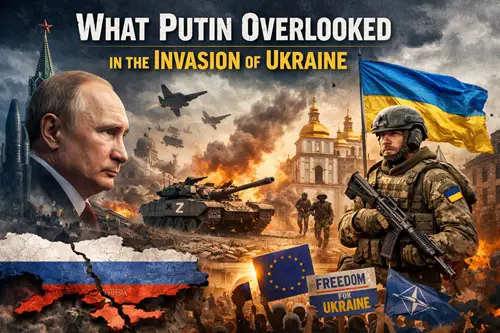 When Vladimir Putin launched what he called a “three-day Special Military Operation” against Ukraine in February 2022, he acted on a cluster of assumptions that proved catastrophically wrong. Four years on—longer than World War II lasted for the Soviet Union—Russia has failed even to secure the two Donbas oblasts it cynically declared “independent” as a pretext for war. This failure is not primarily the result of battlefield accidents or Western “interference,” but of deep strategic misjudgments at the level of political psychology, military doctrine, economics, and historical interpretation. This essay examines what Putin fundamentally overlooked when he decided to attack Ukraine. 1. He Misread Ukrainian National IdentityPutin's gravest error was ideological. He treated Ukraine not as a sovereign nation with its own identity, but as an artificial state whose population could be rapidly subdued or realigned. This view rested on three false assumptions: • That Ukrainian identity was shallow and reversible • That Russian-speaking Ukrainians would welcome Russian troops • That Kyiv's government lacked legitimacy and resilience In reality, Ukrainian national identity had hardened since 2014. Russia's annexation of Crimea and its proxy war in Donbas had already done what centuries of Russification failed to do: forge a broad civic nationalism that crossed linguistic, ethnic, and regional lines. The invasion did not divide Ukraine—it unified it. Putin mistook historical proximity for political loyalty, and cultural overlap for strategic consent. 2. He Confused Corruption with CollapseRussian intelligence assessments appear to have extrapolated Ukraine's real problems—corruption, oligarchic influence, bureaucratic inefficiencies—into a fantasy of imminent state failure. This was a classic authoritarian error: mistaking internal critique and pluralism for weakness. Ukraine's political system, precisely because it was contested and imperfect, proved more adaptable under pressure than Russia's centralized, brittle governance. The Ukrainian state did not collapse; it mobilized. Civil society, local governments, and volunteer networks filled gaps faster than any top-down system could. Putin assumed that dysfunction meant fragility. In practice, it meant flexibility. 3. He Planned a Coup, Not a WarThe initial invasion plan bore all the hallmarks of a decapitation strike: • Rapid airborne assaults on Kyiv • Minimal logistical preparation • Parade uniforms and riot police instead of occupation forces This was not a plan to conquer and hold territory—it was a plan to install a client regime before serious resistance could form. Once this gamble failed, Russia found itself fighting a war it had not prepared for: • Supply chains collapsed • Command structures proved rigid and corrupt • Casualties mounted with no operational breakthrough The Kremlin transitioned from a failed coup attempt to a grinding war of attrition—but without the economic, demographic, or industrial advantages required to win such a war decisively. 4. He Underestimated the West's Capacity for Strategic LearningPutin assumed the West was: • Too divided • Too risk-averse • Too dependent on Russian energy While these assumptions were partially correct in the short term, he overlooked something crucial: adaptive capacity. NATO and EU states did not respond instantly or perfectly—but they learned. Arms deliveries scaled up, doctrines evolved, sanctions regimes tightened, and energy dependencies were restructured faster than Russia anticipated. Putin planned for Western paralysis. Instead, he triggered Western rearmament, NATO expansion, and long-term strategic decoupling from Russia—outcomes directly contrary to his stated goals. 5. He Believed Nuclear Coercion Still Worked Like It Did in the Cold WarRussia's nuclear arsenal was meant to deter escalation and constrain Western involvement. While it succeeded in preventing direct NATO intervention, it failed to achieve broader strategic intimidation. Why? Because nuclear threats are most effective when the issuer is perceived as: • Rational • Predictable • Defensive By launching a war of aggression based on historical grievance and imperial revisionism, Putin degraded the credibility of Russia's nuclear signaling. Nuclear weapons prevented Russia's defeat—but they did not secure its victory. Deterrence worked tactically. It failed strategically. 6. He Ignored the Economics of Long WarsRussia entered the war assuming: • Sanctions would be symbolic • Energy exports would insulate the economy • Time favored the attacker Instead, the war exposed structural weaknesses: • Technological dependence on Western components • Demographic decline limiting manpower • Capital flight and brain drain • A military-industrial base optimized for prestige weapons, not sustained high-intensity warfare Ukraine, by contrast, externalized much of its economic burden to allies while internalizing moral and political legitimacy. Putin planned a short war financed by inertia. He got a long war financed by exhaustion. 7. He Fell Victim to His Own Propaganda SystemPerhaps the most overlooked factor is epistemic. Authoritarian systems reward loyalty over accuracy. Over time, this creates an information bubble in which leaders hear what they want to hear. Putin's long isolation—both physical and intellectual—meant that bad assumptions were not challenged, but reinforced. Ukraine was not merely misjudged; it was misrepresented at every level of decision-making. By the time reality intruded, the costs of reversal were politically unbearable. The war became self-perpetuating, not because it was winnable, but because admitting failure threatened regime legitimacy. Conclusion: The Strategic Error Was Not Tactical—but CivilizationalPutin did not simply underestimate Ukraine or overestimate Russia. He misjudged the nature of modern warfare in a globalized, information-saturated world. He believed: • History could be reversed by force • Identity could be imposed by decree • Fear could substitute for legitimacy Instead, he discovered that wars of conquest in the 21st century do not fail because of insufficient brutality, but because they collide with realities that tanks cannot suppress: national self-determination, economic interdependence, and adaptive alliances. The ultimate irony is this: in attempting to prevent Ukraine from becoming a nation, Putin ensured that it became one—irreversibly, and at immense cost to Russia itself.
Widget is loading comments...
|