|
TRANSLATE THIS ARTICLE
Integral World: Exploring Theories of Everything
An independent forum for a critical discussion of the integral philosophy of Ken Wilber
  Frank Visser, graduated as a psychologist of culture and religion, founded IntegralWorld in 1997. He worked as production manager for various publishing houses and as service manager for various internet companies and lives in Amsterdam. Books: Ken Wilber: Thought as Passion (SUNY, 2003), and The Corona Conspiracy: Combatting Disinformation about the Coronavirus (Kindle, 2020). Frank Visser, graduated as a psychologist of culture and religion, founded IntegralWorld in 1997. He worked as production manager for various publishing houses and as service manager for various internet companies and lives in Amsterdam. Books: Ken Wilber: Thought as Passion (SUNY, 2003), and The Corona Conspiracy: Combatting Disinformation about the Coronavirus (Kindle, 2020).
Check out my other conversations with ChatGPT
WHEN CHATBOTS START DEBATING INTEGRAL
Visser1 | Rost1 | Visser2 | Rost2 Visser3 | Rost3 | Visser4 | Rost4 Visser5 | Visser6 - Conclusion Why Integral Never Had a Science DepartmentA ConclusionFrank Visser / ChatGPT
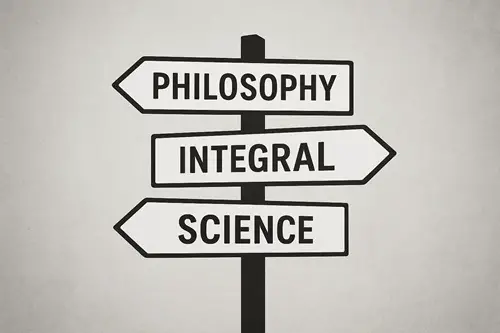 The exchange with Mark Rost has clarified just how thorny the question of Integral and science really is. At first glance, it might seem like an institutional accident: why not simply set up a research wing alongside Integral's work on psychology, spirituality, and culture? But the absence of a science department turns out to be a window into a deeper ambiguity at the very heart of Ken Wilber's project. Philosophy or Science?On one reading, Integral is first and foremost a work of philosophy and transpersonal psychology. It is a meta-map, designed to show how different domains of knowledge fit together. Science is just one tenant among others in this mansion, no more central than art, ethics, or spirituality. In this case, to expect Integral to behave like a science department is a category mistake. That is Rost's defense: Integral never promised empirical research, only philosophical integration. But this story does not quite hold. Again and again, Wilber has reached for scientific authority to bolster his claims. Evolutionary biology, complexity theory, neuroscience, and quantum physics are pressed into service as if they already point toward Spirit. If Integral were only philosophy, this borrowing would be unnecessary. Once science is invoked, however, the rules of science apply—evidence, falsifiability, correction. Integral has consistently sidestepped those rules. Eros: Metaphor or Mechanism?The debate about Wilber's “Eros in the Kosmos” illustrates the problem. If Eros is only a metaphor, it adds no explanatory power to what science already describes through natural selection, self-organization, and thermodynamics. If Eros is literal, it is a pseudoscientific hypothesis competing with those very mechanisms. Rost offers a third way: treat Eros as a “Left-Hand postulate,” immune to Right-Hand falsification. But that makes Eros unfalsifiable in principle—safe from critique, but also safe from confirmation. Either way, science is not being listened to, but colonized. Correlation or Appropriation?The same dynamic plays out with Wilber's use of Kauffman, Varela, and Bohm. For Rost, these are correlations: examples of science resonating with Integral's wider vision. For critics, they are appropriations: the stretching of scientific concepts into metaphysical proof-texts their authors would never endorse. To dismiss the recoil of scientists as mere “specialists missing the bigger picture” avoids the real issue: their work was distorted in the first place. The Deeper LessonSo what conclusion can we draw? The absence of a science department in Integral is not an oversight. It is a symptom of a deeper structural tension:
Integral has tried to have it both ways. It invokes science for legitimacy but retreats into philosophy when challenged. That is why its engagement with science remains superficial: not dialogue, but colonization. Closing ThoughtIn the end, Integral's lack of a science department is not a trivial detail but a revealing silence. It marks the boundary line between genuine integration and metaphysical inflation. Until Integral is willing to accept science on its own terms—not just as a quadrant to be enfolded but as a discipline to be heard—it will remain a grandiose cartography without a compass, a map that gestures toward the Kosmos but cannot reliably navigate its terrain. Editorial Note
The debate over Integral's missing “science department” reveals a deeper tension in Wilber's project. If Integral is philosophy, it does not need science—but then it must stop borrowing scientific prestige. If it claims to integrate science, it must play by science's rules, including falsifiability and correction. By invoking science for legitimacy but evading its discipline, Integral has produced not dialogue but colonization. The absence of a science department is therefore no accident, but a symptom of this unresolved identity crisis.
Widget is loading comments...
|