|
TRANSLATE THIS ARTICLE
Integral World: Exploring Theories of Everything
An independent forum for a critical discussion of the integral philosophy of Ken Wilber
  Frank Visser, graduated as a psychologist of culture and religion, founded IntegralWorld in 1997. He worked as production manager for various publishing houses and as service manager for various internet companies and lives in Amsterdam. Books: Ken Wilber: Thought as Passion (SUNY, 2003), and The Corona Conspiracy: Combatting Disinformation about the Coronavirus (Kindle, 2020).
Check out my other conversations with ChatGPT
The Woke ControversySocial Justice, Cultural Polarization, and the Battle for Western ValuesFrank Visser / ChatGPT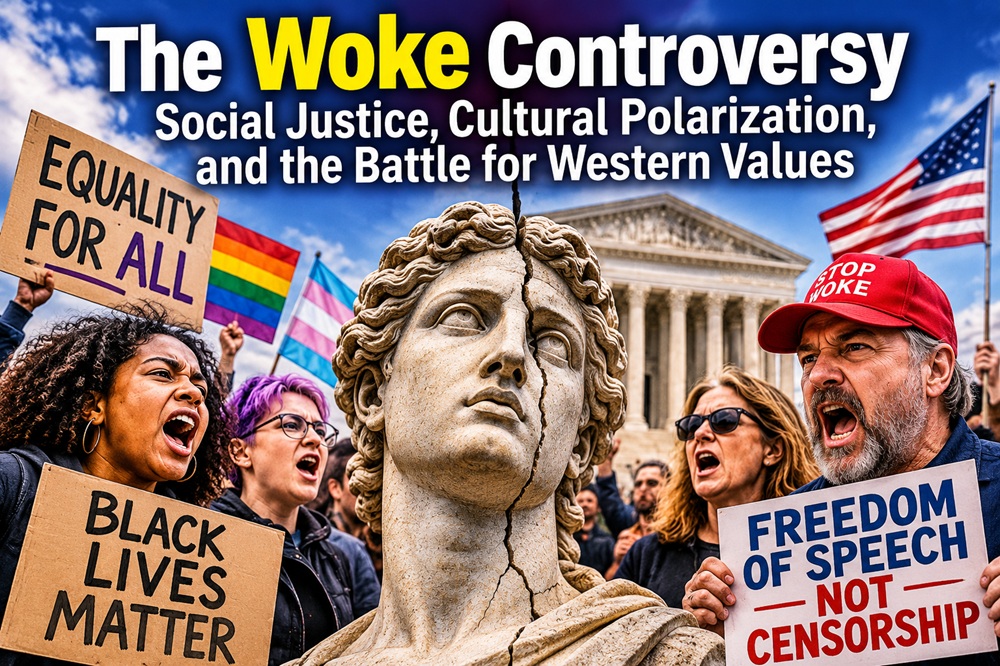 Introduction: How Did Wokeness Become a Cultural Battleground?Few cultural controversies in contemporary Western society have become as emotionally charged as the debate over "wokeness." Originally associated with awareness of racial injustice and social discrimination, the term has evolved into a catch-all designation for a broad range of progressive positions concerning race, gender, sexuality, colonialism, identity, language, education, and institutional power. What began as a call for social awareness has become one of the defining ideological conflicts of the twenty-first century. For supporters, being woke means recognizing injustices that established institutions have ignored or normalized. It involves listening to marginalized communities, challenging inherited privileges, and correcting inequalities that cannot be explained simply by individual effort or merit. For opponents, wokeness represents an increasingly dogmatic ideology that divides society into categories of oppressors and oppressed, restricts freedom of expression, undermines universal standards, and replaces rational discussion with moral conformity. Both descriptions contain elements of truth. Neither adequately captures the entire phenomenon. The central problem is that a legitimate concern with social injustice has become entangled with a particular ideological interpretation of society, one that sometimes treats disagreement as evidence of moral deficiency. At the same time, opposition to excesses of progressive activism has frequently developed into a political reaction that dismisses genuine problems of discrimination and inequality. Understanding the woke controversy therefore requires moving beyond the familiar opposition between progressive enlightenment and conservative reaction. 1. The Origins of Wokeness: From Racial Awareness to Cultural IdeologyThe word "woke" has African American origins. It emerged in Black American vernacular as an expression of vigilance concerning racial injustice and the dangers of living in a society structured by racial inequality. To stay woke meant remaining alert to discrimination, police violence, institutional racism, and the persistence of historical injustices. The term gained wider prominence during the Black Lives Matter movement, particularly following the killing of Michael Brown in Ferguson in 2014 and the subsequent protests against police violence. Initially, the concept had a relatively straightforward moral meaning: do not be indifferent to injustice simply because it does not affect you personally. This is hardly a controversial proposition. Democratic societies should be attentive to unequal treatment, institutional discrimination, and the historical consequences of exclusion. However, the meaning of wokeness gradually expanded. It came to encompass a much broader intellectual and political framework, drawing on critical race theory, postcolonial studies, feminist theory, queer theory, and various forms of poststructuralist philosophy. These traditions are not interchangeable, and it would be inaccurate to treat them as one coherent doctrine. Nevertheless, they share an interest in examining how social institutions, cultural norms, and established forms of knowledge can reproduce relations of power. The resulting intellectual movement challenged the assumption that Western societies had already achieved sufficient equality through formal civil rights legislation and liberal democratic institutions. It argued that discrimination could persist in less visible forms, embedded in everyday practices, institutional procedures, cultural representations, and supposedly neutral standards. This insight deserves serious consideration. But the expansion of the concept also introduced new difficulties. 2. Critical Race Theory and the Problem of Structural RacismOne of the most influential intellectual sources of contemporary wokeness is Critical Race Theory (CRT), which developed within American legal scholarship during the late twentieth century. CRT challenged the idea that racism should be understood exclusively as individual prejudice or intentional discrimination. Instead, it examined how apparently neutral laws, institutions, and social arrangements could perpetuate racial inequalities. This distinction between individual and structural explanations is important. A society can formally prohibit discrimination while continuing to exhibit substantial inequalities in wealth, education, housing, employment, and political influence. Historical disadvantages do not automatically disappear when discriminatory laws are abolished. However, some popular interpretations of structural racism move beyond identifying demonstrable inequalities. They risk treating virtually every disparity as evidence of discrimination, without adequately investigating alternative explanations. This creates an epistemological problem. If unequal outcomes are automatically interpreted as evidence of oppression, while equal outcomes are interpreted as evidence that oppressive systems have merely become more sophisticated, the theory becomes difficult to falsify. A convincing explanation of inequality must investigate multiple contributing factors, including historical exclusion, socioeconomic circumstances, educational opportunities, family background, institutional practices, individual choices, and discrimination. It should neither assume that all inequalities are unjust nor presume that existing inequalities are necessarily deserved. The distinction between identifying structural injustice and explaining every social difference through structural injustice is crucial. 3. Identity Politics and the Fragmentation of UniversalismAnother important feature of contemporary wokeness is its emphasis on identity. Race, gender, sexuality, ethnicity, disability, and other social characteristics become central categories through which individuals understand their position in society. There are good reasons for recognizing group identities. People experience discrimination partly because they are perceived as belonging to particular groups. Ignoring these experiences in the name of abstract equality can perpetuate injustice. Nevertheless, identity politics has a potentially divisive side. When individuals are primarily understood through their membership in particular identity categories, their common humanity risks becoming secondary. Society is increasingly interpreted as a collection of competing groups, each with its own historical grievances, interests, and claims to recognition. This creates an unfortunate paradox. A movement that seeks to overcome discrimination can inadvertently reinforce the very categories it hopes to make less consequential. The traditional liberal ideal emphasizes universal citizenship: individuals should enjoy equal rights regardless of race, religion, gender, or sexual orientation. Certain contemporary identity-based approaches challenge this universalism, arguing that supposedly universal principles often reflect the historical interests of dominant groups. There is an important point here. Universal principles have frequently been applied selectively. Western democracies have proclaimed equality while maintaining slavery, colonial domination, segregation, and gender discrimination. But the appropriate response is not to abandon universalism. It is to make universalism more consistent. The solution to selective equality is not competing particularisms. It is a more genuinely inclusive conception of equal human dignity. 4. Language, Political Correctness, and the Policing of SpeechOne of the most visible aspects of the woke controversy concerns language. Progressive activists have challenged expressions considered racist, sexist, homophobic, transphobic, or otherwise discriminatory. They have encouraged the adoption of more inclusive terminology and questioned traditional linguistic conventions. Some of these changes are entirely reasonable. Language is not politically neutral in every context. Words can reinforce stereotypes, humiliate individuals, or normalize discriminatory assumptions. There is nothing inherently objectionable about reconsidering terminology that unnecessarily stigmatizes particular groups. However, the politics of language can become excessive. When linguistic mistakes are treated as moral offenses, when changing terminology becomes an endless exercise in ideological compliance, or when people are publicly condemned for failing to adopt the latest preferred vocabulary, communication becomes increasingly difficult. The distinction between disagreement, ignorance, insensitivity, and deliberate hostility tends to disappear. This is particularly problematic in academic institutions, where the freedom to formulate unpopular hypotheses and challenge established assumptions should be fundamental. A society that protects only approved forms of expression does not become more enlightened. It becomes intellectually fragile. There is also a danger of confusing linguistic change with substantive progress. Replacing one set of words with another does not automatically improve material conditions or eliminate discrimination. Respectful language matters, but it cannot substitute for social and institutional reform. 5. Gender Identity and the Limits of Progressive ConsensusGender identity has become one of the most contentious areas of the woke debate. The growing recognition of transgender people has challenged traditional assumptions about the relationship between biological sex and gender identity. Supporters emphasize personal autonomy, dignity, and protection against discrimination. Critics raise questions about biological categories, women's rights, competitive sports, medical treatment of minors, and the boundaries of institutional accommodation. These discussions are particularly difficult because they involve competing interests and different understandings of human identity. The recognition that transgender people deserve safety, dignity, and equal protection under the law should not require abandoning scientific discussion of biological sex. Conversely, acknowledging biological distinctions does not justify hostility, humiliation, or discrimination against transgender individuals. A mature discussion must distinguish between several questions that are often conflated: the biological classification of sex, the psychological and social dimensions of gender, legal recognition, medical intervention, and the practical organization of particular institutions. Different questions may require different answers. One problem with ideological polarization is that it encourages people to treat a position on one question as determining their position on all the others. A person who supports transgender rights may have legitimate reservations about a particular sports policy. Someone who emphasizes biological sex may nevertheless support extensive legal protections for transgender people. Democratic debate should leave room for such distinctions. 6. Universities and the Crisis of Intellectual FreedomUniversities have become central battlegrounds in the woke controversy. Historically, universities have been expected to cultivate critical inquiry, expose students to competing perspectives, and challenge established assumptions. They are not supposed to function as ideological training centers. Yet some academic environments have developed increasingly restrictive norms concerning controversial subjects. Disinvitation campaigns, protests against controversial speakers, disciplinary procedures surrounding offensive statements, and informal pressures to conform to prevailing ideological expectations have generated legitimate concerns. The phenomenon commonly described as cancel culture is not limited to progressive activism, but progressive campus politics has provided some prominent examples. The problem is not that students challenge speakers. Protest is itself a legitimate form of expression. The problem arises when disagreement becomes an attempt to prevent others from speaking, when accusations replace arguments, or when institutional authorities fail to protect intellectual freedom. Universities should be places where controversial propositions can be examined without automatically being interpreted as endorsements of those propositions. This includes the freedom to criticize progressive theories themselves. Indeed, a theory that claims to be emancipatory should be especially willing to expose itself to criticism. If its validity depends on restricting criticism, something has gone seriously wrong. 7. The Conservative Backlash: Anti-Wokeness as Political WeaponThe reaction against wokeness has become a powerful political force, particularly in the United States. Conservative politicians, commentators, and media organizations have transformed opposition to progressive cultural politics into a central component of their political identity. Donald Trump has repeatedly presented himself as an opponent of woke ideology, portraying progressive institutions as enemies of traditional American values. This political strategy has proved effective because it connects with genuine frustrations. Many people feel that cultural elites impose ideological expectations on ordinary citizens while dismissing their concerns as backward or morally unacceptable. However, anti-wokeness has developed its own ideological excesses. In some conservative circles, the term has become a convenient label for virtually any progressive initiative, whether or not it involves ideological coercion. Diversity programs, environmental concerns, minority representation, historical reassessment, and even ordinary expressions of social tolerance can all be denounced as woke. This produces a mirror image of the problem it claims to oppose. Where some progressive activists interpret disagreement as evidence of prejudice, some conservative activists interpret progressive reform as evidence of ideological subversion. Both approaches encourage political tribalism. The conservative backlash also has a practical contradiction. It frequently invokes freedom of speech while supporting restrictions on educational curricula, books, university programs, and discussions of controversial historical subjects. The defense of intellectual freedom cannot be selective. It must apply equally to progressive and conservative viewpoints. 8. The Commercialization of WokenessAnother important dimension of the controversy is its commercialization. Corporations have increasingly adopted the language of diversity, inclusion, equality, and social responsibility. Advertising campaigns, employee policies, corporate statements, and public relations initiatives frequently incorporate progressive terminology. Some of these initiatives reflect genuine improvements in workplace practices. Others appear to be exercises in reputation management. This phenomenon is sometimes called woke capitalism. Companies discover that progressive language can enhance their public image, attract certain consumer groups, and demonstrate conformity with contemporary cultural expectations. But corporate virtue signaling is not the same as social justice. A company may celebrate diversity in its advertising while maintaining exploitative working conditions, aggressive tax practices, or environmentally damaging business models. Similarly, corporations may abandon progressive branding when political conditions or consumer preferences change. The commercialization of wokeness therefore reveals a deeper problem: moral language can become detached from substantive moral commitments. The same criticism applies to institutions that adopt fashionable diversity terminology without examining whether their actual practices have changed. Social justice should be measured by outcomes and institutional conduct, not by slogans. 9. Colonialism, Historical Guilt, and the Reassessment of Western CivilizationWokeness has also contributed to a broader reassessment of Western history. Colonialism, slavery, imperialism, racism, and the exploitation of indigenous populations have received renewed attention. Historical narratives that once emphasized Western achievements have been challenged for marginalizing the experiences of conquered and exploited peoples. This reassessment is necessary. Western civilization cannot be understood honestly without acknowledging its history of domination and exploitation. The transatlantic slave trade, European colonialism, the dispossession of indigenous populations, and the racial hierarchies that accompanied imperial expansion are not marginal details. They are integral parts of modern history. At the same time, the Western intellectual tradition contains resources for criticizing these injustices. The Enlightenment ideals of individual liberty, rational inquiry, legal equality, and universal human rights have repeatedly been invoked by reformers challenging established power structures. These principles were often applied inconsistently, but their emancipatory potential should not be dismissed. A particularly unproductive tendency in some contemporary progressive discourse is to treat Western civilization as fundamentally defined by oppression, while overlooking the internal struggles that produced abolitionism, democratic reform, scientific inquiry, and human rights. Historical understanding requires more than replacing one triumphalist narrative with another, equally selective account of permanent Western guilt. It requires recognizing both achievement and failure. 10. The Psychological Dimension: Moral Superiority and Group BelongingThe woke controversy is not merely an intellectual disagreement. It also has a psychological dimension. Political identities provide people with a sense of belonging, purpose, and moral orientation. Being part of a movement that claims to fight injustice can be deeply meaningful. However, moral commitment can easily become moral self-righteousness. People may begin to derive their sense of personal virtue from their ability to identify the prejudices and moral failures of others. Social media intensifies this tendency. Public denunciations, accusations, and displays of ideological conformity are rewarded with attention and approval from like-minded audiences. The resulting environment encourages moral competition rather than mutual understanding. This phenomenon is not unique to progressives. Conservative and nationalist movements display similar psychological mechanisms. Both can create communities organized around shared grievances, perceived enemies, and claims to moral superiority. In either case, political disagreement becomes a struggle over identity and belonging. The difficulty is that people become less interested in discovering whether their own assumptions are mistaken. Instead, they seek confirmation that their opponents are morally defective. This is one of the most damaging consequences of contemporary political polarization. 11. A More Adequate Framework: Beyond Woke and Anti-WokeHow can we move beyond this controversy without simply splitting the difference between two opposing camps? First, we should distinguish legitimate social criticism from ideological dogmatism. Racism, sexism, homophobia, and other forms of discrimination are real phenomena. Their existence should not be denied simply because some activists employ questionable arguments or tactics. Second, we should defend universal principles. Equal rights, freedom of expression, individual responsibility, due process, and the dignity of persons should not depend on political affiliation or group identity. Third, we should distinguish empirical claims from moral commitments. Whether a particular institution exhibits racial discrimination is an empirical question requiring evidence. Whether discrimination is morally unacceptable is a normative question. Confusing these categories makes rational discussion unnecessarily difficult. Fourth, we should resist the tendency to reduce individuals to representatives of social categories. People have multiple identities, experiences, interests, and intellectual commitments. They cannot be adequately understood through a single characteristic. Finally, we should recognize that both progressive and conservative movements are vulnerable to ideological capture. The progressive movement can become intolerant in the name of tolerance. The conservative movement can become authoritarian in the name of freedom. Both can mistake their own political preferences for universal moral truths. The answer is not political neutrality toward injustice. It is critical independence toward every ideology claiming to represent justice. 12. The Integral Perspective: Can We Transcend the Culture War?From an integral perspective, the woke controversy can be interpreted as a conflict between different cultural value systems. A traditional worldview tends to emphasize inherited identities, established institutions, social cohesion, and continuity. A modern worldview emphasizes individual rights, rationality, universal law, and achievement. A postmodern worldview becomes increasingly sensitive to cultural exclusion, unequal power relations, and the experiences of marginalized groups. These are useful distinctions, provided they are treated as interpretive frameworks rather than fixed stages through which everyone must progress. Each perspective contributes something important. Traditionalism reminds us that societies need continuity, shared norms, and institutional stability. Modern liberalism emphasizes individual autonomy, universal rights, scientific reasoning, and the rule of law. Postmodern pluralism challenges the assumption that dominant cultural perspectives adequately represent everyone's experience. The problem emerges when any one perspective becomes exclusive. Traditionalism can defend unjust hierarchies. Modernism can underestimate historical and cultural inequalities. Postmodernism can undermine the very universal standards required to criticize injustice consistently. The challenge is therefore not to declare one worldview superior to all the others, but to preserve their legitimate insights while identifying their limitations. This does not mean that every claim deserves equal respect or that every political disagreement can be reconciled. Some claims are factually false, some policies are unjustifiable, and some political movements threaten democratic institutions. An integral approach should not become an excuse for relativism. It should encourage a more comprehensive analysis of the conflict, including its historical, institutional, psychological, and philosophical dimensions. Conclusion: Justice Without Dogmatism, Freedom Without IndifferenceThe woke controversy reveals a genuine crisis in Western democratic culture. On one side, legitimate demands for equality, recognition, and protection against discrimination have sometimes developed into forms of ideological conformity that undermine open inquiry and universal citizenship. On the other side, opposition to progressive excesses has frequently become a vehicle for reactionary politics, historical revisionism, and the dismissal of real social problems. Neither side has a monopoly on reason, justice, or freedom. The original impulse behind wokeness deserves recognition: societies should remain alert to injustice, particularly when it is hidden behind established institutions and cultural conventions. But awareness is not the same as wisdom. Moral sensitivity does not automatically produce sound political judgment. And a movement that claims to emancipate society should be willing to tolerate disagreement, scrutiny, and self-correction. Equally, the defense of Western civilization should not become an excuse for ignoring its historical failures. Its most valuable traditions include precisely those principles that make criticism of its own institutions possible. Perhaps the most important distinction is between fighting injustice and constructing an ideology around the permanent identification of enemies. The former is indispensable to democracy. The latter threatens to undermine it. Western culture does not need less concern for social justice. It needs a more intellectually mature understanding of what justice entails. It needs universalism without blindness to difference, pluralism without relativism, freedom without indifference, and equality without ideological coercion. The ultimate challenge is to create a political culture in which people can disagree profoundly without regarding one another as enemies. That would be a genuinely progressive achievement, whether or not anyone chooses to call it woke. Comment Form is loading comments...
|