|
TRANSLATE THIS ARTICLE
Integral World: Exploring Theories of Everything
An independent forum for a critical discussion of the integral philosophy of Ken Wilber
  Frank Visser, graduated as a psychologist of culture and religion, founded IntegralWorld in 1997. He worked as production manager for various publishing houses and as service manager for various internet companies and lives in Amsterdam. Books: Ken Wilber: Thought as Passion (SUNY, 2003), and The Corona Conspiracy: Combatting Disinformation about the Coronavirus (Kindle, 2020).
Check out my other conversations with ChatGPT The So-Called Problem with IslamBetween Left-Wing Denial and Right-Wing AlarmismFrank Visser / ChatGPT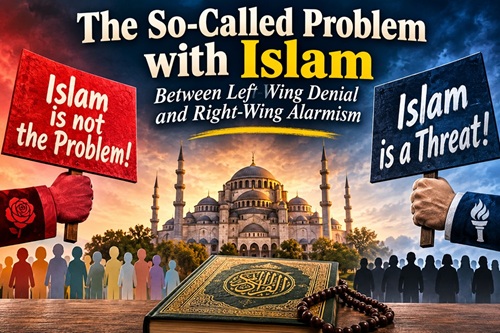 Introduction: Is There Really a Problem with Islam?Few subjects in contemporary Western politics are as politically charged as Islam. For some, Islam represents an inherently backward, patriarchal and intolerant religion that is fundamentally incompatible with liberal democracy. For others, criticism of Islam is largely a manifestation of Western prejudice, colonial attitudes, racism and anti-immigrant sentiment. Between these opposing positions lies a complicated reality that neither political camp seems particularly eager to confront in its entirety. The question, therefore, is not simply whether Islam has a problem. It is also what exactly constitutes that problem, who gets to define it, and why discussions about it so readily deteriorate into ideological warfare. There are genuine problems associated with particular interpretations of Islamic theology, religious authority, political Islam and cultural conservatism. These include restrictions on freedom of expression, the treatment of women, hostility toward homosexuality, religious intolerance, apostasy laws and the justification of violence in the name of religion. These issues deserve serious examination. But it is equally misleading to treat Islam as a single, uniform entity, or to regard Muslims collectively as responsible for the actions of Islamist movements, authoritarian governments or terrorist organizations. The political debate has become trapped between two forms of simplification: a right-wing tendency to portray Islam as an existential civilizational threat, and a left-wing tendency to regard criticism of Islam as primarily an expression of prejudice. Both positions obstruct the kind of open, evidence-based discussion that a liberal democracy needs. 1. The Right-Wing Perspective: Islam as a Civilizational ThreatFor much of the European and American political right, Islam has become a central symbol of cultural anxiety. The argument generally proceeds from the observation that Islam is not merely a private religious faith but can also provide a comprehensive framework for organizing society, including its legal, political and moral institutions. Unlike the secular separation of church and state that gradually developed in Western Europe, some influential Islamic traditions envision religion as an organizing principle of public life. Sharia, understood in its various interpretations, can encompass not only personal religious obligations but also family law, criminal justice and political authority. Right-wing critics point to countries where religious authorities exercise considerable influence over legislation, where apostasy or blasphemy can be punished, where women face systematic discrimination, and where homosexuality is criminalized. They also point to Islamist organizations that seek to replace democratic institutions with religious government. These are not imaginary concerns. Religious authoritarianism exists, and some political movements explicitly reject the fundamental principles of liberal democracy. The right is also correct to insist that immigration policy cannot be separated entirely from questions of integration, social cohesion and the compatibility of certain cultural practices with constitutional rights. A democratic society has legitimate reasons to expect newcomers, regardless of their religious background, to respect its laws and institutions. However, the right frequently moves from these defensible observations to much broader conclusions. Islam becomes a single, essentially unchanging ideology. Muslims become representatives of that ideology, regardless of their individual beliefs, political opinions or degree of religious commitment. The actions of Islamist extremists are treated as revealing the underlying nature of the entire religion. This is a serious analytical mistake. There are approximately two billion Muslims worldwide, living in vastly different political, cultural and economic circumstances. Their religious practices range from secular or culturally inherited identities to conservative orthodoxy, reformist theology and political Islamism. Indonesia, Albania, Turkey, Iran, Saudi Arabia and Senegal cannot simply be treated as interchangeable manifestations of one social system. Moreover, the right frequently overlooks the political and historical circumstances in which radical Islamism developed, including authoritarian government, colonial intervention, regional conflicts, foreign occupation and the failure of secular nationalist movements. None of these circumstances excuses religious extremism. They do, however, help explain why it emerges and why simplistic cultural explanations are inadequate. 2. The Left-Wing Perspective: Islam as a Minority to Be ProtectedThe political left approaches the subject from a different historical and moral background. Its emphasis on equality, anti-racism, minority rights and opposition to discrimination has made it particularly sensitive to anti-Muslim prejudice. This concern is understandable. Muslims in Western societies have experienced discrimination, stereotyping, hostility and, in some cases, outright violence. Muslim communities are not collectively responsible for terrorism, nor should individuals be treated as suspect because of their religious background. The left also recognizes that criticism of Islam can sometimes function as a socially acceptable vehicle for xenophobia. Political movements that speak about defending Western civilization may be less interested in defending universal human rights than in constructing an exclusionary national identity. But here, too, a legitimate concern can become an ideological blind spot. Parts of the progressive left have developed a tendency to approach Muslim communities primarily through the category of victimhood. Islam is interpreted as the religion of a marginalized minority, and criticism of its doctrines or institutions is consequently suspected of being an expression of racism. This creates an uncomfortable contradiction. The left traditionally regards religion as a legitimate subject of secular criticism. It has challenged the authority of the Catholic Church, opposed religious restrictions on reproductive rights, defended freedom of expression against religious censorship and campaigned for the emancipation of women and sexual minorities. Yet when similar criticisms are directed at conservative Islamic institutions, the response can become remarkably cautious. Why should religious conservatism receive different treatment depending on the identity of its adherents? There is an important distinction between protecting Muslims against discrimination and protecting Islamic doctrines against criticism. The former is a democratic obligation. The latter would amount to granting religious ideas a special exemption from public scrutiny. A Muslim woman challenging compulsory veiling, a former Muslim criticizing religious authority, or an LGBTQ activist opposing religious homophobia deserves the same freedom of expression as anyone else. Indeed, these voices are sometimes particularly vulnerable to intimidation from within their own communities. A progressive politics that cannot defend such individuals without qualification has abandoned part of its emancipatory mission. 3. Islam Is Not the Same as IslamismOne of the most important distinctions in this debate is between Islam as a religion and Islamism as a political ideology. Islam encompasses a broad collection of beliefs, practices, traditions and interpretations. Islamism, by contrast, refers to political movements that seek to organize society and government according to particular interpretations of Islam. Islamism itself is not a homogeneous movement. It includes parliamentary political parties, conservative social movements, revolutionary organizations and violent jihadist groups. Their strategies and objectives differ considerably. Nevertheless, some forms of Islamism challenge the foundations of liberal democracy. They reject the idea that human legislation should be sovereign when it conflicts with religious authority. They may also subordinate individual freedoms to collective religious obligations. This creates a genuine constitutional problem. Liberal democracy depends on the principle that no religious authority possesses an automatic right to determine the law for everyone else. Citizens are free to practice their religion, but religious institutions must operate within the same constitutional framework as other institutions. This principle applies equally to Christianity, Judaism, Hinduism and Islam. It is therefore perfectly legitimate to criticize political Islam when it seeks to undermine secular government, equality before the law or individual freedom. What is illegitimate is transferring that criticism indiscriminately to Muslims as individuals. The distinction is essential, but it is not always maintained in political debate. 4. The Difficult Question of Islamic DoctrineThere is another issue that is frequently avoided: to what extent do problematic political and social practices originate in Islamic religious texts and traditions themselves? It is tempting to answer that extremism is simply a distortion of Islam. This is often true in the sense that many Muslims reject extremist interpretations. But it does not settle the theological question. The Quran, the Hadith traditions and the subsequent development of Islamic jurisprudence contain passages and legal traditions that have been interpreted in ways that conflict with contemporary liberal values. Questions concerning gender relations, inheritance, religious conversion, blasphemy, homosexuality, warfare and relations with non-Muslims cannot simply be dismissed as inventions of modern extremists. At the same time, religious texts do not interpret themselves. Their meaning is mediated by historical context, legal traditions, schools of interpretation and contemporary political circumstances. Christianity provides an instructive comparison. Biblical texts have been used to justify slavery, religious persecution, the subordination of women and hostility toward homosexuality. Yet Christian societies have also undergone profound processes of secularization and theological reinterpretation. The history of Christianity demonstrates that religious traditions can change, sometimes dramatically, without disappearing. Islam is not exempt from this possibility. Indeed, Muslim reformers, secular intellectuals, feminists and progressive theologians have long challenged conservative interpretations from within the tradition. But genuine reform requires more than declaring that violent or discriminatory practices are un-Islamic. It requires confronting the textual, theological and institutional foundations that allow such practices to be justified. This is where a serious debate should take place. 5. Women, Sexual Minorities and Religious ConservatismPerhaps the most concrete area in which the tensions become visible concerns women's rights and the rights of sexual minorities. In several Muslim-majority countries, women face legal discrimination, restrictions on personal autonomy and unequal treatment in marriage, divorce and inheritance. In some countries, homosexuality is criminalized, sometimes with extremely severe penalties. Religious justifications are frequently invoked to defend these practices. The controversy surrounding the hijab illustrates the complexity of the issue. Some women regard it as a voluntary expression of religious identity. Others experience it as an obligation imposed by family, community or state authorities. A genuinely emancipatory position must defend both the right to wear religious clothing and the right not to wear it. It should oppose compulsory veiling as firmly as it opposes compulsory unveiling. The same principle applies to sexual minorities. Their rights cannot be subordinated to religious objections, whether those objections originate in Islam, Christianity or any other tradition. Here, the left should be more consistent, while the right should recognize that defending women's and LGBTQ rights does not require hostility toward Muslims as a population. Universal rights must remain universal. 6. The Problem of MulticulturalismThe debate about Islam is also a debate about multiculturalism. Western European societies have become increasingly diverse through immigration, decolonization, globalization and the movement of refugees. This has created societies in which different religious and cultural traditions coexist within shared political institutions. Multiculturalism can mean something perfectly reasonable: allowing different communities to maintain their cultural identities while participating equally in democratic society. But it becomes problematic when cultural difference is treated as a justification for unequal rights or separate moral standards. A liberal democracy cannot accept that practices forbidden under its laws become acceptable merely because they are defended as cultural or religious traditions. Forced marriage, honor-based violence, female genital mutilation, intimidation of religious dissenters and discrimination against women cannot be defended through appeals to cultural sensitivity. Nor should the state allow religious authorities to exercise coercive power over individuals who wish to leave their communities or abandon their faith. This is not an argument against cultural diversity. It is an argument for the primacy of individual rights over collective religious authority. The political left sometimes struggles with this distinction because it fears that defending universal principles will strengthen the political right. But refusing to confront illiberal practices does not make them disappear. It merely leaves the field open to those who exploit them. Conversely, the right often presents multiculturalism itself as the source of social fragmentation, overlooking the fact that successful integration is possible and that many Muslims participate fully in democratic institutions. The real challenge is not cultural uniformity but constitutional solidarity. 7. The Geopolitical Dimension: Islam and Authoritarian PowerThe international dimension complicates matters further. Many Western discussions of Islam focus on immigration and terrorism while paying insufficient attention to the political systems of Muslim-majority countries. Saudi Arabia has historically promoted an extremely conservative form of Islam through religious institutions and international networks. Iran operates a theocratic political system in which clerical authority exercises ultimate constitutional power. Afghanistan under Taliban rule represents an especially repressive model of religious government. Yet the relationship between Islam and political power is not uniform. Indonesia, the world's largest Muslim-majority country, has a democratic political system, albeit with its own problems of religious intolerance and institutional weakness. Senegal has a long tradition of religious pluralism, while Albania has a predominantly Muslim cultural heritage within a formally secular state. Furthermore, Western governments have often maintained close relations with authoritarian Muslim-majority governments when strategic or economic interests demanded it. The political right, which frequently presents itself as a defender of Western values, has not always been consistent in this respect. Its criticism of religious authoritarianism can become selective when energy supplies, arms contracts or geopolitical alliances are involved. The left, meanwhile, sometimes explains Islamist movements almost exclusively through Western imperialism, thereby minimizing the independent ideological ambitions and domestic responsibilities of religious-political actors. Both approaches are inadequate. Western intervention does not explain everything about Islamist radicalism, just as Islamic doctrine alone cannot explain the political trajectory of every Muslim-majority society. A serious analysis must take account of religion, institutions, history, economics and international power simultaneously. 8. Free Speech and the Fear of Criticizing IslamOne particularly troubling feature of the debate concerns freedom of expression. Criticism of Islam has occasionally provoked threats, intimidation and violence. The murders of people associated with criticism or satire of Islam have demonstrated that the consequences of religious dissent can be deadly. The attacks on Charlie Hebdo in Paris in 2015 remain an important example. Whatever one thinks of the magazine's editorial style, the right to criticize and satirize religious beliefs is fundamental to a free society. The same applies to writers, academics, journalists and former Muslims who question religious authority. A democratic society must protect the right to criticize Islam, including harshly. It must equally protect Muslims against discrimination, threats and violence. These principles are not contradictory. Indeed, they depend on one another. Freedom of religion is inseparable from freedom to reject religion, criticize religious institutions and change one's beliefs. This is particularly important for ex-Muslims, who can face hostility not only from religious communities but also from political activists who regard public criticism of Islam as inherently suspect. The left should recognize that freedom of conscience includes the freedom to leave one's religion. The right should recognize that defending free speech does not justify treating an entire religious population as an enemy. 9. The Political Exploitation of the Islam DebateThe so-called problem with Islam has become politically useful to both sides. For the populist right, Islam provides a convenient symbol around which anxieties about immigration, globalization, national identity and declining cultural authority can be organized. It offers a seemingly straightforward explanation for complex social developments. Instead of examining economic inequality, housing shortages, educational disadvantages, failures of integration or the political consequences of globalization, political entrepreneurs can blame an allegedly incompatible religion. The left, in turn, sometimes uses the specter of right-wing racism to avoid difficult discussions about religious conservatism, integration and illiberal practices within minority communities. The result is a mutually reinforcing polarization. The right points to examples of Islamist extremism and accuses the left of denying reality. The left points to examples of anti-Muslim discrimination and accuses the right of racism. Each side finds evidence that confirms its existing worldview. Meanwhile, the people most directly affected by these tensions are frequently overlooked: ordinary Muslims who want to live peacefully, secular Muslims who reject religious authoritarianism, women challenging patriarchal traditions, religious minorities facing persecution, and citizens who simply want their democratic rights respected. The debate becomes less about solving problems than about defending political identities. 10. A Liberal Alternative: Neither Islamophobia nor IslamophiliaWhat would a more intellectually consistent position look like? It would begin by rejecting collective guilt. Muslims should not be held responsible for terrorism, religious authoritarianism or the actions of foreign governments merely because they share a religious identity. It would also reject the idea that Islam, as a religion, should be exempt from critical examination. Religious doctrines are human intellectual and historical constructions. Like all other ideologies, they can be questioned, challenged and rejected. It would defend secular government, equality before the law, freedom of conscience, freedom of expression, gender equality and LGBTQ rights without making exceptions for religious sensitivities. It would distinguish between private religious practice and political movements seeking to impose religious authority on society. It would also recognize that integration is a two-way process. Immigrants must respect the constitutional framework of their new society, while the receiving society must offer equal opportunities, protection against discrimination and genuine possibilities for social participation. Finally, it would acknowledge that Islam is not a static historical object. Muslim societies, like Christian and secular societies, contain internal conflicts, reform movements and competing interpretations. The objective should not be to eliminate Islam from Western societies, nor to romanticize it as an inherently emancipatory cultural alternative to Western civilization. The objective should be to ensure that religious freedom and democratic freedom remain compatible. Conclusion: The Problem Is Not Islam Alone, but the Politics Surrounding ItIs there a problem with Islam? There are certainly problems associated with particular Islamic doctrines, institutions and political movements. Some interpretations of Islam remain deeply patriarchal, authoritarian and intolerant. Islamist organizations that seek to subordinate democratic government to religious authority deserve unequivocal criticism. Pretending otherwise, in the name of multicultural sensitivity, is intellectually dishonest. But the claim that Islam itself is fundamentally incompatible with democracy is equally simplistic. It ignores the diversity of Muslim populations, the possibility of religious reform, the historical transformation of other religious traditions and the existence of Muslims who actively defend secular democracy. The right is justified in demanding that liberal societies defend their constitutional principles. It is not justified in turning that demand into collective suspicion of Muslims. The left is justified in opposing discrimination and defending minority rights. It is not justified in treating criticism of religious conservatism as inherently racist or in applying universal emancipatory principles selectively. Ultimately, the most useful distinction is not between Islam and the West, but between liberal and illiberal forms of thought and political organization. There are liberal and illiberal Muslims, just as there are liberal and illiberal Christians, Jews, Hindus and atheists. Religious identity alone does not determine one's relationship to democracy. A mature liberal society must be capable of holding two positions simultaneously: Muslims have exactly the same rights as other citizens, and Islamic doctrines have exactly the same right to be criticized as other religious and political doctrines. Neither religious sensitivities nor political correctness should determine the boundaries of public debate. The real test of liberal democracy is whether it can defend freedom against authoritarianism without becoming authoritarian itself, and whether it can defend minorities without surrendering its universal principles. That is the debate we should be having. Not whether Islam should be accepted or rejected wholesale, but which ideas, practices and institutions are compatible with a free and democratic society.
Comment Form is loading comments...
|