|
TRANSLATE THIS ARTICLE
Integral World: Exploring Theories of Everything
An independent forum for a critical discussion of the integral philosophy of Ken Wilber
  Frank Visser, graduated as a psychologist of culture and religion, founded IntegralWorld in 1997. He worked as production manager for various publishing houses and as service manager for various internet companies and lives in Amsterdam. Books: Ken Wilber: Thought as Passion (SUNY, 2003), and The Corona Conspiracy: Combatting Disinformation about the Coronavirus (Kindle, 2020). Frank Visser, graduated as a psychologist of culture and religion, founded IntegralWorld in 1997. He worked as production manager for various publishing houses and as service manager for various internet companies and lives in Amsterdam. Books: Ken Wilber: Thought as Passion (SUNY, 2003), and The Corona Conspiracy: Combatting Disinformation about the Coronavirus (Kindle, 2020).
Check out my other conversations with ChatGPT Sex and the Binary DebateBiology, Identity, and the Making of a Culture WarFrank Visser / ChatGPT
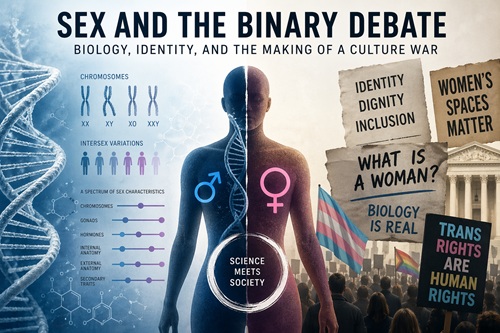 The question of whether sex is or is not a binary sits at the intersection of biology, philosophy, and politics. What might once have been a relatively technical discussion in developmental biology has become a symbolic flashpoint in broader cultural disputes about identity, language, and social norms. Sex as a Biological CategoryIn classical biology, sex is defined in terms of reproductive roles organized around gamete size, a framework sometimes called anisogamy. In this model, males produce small gametes (sperm) and females produce large gametes (eggs). This distinction is remarkably stable across most sexually reproducing species and forms the basis for calling sex “binary.” From this perspective, the binary is not arbitrary but rooted in evolutionary constraints. There are not multiple gamete types in humans or other mammals—only two. This is why many biologists argue that sex, strictly defined, is binary at the level of reproductive function. However, complications arise when we move from this abstract definition to real organisms. Human sexual development involves multiple layers: chromosomes (XX, XY, and variations), gonads (ovaries or testes), hormones, internal reproductive structures, and external genitalia. These layers typically align, but not always. Conditions grouped under the umbrella of intersex (or DSDs, differences/disorders of sex development) involve atypical combinations of these traits. Examples include androgen insensitivity syndrome or congenital adrenal hyperplasia. These cases are rare—estimates often cited are around 0.01% to 0.1% for clinically significant conditions—but they are biologically real. Scholars such as Anne Fausto-Sterling have argued that these variations challenge a strict binary classification, proposing instead that sex is better understood as a spectrum or at least a “bimodal distribution.” Critics respond that while variation exists, it does not undermine the fundamental binary defined by gamete roles; rather, it represents developmental deviations from that binary. So scientifically, the disagreement is partly semantic and partly conceptual. It hinges on which level of analysis is treated as primary: reproductive function (binary) or phenotypic variation (more continuous). Gender, Identity, and Conceptual ExpansionThe debate intensifies when sex is conflated—or deliberately connected—with gender. Gender refers to social roles, identity, and cultural expectations associated with being male or female. Over the past century, especially since the late 20th century, gender has been increasingly understood as distinct from biological sex. The rise of transgender and non-binary identities has further complicated the discourse. For some, the claim that “sex is not binary” functions as a way to legitimize identities that do not fit traditional male/female categories. For others, this move is seen as conflating biological categories with subjective identity, leading to conceptual confusion. This is where the discussion moves from descriptive science into normative territory. Science can describe variation, but it does not dictate how societies should classify or respond to that variation. Why It Became a Culture War IssueThe shift from technical debate to culture war battleground has several drivers. First, institutional stakes are high. Legal systems, sports organizations, healthcare protocols, and educational policies often rely on sex classification. Questions such as who can compete in women's sports, access sex-segregated spaces, or receive certain medical treatments are not abstract—they require operational definitions. Second, language has become politicized. Phrases like “sex is binary” or “sex is a spectrum” are no longer neutral descriptions but signals of broader ideological alignment. Each side often interprets the other as denying either biological reality or human dignity. Third, the issue intersects with broader anxieties about social change. Rapid shifts in norms around gender identity, especially in Western societies, have triggered both support and backlash. For some, expanding categories is seen as progress toward inclusivity; for others, it represents a destabilization of long-standing social structures. Fourth, digital media amplifies conflict. Social platforms reward simplified, emotionally charged claims rather than nuanced distinctions. The difference between “mostly binary with exceptions” and “not strictly binary” collapses into slogan-level opposition. Clarifying the Core DisagreementAt its core, the dispute is not purely about facts but about framing. One side emphasizes evolutionary biology and reproductive roles, arguing that sex is binary in a fundamental, functional sense. Variation exists but does not redefine the category. The other side emphasizes developmental biology and lived experience, arguing that the existence of intersex conditions and gender diversity makes a rigid binary inadequate for describing human reality. Both perspectives draw on legitimate aspects of science, but they prioritize different levels of analysis and different social implications. ConclusionThe “sex is/is not a binary” debate illustrates how scientific concepts can become entangled with cultural values. Biologically, sex in humans is strongly dimorphic and organized around two reproductive roles, yet it also exhibits real, if rare, variation in development. Culturally, the meaning and significance of these facts are contested. The intensity of the conflict reflects not just disagreement over biology, but deeper questions about identity, fairness, language, and the role of science in public life. As long as those underlying tensions remain unresolved, the debate is unlikely to return to a purely technical domain. Appendix: Intersex Women and Elite SportsThe abstract debate about whether sex is binary becomes sharply concrete in the context of elite athletics. Competitive sport depends on categorization, and the male-female division is one of its most consequential, given the well-documented performance differences driven largely by testosterone-mediated development during puberty. The Scientific and Regulatory ProblemMale puberty typically results in significant increases in muscle mass, bone density, hemoglobin levels, and cardiovascular capacity. These advantages translate into performance gaps—often in the range of 10-15% in many track and field events. Women's sport exists precisely to create a protected category where these advantages are excluded. However, certain intersex conditions complicate this framework. Some individuals with differences of sex development (DSDs) who are legally and socially recognized as women may have atypically high endogenous testosterone levels, sometimes within the typical male range. This raises a difficult question: should eligibility be determined by legal gender, biological traits, or some hybrid criterion? Organizations such as World Athletics have attempted to resolve this by setting testosterone thresholds for participation in certain female categories. Athletes above the threshold must lower their testosterone levels—usually through medication—to remain eligible. The Case of Caster SemenyaThe issue gained global attention through the case of Caster Semenya, a two-time Olympic champion in the 800 meters. Semenya has a DSD condition that leads to elevated natural testosterone levels. Under World Athletics regulations, she was required to reduce these levels to compete in her preferred events. Semenya challenged these rules through the Court of Arbitration for Sport and later the European Court of Human Rights, arguing that they were discriminatory and violated her rights. While some legal decisions have been partially in her favor procedurally, the core regulations have largely remained intact in sport governance. Competing PrinciplesThis controversy exposes a genuine conflict between two principles that are not easily reconciled. On one side is fairness in competition. If elevated testosterone confers a performance advantage comparable to that seen in male athletes, then allowing such athletes to compete in the female category may undermine its purpose. On the other side is inclusion and non-discrimination. Athletes like Semenya are not doping; their biology is natural. Requiring medical intervention to compete raises ethical concerns about bodily autonomy and the medicalization of natural variation. Conceptual Fault LinesThe sports debate mirrors the broader “sex binary” dispute but forces clearer definitions. Governing bodies are effectively compelled to operationalize sex in measurable terms—most commonly via testosterone—rather than rely on abstract categories. Critics argue that testosterone is an imperfect proxy, noting that athletic performance depends on many variables. Supporters counter that, while imperfect, it is the most practical and scientifically grounded marker available for maintaining a meaningful female category. A Microcosm of the Larger DebateIntersex women in sports represent a boundary case where biological variation, identity, and institutional rules collide. The stakes are unusually high because outcomes are zero-sum: inclusion of one athlete may affect the competitive opportunities of others. As a result, this issue has become a focal point in the wider culture war. It condenses abstract disagreements about sex and gender into concrete policy decisions with visible winners and losers. No resolution has achieved broad consensus. What remains is an ongoing attempt to balance fairness, inclusion, and scientific coherence—an effort that reflects, in concentrated form, the larger tensions surrounding sex as a biological and social category.
Widget is loading comments...
|