|
TRANSLATE THIS ARTICLE
Integral World: Exploring Theories of Everything
An independent forum for a critical discussion of the integral philosophy of Ken Wilber
  Frank Visser, graduated as a psychologist of culture and religion, founded IntegralWorld in 1997. He worked as production manager for various publishing houses and as service manager for various internet companies and lives in Amsterdam. Books: Ken Wilber: Thought as Passion (SUNY, 2003), and The Corona Conspiracy: Combatting Disinformation about the Coronavirus (Kindle, 2020).
Check out my other conversations with ChatGPT
The Mean Green Meme:
An allergy to Green goes a really long way Was Wilber prophetic about Woke Culture of just conservative? Ken Wilber's selective critique of the Mean Green Meme The Mean Green Meme Under Examination The War of the MemesKen Wilber's selective critique of the Mean Green Meme and the neglected pathologies of the other stagesFrank Visser / ChatGPT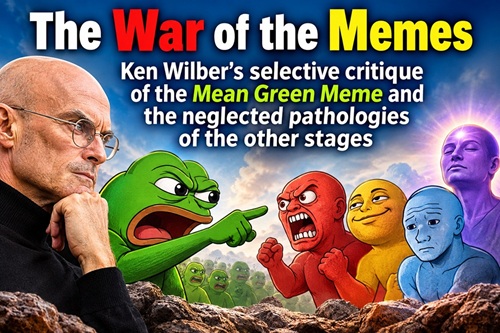 Introduction: When only one meme becomes the enemyOne of the more revealing features of Ken Wilber's later intellectual work is his recurring criticism of what he calls the Mean Green Meme (MGM). In his interpretation of Spiral Dynamics, Green represents pluralism, egalitarianism, multicultural sensitivity, environmental concern, and an emphasis on inclusion. These are valuable developments, but Wilber argues that Green can degenerate into relativism, political correctness, ideological conformity, excessive subjectivism, and an inability to acknowledge differences in developmental achievement. There is something legitimate in this criticism. Egalitarian ideals can become intolerant of disagreement. Multiculturalism can turn into an uncritical celebration of cultural difference. Sensitivity to marginalization can become a substitute for examining evidence. And a movement that regards itself as uniquely compassionate can develop its own forms of moral superiority. But an important question follows: Why does Wilber seem so preoccupied with the pathological expressions of Green, while giving considerably less attention to the pathological expressions of the other developmental stages? If every developmental level has both healthy and unhealthy expressions, then the principle should apply consistently. Orange can become techno-capitalist domination, Blue can become religious fundamentalism, Red can become violent authoritarianism and terrorism, and even Yellow can become an intellectually sophisticated form of elitism. A genuinely integral critique would examine all these pathologies, including the ways in which they interact, reinforce one another, and occasionally form politically improbable alliances. This suggests a broader subject than the familiar dispute between progressive and conservative worldviews. We might call it The War of the Memes: the struggle between developmental value systems, not simply as abstract stages of consciousness, but as competing political, economic, religious, and cultural forces. 1. The developmental double standardBefore developing this criticism, we should acknowledge an important qualification. Wilber has not entirely ignored the unhealthy expressions of other memes. In his response On the Mean Memes in General, he explicitly acknowledges the existence of the Mean Red Meme, Mean Blue Meme, Mean Orange Meme, and even Mean Yellow Meme. He also argues that his critique of Orange is implicit in his extensive criticism of modernity's reduction of reality to scientific materialism, which he calls Flatland. He therefore cannot fairly be accused of having no conceptual framework for criticizing the other levels. Indeed, he explicitly states that each level has healthy and unhealthy manifestations. But this concession makes the question more interesting rather than less. The issue is not whether Wilber recognizes these other pathologies in principle. It is whether he has investigated them with anything approaching the same rhetorical intensity, political specificity, and sustained attention that he has devoted to Green. His own explanation is partly that he has not had sufficient time, and that he has concentrated on what he considers the dominant cultural pathology of his period.[1] He even acknowledges having neglected unhealthy Yellow and economic-political factors in the social system. That is an admission worth taking seriously. But it also reveals a limitation in the integral project: a developmental theory that claims to encompass the entire spectrum of human consciousness can become politically selective in its practical application. The result is an asymmetry. Green's failures become highly visible, while the pathologies of other value systems are more readily treated as historical problems, unfortunate excesses, or matters requiring contextual understanding. Why should this be so? One possible explanation is that Wilber's criticism of Green has a particular cultural and political target: progressive academia, postmodern intellectuals, multiculturalism, and the contemporary American Left. These are the movements with which he has had the most visible intellectual disagreements. His critique consequently risks becoming less an impartial investigation of developmental pathologies than a sustained polemic against one particular political-cultural constituency. The question of consistency is unavoidable. If Green must be held accountable for its shadow, why should Orange, Blue, Red, and Yellow receive any less scrutiny? 2. Mean Orange: The tyranny of techno-capitalism
 Orange represents a major achievement in human development: rationality, scientific inquiry, individual achievement, entrepreneurship, technological innovation, and emancipation from traditional authority. It helped produce modern science, constitutional democracy, industrialization, and unprecedented improvements in material living conditions. These achievements deserve recognition. But Orange also has a dark side. Its pathological expression might be called techno-capitalism: the assumption that everything valuable can be measured, optimized, monetized, and converted into competitive advantage. Human beings become consumers, workers become economic resources, nature becomes raw material, and technological innovation becomes an end in itself. This is not simply ordinary capitalism. It is the transformation of economic rationality into an all-encompassing worldview. Consider the contemporary technology industry. Its most powerful corporations frequently present themselves as agents of human progress while accumulating enormous economic and political influence. Social media platforms monetize attention, algorithmic systems manipulate behavior, surveillance becomes a business model, and artificial intelligence threatens to concentrate intellectual and economic power in a relatively small number of corporations. The language is invariably optimistic: innovation, disruption, efficiency, connectivity, abundance. But who benefits? Who controls the infrastructure? Who bears the social costs? The Mean Orange Meme does not necessarily look cruel. It can look exceptionally successful. Its pathology is precisely that it can confuse economic growth with human development, technological capability with wisdom, and market dominance with social progress. Wilber's criticism of Flatland certainly touches this problem. His distinction between the differentiation and dissociation of the value spheres is relevant here. But a genuinely integral political critique would have to go further, examining the institutional power of corporations, the concentration of wealth, the political influence of technological oligarchies, and the environmental costs of unlimited economic expansion. It would also have to confront the uncomfortable possibility that some of the most technologically advanced societies are not necessarily the most psychologically, ethically, or politically developed. A society can be Orange in its technological sophistication and deeply Blue or Red in its political behavior. 3. Mean Blue: The tyranny of absolute truth
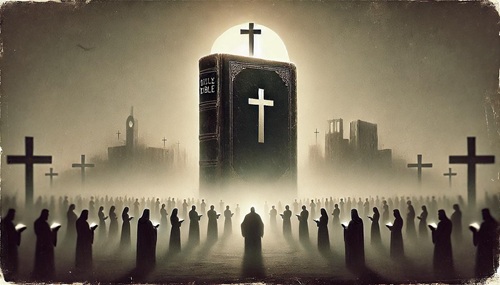 Blue provides something equally important: order, discipline, moral commitment, institutional continuity, and a sense of belonging to a larger normative community. Without Blue, societies would struggle to establish durable institutions, common rules, and shared moral expectations. But Blue has its own characteristic pathology: the conviction that one possesses the one true account of reality and that everyone else must submit to it. Religious fundamentalism is an obvious manifestation. When sacred texts, religious authorities, or supposedly divine commandments become immune to questioning, moral certainty can turn into intellectual imprisonment and political repression. This is not confined to Islam. Christian nationalism, Hindu nationalism, ultra-Orthodox religious authoritarianism, and other forms of religious fundamentalism can all exhibit this tendency. The problem is not religious commitment as such. It is the conversion of religious conviction into coercive political authority. In its extreme forms, Mean Blue seeks to regulate private life, suppress dissent, subordinate women, restrict freedom of expression, and punish deviations from prescribed religious norms. It is worth noting that Wilber's developmental framework should be particularly useful here. It can distinguish the healthy contribution of traditional religion from its authoritarian and exclusionary expressions. Yet the question is whether this distinction receives the same sustained attention in his political commentary as the distinction between healthy Green and Mean Green. There is also a broader problem. Blue can appropriate the language of moral superiority just as Green can. Its adherents may regard themselves as defenders of civilization, family values, divine truth, or moral order, while portraying their opponents as corrupt, decadent, or dangerous. In this respect, the Mean Blue Meme is not merely conservative. It is absolutist. It cannot comfortably coexist with a society in which different people are free to reach different conclusions about ultimate questions. 4. Mean Red: The politics of domination and terror
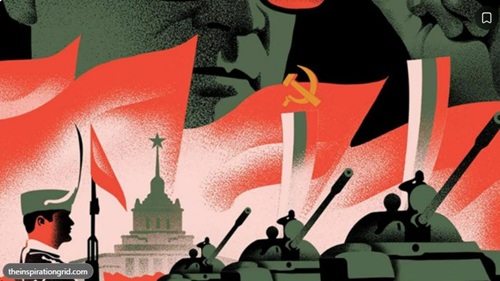 Red represents power, assertiveness, independence, immediate gratification, and the capacity to challenge established authority. It can be a necessary corrective to excessive submission and conformity. People sometimes need to stand up for themselves, resist oppression, and assert their rights. But Mean Red is power without adequate restraint. Its political manifestations include personal dictatorship, aggressive nationalism, organized violence, political intimidation, gangsterism, and terrorism. Here the examples are numerous. Authoritarian rulers who regard their personal ambitions as more important than the lives of their citizens, terrorist organizations that use violence to impose ideological visions, and political movements that glorify force all exhibit aspects of this pathology. Putin's invasion of Ukraine offers an instructive example of how different developmental patterns can become entangled. The Russian regime combines authoritarian nationalism, traditionalist rhetoric, imperial ambition, and a highly instrumental use of modern technology and economic resources. It would be simplistic to assign the entire phenomenon to one color. Indeed, this is precisely why a more sophisticated integral analysis is necessary. The Red impulse to dominate can be legitimized by Blue narratives of historical destiny, religious identity, and national greatness. Orange technological and economic capabilities can then serve these political ambitions. The result is not a purely Red phenomenon but a coalition of developmental pathologies. The same applies to terrorism. A terrorist organization may combine Red violence with Blue absolutist ideology, while exploiting Orange communications technologies and financial networks. Calling this simply a Red pathology misses the ideological and institutional structures that sustain it. The integral question should therefore not merely be which developmental level is involved, but how different levels cooperate in producing destructive outcomes. 5. Mean Yellow: The elitism of the supposedly integral
 Perhaps the most neglected pathology is that of Yellow itself. Yellow is supposed to represent a major developmental breakthrough: systems thinking, flexibility, contextual understanding, the capacity to recognize the partial truths of different value systems, and an ability to work with complexity rather than reduce everything to one perspective. These are admirable qualities. But what happens when people identify themselves as Yellow? The danger is that developmental superiority becomes a new basis for social distinction. Those who regard themselves as more evolved may begin to look down upon people who supposedly remain trapped in lower developmental structures. Instead of overcoming the limitations of earlier value systems, they acquire a sophisticated vocabulary for dismissing them. This is a particularly insidious form of elitism because it can present itself as intellectual maturity. The Yellow individual understands why everyone else thinks as they do. The Red person is power-driven, the Blue person absolutist, the Orange person materialistic, and the Green person relativistic. Yellow, meanwhile, sees the whole picture. But does it? There is a danger that developmental maps become instruments of social ranking rather than tools for understanding. A person can use the language of complexity while remaining remarkably insensitive to ordinary human concerns. Worse, the claim to transcend ideological divisions can become an excuse for avoiding moral judgment. An integral thinker might explain the historical and psychological conditions that produce authoritarianism without adequately confronting its victims or the responsibilities of its perpetrators. Understanding the worldview of an aggressor does not require suspending judgment about aggression. Nor does an ability to recognize multiple perspectives automatically confer wisdom, compassion, or political competence. This raises an uncomfortable question for the integral movement itself: can the self-proclaimed representatives of second-tier consciousness recognize their own collective shadow? Wilber has occasionally acknowledged unhealthy Yellow, but the implications deserve considerably more attention. An integral movement that identifies itself with a higher stage of consciousness can become a status hierarchy in which criticism is dismissed as evidence of insufficient development. At that point, the theory intended to overcome developmental arrogance becomes an instrument of it. 6. The strange alliance: Mean Green meets Mean BlueOne of the most interesting contemporary manifestations of the war of the memes is the occasional alliance between Western progressive movements and Islamist political movements. At first sight, this seems almost incomprehensible. How can people who champion feminism, LGBTQ rights, freedom of expression, secularism, and multicultural tolerance find themselves defending movements whose ideological foundations may be profoundly hostile to those very values? The answer requires distinguishing several things that are too often conflated: Islam as a religion, Muslims as diverse individuals and communities, Islamism as a political ideology, and jihadist movements that advocate or practice violence. Criticism of Islamism is not hostility toward Muslims. Nor does defending the civil rights of Muslims require defending Islamist political projects. Nevertheless, a peculiar political convergence can occur between certain Western progressive activists and Islamist organizations or their sympathizers. This convergence is sometimes described as an alliance between the regressive Left and political Islam. It is not a formal alliance, and it certainly does not characterize the Left as a whole. But it deserves serious examination. The underlying mechanism is one of selective moral attention. For some Western progressives, opposition to American imperialism, Western interventionism, colonial history, and perceived Islamophobia becomes so central that the ideological character of the movements they support is pushed into the background. The reasoning can become remarkably one-sided: if a political movement opposes Western power, it must somehow be on the right side of history. This is where a legitimate Green concern for marginalized populations can become distorted. Solidarity with people who experience discrimination is transformed into uncritical solidarity with political organizations that claim to represent them. But there is a fundamental contradiction here. Green pluralism celebrates diversity and individual freedom. Islamist political fundamentalism, in its authoritarian expressions, seeks to subordinate individual freedoms to religiously defined collective norms. Green feminism demands equality between men and women. Islamist fundamentalism may defend patriarchal institutions and restrictions on women's autonomy. Green supports LGBTQ rights. Islamist fundamentalism can regard homosexuality as morally unacceptable and seek to restrict its public expression or criminalize it. Green values freedom of conscience. Religious fundamentalism may reject the legitimacy of abandoning or criticizing the faith. These are not minor differences of cultural emphasis. They concern fundamental principles of human freedom. A genuinely pluralistic worldview cannot defend pluralism selectively. Nor should opposition to Western foreign policy entail support for every movement opposing the West. One can criticize the Iraq War, Western double standards, colonial history, and Islamophobia without excusing Hamas's attacks on civilians, Iranian repression, or the authoritarian ambitions of Islamist movements. The same applies to the Russian invasion of Ukraine. Opposition to American geopolitical dominance does not require apologetics for Putin's imperialism. This is a recurring feature of ideological politics: the enemy of my enemy becomes my friend, even when that supposed friend represents values I would otherwise reject. In Spiral Dynamics terminology, one could interpret this as an unhealthy Green tendency to romanticize the marginalized or oppressed, combined with an insufficiently critical relationship to Blue absolutism and Red power. But we should be careful not to turn this into another simplistic color diagnosis. Some of these alliances are better explained by geopolitical calculations, activist subcultures, historical grievances, and the dynamics of coalition politics than by developmental stages. The important point is that political solidarity should not suspend moral and intellectual scrutiny. 7. The cross-links: How pathologies reinforce one anotherThe real problem with concentrating on individual memes is that destructive political phenomena rarely belong to one developmental category. They are usually combinations. Consider the following examples. Red and Blue: Authoritarian religious nationalism. Power-seeking leaders employ religious or historical narratives to legitimize domination. The authoritarian impulse supplies the coercion; the absolutist worldview supplies the moral justification. Orange and Red: Technological authoritarianism. Modern surveillance, artificial intelligence, digital propaganda, and military technology provide powerful instruments for regimes pursuing traditional ambitions of control and domination. Orange and Blue: The commercial exploitation of fundamentalism. Religious movements can use sophisticated marketing, media empires, financial networks, and digital platforms to spread absolutist beliefs and consolidate political influence. Green and Blue: The regressive alliance. Progressive concern for marginalized populations can, in certain circumstances, lead to apologetics for conservative or fundamentalist political movements, particularly when both oppose a perceived Western enemy. Green and Red: Revolutionary romanticism. Some progressive movements may excuse political violence when it is framed as resistance, liberation, or anti-imperialist struggle, even when the violence targets civilians. Yellow and Orange: Technocratic elitism. Systems thinkers and self-appointed experts may become so enamored of complexity, optimization, and managerial competence that democratic participation and ordinary human concerns are treated as obstacles to efficient governance. These combinations demonstrate why a simplistic assignment of political positions to colors is inadequate. The same individual, organization, or political movement can display several value systems simultaneously. A technologically sophisticated organization may embrace premodern religious doctrines. A movement advocating social equality may employ authoritarian methods. A government promoting economic modernization may suppress political freedom. Developmental levels do not necessarily replace one another in a neat sequence. They coexist, interact, and sometimes reinforce one another. This is precisely where an integral approach should demonstrate its analytical value. It should investigate not only the internal contradictions of individual value systems but also the alliances and mutual reinforcements between their pathological expressions. 8. The Mean Green Meme as a political obsessionWe can now return to Wilber's original concern. His criticism of Mean Green was not entirely misplaced. Progressive movements can become intolerant, ideologically conformist, excessively relativistic, and hostile to rational disagreement. The rejection of all hierarchies can obscure legitimate differences in competence, knowledge, and responsibility. But there is a difference between identifying a genuine pathology and allowing it to dominate one's political imagination. Wilber's treatment of Green has often been unusually charged. His language of Boomeritis, narcissism, nihilism, political correctness, and the cultural Inquisition has contributed to an atmosphere in which Green itself can become suspect within integral circles. This has consequences. Once Green becomes the principal developmental adversary, it becomes tempting to interpret political developments primarily through the lens of Green's failures. The excesses of progressive politics receive attention, while the dangers of authoritarian nationalism, religious fundamentalism, economic oligarchy, and technological domination risk becoming secondary concerns. This is especially problematic in a period when authoritarian political movements are gaining influence in various parts of the world. There is also an important issue of political responsibility. Criticizing progressive excesses is not the same as explaining the political success of authoritarian alternatives. The latter requires an equally serious examination of the interests, institutions, ideologies, and power structures supporting them. A theory of development should not become a vehicle for expressing one's political disappointments. Indeed, the more strongly Wilber identifies himself with second-tier consciousness, the more important it becomes that he apply his own standards of self-reflection to his political preferences. If the Mean Green Meme is capable of projecting its shadow onto its ideological opponents, so is an integral movement that believes it has transcended the limitations of conventional and postconventional thinking. The question is not whether Green has a shadow. Of course it does. The question is why its shadow has received so much more attention than the shadows of its competitors. 9. Beyond the War of the Memes: An integral critique of powerWhat would a more balanced integral political analysis look like? First, it would apply the same standards to every developmental level. No value system should be protected from criticism because of its historical contributions, its supposed developmental necessity, or its political usefulness. Second, it would distinguish the healthy achievements of each level from its pathological expressions. The solution to religious fundamentalism is not the elimination of religion; the solution to techno-capitalism is not the rejection of science and entrepreneurship; the solution to progressive intolerance is not the abandonment of equality and human rights. Third, it would examine the interactions between levels. Political movements are not neatly color-coded entities. Their ideologies, organizational structures, economic interests, and methods of exercising power may derive from different developmental configurations. Fourth, it would distinguish explanation from justification. Understanding why people support authoritarian movements does not mean legitimizing authoritarianism. Recognizing the historical grievances behind terrorism does not excuse the deliberate targeting of civilians. Understanding the limitations of progressive politics does not require endorsing its authoritarian opponents. Finally, an integral approach would have to examine its own institutional and intellectual environment. Who gets classified as Green? Who gets to claim Yellow? What happens when a critic challenges the developmental status of the integral establishment itself? These questions matter because developmental language can easily become a political weapon. Instead of analyzing arguments, people classify their opponents. Instead of examining evidence, they assign developmental positions. Instead of responding to criticism, they declare the critic insufficiently evolved. That is not integral thinking. It is developmental tribalism. 10. Conclusion: Who watches the watchers?The War of the Memes should not be understood as a contest in which one developmental level must defeat the others. It is a struggle to recognize and overcome the pathological tendencies that can emerge within every worldview. Green needs Orange's respect for evidence and rational argument. Orange needs Green's concern for social justice and ecological responsibility. Blue needs the freedom of conscience that pluralism provides. Red needs the restraints imposed by law and mutual recognition. Yellow needs the humility to recognize that systems thinking does not automatically make its practitioners wise. And none of these achievements should be confused with the disappearance of earlier forms of consciousness. Human beings and societies continue to draw upon multiple value systems, often in contradictory ways. Perhaps the most important lesson is that no developmental stage has a monopoly on hypocrisy, intolerance, narcissism, or the abuse of power. Wilber's criticism of Mean Green would have been considerably more convincing had it been accompanied by an equally sustained investigation of Mean Orange, Mean Blue, Mean Red, and Mean Yellow. His occasional acknowledgment of these pathologies is not the same as a comprehensive analysis of their contemporary political manifestations.[1] There is an irony here. An integral philosophy that promises to transcend partial perspectives risks becoming partial itself when it develops a disproportionate fixation on one particular ideological opponent. The ultimate test of an integral theory is not how effectively it diagnoses the limitations of its critics, but whether it can apply the same critical standards to its own assumptions, affiliations, and institutional loyalties. Perhaps we should therefore add one more question to the integral vocabulary: What happens when the people who claim to have transcended the War of the Memes become combatants themselves? That is the shadow that an integral movement most urgently needs to investigate. A final thought: The real meaning of second-tier consciousnessSecond-tier consciousness, if the concept has any genuine value, should mean more than the ability to classify the world into developmental stages. It should mean an increased capacity to recognize partiality, including one's own. It should make us less susceptible to ideological loyalties, not more confident in our superiority over those who have not supposedly reached our level. It should encourage us to criticize authoritarianism wherever it appears, whether it wears the clothes of religious traditionalism, revolutionary liberation, economic efficiency, progressive morality, or integral sophistication. And it should make us especially suspicious of theories that explain the shortcomings of everyone except their own adherents. The real war is not between Green and the other memes. It is between critical self-reflection and the human tendency to turn every worldview into an unquestionable identity. That war has no guaranteed developmental winner. NOTES[1] Ken Wilber, "On the mean memes in general, Red to blue to orange to green to yellow....", www.integralworld.net, February 2002.
Comment Form is loading comments...
|