|
TRANSLATE THIS ARTICLE
Integral World: Exploring Theories of Everything
An independent forum for a critical discussion of the integral philosophy of Ken Wilber
  Frank Visser, graduated as a psychologist of culture and religion, founded IntegralWorld in 1997. He worked as production manager for various publishing houses and as service manager for various internet companies and lives in Amsterdam. Books: Ken Wilber: Thought as Passion (SUNY, 2003), and The Corona Conspiracy: Combatting Disinformation about the Coronavirus (Kindle, 2020). Frank Visser, graduated as a psychologist of culture and religion, founded IntegralWorld in 1997. He worked as production manager for various publishing houses and as service manager for various internet companies and lives in Amsterdam. Books: Ken Wilber: Thought as Passion (SUNY, 2003), and The Corona Conspiracy: Combatting Disinformation about the Coronavirus (Kindle, 2020).
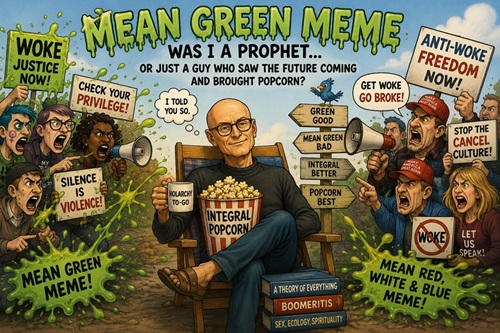
Check out my other conversations with ChatGPT The Mean Green MemeWas Ken Wilber Prophetic About Woke Culture or Just Conservative?Frank Visser / ChatGPT
Ken Wilber's notion of the Mean Green Meme (MGM), developed around the turn of the millennium in A Theory of Everything (2000), Boomeritis (2002), and related writings, has acquired an unexpected afterlife. At the time, it struck many readers as an eccentric, even cranky, diagnosis of the cultural left: a pathological form of pluralism characterized by excessive sensitivity to oppression, identity politics, political correctness, and a refusal to acknowledge developmental hierarchies. Two decades later, the vocabulary has changed. We now speak of wokeness, cancel culture, DEI, intersectionality, identity politics, social justice activism, and the culture wars. Some of the phenomena Wilber was pointing toward are unmistakably visible. Universities and corporations have indeed experienced conflicts over language, identity, inclusion, and ideological conformity. Public controversies have erupted over pronouns, race, gender, historical memory, and the boundaries of legitimate speech. Critics of "wokeness" can point to real examples of moral absolutism, public shaming, illiberalism, and intellectual conformity. So was Wilber prophetic? The answer, I think, is yes—but only in a limited and rather ironic sense. Wilber anticipated some genuine tensions that would become much more prominent in the following decades. But he did so through a theoretical framework that was itself deeply biased, overgeneralized, and insufficiently empirical. His diagnosis of "Mean Green" was not simply a neutral prediction of the future. It was also a conservative reaction against the excesses of the progressive culture of his own time, translated into the elaborate language of developmental psychology. In other words, Wilber saw something real. But he also saw it through a lens that distorted what he was seeing. The Strange Career of the Mean Green MemeWilber's basic argument was developmental. Human cultures and individuals, he argued, move through recognizable stages or levels of consciousness. In his version of Spiral Dynamics, associated with Don Beck and Christopher Cowan, the color Green represented pluralistic, egalitarian, multicultural consciousness. Green was historically important because it challenged the limitations of earlier stages. It rejected authoritarianism, racism, rigid hierarchies, patriarchy, and ethnocentrism. It emphasized diversity, sensitivity, inclusion, and the recognition of marginalized voices. So far, so good. But Wilber argued that Green could become pathological. When pluralism becomes absolutized, it begins to reject all hierarchy—including legitimate developmental distinctions. When sensitivity to oppression becomes obsessive, every difference can be interpreted as domination. When every perspective is treated as equally valid, the result can be relativism. When identity becomes central, people can become trapped within their group identities rather than moving toward more universal forms of consciousness. This pathological Green was the Mean Green Meme. The phrase was deliberately provocative. Wilber wanted to distinguish between healthy Green and pathological Green. The former was a necessary stage in human development; the latter was a kind of developmental cul-de-sac. The problem was that Wilber increasingly seemed to treat the pathological version as if it were the defining feature of contemporary progressivism. That is where the trouble began. And Then Came WokeThere is an obvious sense in which Wilber's analysis now looks remarkably prescient. The contemporary culture wars have produced phenomena that resemble his warnings. In some activist environments, moral language has become highly absolutist. People can be publicly condemned for using allegedly problematic language. Intentions may matter less than perceived impact. Historical and social questions are sometimes framed in binary moral terms: oppressor and oppressed, privileged and marginalized. The expansion of identity categories has also generated new tensions. Race, gender, sexuality, disability, and other identities increasingly shape public discourse. Sometimes this has produced greater recognition and justice. At other times it has generated competitive victimhood, factionalism, and an obsessive preoccupation with status. Wilber's critique of Green's tendency to fragment the world into ever smaller identity groups therefore has some bite. He also anticipated a tension between pluralism and universalism. A society that wants to recognize every particular identity faces a difficult question: what, ultimately, holds the society together? If every group possesses its own perspective and every perspective is treated as epistemically privileged, how do we adjudicate conflicts between them? These are real questions. Wilber was also right to worry that a movement originally devoted to liberation could develop its own forms of conformity. The history of progressive movements is full of such paradoxes. A culture that begins by challenging orthodoxy can eventually create new orthodoxies of its own. The contemporary culture wars have made this contradiction impossible to ignore. But this is where we should resist the temptation to declare Wilber a prophet. The Conservative Insight Hidden Inside the Integral TheoryThere was always something unmistakably conservative about Wilber's critique of Mean Green. This does not mean that Wilber was simply a conservative in the conventional political sense. His politics were idiosyncratic, and his broader worldview contained elements that could not easily be placed on the standard left-right spectrum. But his criticism of Green contained a distinctly conservative intuition: the belief that social order depends upon legitimate hierarchy, that universal values are superior to identity fragmentation, that excessive egalitarianism can become destructive, and that rapid cultural change can generate unintended consequences. These are classic conservative themes. Wilber simply translated them into developmental language. Instead of saying, "The Left has gone too far," he said, in effect, "Green has become pathological." Instead of saying, "Identity politics fragments society," he said, "Green's pluralism has become a developmental absolutism." Instead of saying, "We need hierarchy," he said, "We need holarchy—hierarchies of increasing complexity and inclusion." The terminology was novel. The underlying concern was not. This is one reason the Mean Green Meme has aged rather differently from Wilber's more grandiose claims about consciousness. His diagnosis resonates today partly because he was expressing an old conservative concern in the vocabulary of developmental psychology. That does not make the concern false. But it does mean that we should be cautious about presenting it as a scientific discovery. The Problem with Calling It a "Meme"The term "Mean Green Meme" also creates a conceptual problem. Wilber's language suggests that there is a relatively identifiable developmental structure called Green that can become pathological in a characteristic way. But actual political movements are far messier. The contemporary progressive left is not one thing. It contains liberal humanists, democratic socialists, Marxists, intersectional activists, civil-rights organizations, environmentalists, feminists, queer theorists, academics, social democrats, anarchists, institutional reformers, and ordinary people who simply favor greater equality. These groups frequently disagree with one another. The same is true of the people called "woke." The term itself has become so politically loaded that it can mean anything from "socially conscious" to "authoritarian leftist." The category has become a weapon in the culture wars rather than a precise analytical concept. Wilber's model tends to flatten this complexity. It transforms a heterogeneous political field into a developmental stage. That is convenient—but it is not necessarily accurate. The Real Achievement: He Identified a Recurring Cultural PatternThere is nevertheless something important in Wilber's insight. Perhaps the best way to understand Mean Green is not as a scientifically validated developmental stage, but as a recurring pathology of moralized egalitarianism. Any movement can become absolutist. A religious movement can become fundamentalist. A revolutionary movement can become authoritarian. A nationalist movement can become xenophobic. A libertarian movement can become indifferent to social suffering. And a progressive movement can become morally puritanical. The problem is not that Green exists. The problem is that every healthy value can become pathological when absolutized. Pluralism can become relativism. Equality can become hostility to excellence. Sensitivity can become fragility. Inclusion can become coercive conformity. Anti-racism can become racial essentialism. Feminism can become hostility toward men. Social justice can become punitive moralism. Environmentalism can become apocalyptic authoritarianism. And criticism of all these things can itself become reactionary. The real insight here is not uniquely Wilberian. It is a general principle of political psychology: virtues can become vices when detached from competing virtues. Pluralism needs universalism. Equality needs competence. Compassion needs judgment. Freedom needs responsibility. Tolerance needs limits. Wilber was right to insist on this kind of balancing act. But He Was Too Quick to Pathologize the LeftThe deeper weakness of Wilber's argument is that he often seemed to treat the excesses of progressive culture as evidence of a developmental pathology rather than as the predictable consequences of historical change. The rise of identity politics did not emerge from nowhere. It emerged from real historical experiences: racism, colonialism, sexism, homophobia, and exclusion. The heightened sensitivity to language did not emerge from nowhere either. It emerged partly from the recognition that language can reinforce social hierarchies and that institutions can exclude people without explicit discriminatory intent. One can criticize the excesses of these movements without pretending that the underlying problems were imaginary. Wilber's developmental framing sometimes risks doing exactly that. It is tempting to say: "These activists are merely trapped at Green." But perhaps some of them are simply responding to genuine injustice. And perhaps what looks like pathological Green from one perspective looks like overdue moral progress from another. This is the fundamental epistemological problem with developmental stage theories: who gets to decide which perspective represents the higher stage? Wilber, naturally, placed himself at a more advanced position—Integral. That creates an uncomfortable circularity. If someone disagrees with Wilber, perhaps they are at a lower stage. If they criticize Integral Theory, perhaps they are trapped in Green. If they reject his hierarchy, that rejection itself can be interpreted as evidence of their developmental limitations. This is a remarkably convenient intellectual arrangement. The Irony of Wilber's ProphecyThere is therefore an amusing irony in Wilber's apparent prophecy. He anticipated the emergence of a culture war over progressive identity politics—but his own theory can now be used by the very conservatives who would otherwise have little interest in Integral Theory. The contemporary right can easily say: "Look! Ken Wilber predicted wokeism twenty years ago." But this is misleading. Wilber did not predict today's political landscape in detail. He did not predict TikTok activism, corporate DEI departments, the backlash against transgender rights, the rise of Trumpism, the online culture wars, or the transformation of "woke" into a universal conservative insult. What he predicted was something more general: A progressive movement based on pluralism and equality might eventually generate its own forms of absolutism, moralism, and conformity. That prediction was reasonable. It was also not particularly difficult to make. History is full of examples of movements that become rigid and dogmatic once they acquire power. The genuinely interesting question is whether Wilber's developmental theory explains this better than ordinary political sociology or psychology. I am not convinced that it does. The Missing Half of the StoryThe biggest problem with the Mean Green diagnosis is that Wilber did not develop an equally powerful analysis of the pathologies of the Right. If Green can become Mean Green, what happens when Orange becomes predatory capitalism? What happens when Blue becomes religious fundamentalism? What happens when Red becomes authoritarian nationalism? What happens when the desire for order becomes fascism? What happens when the rejection of "wokeness" becomes a license for racism, misogyny, or authoritarianism? Here the symmetry becomes important. The contemporary culture wars are not simply a story of pathological Green. They are an interaction between pathologies on the left and right, each feeding the other. The excesses of woke activism can generate conservative backlash. The excesses of conservative backlash can radicalize the left. Each side then points to the other as proof of its own righteousness. This is the great engine of contemporary polarization. Wilber's framework is less useful here because Mean Green tends to become the villain of the story. The developmental critique points mostly in one direction. But history rarely does. Was Wilber Conservative?Perhaps the fairest answer is this: Wilber was not simply a conservative, but his critique of Mean Green contained a strong conservative corrective to his own earlier sympathies with progressive and countercultural thought. That corrective was valuable. Indeed, one could argue that it was necessary. The New Age and countercultural movements often celebrated subjective experience, personal freedom, anti-authoritarianism, and spiritual exploration while neglecting the importance of institutions, evidence, social complexity, and collective responsibility. Wilber's insistence that development requires integration rather than endless rebellion against authority was an important contribution. But Wilber's correction sometimes overshot. His enthusiasm for developmental hierarchy encouraged him to interpret political disagreement as developmental inferiority. His distinction between healthy and pathological Green became increasingly polemical. And his critique of pluralism occasionally seemed to underestimate how much genuine injustice had been exposed by the very movements he criticized. In that respect, Wilber became caught in the same trap he diagnosed. He wanted to transcend ideological polarization, but he increasingly became identified with one side of the polarization. The Strange Fate of Mean GreenThe most interesting question today is therefore not whether Wilber was right about woke culture. It is whether his framework helps us understand why the culture wars became so intense in the first place. Here I think the answer is partly yes. Wilber saw that progressive culture had entered a new phase. The old liberal emphasis on universal individual rights was being supplemented—and sometimes displaced—by a more group-oriented politics of identity, recognition, and historical grievance. He saw that this could produce a clash between universalism and particularism, between equality and identity, between freedom of expression and protection from harm. Those tensions are very real. But he did not sufficiently appreciate that the same tensions would provoke a reaction from the Right that could be equally absolutist. The result is not simply Mean Green. It is a mutual radicalization machine. The woke activist sees the conservative as an oppressor. The conservative sees the woke activist as a tyrant. Each side selects the most extreme examples of the other and treats them as representative. And both sides become increasingly convinced that compromise is morally illegitimate. That is the deeper pathology of our time. Conclusion: Prophetic, but Not a ProphetWilber deserves some credit for seeing, well before the current culture wars, that the progressive emphasis on pluralism and identity could develop pathological forms. In that limited sense, his Mean Green diagnosis was indeed prescient. But the claim that he "predicted wokeism" goes too far. He was responding to cultural tendencies already visible around 2000, and he interpreted them through a developmental framework that was itself shaped by his own ideological commitments. His analysis captured something real, but it exaggerated its coherence and underestimated the complexity of the forces involved. The most charitable interpretation is therefore that Wilber was neither a prophet nor merely a conservative crank. He was a perceptive cultural critic who identified a genuine vulnerability in progressive politics: the possibility that a movement dedicated to pluralism could become intolerant, that equality could become suspicious of excellence, and that moral sensitivity could become moral authoritarianism. But he was less perceptive about the mirror image. The same thing can happen on the Right. Indeed, it is happening now. The contemporary culture wars are not proof that Wilber's developmental hierarchy was correct. They are evidence that every political and moral ideal has shadow sides. Pluralism can become dogmatic. Tradition can become oppressive. Equality can become leveling. Hierarchy can become domination. Freedom can become selfishness. Order can become authoritarianism. The real lesson of Mean Green, stripped of its developmental mystique, is therefore a much simpler one: Beware the moment when your virtue becomes your weapon. Wilber saw that danger on the Left before many others did. What he did not fully see was that the same warning would eventually have to be applied to the Right—and, perhaps most importantly, to himself. Appendix: Was Wilber's “Many Gifts of Green” Just Lip Service or Authentic?One of the most revealing passages in Ken Wilber's critique of the Mean Green Meme is his insistence that Green has many genuine gifts. This is important because it complicates the caricature of Wilber as simply an anti-woke conservative avant la lettre. He repeatedly acknowledged that the pluralistic stage had accomplished something historically indispensable. Green challenged racism, sexism, authoritarianism, ethnocentrism, and rigid social hierarchies. It expanded the moral circle. It made previously invisible suffering visible. It cultivated sensitivity to difference. It helped expose the shadow of supposedly "universal" systems that were, in practice, often designed around the experiences of white, male, Western, heterosexual elites. Wilber's language here was not merely decorative. I think there was something genuinely authentic in his appreciation of Green. But there is a significant qualification. The further Wilber developed his critique of Mean Green, the more his praise of Green sometimes began to feel like a ritual disclaimer before the real attack. "Green has many gifts, but..." became structurally similar to the familiar formula, "I'm not saying I'm against X, but..." The praise established his credentials as an integral thinker; the "but" then allowed him to proceed with an increasingly sweeping indictment. The question, therefore, is not whether Wilber ever sincerely appreciated Green. He clearly did. The more interesting question is whether his overall intellectual treatment of Green was balanced by that appreciation. I don't think it was. The Authenticity of the PraiseWilber's admiration for Green makes sense when we consider his own intellectual history. His early work was deeply influenced by the counterculture, Eastern spirituality, humanistic psychology, transpersonal psychology, and the civil-rights and anti-authoritarian movements of the postwar era. His intellectual project was never a straightforward defense of traditional conservatism. Indeed, much of what he later classified as Green was woven into the very foundations of his own worldview. The insistence that consciousness develops beyond conventional religious authority is Green-compatible. The recognition of multiple perspectives is Green-compatible. The critique of ethnocentrism is Green-compatible. The appreciation of feminism and multiculturalism is Green-compatible. The rejection of rigid social hierarchies is Green-compatible. Even the idea that different knowledge systems should be respected rather than simply dismissed as inferior has an unmistakably pluralistic flavor. Wilber could hardly have built his Integral Theory without absorbing many of these achievements. So when he praised the "many gifts of Green," I believe he was often speaking sincerely. Green had helped create the cultural conditions in which a project like Integral Theory could emerge. There is a deep irony here. Integral Theory itself is partly a child of the very Green culture that Wilber increasingly criticized. Green as the Necessary EnemyYet Wilber's relationship with Green became increasingly ambivalent. Green was simultaneously the indispensable achievement of modernity and the principal obstacle to the next stage of development. This creates a peculiar psychological dynamic. The earlier stage must be praised because it is genuinely valuable, but it must also be surpassed because the theorist has now moved beyond it. This is where Wilber's developmental model becomes vulnerable to a kind of self-serving teleology. Every stage has its gifts and pathologies. But the stage at which Wilber believed Integral Theory operated—second-tier consciousness—always seems to possess the capacity to integrate the gifts of all previous stages while avoiding their limitations. Green is pluralistic but fragmented. Orange is rational but materialistic. Blue is orderly but authoritarian. Red is powerful but impulsive. Integral, meanwhile, gets to take the best of everything. This is an extraordinarily attractive position to occupy. It is also rather convenient. The theorist can criticize everyone else while claiming to transcend their partiality. That doesn't mean the model is false. But it does mean that Wilber's praise of Green should be read alongside the structural advantage his theory gains from positioning itself as the stage that has finally understood why all previous stages are incomplete. The Difference Between Appreciating Green and Listening to GreenThis, I think, is the crucial distinction. Wilber certainly appreciated Green. But did he really listen to Green? These are not the same thing. One can acknowledge the gifts of a movement while dismissing its criticisms. One can say, "Yes, multiculturalism is valuable," while rejecting the deeper critiques of one's own assumptions. One can praise feminism while treating feminist criticism as a developmental pathology. One can celebrate diversity while insisting that one's own theoretical framework represents the higher synthesis. At a certain point, the question becomes whether Green is being treated as a genuine intellectual interlocutor—or merely as a stage that has been successfully diagnosed. Here Wilber often fell short. His theory could explain why Green thought what it thought. But it was less willing to consider that Green might have discovered something Wilber himself had not yet understood. That is a serious limitation. A truly integral approach should allow information to flow in both directions. Wilber's model, however, often seems to flow vertically: from lower to higher, from partial to more comprehensive, from Green to Integral. The possibility that the supposedly "higher" stage might need to be corrected by the supposedly "lower" one receives less attention. The "Many Gifts" FormulaThere is therefore a rhetorical pattern worth examining. Wilber's argument often follows this structure: Green has made tremendous contributions. Green has expanded human empathy. Green has challenged oppression. Green has recognized cultural diversity. Green has exposed hidden power structures. But Green has now gone too far. The problem is that the "but" tends to swallow the preceding paragraphs. This is particularly evident when Wilber's rhetoric becomes increasingly polemical. The phrase "Mean Green Meme" is itself not a neutral description. It is memorable precisely because it is mocking. It transforms a complex political and intellectual tendency into a catchy villain. The "many gifts" therefore function partly as a protective shield against the charge of reactionary thinking. Wilber can say, with some justification, "I am not attacking Green. I have repeatedly praised Green." And that is true. But the practical effect of the theory can still be to delegitimize progressive criticism by associating it with developmental pathology. The result is a subtle asymmetry. Green must constantly demonstrate that it is "healthy Green." Integral, by contrast, rarely has to demonstrate that it is "healthy Integral." The Deeper Problem: Who Decides When Green Becomes Mean?The most difficult question is one Wilber never adequately resolves: Who gets to decide when Green has crossed the line into Mean Green? Is demanding racial equality Green or Mean Green? Is insisting on inclusive language Green or Mean Green? Is criticizing traditional gender roles Green or Mean Green? Is challenging Western cultural assumptions Green or Mean Green? Is calling out unconscious privilege Green or Mean Green? The answer cannot simply be: "Whatever Wilber's developmental model says." That would turn the theory into a self-validating system. The problem is particularly acute because the boundaries between healthy and pathological forms of a movement are always contested. The abolitionist movement was once denounced as dangerously radical. The women's suffrage movement was dismissed as socially destructive. The civil-rights movement was accused of provoking disorder. Many demands that initially appeared excessive eventually became mainstream moral commitments. This does not mean every progressive demand is justified. It means that historical progress often looks pathological to those whose assumptions it challenges. Wilber's framework does not provide an adequate independent criterion for distinguishing the two. The Forgotten GiftsThere is also a curious irony in the current culture wars. Some of the things Wilber criticized as "Mean Green" have become part of the mainstream moral consensus. Few people today would defend racism or sexism by appealing to traditional hierarchy. Corporations routinely celebrate diversity. Universities teach multicultural perspectives. Psychological institutions emphasize cultural sensitivity. Public discourse takes structural discrimination far more seriously than it did several decades ago. In other words, some of Green's "gifts" have become so successful that we have forgotten they were once controversial. This raises an uncomfortable possibility. Perhaps some of what Wilber regarded as the pathology of Green was actually the growing pains of a society undergoing moral expansion. That does not vindicate every excess of contemporary identity politics. But it should make us cautious about applying developmental labels too quickly. So: Lip Service or Authentic?My verdict would be: authentic appreciation, selective empathy, and ultimately insufficient humility. Wilber genuinely recognized that Green had transformed the moral landscape. He was not secretly a traditionalist who wanted to turn the clock back. His Integral project genuinely depends on achievements associated with pluralism, multiculturalism, feminism, and postmodern critique. But his appreciation had limits. He wanted to include and transcend Green, but he was much better at transcending Green than at allowing Green to challenge Integral Theory on its own terms. The "many gifts of Green" were therefore real—but they became increasingly subordinate to the larger narrative in which Green was the stage that had to be diagnosed, corrected, and eventually surpassed. The fairest conclusion is that Wilber's praise was not merely lip service, but neither was it the full intellectual reciprocity that his rhetoric of "integral inclusion" would suggest. He loved Green as a historical achievement. He admired Green as a necessary stage. He feared Green as a cultural pathology. And perhaps most revealingly, he needed Green as an antagonist. Without Mean Green, Integral Theory loses one of its most convenient villains. And without the villain, the Integral hero—the thinker who supposedly sees beyond the limitations of every partial perspective—becomes considerably less heroic. That is the paradox at the heart of Wilber's treatment of Green: he may have sincerely loved many of its gifts, but he also needed to diminish the giver in order to establish the superiority of the gift he himself was offering.
Widget is loading comments...
|