|
TRANSLATE THIS ARTICLE
Integral World: Exploring Theories of Everything
An independent forum for a critical discussion of the integral philosophy of Ken Wilber
  Frank Visser, graduated as a psychologist of culture and religion, founded IntegralWorld in 1997. He worked as production manager for various publishing houses and as service manager for various internet companies and lives in Amsterdam. Books: Ken Wilber: Thought as Passion (SUNY, 2003), and The Corona Conspiracy: Combatting Disinformation about the Coronavirus (Kindle, 2020).
Check out my other conversations with ChatGPT
Russian War Propaganda:
The Ten Most Common Forms of Russian War Propaganda Seven AI Chatbots on Russian War Propaganda Two Russian AI Chatbots on Russian War Propaganda Two Russian AI Chatbots on Russian War Propaganda and DisinformationFrank Visser / ChatGPT
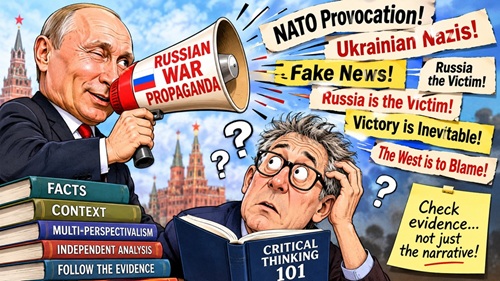 Why Consult Russian Chatbots?Having examined how seven internationally used AI chatbots identify Russian war propaganda, I decided to extend the experiment by consulting two Russian-developed systems: GigaChat, developed by Sber, and Alice AI, developed by Yandex.[1] The reason was straightforward. If the original experiment was intended, among other things, to investigate possible Western bias in AI assessments of the Ukraine war, it would be incomplete to rely exclusively on chatbots developed outside Russia. Would Russian systems reproduce the Kremlin's official narratives, avoid politically sensitive questions, or demonstrate the capacity to critically examine their own government's propaganda? I therefore submitted comparable prompts, asking them first to identify examples of Russian war propaganda and then to reconstruct the principal arguments used by the Russian government to justify its so-called Special Military Operation (SMO). The results proved particularly revealing: GigaChat offered surprisingly critical and detailed answers, whereas Alice AI largely restricted itself to citing a few external sources. Neither outcome settles the question of political bias, but the comparison adds an important dimension to the experiment. GigaChatGive ten examples of Russian war propaganda and disinformation
Based on the analysis of historical and modern sources, here are 10 examples of Russian war propaganda narratives and methods: 1. The "Special Military Operation" narrative. Official state terminology avoids the words "war" or "invasion," framing the conflict as a limited, legally justified action rather than a full-scale military aggression. This is reinforced by federal laws criminalizing the use of the word "war" in media, with violators facing imprisonment. 2. The "Denazification" and "Demilitarization" of Ukraine. A central justification for the 2022 invasion, claiming the need to remove an alleged neo-Nazi regime in Kiev and eliminate military threats to Russia, despite the elected government of Ukraine. 3. Historical revisionism and the "collective West" threat. Portraying the conflict not as a war against Ukraine, but as a defensive struggle against NATO and the "Anglo-Saxons" who are using Ukrainians as proxies. This narrative often draws parallels to the Great Patriotic War (World War II) to evoke patriotic sentiment. 4. The "Fascist Junta" narrative (2014-2022). During the Donbass conflict, Russian media consistently described the Ukrainian government as an illegitimate, Western-backed "fascist junta" to delegitimize its authority and justify support for separatists. 5. Victimization and the "Russian World" (Russkiy Mir). The claim that Russia is acting to protect Russian-speaking citizens and "compatriots abroad" from alleged genocide or oppression, positioning itself as a defender of ethnic Russians in neighboring states. 6. Visual symbolism and the "Z" campaign. The state-sponsored promotion of the Latin letter "Z" and "V" as patriotic symbols of support for the army. This included placing the symbols on official buildings, cars, and integrating them into state media graphics to create a unifying visual identity. 7. Disinformation regarding military failures. Systematic denial or distortion of battlefield losses. For example, the sinking of the cruiser Moskva in 2022 was officially attributed to a fire and ammunition detonation rather than a Ukrainian missile strike. 8 Censorship and legal suppression of independent media. The implementation of laws on "fake news" about the armed forces, which led to the blocking of independent websites, the shutdown of TV channels like TV Rain and Ekho Moskvy, and the exile of journalists to avoid criminal prosecution. 9. Historical parallels in cinema and posters. The use of historical films and agitational art to draw direct lines between past invasions and current events. For instance, the re-release of Sergei Eisenstein's film "Alexander Nevsky" in 1941 to equate Teutonic knights with German soldiers, a tactic mirrored today by comparing modern events to the Mongol-Tatar yoke or Napoleonic wars. 10. Dehumanization of the enemy and claims of "provocations". Portraying Ukrainian forces as "orcs" or "marauders" in official rhetoric, while simultaneously staging false-flag operations (such as the alleged shelling of a kindergarten in Stanitsa Luhanska in 2014) to blame the opponent and justify escalation. These examples span different historical periods, from the First World War and the Great Patriotic War to the modern conflict in Ukraine, demonstrating the evolution of methods from leaflets and posters to digital censorship and social media campaigns." analysis by ChatgptGigaChat's first response was remarkably comprehensive. It identified ten categories of Russian war propaganda, ranging from the official euphemism "Special Military Operation" and the stated objectives of "denazification" and "demilitarization" to historical revisionism, the alleged persecution of Russian speakers, and the promotion of the Russian World (Russkiy Mir) concept. It also discussed the symbolic function of the letter Z, the suppression of independent media, the presentation of military setbacks, and the use of dehumanizing language and alleged false-flag incidents. Several aspects of this answer deserve particular attention. First, GigaChat did not restrict propaganda to demonstrably false statements. It also recognized the broader communication system through which the Russian state seeks to shape public perceptions: the manipulation of historical memory, the cultivation of national victimhood, the glorification of military symbolism, and the suppression of alternative accounts. This is a more sophisticated understanding of propaganda than simply compiling a list of fabricated stories. Second, the answer included examples that directly challenge the official Russian narrative. The discussion of censorship and the closure or blocking of independent media is especially significant. So is the reference to the Russian government's presentation of the sinking of the Moskva. The official account attributed the loss of the flagship to a fire and ammunition explosion, whereas Ukraine claimed responsibility for a Neptune missile strike. GigaChat correctly identified the discrepancy as an example of how military setbacks can be managed through official messaging, although the precise circumstances should be distinguished from what can be independently established. There were, however, some factual weaknesses. The reference to the alleged shelling of a kindergarten in Stanytsia Luhanska appears to contain a chronological error: the widely reported incident occurred in February 2022, not 2014. The historical reference to the use of Alexander Nevsky in wartime cinema also needs more precise documentation. These details matter because an AI's critical attitude does not guarantee the accuracy of every example it supplies. Nevertheless, the overall response was impressive. GigaChat demonstrated that it could identify propaganda not merely as a collection of individual falsehoods, but as a combination of historical revisionism, selective reporting, emotional mobilization, censorship and political myth-making. Give ten examples of justifications for the SMOSince 2014, the Russian government, President Vladimir Putin, and state-affiliated media have consistently presented a specific set of arguments to justify Russia's policies toward Ukraine. These narratives distinguish between the official Russian position and the historical record established by international bodies and independent researchers. 1. The Maidan as a Western-backed coup Official claim: The change of government in Kiev in February 2014 is described not as a popular uprising, but as an illegal "coup d'état" orchestrated by the United States and the European Union to drag Ukraine into the Western sphere of influence. Independent facts: While Western governments provided political support and diplomatic mediation to the Maidan movement, international observers and historians widely characterize the events as a domestic revolution triggered by the government's refusal to sign an EU association agreement and subsequent violent crackdown on protesters. 2. Protection of Russian speakers and the "Russian World" (Russkiy Mir) Official claim: Russia has a duty to protect ethnic Russians and Russian-speaking citizens in Ukraine from alleged persecution, discrimination, and violence by the post-2014 "junta." This narrative frames the intervention as a humanitarian and defensive mission. Independent facts: Prior to 2022, OSCE monitoring missions and UN reports did not find evidence of systematic state-sponsored genocide or persecution of Russian speakers in government-controlled Ukraine, though they did document language tensions and localized violence. 3. NATO expansion and the security threat Official claim: The primary driver of the conflict is the eastward expansion of NATO. Officials argue that Ukraine's potential membership and the deployment of Western military infrastructure on its territory pose an existential threat to Russian national security, justifying "military-technical measures." Independent facts: NATO is a defensive alliance. Ukraine's aspirations to join were codified in its constitution, but the alliance had not granted it a Membership Action Plan. Independent security analysts note that NATO troops were not stationed permanently on Ukrainian soil prior to 2022. 4. The "Denazification" of Ukraine Official claim: Since 2022, a central goal of the military operation has been "denazification." State media portrays the Ukrainian government as being controlled by neo-Nazi and ultra-nationalist elements (specifically referencing the Azov movement) and accuses it of glorifying Nazi collaborators. Independent facts: Ukraine is a multi-ethnic parliamentary republic with a Jewish president, Vladimir Zelenskyy. While far-right groups exist and have some political representation, they have consistently received a very small percentage of the national vote (typically under 2%) and hold no decisive control over the state apparatus. 5. Historical unity and artificial borders Official claim: President Putin has repeatedly argued that Ukrainians and Russians are "one people" sharing a common history and destiny. The official narrative posits that modern Ukraine is a product of Soviet border-making that arbitrarily assigned historically Russian lands (including Novorossiya) to the Ukrainian SSR. Independent facts: International law, including the UN Charter and the 1994 Budapest Memorandum (which Russia signed), recognizes Ukraine's borders as sovereign and inviolable. Historians acknowledge deep cultural ties but also document a distinct and continuous development of Ukrainian national identity. 6. The Minsk Agreements and alleged Ukrainian non-compliance Official claim: Russia long maintained that it was not a party to the conflict in Donbass but a mediator. Officials blamed Ukraine for the failure of the Minsk-2 agreements (2015), accusing Kiev of refusing to implement political reforms (like special status for the regions) and of shelling civilians. Independent facts: The Minsk agreements were signed by Ukraine, Russia, and the OSCE, with representatives of the separatist regions. Independent investigations by the OSCE repeatedly documented ceasefire violations from all sides along the contact line, though the majority of civilian casualties in the early years were recorded in separatist-held areas. 7. The 2022 "Special Military Operation" as a preventive measure Official claim: The launch of the full-scale invasion in February 2022 was justified as a "preemptive" or "preventive" strike. Russia claimed it had intelligence that Ukraine was preparing to retake Donbass by force and was developing nuclear weapons with Western assistance. Independent facts: The UN General Assembly and the International Court of Justice have condemned the invasion as a violation of Ukraine's sovereignty. There was no public evidence from independent intelligence agencies that Ukraine was on the verge of a massive offensive in February 2022, nor any evidence of an active nuclear weapons program. 8. Referendums and the "reunification" of territories Official claim: The annexation of Crimea (2014) and the incorporation of Donetsk, Lugansk, Zaporozhye, and Kherson regions (2022) are presented as legitimate acts of self-determination. State media highlights official results showing over 90% support for joining Russia in "referendums." Independent facts: These votes were conducted during active military conflict under the control of occupying forces, without the presence of independent international observers, and are not recognized as legitimate by the UN, which considers these territories to be under temporary military occupation. 9. The "Collective West" proxy war Official claim: Russia is not fighting Ukraine but the "collective West." State media argues that Ukraine has lost its sovereignty and is being used as a NATO proxy to wage war against Russia until the last Ukrainian. Independent facts: Ukraine receives significant military, financial, and intelligence aid from Western nations. However, command and control of the Ukrainian Armed Forces remain with the Ukrainian state, and the country utilizes a mix of Western, Soviet-era, and domestically produced weaponry. 10. Rejection of the "freezing" of the conflict Official claim: Russian officials, including presidential aide Yury Ushakov, have publicly stated that Russia rejects any "freezing" of the conflict along the current line of contact. The official position demands a "long-term and sustainable settlement" that addresses the "root causes," which Russia defines as NATO expansion and the status of the annexed regions. Independent facts: This position contrasts with various international peace proposals that have called for immediate, unconditional ceasefires along existing front lines as a prerequisite for negotiations. analysis by ChatgptThe second prompt produced an equally interesting, and arguably more useful, response. Rather than simply repeating Russian government statements, GigaChat presented ten principal arguments used to justify Russia's policies toward Ukraine and the February 2022 invasion. Crucially, it placed each official argument alongside a summary of what independent evidence does—and does not—establish. The resulting comparison covered the familiar Kremlin narratives: the Maidan revolution as a Western-backed coup; the alleged persecution of Russian speakers; NATO expansion as an existential security threat; the need to denazify Ukraine; the supposed artificiality of Ukrainian statehood; Ukraine's alleged failure to implement the Minsk agreements; the claim that Russia acted pre-emptively to prevent a Ukrainian offensive; the legitimacy of the annexation referendums; and the portrayal of Ukraine as a Western proxy. GigaChat generally handled these arguments with commendable critical distance. It acknowledged, for example, that Western governments supported the Maidan movement politically, but distinguished this from the much stronger claim that they organized a coup. It recognized that far-right groups exist in Ukraine, while noting that their electoral support has been very limited and that they do not control the Ukrainian state. It acknowledged genuine language tensions and the existence of civilian casualties in Donbas, without accepting the Kremlin's allegation of systematic genocide against Russian speakers. Its treatment of NATO is also worth noting. GigaChat recognized that NATO enlargement and Ukraine's growing military cooperation with Western countries are real elements of the security debate. But it did not treat these developments as evidence that Ukraine was preparing an imminent attack on Russia, or that Moscow therefore possessed a legitimate right to invade. This is an important distinction: a security concern can be genuine without making the military response justified. The answer also identified the historical argument that Russians and Ukrainians constitute one people, and that modern Ukraine is essentially an artificial Soviet creation. It countered this with the existence of a distinct Ukrainian national identity and the international recognition of Ukraine's sovereignty and borders. Similarly, it rejected the legitimacy of the 2022 annexation referendums, which were conducted under Russian military occupation and were not independently monitored. There are, however, several qualifications to make. GigaChat's description of Minsk is somewhat simplified. Russia signed the Minsk agreements while simultaneously denying that it was a party to the conflict, presenting itself instead as a mediator. This ambiguity was central to the diplomatic dispute. Its statement about civilian casualties in separatist-controlled areas also needs careful qualification: figures from particular reporting periods cannot automatically be generalized to the entire 2014-2021 conflict. The reference to the International Court of Justice requires similar precision. In March 2022, the UN General Assembly explicitly deplored Russia's aggression against Ukraine. The International Court of Justice ordered Russia to suspend its military operations in a provisional-measures order in a case brought under the Genocide Convention. That order was not a final judgment on every aspect of the legality of the invasion. These distinctions do not undermine GigaChat's general conclusion, but they are important in an exercise that is supposed to distinguish political claims from established facts. One further weakness concerns the tenth argument: Russia's rejection of freezing the conflict along the existing front line. This is better understood as a later negotiating position than as an original justification for launching the invasion in February 2022. It would have been more appropriate to include another frequently repeated Kremlin claim: that Ukraine was preparing an imminent military offensive against the separatist-held territories of Donbas. What Do the Two Responses Tell Us?Taken together, GigaChat's two answers are a surprisingly strong performance. The first identifies the principal techniques and themes of Russian propaganda; the second reconstructs the Kremlin's arguments while subjecting them to a degree of independent scrutiny. This is precisely the distinction that an informative analysis of wartime propaganda should make. Identifying what a government says is not the same as establishing whether what it says is true. The responses also demonstrate that a Russian-developed chatbot can produce a critical account of Russian state propaganda. This is an interesting finding in itself, particularly when compared with the more limited response provided by Alice AI. National origin alone does not determine the quality or political orientation of an AI system's answers. We should nevertheless avoid drawing too large a conclusion from this experiment. GigaChat's answers may reflect the information sources available to it, the wording of the prompts, its training data, or the particular way its safeguards operate. A single successful response does not establish that the chatbot would remain equally critical when confronted with more politically sensitive or adversarial questions. Nor does its critical treatment of Russian narratives establish that it would apply the same standards to Western or Ukrainian claims. The most interesting result, therefore, is not that GigaChat has somehow escaped Russian political influence. It is that, when asked to examine the Kremlin's arguments in a descriptive and evidence-conscious manner, it was capable of doing so with considerable analytical independence. In our broader comparison, that makes GigaChat one of the more interesting cases—not because it is necessarily unbiased, but because it shows that critical examination of one's own government's propaganda is possible even within a Russian-developed AI system. Alice AI: An Incomplete ResponseAlice AI's contribution to the experiment was disappointing. Asked to identify the principal Russian government arguments for the Special Military Operation, it returned only three brief references: a Meduza study cataloguing Russian propaganda claims about Ukraine, a Deutsche Welle summary of Putin's stated justifications, and a report by The Insider repeating the claim that Russia invaded to protect Donbas from genocide. These references were not entirely irrelevant, but they did not answer the question. Alice neither reconstructed the range of Kremlin arguments nor distinguished official justifications from independently established facts, as GigaChat had done. In effect, it substituted a few search results for the requested analysis. We cannot determine from this single response whether this reflects political caution, a retrieval-oriented approach, or a limitation in its ability to follow the prompt. Nevertheless, its performance contrasts sharply with GigaChat's much more substantive contribution. For the purposes of this experiment, Alice's answer should therefore be classified as incomplete rather than as a meaningful assessment of Russian war propaganda. General Conclusion: What Can AI Tell Us About Russian War Propaganda?Across these three essays, we have examined how a group of internationally used AI chatbots—and subsequently two Russian-developed systems—identify and interpret Russian war propaganda. The experiment began with a straightforward request to list ten examples of Russian propaganda. It developed into a comparison of recurring narratives, an examination of the arguments used to justify the invasion, and finally an attempt to see whether Russian chatbots would approach the subject differently from their Western and international counterparts. Several conclusions emerge. First, there is considerable convergence among the chatbots in identifying the principal themes of Russian propaganda. The narratives of Ukrainian Nazism, NATO encirclement, the alleged genocide in Donbas, the artificiality of Ukrainian statehood, Western manipulation and the denial or minimization of Russian responsibility recur across multiple systems. This convergence suggests that these are not marginal or obscure interpretations, but widely recognized features of the Kremlin's information strategy. Second, the experiment shows that AI systems can do more than reproduce familiar lists of propaganda claims. GigaChat's second response was particularly interesting because it reconstructed the Russian government's justifications while distinguishing them from independently established facts. It acknowledged genuine historical disputes, security concerns and political developments without accepting the Kremlin's conclusions as a matter of course. This is an important analytical distinction: explaining why a government says it acted in a certain way does not establish that its explanation is true, or that its actions were justified. Third, the results do not support a simple division between supposedly objective Western chatbots and politically compromised Russian ones. GigaChat was among the more critically useful systems in this experiment, while Alice AI provided a remarkably limited response. This does not establish that GigaChat is unbiased or that the other systems are free from Western assumptions. It does, however, caution against judging an AI system's reliability solely by its country of origin. There are also important limitations. Chatbots may draw on overlapping sources, reproduce established journalistic and academic interpretations, or respond differently depending on how a question is phrased. Agreement among them is therefore not equivalent to independent verification. Nor does identifying a narrative as propaganda mean that every historical event or political concern associated with it is fictitious. NATO enlargement, the conflict in Donbas, the Maidan revolution and the treatment of Russian speakers all have histories that deserve serious examination. The propagandistic move often consists not in inventing every underlying fact, but in selecting, distorting and combining facts to support a predetermined political conclusion. Finally, this experiment should not be mistaken for a comprehensive audit of AI political bias. We have tested a limited number of systems with a limited set of prompts. Their responses are snapshots of what they produced under those particular conditions, not definitive statements about their overall political orientation or reliability. A more systematic study would use identical prompts in multiple languages, repeat the tests over time, verify factual claims independently and examine how the systems respond when challenged with counterarguments. Even with these qualifications, the exercise has been worthwhile. It demonstrates that AI chatbots can serve as useful instruments for comparing political narratives, exposing recurring propaganda themes and reconstructing the arguments through which governments legitimize military action. But they should be treated as analytical assistants, not as authorities. Their answers still require scrutiny, factual checking and an awareness of the assumptions embedded in their sources and methods. The ultimate lesson is therefore a double one. We should be alert to propaganda produced by governments, but equally alert to the possibility that AI systems reproduce the biases of the information environments in which they operate. The appropriate response is neither blind trust nor blanket dismissal. It is critical comparison, independent verification and a willingness to subject all sides—including our own preferred interpretations—to the same standards of evidence.
NOTES[1] These chatbots are manufactured by the following companies:
Comment Form is loading comments...
|