|
TRANSLATE THIS ARTICLE
Integral World: Exploring Theories of Everything
An independent forum for a critical discussion of the integral philosophy of Ken Wilber
  Frank Visser, graduated as a psychologist of culture and religion, founded IntegralWorld in 1997. He worked as production manager for various publishing houses and as service manager for various internet companies and lives in Amsterdam. Books: Ken Wilber: Thought as Passion (SUNY, 2003), and The Corona Conspiracy: Combatting Disinformation about the Coronavirus (Kindle, 2020).
Check out my other conversations with ChatGPT
Russian War Propaganda:
The Ten Most Common Forms of Russian War Propaganda Seven AI Chatbots on Russian War Propaganda Two Russian AI Chatbots on Russian War Propaganda The Ten Most Common Forms of Russian War Propaganda and DisinformationHow the Kremlin manufactures an alternative reality about its invasion of UkraineFrank Visser / ChatGPT
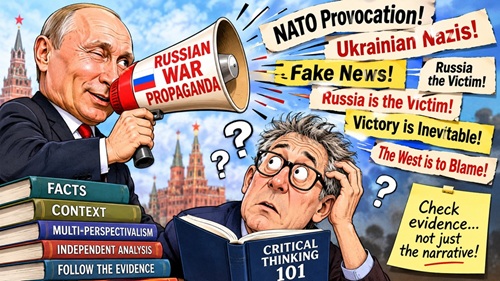 Introduction: The war behind the warRussia's invasion of Ukraine on February 24, 2022, has been accompanied by an enormous propaganda campaign. This is not simply a matter of presenting the Russian government's position in a favourable light. It is a systematic effort to construct an alternative reality in which Russia is not the aggressor, Ukraine is not a legitimate victim, Western countries are responsible for the conflict, and the Kremlin is conducting a defensive struggle against an existential threat. The information war serves several purposes simultaneously. It helps justify the invasion to the Russian domestic audience, undermines Ukrainian morale, weakens Western support for Ukraine, creates divisions within NATO and the European Union, and influences countries outside the Western alliance. It also attempts to make the international community uncertain about what is actually happening. Russian propaganda is particularly effective because it does not always depend on outright fabrication. It frequently combines genuine events with selective reporting, misleading historical comparisons, exaggerated claims, conspiracy theories, manipulated images and outright inventions. A real Ukrainian military mistake, for example, can be transformed into evidence that the entire Ukrainian government is criminal. A genuine disagreement between Western governments becomes proof that NATO is collapsing. A minor Russian territorial advance becomes a decisive strategic victory. The following ten categories capture some of the most persistent and influential forms of Russian war propaganda. They overlap considerably, and individual campaigns often employ several of them simultaneously. 1. Reversing the roles of aggressor and victimPerhaps the most fundamental Russian propaganda technique is to reverse the moral and political responsibilities for the war. Russia presents itself as a country forced into military action by Western expansionism, Ukrainian hostility and the alleged persecution of Russian-speaking populations. The invasion is consequently described as a defensive operation rather than an act of aggression. This narrative has several variations. Russia supposedly had no choice but to intervene. NATO had surrounded it. Ukraine was preparing to attack the Donbas. The West had systematically ignored Russian security concerns. Moscow was therefore compelled to act before it was too late. The problem with this presentation is that it confuses geopolitical grievances with a legitimate justification for invasion. Russia's dissatisfaction with NATO enlargement, its opposition to Ukraine's Western orientation and its desire to retain influence over neighbouring countries do not confer a right to invade them. There is also a revealing asymmetry. Russian propaganda insists that Russia must be allowed to defend its security interests, while denying Ukraine the equivalent right to choose its alliances and determine its own foreign policy. The aggressor-victim reversal is the foundation upon which much of the remaining propaganda is constructed. If Russia can persuade audiences that it is the real victim, virtually every subsequent military action can be presented as self-defence. 2. The Nazi and fascist Ukraine narrativeThe second major propaganda instrument is the persistent portrayal of Ukraine as a Nazi state. The Kremlin's official justification for the invasion included the promise to "denazify" Ukraine. Russian media routinely associate the Ukrainian government, military and nationalist movements with fascism, Nazism and the historical collaboration of certain Ukrainian nationalists with Nazi Germany. There is a historical basis for discussing Ukrainian nationalist collaboration during the Second World War. There are also far-right organisations and individuals in contemporary Ukrainian politics. Ukraine, like other European countries, has its share of extremist movements. But acknowledging these facts is very different from describing an entire country as Nazi-controlled. Ukraine has a democratically elected government, a functioning multiparty political system and a Jewish president, Volodymyr Zelenskyy. Far-right political organisations have generally performed poorly in national elections. The existence of controversial historical figures or extremist military formations does not establish that the Ukrainian state is fascist. The propaganda technique works through association rather than demonstration. A photograph of a soldier with a controversial insignia, a reference to Stepan Bandera, or an isolated incident involving a far-right activist is presented as evidence of the ideological character of the entire country. The historical irony is considerable. Russia invokes the Soviet victory over Nazi Germany to legitimise an invasion of a neighbouring country, while simultaneously employing imperialist rhetoric and denying that country's independent national identity. The word Nazi has become less an analytical description than a political weapon. Its purpose is to make Ukraine appear so morally repugnant that its destruction can be presented as liberation. 3. NATO provocation and the American puppet narrativeAnother persistent claim is that Ukraine is not an independent political actor but merely an instrument of the United States and NATO. According to this narrative, Washington orchestrated the 2014 Maidan revolution, installed a puppet government in Kyiv, directed Ukrainian military operations and is ultimately responsible for the war. Ukraine is portrayed as a Western military outpost whose purpose is to weaken Russia. This argument contains a familiar mixture of geopolitical analysis and conspiracy thinking. It is perfectly legitimate to examine American influence in Ukraine, Western military assistance, NATO enlargement and the strategic calculations of Washington. Western governments have their own interests, and their policies deserve scrutiny. But influence is not the same as control. Ukraine has its own political institutions, public opinion, national interests and security concerns. Its resistance to Russian aggression cannot be reduced to an American geopolitical project. The puppet narrative also conveniently erases Ukrainian agency. It treats Ukrainians as incapable of making independent political decisions, even when those decisions involve enormous personal sacrifices. The underlying imperial assumption is that Ukraine cannot legitimately choose a future different from the one preferred by Moscow. A related argument claims that NATO expansion left Russia with no alternative. This ignores the fact that countries such as Poland, the Baltic states, Finland and Sweden sought NATO membership partly because of their historical experiences and fears of Russian domination. Finland and Sweden, in particular, changed their long-standing military positions after Russia launched its full-scale invasion. The Kremlin's preferred interpretation turns this sequence of events upside down: Russia's neighbours seek protection because of Russian aggression, but their search for protection is then presented as evidence that Russia was threatened all along. 4. The fabricated genocide and the protection of Russian speakersOne of the most consequential pre-invasion narratives was the allegation that Ukraine was committing genocide against Russian-speaking populations in the Donbas. The Kremlin repeatedly claimed that Russian-speaking inhabitants of eastern Ukraine were victims of systematic persecution and extermination. This provided an ostensibly humanitarian justification for Russian intervention. The conflict in the Donbas, which began in 2014, was real. It involved armed separatism, Russian intervention, Ukrainian military operations and civilian casualties. There were genuine grievances, political divisions and abuses that deserved investigation. But these facts do not establish the existence of a Ukrainian genocide. Russia transformed a complicated conflict into a story of deliberate extermination, presenting itself as the indispensable protector of an endangered population. This narrative also rests on a questionable assumption: that Russian-speaking Ukrainians necessarily identify with Russia or want to become part of the Russian state. Language, ethnicity, citizenship and political allegiance are not interchangeable. Millions of Russian-speaking Ukrainians identify strongly with Ukraine and have resisted the Russian invasion. The propaganda has therefore produced a particularly striking contradiction. Russia claims to be liberating Russian-speaking Ukrainians while destroying their homes, cities and infrastructure and forcing millions to flee. The alleged humanitarian justification has become one of the most cynical elements of the war's ideological packaging. 5. Historical revisionism and the denial of Ukrainian statehoodRussian propaganda frequently questions whether Ukraine is a genuine historical nation at all. Vladimir Putin's 2021 essay on the historical unity of Russians and Ukrainians, followed by his February 2022 address preceding the invasion, articulated a vision in which Ukraine's independent existence was treated as an artificial historical construction. According to this interpretation, Russians and Ukrainians constitute essentially one people, separated by unfortunate historical developments and manipulated by hostile foreign powers. The implication is that Ukrainian independence is provisional, unnatural or illegitimate. This is not merely an argument about historical interpretation. It has direct political consequences. If Ukraine is not considered a fully legitimate nation, its sovereignty becomes negotiable and its territorial integrity subordinate to Russia's supposed historical rights. The Kremlin selectively invokes history to support its territorial ambitions. It celebrates the Soviet Union when doing so reinforces Russian greatness, condemns Soviet historical decisions when they contradict contemporary Russian claims, and invokes the Russian Empire when seeking to establish historical ownership over neighbouring territories. The same selective approach appears in the treatment of Crimea. Its annexation in 2014 is portrayed as the correction of an historical mistake, while the subsequent invasion is presented as the restoration of a natural political and cultural unity. Historical connections between Russia and Ukraine are undeniable. But shared history does not establish contemporary political ownership. Many European countries have complicated histories of changing borders, dynasties and empires. None of these facts gives neighbouring states an unlimited right to redraw present-day boundaries. The denial of Ukrainian statehood is therefore not an innocent historical debate. It is an ideological instrument for legitimising territorial conquest. 6. Fabricated evidence, conspiracy theories and false-flag accusationsRussian disinformation frequently relies on fabricated documents, manipulated photographs, misleading videos and elaborate conspiracy theories. The alleged American bioweapons laboratories in Ukraine are a particularly revealing example. The existence of biological research facilities was transformed into claims that the United States was developing biological weapons, potentially targeting Russians. The distinction between legitimate public-health research and a secret biological weapons programme was systematically blurred. Other examples include fabricated reports of Ukrainian atrocities, false claims about attacks on Russian civilians, invented evidence of Western military operations and allegations that Ukraine or its allies were planning false-flag incidents. A particularly useful variation is the pre-emptive accusation. When an event occurs that could generate international criticism of Russia, Russian sources may immediately suggest that Ukraine staged it, that Western intelligence services organised it, or that the incident was designed to provoke a wider war. The March 2026 European External Action Service report documents the continued use of fabricated investigations, fake documents, impersonated media websites and false-flag accusations. These campaigns are not confined to official Russian statements; they circulate through networks of anonymous accounts and seemingly independent websites. The method is important because it creates a permanent fog of suspicion. Audiences are encouraged to believe that nothing can be established with confidence. Even when an individual fabrication is exposed, the damage may already have been done. The original allegation has circulated widely, while the correction receives considerably less attention. 7. Denying Russian atrocities and reversing responsibilityA particularly disturbing category involves the denial or distortion of evidence concerning Russian military conduct. The massacre of civilians in Bucha in 2022 provides an important example. After Russian forces withdrew from the town, evidence emerged of civilians killed during the occupation. Rather than acknowledging the evidence and accepting responsibility, Russian official channels promoted contradictory explanations, including claims that the scenes had been staged by Ukraine. Similar tactics have been used in response to attacks on civilian infrastructure, the destruction of residential areas and allegations of unlawful deportations. The pattern is remarkably consistent. First, deny that the event happened. Then suggest that Ukraine staged it. If the evidence becomes overwhelming, question the circumstances, identify alternative perpetrators or shift attention to alleged Ukrainian violations. The deportation and transfer of Ukrainian children to Russia is another important example. Moscow has frequently presented these actions as humanitarian evacuations, while avoiding the central questions of consent, parental rights, legal safeguards and the children's return. This technique should not be confused with legitimate demands for independent investigations. Wartime claims require verification, and Ukrainian forces should be held accountable for substantiated violations as well. But the existence of possible Ukrainian misconduct does not invalidate evidence of Russian misconduct. Nor does it establish that all allegations against Russia are fabricated. The objective is to make accountability impossible by turning every documented atrocity into an endless argument about competing accusations. 8. Inflating military victories and manufacturing an image of inevitabilityRussian propaganda has increasingly relied on presenting the battlefield situation as an uninterrupted sequence of Russian successes. Small territorial advances are announced as major breakthroughs. Ukrainian withdrawals are described as collapses. Russian casualties and equipment losses receive limited attention, while Ukrainian losses are exaggerated. Claims of imminent Ukrainian defeat are repeated long before they become reality. Maps play an important role in this process. Changes in the colour of a contested area can suggest decisive territorial control even when the actual military situation remains uncertain. This practice has sometimes been described as mapaganda: the use of maps and selectively presented territorial information to create an exaggerated impression of military progress. The objective is not necessarily to convince everyone that Russia is winning every battle. It is to establish a broader impression that Russian victory is inevitable and that resistance is futile. This message serves several audiences. Russian citizens are reassured that sacrifices are producing results. Ukrainian soldiers and civilians are encouraged to lose hope. Western governments are told that continued military assistance merely postpones an inevitable defeat. The EUvsDisinfo review of 2025 identified exaggerated battlefield victories as a particularly prominent theme, including inflated claims about control of contested towns and villages. Its subsequent reporting in 2026 has also documented the recycling of such claims. Russia has undoubtedly achieved territorial gains and retains substantial military capabilities. A serious analysis should not dismiss these developments. But the presentation of every incremental advance as a strategic triumph conceals the enormous costs, delays and failures of the invasion. Propaganda replaces a complicated military assessment with a simple psychological message: Russia is strong, Ukraine is finished, and the West should accept reality. 9. Western war fatigue, European warmongering and the false promise of peaceAs the war continues, Russian propaganda has increasingly concentrated on weakening Western public support for Ukraine. The message is straightforward: Europe is exhausted, American support is unreliable, sanctions have failed, Ukraine cannot win, and taxpayers should stop financing a hopeless conflict. The Kremlin also portrays European governments as warmongers who deliberately prevent peace by continuing to supply Ukraine with weapons. This is a particularly effective propaganda strategy because it exploits genuine disagreements and legitimate public concerns. There are real debates about the cost of military assistance, the economic consequences of sanctions, the risks of escalation, the possibility of negotiations and the long-term security of Europe. Western governments have made mistakes, and their policies deserve critical examination. But Russian propaganda systematically distorts these debates. It presents continued Ukrainian resistance as the principal obstacle to peace, rather than addressing the central issue of Russian military occupation and territorial demands. A ceasefire or negotiated settlement is not automatically a just or durable peace. Its terms matter. A settlement imposed on Ukraine under military pressure could reward aggression and encourage further territorial expansion. The Kremlin's peace rhetoric is therefore often strategically selective. It demands concessions from Ukraine while portraying Russian territorial claims as non-negotiable. At the same time, European support for Ukraine is depicted as an attempt to prolong the war for ideological or economic reasons. The contradiction is obvious: Russia claims to desire peace while continuing its invasion, and accuses others of prolonging a war that it initiated and can help end by withdrawing its forces. The purpose of this narrative is to turn Western democracies against their own policies and to make support for Ukraine appear both futile and irresponsible. 10. Whataboutism, moral equivalence and the exploitation of Western divisionsFinally, Russian propaganda frequently avoids defending its own conduct directly by pointing to the misconduct of others. Why criticise Russia for invading Ukraine when the United States invaded Iraq? Why condemn Russian bombing when NATO bombed Yugoslavia? Why discuss Russian human-rights violations when Western governments have supported authoritarian regimes? These questions are not necessarily illegitimate. Western foreign policy contains serious contradictions, and American and European governments should be held accountable for their own actions. The propaganda trick lies in using one wrong to excuse another. The fact that the United States violated international law in Iraq does not make Russia's invasion of Ukraine lawful. The fact that NATO conducted a controversial military intervention in Kosovo does not give Moscow a right to annex Ukrainian territory. This is the classic whataboutism technique: replacing an examination of the specific accusation with a discussion of somebody else's alleged hypocrisy. A related technique is to amplify existing political divisions within Western societies. Russian information operations exploit disagreements over immigration, energy prices, elections, nationalism, distrust of institutions and relations between Europe and the United States. They do not necessarily need to persuade people to support Russia. It may be sufficient to persuade them that all governments lie, all media are corrupt, all international institutions are hypocritical and no reliable distinction can be made between aggressor and victim. This is propaganda by exhaustion. Rather than establishing a convincing alternative account of events, it attempts to destroy confidence in the possibility of establishing the truth at all. The result is a fragmented information environment in which people increasingly select whatever version of reality confirms their existing political preferences. Conclusion: The purpose is not always to make people believe RussiaThese ten propaganda techniques reveal a coherent strategy. They are not isolated examples of misleading journalism or occasional exaggerations by enthusiastic supporters of the Russian government. Together, they constitute an information system designed to protect the Kremlin's political legitimacy, justify territorial expansion and weaken resistance to Russian ambitions. There is, however, an important distinction between propaganda and disinformation. Propaganda selects, emphasises and interprets information to advance a political objective. Disinformation goes further by deliberately introducing false or misleading information. Russian wartime communication employs both, often simultaneously. It is also important not to make the opposite mistake: not every criticism of Ukraine, NATO, the European Union or American foreign policy is Russian propaganda. Western governments should be scrutinised, Ukrainian political leaders should be criticised when warranted, and allegations of misconduct by Ukrainian forces should be investigated. A democratic society must retain that critical independence. The decisive question is whether an argument withstands examination of its evidence, consistency and implications, or whether it merely reproduces a politically convenient narrative. Perhaps the most successful Russian propaganda does not persuade its audience that Putin is right. It persuades people that nobody can know who is right. It replaces factual disagreement with radical distrust, and political analysis with cynicism. That is why the Kremlin's information warfare extends far beyond Russian television and official statements. It benefits whenever fabricated stories circulate through social media, whenever Western commentators repeat unverified allegations, whenever genuine criticism of Western policy is transformed into justification for Russian aggression, and whenever the distinction between an invading army and a country defending itself becomes blurred. The ultimate objective is not necessarily to win the argument. It is to make the argument unwinnable. And that, in an age of information overload, may be one of the most dangerous weapons in Russia's war against Ukraine. Appendix: Isn't This Precisely Western War Propaganda?There is an obvious objection to the preceding discussion: isn't this precisely the kind of Western war propaganda that Joseph Dillard has been criticising? Isn't the repeated emphasis on Russian imperial ambitions, Putin's authoritarianism, Russian disinformation and Ukrainian victimhood itself part of a Western narrative designed to mobilise public opinion against Russia? This is a legitimate question. It deserves more than a dismissive answer. Western governments have indeed engaged in wartime propaganda. They have selectively presented information, emphasised Russian misconduct, highlighted Ukrainian resistance, downplayed inconvenient developments and sometimes made claims that subsequently required correction. Western media are not immune to national bias, political pressure or emotional framing. Nor should we assume that every Ukrainian government statement is accurate simply because Ukraine is defending itself against aggression. There is also a legitimate geopolitical debate about NATO enlargement, Western diplomatic mistakes, American strategic interests, the failure of European security arrangements and the missed opportunities for negotiation. These subjects should remain open to critical examination. But acknowledging Western propaganda does not establish the truth of Russian counter-narratives. Nor does it follow that every criticism of Putin serves a Western propaganda objective. The distinction is between propaganda and evidence-based criticism. If we describe Russia as imperialist, we should explain what we mean and provide evidence. If we accuse Putin of denying Ukrainian sovereignty, we should examine his actual statements. If we discuss Russian atrocities, we should rely on independently investigated cases rather than simply repeating Ukrainian government announcements. The same standards apply in reverse. Allegations of Ukrainian atrocities should be investigated. Claims about NATO's role should be documented. Assertions about Western responsibility should be supported by historical evidence rather than inferred from Russian official statements. There is a further distinction between explaining and justifying. Russia's security concerns may be genuine. NATO enlargement may have contributed to Russian insecurity. American foreign policy may have been strategically irresponsible. None of these propositions establishes a legal or moral justification for invading Ukraine. Likewise, recognising Ukrainian sovereignty does not require idealising the Ukrainian government, overlooking its political problems or denying its own propaganda. The danger is that we replace one simplified narrative with another. A Western narrative in which Russia is irrationally aggressive and the West entirely innocent is just as intellectually inadequate as a Russian narrative in which Russia is permanently defensive and the West entirely responsible. This is precisely why my original April 2022 observation remains important: transcending black-and-white thinking must include Putin's own black-and-white analysis. But it must also include our own. I would therefore propose a simple test for distinguishing independent analysis from wartime propaganda: • Are the factual claims independently verifiable? • Are inconvenient facts acknowledged, even when they undermine one's preferred position? • Are the political interests of all parties examined? • Are explanations of an opponent's behaviour distinguished from justifications of that behaviour? • Is the interpretation open to revision when contrary evidence emerges? These criteria should apply equally to Western, Ukrainian and Russian accounts. Ultimately, the purpose of critical thinking is not to produce a more convincing propaganda narrative for our preferred side. It is to become less dependent on propaganda altogether. The answer to Russian propaganda cannot simply be Western propaganda. It must be better historical analysis, more rigorous fact-checking and a willingness to scrutinise our own political assumptions. That is the intellectual standard I would like Joseph Dillard to apply to his own arguments, and one I must apply to mine.
Comment Form is loading comments...
|