|
TRANSLATE THIS ARTICLE
Integral World: Exploring Theories of Everything
An independent forum for a critical discussion of the integral philosophy of Ken Wilber
  Frank Visser, graduated as a psychologist of culture and religion, founded IntegralWorld in 1997. He worked as production manager for various publishing houses and as service manager for various internet companies and lives in Amsterdam. Books: Ken Wilber: Thought as Passion (SUNY, 2003), and The Corona Conspiracy: Combatting Disinformation about the Coronavirus (Kindle, 2020).
Check out my other conversations with ChatGPT
Russian War Propaganda:
The Ten Most Common Forms of Russian War Propaganda Seven AI Chatbots on Russian War Propaganda Two Russian AI Chatbots on Russian War Propaganda Seven AI Chatbots on Russian War Propaganda and DisinformationFrank Visser / ChatGPT
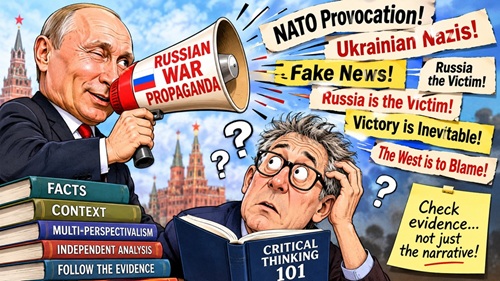 Comparing Seven AI Assessments of Russian War PropagandaTo investigate whether the identification of Russian war propaganda is merely a reflection of Western political perspectives, I asked seven AI chatbots from different technological and geopolitical backgrounds—ChatGPT, Grok Claude, Gemini, DeepSeek, Kimi and Qwen[1]—to independently identify ten examples of Russian propaganda related to the war in Ukraine. This produced a total of 70 examples. I subsequently grouped similar arguments into broader thematic categories and counted how many of the seven chatbots mentioned each narrative. The resulting frequency table offers a comparative overview of which propaganda themes are most widely recognized across these AI systems. The classification is qualitative: different formulations of essentially the same argument have been grouped together. Frequency table: Russian propaganda narratives
Frequency indicates the number of chatbots (out of seven) that mentioned the narrative. Similar formulations have been grouped together. Analysis: Where Do the Chatbots Agree?The most striking finding is the degree of convergence. Three broad narratives appear in all seven responses: the portrayal of Ukraine as a Nazi-controlled state requiring denazification, the presentation of NATO and the West as aggressors responsible for provoking Russia, and the use of fabricated evidence, staged events, false flags and atrocity stories. These are arguably the three central pillars of Russia's information campaign surrounding its invasion of Ukraine. Historical revisionism and the denial of Ukrainian statehood come next, appearing in six of the seven responses. This is significant because Russian propaganda does not merely attempt to justify a particular military operation. It also challenges the historical and political legitimacy of Ukraine as an independent nation, frequently presenting Ukrainian territory as rightfully belonging to Russia. The alleged genocide of Russian speakers in Donbas is mentioned by five chatbots. Four identify the denial or minimization of Russian war crimes, particularly the Bucha massacre, while four also mention the conspiracy narrative about American biological laboratories in Ukraine. The euphemistic description of the invasion as a "Special Military Operation" and the demonization of opponents are similarly represented. Other themes receive less attention. Religious justifications and satanic imagery, exaggerated military successes, concealment of Russian casualties, Western war fatigue and the manipulation of refugee narratives occur less frequently. These differences suggest that the chatbots distinguish, to varying degrees, between the major strategic narratives and more specialized propaganda techniques. Does This Demonstrate the Absence of Western Bias?The results are particularly interesting because the seven systems do not all originate from the same geopolitical environment. ChatGPT, Grok, Claude and Gemini are Western-developed systems, whereas DeepSeek, Kimi and Qwen are Chinese-developed. The latter three therefore provide an opportunity to examine whether the recognition of Russian propaganda is confined to Western AI environments. The fact that Chinese-developed systems also identify numerous central Russian propaganda narratives makes it difficult to dismiss the overall findings simply as an expression of Western political preferences. However, agreement between chatbots does not automatically establish either their independence or their objectivity. They may draw on overlapping information sources, and their answers may reflect widely established interpretations of the war. Nor should identifying propaganda mean that every Russian argument about NATO, European security or Western foreign policy is automatically false. NATO enlargement is a historical fact, and Russia has articulated genuine security concerns. The critical question is how such facts are selected, framed, exaggerated and deployed to justify an invasion, deny Ukrainian sovereignty or evade responsibility for Russian actions. Overall, this experiment suggests that the recognition of major Russian wartime propaganda narratives extends across AI systems with different institutional and geopolitical backgrounds. It does not prove that these systems are free of bias, but it provides an interesting starting point for investigating how consistently AI chatbots can identify state-sponsored disinformation—and where their assessments begin to diverge. Appendix: Results of the seven AI chatbots
NOTES[1] These chatbots are manufactured by the following companies:
Comment Form is loading comments...
|