|
TRANSLATE THIS ARTICLE
Integral World: Exploring Theories of Everything
An independent forum for a critical discussion of the integral philosophy of Ken Wilber
  Frank Visser, graduated as a psychologist of culture and religion, founded IntegralWorld in 1997. He worked as production manager for various publishing houses and as service manager for various internet companies and lives in Amsterdam. Books: Ken Wilber: Thought as Passion (SUNY, 2003), and The Corona Conspiracy: Combatting Disinformation about the Coronavirus (Kindle, 2020).
Check out my other conversations with ChatGPT
The Visser-Reynolds Debate:
United Against Wilber's Evolutionary Errors What If Wilber Got Evolutionary Science Right? What If Wilber Got Evolutionary Science Right?Frank Visser / ChatGPT
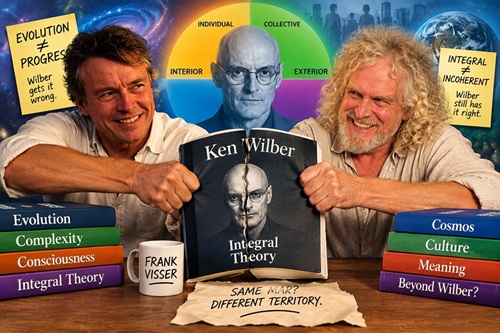
From Cosmic Eros to Natural Selection—and from Evolutionary Destiny to Scientific RealityIf Ken Wilber got evolutionary science right, much of his Integral Theory would have to change. Not necessarily its ambition to connect scientific, psychological, cultural, and philosophical perspectives, but its confidence that these perspectives converge on a single cosmic story: a universe driven from within by an evolutionary impulse toward greater complexity, consciousness, and spiritual realization. The problem is not that Wilber finds evolution fascinating, or that he believes human consciousness deserves a prominent place in our understanding of the universe. The problem is that he frequently moves from established scientific findings to philosophical interpretations without adequately distinguishing between the two. Evolution becomes not merely a process that produces novelty, but a process that somehow wants to produce it. Complexity becomes more than a contingent outcome of particular conditions; it becomes evidence of a cosmic direction. And the emergence of human consciousness is presented as one episode in a grand developmental narrative whose ultimate destination Wilber believes he can describe in spiritual terms. What would happen if we removed these speculative additions and allowed evolutionary biology, physics, and the study of self-organizing systems to speak for themselves? 1. Evolution Has No Cosmic DestinationThe first correction would be fundamental: biological evolution does not possess a predetermined goal. Natural selection can produce adaptation, specialization, and remarkable complexity, but it does so through differential reproductive success under particular environmental conditions. Mutations arise without regard to what organisms need, and natural selection filters inherited variation according to its consequences in specific circumstances. Evolution can produce increasing complexity, but it can also produce simplification, degeneration, and the loss of structures that are no longer useful. Parasites may lose genes and organs. Cave-dwelling organisms may lose functional eyes. Organisms may become exquisitely adapted to a narrow ecological niche while remaining evolutionarily vulnerable to environmental change. There is no universal evolutionary ladder on which every lineage climbs toward greater consciousness. Bacteria are not failed attempts at producing human beings. They are extraordinarily successful organisms that have persisted for billions of years. Wilber could certainly retain the observation that some evolutionary lineages have produced increasingly complex structures and capacities. But he would have to abandon the inference that these developments reveal the direction of evolution as a whole. The history of life is not a staircase with humanity waiting at the top. It is a branching, contingent history of diversification, extinction, adaptation, and occasional spectacular innovation. 2. Complexity Does Not Require a Cosmic ImpulseWilber's concept of Eros gives this evolutionary narrative its metaphysical engine. The universe is said to possess an intrinsic drive toward greater depth, organization, and consciousness. But what explanatory work does this cosmic impulse actually perform? Science already has ways to investigate the emergence of organized complexity. Stars form through gravitational collapse. Chemical systems can develop complex reaction networks. Under suitable conditions, self-organizing processes produce spatial and temporal patterns. Biological evolution generates increasingly elaborate adaptations through variation, inheritance, selection, and other evolutionary mechanisms. None of these processes requires a universal desire to become more complex. This does not mean that science has explained every transition from nonliving chemistry to living organisms, or that every question about the origin of complexity has been settled. It means that invoking Eros does not resolve those open questions merely by giving them a spiritual name. A scientific account must identify mechanisms, specify conditions, generate testable consequences, and remain open to correction. If Eros simply means that novelty sometimes emerges, it adds little to the explanation. If it means that the universe possesses a genuine purposive tendency toward consciousness, it introduces a much stronger claim—one that requires independent evidence. Wilber's defenders might respond that Eros is not intended as a conventional physical force. But this defense creates a dilemma. If Eros is metaphorical, it cannot substitute for scientific explanation. If it is a real causal principle, its existence and effects need to be established rather than inferred from the fact that evolution has occurred. 3. Self-Organization Is Not Evidence of Spiritual DirectionOne of the most persistent problems in Wilber's evolutionary thinking is the tendency to treat self-organization as if it were evidence for an inherent upward drive in the cosmos. Self-organization is a well-established family of phenomena in which local interactions, feedback, and flows of energy or matter produce organized patterns without requiring a central controller. Such processes are important in physical, chemical, and biological systems. But self-organization does not mean that matter spontaneously strives toward higher consciousness. It means that particular systems can develop organized structures under particular conditions. A convection pattern in a heated fluid, a chemical oscillation, and a living cell are all examples of organized behavior, but they do not thereby share a spiritual intention. Their similarities may be scientifically illuminating without implying that they are stages in a universal movement toward Spirit. The crucial distinction is between the emergence of organization and the metaphysical interpretation of that emergence. Wilber is entitled to propose that these phenomena express a deeper spiritual principle. What he cannot legitimately do is present the existence of self-organization as sufficient evidence for that principle. The scientific phenomenon and the metaphysical interpretation remain distinct claims. 4. The Second Law Does Not Forbid EvolutionA scientifically informed Integral Theory would also need to abandon the misleading opposition between entropy and evolution. The second law of thermodynamics states, broadly speaking, that the total entropy of an isolated system does not decrease. It does not state that every local system must become less organized at every moment. Earth is not an isolated system: it receives energy from the Sun and radiates energy into space. Organisms and ecosystems operate within energy and matter flows, while the total entropy balance includes their surroundings. Consequently, the development of complex organisms does not violate thermodynamics. Nor does it require a mysterious force that counteracts a universal tendency toward disorder. The language of the universe winding down can be useful when discussing certain thermodynamic developments, but it is not a complete description of every process in the cosmos. Likewise, evolution is not a universal winding up that simply reverses entropy. Biological evolution is a population-level process involving heredity and differential reproduction; thermodynamics describes constraints on energy transformations and entropy. The two domains are related, but they are not interchangeable. A more defensible account would recognize that local increases in organization can occur while entropy is produced elsewhere. It would also recognize that not every energy flow produces biological complexity, and that the emergence and maintenance of life depend on highly specific physical and chemical conditions. There is no need to turn the second law into evolution's cosmic adversary and then introduce Eros as its metaphysical opponent. That dramatic opposition belongs to Wilber's narrative, not to thermodynamics itself. 5. Human Consciousness Is Not the Universe's Predetermined DestinationThe emergence of human consciousness is astonishing enough without being treated as the predetermined purpose of cosmic history. Consciousness remains an active field of scientific and philosophical investigation. Research into nervous systems, cognition, development, and comparative psychology has produced substantial knowledge, while leaving major questions unresolved. There is no scientific consensus that consciousness represents the inevitable culmination of cosmic evolution, much less that it reveals the universe becoming aware of itself in a specifically spiritual sense. A better evolutionary account would emphasize contingency. Had the history of Earth unfolded differently, the particular organisms and cognitive capacities we know might never have appeared. The evolutionary history that produced humans was not a straightforward progression toward a foreordained outcome. This does not diminish the significance of human consciousness. It places that significance on a firmer footing. We can investigate the conditions under which consciousness emerged, compare cognitive capacities across species, and explore the relationship between neural organization and subjective experience. We can also ask philosophical questions about the place of conscious beings in nature. What we cannot simply infer is that because consciousness exists, the universe must have been moving toward it all along. That inference confuses a retrospective story with a demonstrated causal explanation. 6. Evolutionary Progress Must Be Defined, Not AssumedWilber frequently organizes evolutionary developments into hierarchies of increasing complexity, depth, and inclusion. Such frameworks can be useful when comparing particular capacities or levels of organization. A multicellular organism, for example, can possess forms of coordination and specialization unavailable to a single cell. But a hierarchy becomes misleading when a limited comparison is converted into a universal ranking of evolutionary achievement. Progress in what respect? Information processing? Reproductive success? Behavioral flexibility? Ecological resilience? Conscious awareness? Moral responsibility? These dimensions do not necessarily move together. An organism can be highly specialized without being more intelligent. A more cognitively sophisticated animal need not be more ecologically successful than a simpler one. Technological development can increase human power without automatically increasing human wisdom or moral maturity. A scientifically responsible Integral Theory would therefore distinguish among different kinds of complexity and development rather than placing them on a single scale. It would ask which capacities have increased, under what conditions, and according to which evidence. This would also require a more careful treatment of the relationship between biological evolution and cultural evolution. Cultural practices, institutions, technologies, and ideas can accumulate and spread through mechanisms that differ from genetic inheritance. Although these processes interact, cultural change is not simply biological evolution repeated at a higher level. Wilber's developmental hierarchies may still offer interpretive hypotheses. They cannot be treated as established descriptions of the entire evolutionary process merely because their stages have been assigned evocative labels. 7. What Would Remain of Integral Theory?Quite a lot, potentially—but not everything Wilber would like to preserve. Integral Theory could remain a philosophical framework for comparing different explanatory perspectives, examining relations between individual experience and collective life, and exploring how biological, psychological, cultural, and social processes interact. Its insistence that complex human phenomena cannot always be understood from a single disciplinary standpoint remains a worthwhile methodological ambition. But Integral Theory would have to become more modest about its status as a comprehensive account of reality. Its developmental maps would have to be tested against evidence rather than protected by appeals to the partial truths of competing perspectives. Its spiritual interpretations would have to be identified as interpretations, not quietly elevated into scientific conclusions. Most importantly, the framework would need to distinguish between what science has established, what remains an open research question, and what Wilber proposes as a metaphysical interpretation. This distinction would not eliminate philosophy from science. It would make philosophical reflection more honest. A genuinely integral approach should be able to acknowledge that different disciplines investigate different aspects of reality without assuming that their findings must converge on a predetermined spiritual conclusion. Integration should emerge from careful inquiry, not be guaranteed in advance by the architecture of the theory. 8. From Cosmic Eros to Intellectual HonestyImagine an Integral Theory that began by accepting the full contingency of evolution, recognized self-organization without attributing spiritual intentions to matter, understood thermodynamics without turning entropy into a cosmic antagonist, and treated consciousness as a profound but unresolved scientific and philosophical problem. Such a theory might be less grandiose than Wilber's. It would certainly be less confident about the ultimate meaning of cosmic history. But it would be more scientifically credible—and potentially more philosophically interesting. It could still ask whether the emergence of life and consciousness has implications for our understanding of value, meaning, and human responsibility. It could still explore spiritual experiences without claiming that they reveal the causal structure of the universe. And it could still propose connections between levels of organization while recognizing that analogies are not explanations. What it could no longer do is use the existence of evolutionary novelty as evidence that the universe is driven toward a spiritual destination. The deepest irony is that Wilber's grand synthesis might become more genuinely integral by relinquishing its insistence that everything fits into his preferred evolutionary story. An integral philosophy should be capable of learning from evolutionary science, including when the evidence frustrates its expectations. The universe does not owe Integral Theory a happy ending. Evolution may produce extraordinary complexity, consciousness may emerge from natural processes, and human beings may construct increasingly sophisticated accounts of their place in the cosmos. None of this establishes that Spirit has been directing the process from the beginning. If Wilber got evolutionary science right, he would have to replace cosmic destiny with contingent history, Eros with demonstrable mechanisms where mechanisms are called for, and metaphysical certainty with a clear distinction between evidence and interpretation. That would not necessarily mean abandoning spirituality. It would mean abandoning the claim that evolutionary science has already supplied its scientific justification. And perhaps that would be the most integral development of all: not another stage in Wilber's evolutionary ladder, but the willingness of Integral Theory to discover that the universe is under no obligation to confirm it.
Widget is loading comments...
|