|
TRANSLATE THIS ARTICLE
Integral World: Exploring Theories of Everything
An independent forum for a critical discussion of the integral philosophy of Ken Wilber
  Frank Visser, graduated as a psychologist of culture and religion, founded IntegralWorld in 1997. He worked as production manager for various publishing houses and as service manager for various internet companies and lives in Amsterdam. Books: Ken Wilber: Thought as Passion (SUNY, 2003), and The Corona Conspiracy: Combatting Disinformation about the Coronavirus (Kindle, 2020).
Check out my other conversations with ChatGPT
The Visser-Reynolds Debate:
United Against Wilber's Evolutionary Errors What If Wilber Got Evolutionary Science Right? Brad Reynolds and Frank VisserUnited Against Wilber's Evolutionary Errors, Divided Over Their MeaningFrank Visser / ChatGPT
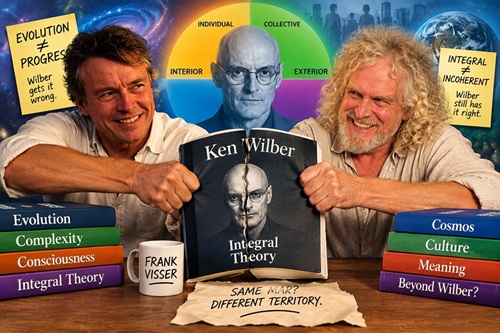 An Unlikely Alliance in the Integral WarsIn the long-running disputes surrounding Ken Wilber's Integral Theory, few intellectual pairings seem less likely to find common ground than Brad Reynolds and Frank Visser. Reynolds is a defender of Wilber's spiritual vision, a former student of the Integral philosopher, and an advocate of what he calls Spirit-in-action. Visser, by contrast, has spent decades scrutinizing Wilber's claims, particularly where they intersect with evolutionary biology, cosmology, and the philosophy of science. Their disagreements are not superficial. They concern the very nature of reality, the status of spiritual knowledge, and whether Wilber's grand synthesis illuminates the world or overlays it with metaphysical assumptions. And yet, on one important issue, they agree: Wilber has sometimes misrepresented evolutionary science, overstated its limitations, and presented his own spiritual interpretation as if it could resolve problems that scientific theories have not adequately explained. This agreement deserves more attention than it usually receives. It demonstrates that even committed defenders and persistent critics of Integral Theory can recognize the same intellectual failure. But it also reveals a deeper divide. For Reynolds, correcting Wilber's scientific overreach need not undermine the spiritual meaning of evolution. For Visser, the correction invites a more radical question: if Wilber's evolutionary arguments fail scientifically, what precisely remains of their explanatory force? The disagreement is therefore not simply about whether Wilber got evolution wrong. It is about what follows when he does. The Common Ground: Wilber's Uneasy Relationship with Evolutionary BiologyWilber's evolutionary vision has long occupied an important place in his philosophy. In Sex, Ecology, Spirituality and subsequent works, evolution is not merely a history of biological diversification. It is part of a much larger cosmic process in which matter gives rise to life, life to mind, and mind to increasingly encompassing forms of consciousness. Wilber interprets this unfolding through the concept of Eros: an immanent spiritual tendency toward self-transcendence, greater depth, and increasing complexity. The ambition is unmistakable. Wilber wants to explain not only how evolutionary transformations occur, but why the universe repeatedly produces new levels of organization and consciousness. He is dissatisfied with accounts that seem to leave the emergence of novelty, complexity, and mind insufficiently explained. His answer is that evolution must be understood as Spirit-in-action. The difficulty arises when this metaphysical interpretation is used to criticize evolutionary biology itself. Wilber has characterized aspects of neo-Darwinian evolution in extraordinarily dismissive terms. In Finding Radical Wholeness (2024, p. 170), for example, he describes chance mutation and natural selection as "utterly idiotic." Such language is not a careful statement of a scientific disagreement. It suggests that the central mechanisms of evolutionary biology are so inadequate that they can scarcely be taken seriously. But contemporary evolutionary biology is not the caricature Wilber sometimes presents. Evolutionary theory encompasses far more than the crude proposition that random mutations, acting alone, somehow generate complexity. Mutation supplies variation; natural selection can systematically change the frequency of heritable traits; genetic drift, gene flow, developmental constraints, ecological interactions, and other processes also contribute to evolutionary change. Research into symbiosis, developmental biology, niche construction, and self-organization further complicates any simplistic picture of evolution as a purely accidental affair. None of this means that every evolutionary question has been settled. The origins of life, the emergence of particular forms of complexity, and the relationships between biological organization and cognition remain subjects of substantial research. Nor does it mean that every proposed extension of evolutionary theory is equally well supported. But unresolved questions are not evidence for a spiritual force, and the complexity of evolutionary explanations does not make them intellectually bankrupt. Visser has developed this criticism systematically, notably in his essay "Ken Wilber's Problematic Relationship to Science." He argues that Wilber has repeatedly portrayed science as unable to explain major evolutionary transitions, invoked scientific thinkers in ways that do not establish their support for his metaphysics, and claimed an explanatory superiority for Eros that he has not demonstrated. His central objection is methodological: Wilber wants the authority of science when it appears to support his worldview, yet is willing to dismiss scientific explanations when they conflict with his preferred interpretation. Reynolds has his own reasons to resist a simplistic reading of Wilber. He argues that Integral Theory is not intended to reduce every dimension of reality to third-person scientific description. Nevertheless, Reynolds has also acknowledged that Wilber's treatment of evolutionary science has sometimes overreached. In his discussion of Visser's critique, Reynolds accepts that Eros should not be framed as a scientific mechanism competing with evolutionary biology. This is significant common ground. The disagreement is not about whether biology should be replaced by a mystical explanation. Both men can recognize that Wilber's rhetoric has sometimes blurred the distinction between a spiritual interpretation of evolution and a scientific account of its mechanisms. The question is what to do with that distinction once it has been acknowledged. Reynolds's Position: Correct the Science, Preserve the SpiritReynolds does not regard the correction of Wilber's scientific claims as a reason to abandon the spiritual dimension of Integral Theory. His strategy is to distinguish between different modes of knowing. Science, in this account, investigates objective processes and causal mechanisms. It describes genetic variation, natural selection, developmental processes, and the observable organization of living systems. But Reynolds argues that human knowledge also includes first-person experience and second-person relations. Consciousness, contemplative experience, love, value, and the apprehension of meaning cannot simply be dismissed because they are not adequately captured by third-person measurement. From this perspective, Eros need not function as an additional biological mechanism. It can instead name an interior recognition of the meaningful unfolding of existence. The universe is not merely something observed from the outside; it is also the condition within which conscious beings experience wonder, beauty, purpose, and spiritual depth. Reynolds made this distinction explicit in his 2026 response to an Integral World discussion of Eros. He agreed that Wilber had sometimes presented Eros in ways that sounded like explanatory science, and that this deserved correction. But he rejected what he regarded as Visser's further move: treating the absence of a scientific mechanism as grounds for dismissing the spiritual significance of evolution altogether. For Reynolds, the mistake would be to assume that all legitimate knowledge must take the form of third-person causal explanation. The spiritual dimension, he argues, is disclosed through other modes of knowing, particularly contemplative and participatory experience. This is a coherent distinction as far as it goes. The experience of awe at the natural world is not identical to an explanation of the natural processes that produced it. A biological account of vision does not exhaust the experience of seeing a sunset, and an evolutionary account of attachment does not automatically settle the philosophical meaning of love. Scientific explanation and existential interpretation are not interchangeable activities. But this distinction also raises a difficult question. Does the fact that an experience is real establish the truth of the metaphysical interpretation attached to it? A contemplative may experience profound unity with the universe. The experience itself can be psychologically real, transformative, and worthy of investigation. Yet the conclusion that the universe is literally permeated by a spiritual force does not follow automatically from that experience. Other interpretations remain possible, including naturalistic accounts of altered consciousness, attention, emotion, and self-representation. Similarly, perceiving directionality in the history of life does not establish that the cosmos possesses an intrinsic intention to produce consciousness. Reynolds may reasonably insist that scientific explanations do not exhaust every question of meaning. But if he wants to establish that Spirit-in-action is more than a personally meaningful interpretation, he must explain what justifies that additional claim. His defense of spiritual knowledge therefore protects the possibility of meaning, but it does not by itself establish a cosmic metaphysics. Visser's Position: Why Preserve an Explanation That Explains Nothing?Visser's criticism begins where Reynolds's distinction leaves off. He is not primarily interested in whether human beings may experience evolution as meaningful, or whether the contemplation of nature can produce spiritual feelings. He questions the inference from such experiences to claims about the structure and direction of the universe. The central problem with Wilber's Eros is not simply that it cannot be measured. It is that, when offered as an explanation of evolutionary developments, it does not appear to explain anything that existing scientific accounts explain inadequately. Consider the emergence of the eye. Evolutionary biology investigates how light-sensitive structures can arise and change through heritable variation, selection, and other evolutionary processes. It reconstructs intermediate forms, compares living organisms, studies genetic and developmental mechanisms, and formulates hypotheses that can be assessed against evidence. What does Eros add to this account? If it means that evolution is driven by an inherent spiritual impulse toward greater complexity, then we need to ask how that impulse operates, what evidence distinguishes its effects from ordinary evolutionary processes, and what observations would count against the hypothesis. If no independent answers are available, Eros is not an additional scientific explanation. It is a metaphysical interpretation laid over the explanation already supplied. The problem becomes sharper when we consider evolutionary history as a whole. Evolution has produced extraordinary complexity, but it has also involved extinction, simplification, parasitism, loss of function, and countless lineages that never developed anything resembling human consciousness. There is no general biological law requiring every lineage to become more complex, more conscious, or more spiritually elevated. The direction of evolution depends on changing environments, inherited structures, contingent events, and the differential reproductive success of organisms. Wilber's larger evolutionary narrative tends to place these uneven developments within a grand ascent toward greater depth. But the existence of some long-term increases in complexity does not establish a universal tendency toward higher consciousness. Nor does the fact that consciousness has emerged establish that it was the goal toward which the universe was moving all along. The distinction between retrospective pattern recognition and genuine explanation is crucial. Once human beings exist, the history leading to humanity can be narrated as a sequence of increasingly complex developments culminating in ourselves. But that narrative is vulnerable to hindsight bias. The outcome is known, and the preceding events are selected and organized to make the outcome appear less surprising than it was. Visser therefore asks a more demanding question than whether Eros can be reconciled with evolutionary biology: what explanatory work does it actually perform? If the answer is none, or none that can be distinguished from the work of existing explanations, then Eros may remain a symbol of wonder or a statement of spiritual commitment. It cannot legitimately be presented as the missing key to evolution. This is the point at which Reynolds and Visser part company. Reynolds wishes to preserve Eros by relocating it to the interior domain of meaning. Visser asks whether this relocation preserves a substantive claim about reality or merely changes the subject. For Visser, a spiritual interpretation can be meaningful without being a necessary feature of the world it interprets. We can appreciate the grandeur of evolution without concluding that a cosmic Spirit was guiding it. The natural history of life is astonishing enough without an additional metaphysical agent—or an immanent spiritual tendency—to make it so. The Crucial Distinction: Meaning Is Not MechanismThe strongest version of Reynolds's position deserves to be taken seriously. He is right that science does not answer every question people ask about existence. It does not determine what we ought to value, whether a life is meaningful, or how a person should interpret a transformative experience. A scientific explanation of the evolutionary origins of human consciousness is not a substitute for the experience of being conscious. But this concession does not settle the dispute over Eros. The crucial question is whether Reynolds is defending the meaningfulness of evolution or the claim that evolution itself expresses an objectively existing spiritual reality. These are different propositions, and moving between them without argument creates precisely the ambiguity that has troubled Wilber's critics. Suppose a person experiences the universe as an unfolding of divine creativity. What has been established? At a minimum, that the person experiences the universe in this way. Perhaps the experience also reveals important truths about the person's psychology, ethical orientation, or capacity for self-transcendence. But the further claim that Spirit is the underlying reality of the universe requires additional justification. Reynolds might reply that contemplative practice provides its own validation, just as scientific observation does. Yet the analogy is not straightforward. Scientific claims are tested against publicly assessable evidence, and scientific methods include procedures for identifying error, comparing competing explanations, and revising conclusions. Contemplative traditions also possess methods of training attention and evaluating experience, but different traditions interpret their experiences through different metaphysical frameworks. Advaita Vedanta, Buddhist traditions, Christian mysticism, and other contemplative systems do not necessarily arrive at the same account of ultimate reality. The fact that contemplatives report profound experiences therefore does not independently establish which metaphysical interpretation, if any, is correct. The experience and the explanation of the experience must be distinguished. Nor does Visser need to claim that science has a monopoly on all possible knowledge. His more defensible position is that claims about an objective cosmic process require evidence appropriate to those claims. If Eros is presented as a feature of the universe that helps explain the emergence of life, consciousness, or complexity, then asking for its explanatory contribution is legitimate. If it is instead a name for the subjective experience of wonder at those phenomena, then it should not be presented as an additional explanation of their occurrence. This is not an attempt to reduce meaning to mechanism. It is an attempt to prevent a claim about meaning from quietly becoming a claim about mechanism whenever the latter seems useful. Wilber's Moving Target: From Cosmic Force to Interior RecognitionPart of the difficulty is that Wilber's language about Eros has never been entirely stable. At times, Eros appears to be an active principle woven into the fabric of the Kosmos, driving self-transcendence and the emergence of higher-order wholes. At other times, Spirit is described as the ultimate reality disclosed through spiritual realization, a reality that cannot be reduced to any scientific account of the phenomenal world. These formulations are related within Wilber's philosophy, but they do not make identical claims. When Wilber describes Eros as a force comparable to gravity or electromagnetism, or argues that it explains evolutionary developments that science supposedly cannot explain, he invites scientific and philosophical questions about causation. What does the force do? How does it operate? What observations support its existence? Why does it produce particular outcomes rather than others? These questions cannot be answered simply by insisting that Eros belongs to a more encompassing worldview. When Eros is redescribed as the interior recognition of meaningful unfolding, a different set of questions arises. How should we understand this experience? What distinguishes spiritual insight from other forms of interpretation? Why should the experience be understood as revealing an objective cosmic Spirit rather than expressing a human response to the natural world? Reynolds's recent defense of Eros emphasizes the second formulation. In his essay "Beyond Eros as Mechanism: Reclaiming the Full Spectrum of Knowing," he argues that Eros should be understood not as a causal mechanism but as a lived recognition of directionality, depth, and meaningful unfolding. He accepts that Wilber's scientific overreach needs correction, while maintaining that Visser's naturalistic outlook fails to do justice to interior knowledge. This is an important clarification, but it also changes the terms of the debate. If Eros is not a mechanism and is not intended to explain biological evolution, then Reynolds cannot use its spiritual significance as evidence that Wilber's criticisms of evolutionary biology were justified. The scientific criticism stands independently of the spiritual interpretation. Moreover, the change of register cannot be allowed to erase the original problem. Wilber has not always confined Eros to a phenomenological description of human experience. His evolutionary narrative makes claims about the Kosmos, not merely about how the Kosmos feels to an awakened observer. Reynolds may wish to preserve the more defensible interpretation, but doing so requires acknowledging that it is not equivalent to every claim Wilber has made. A retreat from an unsuccessful explanatory claim to a more modest existential one can be legitimate intellectual development. It should not, however, be treated as though the original claim had never been made. The Argument from Complexity: Does the Universe Need Eros?One of Wilber's recurring arguments is that the history of the universe displays an astonishing succession of increasingly complex structures. From elementary particles to atoms, molecules, living cells, multicellular organisms, nervous systems, and human consciousness, the natural world has produced forms of organization that seem remarkable when viewed retrospectively. Wilber interprets this history as evidence of an intrinsic drive toward self-transcendence. Reynolds sees the same unfolding as compatible with a spiritual understanding of reality. Visser asks whether the pattern actually requires either interpretation. The scientific alternative is not the claim that everything happens through pure randomness. Random variation and deterministic processes can operate together. Natural selection is not random with respect to reproductive consequences, even though the occurrence of mutations is not generally directed toward the future needs of an organism. Physical and chemical processes can generate organized structures under appropriate conditions. Energy flows through open systems can sustain local increases in organization without violating the second law of thermodynamics. The emergence of complexity therefore does not automatically require a universal drive toward complexity. To explain a particular transition, scientists investigate the relevant physical, chemical, biological, and environmental conditions. Different transitions may require different explanations. There is no reason to assume that one all-encompassing principle must account for every instance of novelty. Indeed, Wilber's tendency to interpret the history of the universe as a continuous ascent toward greater depth risks conflating several different phenomena. Physical complexity, biological complexity, cognitive capacities, ethical development, and contemplative realization are not interchangeable measures of progress. They may be related in particular cases, but their relationships must be established rather than assumed. A bacterium is not an inferior version of a human being in every biologically relevant respect. Many microorganisms are extraordinarily well adapted to their environments, while human beings remain vulnerable to disease, ecological disruption, and their own technological capacities. Evolution produces adaptations and diversity, not a universal ladder on which every organism occupies a rung leading toward humanity. Likewise, the emergence of consciousness does not demonstrate that consciousness was the universe's predetermined destination. It establishes that consciousness arose under particular conditions. The difference between these two statements is the difference between reconstructing an evolutionary history and assigning that history a cosmic purpose. This is where the disagreement between Reynolds and Visser becomes particularly revealing. Reynolds can regard the unfolding of complexity as spiritually meaningful without claiming that science is mistaken. Visser can regard the same unfolding as astonishing without believing that its astonishing character points to Spirit. The observable history is largely shared; the metaphysical interpretations differ. The question is not whether people may find the universe meaningful. It is whether that meaning should be promoted into an objective explanatory principle. What Would Count as Evidence Against Eros?A useful way to clarify the disagreement is to ask what would count against the existence of Eros. If Eros is a causal principle that directs evolution toward greater complexity and consciousness, then the theory should specify the patterns it predicts and distinguish those predictions from what ordinary evolutionary mechanisms already explain. A principle that accounts for every outcome after the fact, whether evolution produces greater complexity, simplification, extinction, or stagnation, risks becoming immune to meaningful testing. If Eros is instead a phenomenological recognition of spiritual meaning, the relevant questions concern the reliability, interpretation, and scope of that experience. Such a claim need not be tested like a biological mechanism, but neither should it automatically inherit the status of objective knowledge merely because it is sincerely experienced. Reynolds may consider these demands an example of scientific reductionism. Visser sees them as elementary intellectual distinctions. Both concerns can be accommodated if the claims are carefully separated. We need not insist that spiritual experience be reduced to biology, but neither should we permit spiritual experience to establish biological or cosmological propositions without further argument. This distinction also clarifies why the phrase "different modes of knowing" cannot by itself settle the dispute. Recognizing different methods of inquiry does not establish that every interpretation produced by those methods is equally reliable. Nor does it establish that different domains of inquiry are insulated from one another whenever their claims conflict. If a spiritual interpretation makes claims about the history of the universe, those claims intersect with cosmology and evolutionary science. If it makes claims about consciousness, it intersects with psychology and neuroscience. Such intersections do not automatically invalidate spiritual interpretations, but they do create obligations to clarify what is being claimed and how the claim is justified. An integral philosophy should be particularly well equipped to make these distinctions. Its promise is to integrate knowledge without confusing the methods and findings of different disciplines. When it invokes an all-encompassing principle to override the findings of a particular science, it risks undermining its own ambition. The Deeper Disagreement: Is Naturalism a Limitation or a Liberation?At the heart of the dispute lies a philosophical difference that no amount of clarification about Eros can entirely remove. Reynolds believes that Visser's naturalism restricts reality to what can be investigated through empirical and rational methods. He regards this as an impoverished conception of knowledge because it excludes, or inadequately recognizes, spiritual realization and the interior dimensions of existence. Visser's position is different. He does not need to deny the reality of subjective experience, the importance of meaning, or the transformative potential of contemplative practices. He can accept all of these while remaining unconvinced that they reveal an objective spiritual structure underlying the universe. His naturalism is not the claim that only laboratory measurements matter. It is the refusal to infer a supernatural or metaphysical reality where the available evidence does not warrant one. The difference can be put simply. Reynolds asks whether science exhausts reality. Visser asks what warrants the additional claims made beyond science. These are not the same question, and answering the first in the negative does not answer the second. Almost everyone can agree that human experience is richer than a list of physical measurements. It does not follow that the universe contains an intrinsic spiritual drive toward higher consciousness. There is also a practical asymmetry between the two positions. Scientific explanations can be revised as evidence accumulates. Naturalistic accounts do not have to explain everything at once, and their incompleteness is not in itself a defect that requires metaphysical supplementation. An unresolved question can remain unresolved while research continues. By contrast, a comprehensive spiritual interpretation may appear to explain everything while specifying very little about how anything actually happens. Its apparent breadth can conceal a lack of explanatory precision. This is the danger of Wilber's grand synthesis. By interpreting the entire history of reality as the unfolding of Spirit, he offers a powerful overarching narrative. But a narrative that accommodates every possible outcome may tell us less about the actual causes of events than a more limited theory that explains a particular process in detail. Visser's preference for naturalistic explanations is therefore not necessarily a refusal to see the whole. It is a preference for earning one's conclusions rather than beginning with them. What Reynolds Gets Right—and What He Still Has to ProveIt would be a mistake to dismiss Reynolds's intervention simply because he defends a metaphysical position Visser does not share. His insistence that spiritual experience and scientific explanation should not be conflated is valuable. His willingness to acknowledge Wilber's scientific overreach also provides a welcome corrective to the tendency among some Integral advocates to defend every statement by the founder of their worldview. Reynolds is right that the scientific account of evolution does not determine the existential significance of evolution for human beings. He is also right that an intellectual framework can become reductive if it refuses to recognize questions that its own methods are not designed to answer. But Reynolds has a further burden if he wants to defend the stronger claim that spiritual realization discloses an objective dimension of reality. He must show why that interpretation is preferable to alternatives, how it is validated, and what it contributes beyond the fact that human beings can experience the universe as meaningful. Calling Eros an interior recognition does not resolve these questions. It identifies a possible location for the experience, not the truth of the metaphysics attached to it. Nor is it enough to accuse Visser of committing a "Visser Fallacy" by treating empirical science as the sole arbiter of reality. Visser's challenge is more specific: when Wilber makes claims about evolution, what justifies them? Reynolds can answer that spiritual realization provides a different perspective, but he must still establish what that perspective entitles him to conclude about the objective world. Otherwise, the argument risks becoming circular. Eros is said to be real because it is disclosed through spiritual awareness, while spiritual awareness is treated as reliable evidence of Eros because the experience is interpreted through an Integral framework. A genuinely critical Integral philosophy would need to examine that circle rather than assume it away. What Visser Gets Right—and Where He Should Be CarefulVisser's criticism is strongest when it focuses on Wilber's scientific claims. His insistence that Eros must not be used as a substitute for evolutionary explanation is justified. His objection to Wilber's dismissive treatment of natural selection is also well founded. Evolutionary biology is a complex, developing field, not a simplistic doctrine waiting for a metaphysical correction. But Visser should also distinguish between rejecting Eros as an explanatory principle and declaring every spiritual interpretation of evolution meaningless. The latter conclusion does not follow automatically from the former. People can interpret the natural world through religious, aesthetic, existential, or contemplative frameworks without claiming that those frameworks constitute scientific explanations. Such interpretations may help individuals articulate their values, orient their lives, or express their sense of belonging to the natural world. Whether they are true in a stronger metaphysical sense remains a separate question. Visser does not need to deny this possibility. His argument is more persuasive when he asks what a particular spiritual claim adds, how it is justified, and whether it should be treated as knowledge about the objective world. This is not a concession that Reynolds has demonstrated the reality of Spirit. It is simply a recognition that criticism should target the actual claim being made. If Reynolds says that contemplating evolution evokes a sense of sacredness, Visser has little reason to dispute the experience. If Reynolds says that this experience proves that Spirit directs evolution, the argument becomes much more demanding. The first statement concerns an experience; the second makes a claim about the universe. Keeping these statements distinct would improve the debate and make it harder for either side to misrepresent the other. Conclusion: Agreement on the Error, Disagreement on the CureThe alliance between Brad Reynolds and Frank Visser is real, but limited. Both can recognize that Ken Wilber has sometimes misrepresented evolutionary science, exaggerated the shortcomings of neo-Darwinian theory, and invoked Eros in ways that blur the line between spiritual interpretation and scientific explanation. For Reynolds, the appropriate response is to clarify the domains of knowledge and preserve Eros as an interior recognition of spiritual meaning. For Visser, the appropriate response is to stop treating Eros as a necessary explanation of the evolutionary process and to ask whether the metaphysical claim adds anything that cannot be established by other means. The disagreement is therefore not over whether evolution is remarkable. It is over whether its remarkable character requires a spiritual interpretation. Reynolds wants an Integral vision in which scientific knowledge and contemplative insight contribute to a larger understanding of reality. Visser wants an account in which the extraordinary achievements of evolutionary science are not diminished by a metaphysical narrative that claims to explain more than it demonstrates. Their common ground should be welcomed. But it should not be mistaken for agreement about the foundations of reality. The decisive question remains unanswered: If Eros does not explain evolution, what evidence establishes that it exists as an objective feature of the Kosmos rather than as a spiritual interpretation of the experience of being alive? Reynolds may have reasons for affirming Spirit that Visser does not accept. That is a legitimate philosophical disagreement. But those reasons must be presented and defended on their own merits, not smuggled into evolutionary biology through dissatisfaction with scientific explanations. And Wilber's scientific mistakes cannot be repaired simply by changing the definition of Eros after the criticism has been made. Perhaps the most productive outcome of this unlikely alliance would be for Reynolds to accept that a spiritual vision does not need to compete with evolutionary biology to be personally meaningful, and for Visser to accept that exposing the scientific weakness of a metaphysical claim does not, by itself, settle every philosophical question about meaning. Neither concession requires the other man to abandon his worldview. But both require intellectual clarity about what has been established, what remains speculative, and what one would have to demonstrate before moving from an experience of meaning to a claim about the structure of the universe. That is where a genuinely integral discussion should begin: not by declaring that Spirit transcends science, nor by assuming that science has already answered every conceivable question, but by distinguishing what we know from what we believe—and refusing to confuse the two simply because we find the universe astonishing.
Widget is loading comments...
|