|
TRANSLATE THIS ARTICLE
Integral World: Exploring Theories of Everything
An independent forum for a critical discussion of the integral philosophy of Ken Wilber
  Frank Visser, graduated as a psychologist of culture and religion, founded IntegralWorld in 1997. He worked as production manager for various publishing houses and as service manager for various internet companies and lives in Amsterdam. Books: Ken Wilber: Thought as Passion (SUNY, 2003), and The Corona Conspiracy: Combatting Disinformation about the Coronavirus (Kindle, 2020).
Check out my other conversations with ChatGPT
The Realism-Idealism Debate:
Wilber and the Realism-Idealism Debate Wilber's Subsistence and Existence Wilber's Subsistence and ExistenceRealism Saved or Redefined?Frank Visser / ChatGPT
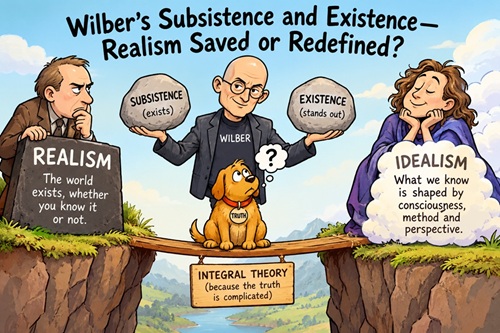
The Problem Wilber Wants to SolveIn his Afterword, “Realism and Idealism in Integral Theory,” published in Dancing with Sophia: Integral Philosophy on the Verge (2019), Ken Wilber attempts to reconcile two apparently opposed positions. Realism maintains that reality exists independently of our knowledge of it. Idealism, in its various forms, emphasizes the constitutive role of consciousness, conceptual schemes, or knowing subjects in determining how reality appears and what can be known about it. Wilber regards both positions as partial truths. The realist, he argues, privileges the objective, exterior dimensions of reality, while the idealist privileges its subjective, interior dimensions. Integral Theory seeks to overcome this opposition by incorporating both into a larger framework of perspectives, methodologies, developmental levels, and quadrants. His distinction between subsistence and ex-istence is central to this project. Subsistence refers to what is objectively real independently of any particular human act of knowing. Ex-istence, by contrast, refers to what stands out within a particular structure of consciousness: what becomes manifest, meaningful, or recognizable within a given worldspace. Wilber illustrates the distinction with atoms. Atoms subsisted during tribal times, even though tribal people did not understand matter in atomic terms. Atoms did not ex-ist in their worldview as atoms, but they nevertheless subsisted in reality. In this respect, Wilber explicitly rejects the idea that human consciousness creates the entire world. He wants to preserve an independent ontological reality while acknowledging that what we know of it depends on our historically and developmentally situated ways of knowing. This is a more sophisticated position than straightforward subjective idealism. The question, however, is whether Wilber successfully reconciles realism and idealism—or whether his solution introduces new difficulties about the relationship between reality, knowledge, and truth. The Rod That Changes with Our MethodsWilber opens his discussion with an iron rod. Looking at the rod does not tell us that it is hot. Touching it does. An infrared instrument reveals radiation invisible to the unaided eye. Different methods of investigation disclose different properties of the same object. This is a perfectly reasonable illustration of methodological pluralism. What we can know about something depends partly on how we investigate it. Visual observation, tactile experience, scientific instrumentation, and theoretical analysis each disclose features that the others may miss. But Wilber draws a much more controversial conclusion. He argues that saying there is “just a single rod in existence” privileges particular methods of detection. The closest approximation to the rod itself, he suggests, would be the sum total of what all possible methods and developmental levels might disclose. He even considers whether we would have to wait until the end of evolution for such a complete account, only to conclude that this would make genuine truth impossible in the meantime. Here the argument takes a questionable turn. The fact that different methods disclose different properties does not establish that there is no single object independent of those methods. Nor does the fact that our knowledge is incomplete imply that the object itself must be understood as a product of the totality of our knowing. We can distinguish between an object and the various ways in which we investigate it without assuming that any one method gives us exhaustive access to the object. Indeed, this distinction is essential to ordinary scientific practice. A thermometer, an infrared camera, and a human hand provide different kinds of information about a heated rod, but we do not normally conclude that each method creates a different rod. Wilber is right that our descriptions are method-dependent. It does not follow that the reality described is method-dependent in the same sense. He moves from a claim about the conditions of knowledge to a stronger claim about the relationship between knowing and being. That transition requires an independent argument. Subsistence and Existence: A Necessary Distinction?Wilber's distinction is intended to preserve precisely the independence that his account of methodological pluralism might otherwise seem to undermine. The atom subsisted before humans discovered it. Its ex-istence as a scientifically recognized object, however, depends on the conceptual and methodological resources available to particular investigators. This distinction captures something important. An object can exist independently of our recognition of it, while our understanding of that object changes dramatically over time. Ancient people did not need atomic theory to inhabit a world containing atoms. Their ignorance of atomic structure did not make atoms any less real. Yet the terminology can obscure as much as it clarifies. In ordinary philosophical usage, existence does not generally mean that something has become salient within a particular worldview. Atoms existed before anyone conceptualized them as atoms. Their scientific recognition changed, not their existence. Wilber gives ex-istence a more specialized meaning: what stands out within a particular worldspace. Once this terminology is understood, his distinction becomes intelligible. But it also raises a question: what exactly does the distinction explain that could not be expressed more straightforwardly by distinguishing reality from our knowledge of it? We could simply say that atoms existed before humans, that ancient people had different understandings of the world, and that modern scientific methods have enabled us to develop more accurate accounts of atomic structure. Nothing in this description requires us to say that atoms did not ex-ist for tribal people, or that existence itself changes meaning with developmental consciousness. Wilber's vocabulary is therefore not necessarily mistaken, but it carries a theoretical burden. He must show that the distinction between subsistence and ex-istence does more than redescribe the familiar difference between what is real and what a particular observer can recognize. The Developmental Relativity of TruthThe most revealing part of Wilber's argument comes when he explains how we are to understand subsistence itself. He writes that the best understanding of an object's subsistence is provided by the highest level of consciousness development available at a given time. His example is the atom: its actual nature is best understood today, he argues, not from earlier developmental levels but from the highest level currently available. He associates this highest perspective with turquoise consciousness and invokes increasingly sophisticated scientific accounts of matter as illustrations of the progression. This introduces a tension. Subsistence is supposed to refer to what is objectively real independently of human knowing. Yet our best account of what subsists is determined, according to Wilber, by the highest available developmental structure of consciousness. Wilber can reasonably reply that the distinction between reality and our knowledge of reality does not require us to possess infallible access to the former. We can acknowledge that the world exists independently of us while admitting that our understanding of it is historically situated and fallible. But this reply exposes a problem with the stronger claims in the Afterword. Wilber does not merely say that knowledge improves through better methods, evidence, and theories. He places this progression within a developmental hierarchy in which each higher level is said to have more truth than the levels below it. He summarizes the position in the formula: “Each level is true, each higher level is more true.” What does this mean in practice? If a lower developmental level holds a belief that conflicts with a higher-level account, are both true in different senses? Or is the lower-level belief simply mistaken about the relevant facts? Wilber sometimes seems to mean that each perspective discloses something genuinely important about reality. At other points, however, his examples involve earlier accounts that are superseded by more accurate ones. These are not the same claim. A perspective can disclose a different aspect of an object without being equally accurate about every claim it makes concerning that object. Methodological pluralism does not require epistemic relativism, and the recognition of partial truths does not imply that all worldviews are true in their own terms. Consider the history of atomic theory. Earlier models contributed to scientific understanding, but they were not all equally accurate representations of atomic structure. Their value depended on what they explained, what evidence supported them, and where they failed. Their historical place in a developmental sequence does not by itself determine their truth. The same applies to Wilber's invocation of turquoise consciousness and string theory. A theory does not become scientifically correct because it is associated with a supposedly higher developmental level. String theory remains a theoretical research program, not an experimentally confirmed account of the fundamental structure of matter. Its scientific standing must be evaluated by scientific criteria, not by its place in an integral hierarchy. Developmental psychology may provide evidence that human cognitive capacities and worldviews change over time. It does not automatically establish that these changes form a universal hierarchy of access to ontological truth. That additional claim requires its own justification. The False Choice Between Final Truth and No Objective TruthWilber's most striking argument concerns the implications of an independent reality. If there is one pregiven, intransitive reality, and each successive developmental level understands it more accurately, then we will never achieve final truth because evolution never ends. According to Wilber, this would leave humanity forever confined to partial falsehoods. He therefore argues that we must recognize each developmental level as genuinely true, with higher levels possessing more truth. This conclusion does not follow. The argument confuses the absence of complete knowledge with the impossibility of objective knowledge. We can know something truly without knowing everything about it. We can also correct errors, improve explanations, and discover previously unknown properties without ever achieving an exhaustive account of reality. A map can be accurate without containing every feature of a landscape. A scientific theory can explain a range of phenomena successfully while remaining incomplete. A measurement can be reliable even when our broader theoretical understanding remains provisional. None of these achievements requires us to possess final, absolute, or omniscient knowledge. The alternative to absolute certainty is not that truth becomes relative to developmental level. It is that our claims about an independently existing world remain open to correction through evidence and argument. This is the position associated with critical realism, which distinguishes the existence of reality from our fallible knowledge of it. Critical realism does not need to claim that science provides an exhaustive or unmediated view of the world. It can acknowledge that knowledge is historically situated, theoretically informed, and open to revision while maintaining that some accounts are better supported than others. Wilber's criticism of realism would be more persuasive if realists generally claimed to possess a final, complete description of reality. But that is not a necessary commitment of realism. The claim that reality exists independently of our knowledge is perfectly compatible with the recognition that our knowledge will always be incomplete. Wilber thus appears to set up a false choice: either one must accept a single pregiven reality that remains forever unknowable in its entirety, or one must adopt a developmental account in which each level has its own truth. A third option is readily available: an independent reality that can be known partially, fallibly, and progressively. Indeed, this third option is precisely what allows scientific inquiry to distinguish genuine progress from mere changes in perspective. Does Integral Theory Escape the Epistemic and Ontic Fallacies?Wilber presents Integral Theory as a way of overcoming what he calls the epistemic and ontic fallacies. In his account, the epistemic fallacy occurs when the contribution of the knowing subject is emphasized to the point that objective reality is denied or made entirely dependent on human knowing. The ontic fallacy occurs when the independent reality of the object is emphasized to the point that the contribution of the knowing subject is ignored. Integral Theory proposes to include both sides. Reality has objective and subjective dimensions, and knowledge involves an interaction between the structures of the knower and the characteristics of what is known. Wilber calls this a unity of ontology and epistemology, or a tetra-enacted reality. The basic insight is defensible. Scientific observation is not simply a passive reception of an uninterpreted world. Investigators employ concepts, instruments, methods, and background assumptions. Different disciplines can reveal different properties of the same phenomenon. Human cognition and culture also influence what questions we ask and what we regard as significant. But recognizing these influences does not require us to say that ontology and epistemology are inseparable in the strong sense Wilber sometimes suggests. We can acknowledge that knowledge is mediated without concluding that the object known is partly constituted by the particular structure of the knower. The distinction matters because the realist's claim is not that human beings encounter reality without concepts, methods, or limitations. It is that what we encounter is not therefore wholly constituted by those concepts, methods, or limitations. Nor does the existence of multiple perspectives establish that every perspective is equally valid within its own domain. Some perspectives are more reliable for particular questions than others. Some methods produce reproducible results; others do not. Some interpretations accommodate the evidence; others conflict with it. These differences cannot be resolved simply by declaring that every perspective is “true but partial.” Integral Theory needs criteria for deciding when a perspective is genuinely disclosing something important, when it is mistaken, and when it is making claims beyond what its methods can support. Without such criteria, perspectival pluralism risks becoming a system in which conflicting claims are incorporated rather than critically adjudicated. Wilber's appeal to the exclusion of perspectives does not resolve this problem. To reject a perspective merely because it differs from one's own would indeed be dogmatic. But to reject a claim because it is unsupported, internally inconsistent, or contradicted by strong evidence is not perspective absolutism. It is ordinary critical reasoning. A comprehensive framework should help us discriminate between better and worse explanations, not merely explain why different people see things differently. From Methodological Pluralism to Ontological PluralismA further difficulty arises from Wilber's movement between two meanings of plurality. The first is methodological: there are different ways of investigating reality, and each can disclose different features. The second is ontological: different developmental levels bring forth different worlds, each with its own reality. The first claim is well supported by the diversity of scientific, phenomenological, cultural, and interpretive inquiry. The second is much more controversial. Wilber repeatedly insists that different developmental levels inhabit different worlds. He describes reality as co-enacted through the interaction of subject, method, and object. In this account, the world disclosed by one developmental structure differs from the world disclosed by another. Some of this language can be interpreted modestly. Different people do inhabit different experiential and conceptual worlds. A child, a physicist, and a religious believer may understand the same event in radically different ways. Cultural assumptions and developmental capacities affect what they notice and how they interpret it. But a stronger ontological interpretation suggests that the reality itself changes with the developmental level of the observer. This raises an obvious question: what remains invariant across these worldspaces, enabling us to say that they are different perspectives on a shared reality rather than entirely different realities? Wilber's notion of subsistence is supposed to provide the answer. Yet the more the content of subsistence is characterized through the highest available developmental perspective, the harder it becomes to specify what this independent reality contributes beyond the changing accounts through which it is known. The problem is not that we must somehow describe reality without using any concepts or methods. That would be an impossible demand. The problem is whether Wilber can maintain a meaningful distinction between what exists independently of our knowledge and what is constituted through our ways of knowing. If the answer is that subsistence is independent but can only be adequately characterized through the highest available developmental perspective, then the distinction remains possible—but the developmental hierarchy must be independently justified. If, however, the highest perspective partly determines the ontology it discloses, then Wilber must explain how the independent contribution of reality can be distinguished from the contribution of the knowing structure. Simply declaring the two inseparable does not solve the problem. It restates the integral position that requires justification. Does Subsistence Require Pan-Interiorism?There is a further question, particularly relevant to the debate over Wilber's ontology: does an independently subsisting reality have to possess interiority all the way down? Wilber's broader Integral Theory is pan-interiorist. He maintains that interiority or prehension is intrinsic to holons, not something that first appears with human consciousness. On this view, atoms do not merely exist as exterior structures; they also possess an interior dimension, however rudimentary. Humans are not required for the Kosmos to have four quadrants. This is an important clarification. It would be inaccurate to criticize Wilber as though he believed a consciousness-free universe existed first and human consciousness subsequently created its interior dimension. His position is that interiority and exteriority are already aspects of the Kosmos. But this does not settle the realism question. The claim that reality exists independently of human knowing does not entail that every entity possesses an interior or a prehensive pole. Pan-interiorism is an additional metaphysical thesis, not a logical consequence of realism or of the existence/subsistence distinction. The meaning of prehension also requires clarification. If it means that entities causally affect one another, then the claim is relatively uncontroversial, but it does not establish that atoms possess an interior analogous to experience. If it means primitive feeling, subjectivity, or experience, then Wilber is making a much stronger claim about the intrinsic nature of matter. The question is what justifies that stronger interpretation. Does prehension explain something that cannot be explained through physical interaction and the emergence of increasingly complex forms of organization? Does it generate distinctive expectations or predictions? What evidence would count against it? These questions are not answered merely by affirming that every holon has four quadrants. A framework can classify the world in terms of interior and exterior dimensions without demonstrating that every entity possesses an interior in the relevant metaphysical sense. This is where the debate with critical realism should be concentrated. A realist can accept that atoms existed before humans, that they interact causally, and that our understanding of them has developed historically without committing to pan-interiorism. Wilber's claim that subsistence is intrinsically four-quadrant therefore requires a separate argument. The distinction between subsistence and ex-istence does not establish pan-interiorism; rather, pan-interiorism helps determine how Wilber interprets the nature of the subsisting Kosmos. What Does Wilber Actually Save?Wilber's achievement should not be dismissed. His Afterword rightly emphasizes that knowledge depends on methods and perspectives, that no single discipline exhausts reality, and that our understanding develops historically. His insistence on including subjective experience, cultural meaning, and objective investigation can help correct reductionist approaches that treat one mode of inquiry as the only legitimate route to knowledge. But these strengths do not establish his more ambitious conclusions. Methodological pluralism does not entail developmental relativism. The partiality of knowledge does not undermine objective truth. The historical evolution of scientific theories does not establish that reality itself changes with every developmental level. And the existence of an independent Kosmos does not entail that every holon possesses interiority. Wilber wants to preserve realism while rejecting the idea that there is one pregiven reality that can be described independently of all perspectives. His solution is to affirm subsistence while treating ex-istence as perspectivally enacted, and to interpret the relationship between the two through an evolving developmental hierarchy. The resulting position is neither straightforward realism nor straightforward idealism. It is an attempt to integrate independent reality with the constitutive role of consciousness. But the integration is not achieved simply by declaring both sides true. The central question is whether Wilber can explain how an independent reality constrains our interpretations, how competing perspectives can be assessed, and how developmental progress can be distinguished from the mere elevation of one worldview over another. If these questions remain unanswered, the integral synthesis risks redescribing the realism/idealism problem rather than resolving it. The most defensible conclusion is therefore not that Wilber has abandoned realism. He explicitly affirms an objective subsistence independent of particular human acts of knowing. The difficulty is that his account of how we know this subsistence depends on a developmental and perspectival framework whose authority is itself in need of justification. Wilber does not simply discard realism; he tries to save it by redefining the relationship between reality, knowledge, and truth. Whether that redefinition succeeds remains an open question. The decisive issue is not whether we can know reality from nowhere, or whether humanity will ever attain final truth. It is whether we can make objectively better and worse claims about a reality that does not depend on our claims about it. Critical realism says we can. Wilber's Afterword offers reasons to take perspectives and methods seriously, but it does not demonstrate that objective truth must be understood as developmentally relative. Nor does it show that realism requires the impossible ideal of complete knowledge. The distinction between subsistence and ex-istence is therefore best treated as a useful proposal for describing the relationship between independent reality and situated knowledge—not as a successful resolution of the realism/idealism debate in itself.
Widget is loading comments...
|