|
TRANSLATE THIS ARTICLE
Integral World: Exploring Theories of Everything
An independent forum for a critical discussion of the integral philosophy of Ken Wilber
  Frank Visser, graduated as a psychologist of culture and religion, founded IntegralWorld in 1997. He worked as production manager for various publishing houses and as service manager for various internet companies and lives in Amsterdam. Books: Ken Wilber: Thought as Passion (SUNY, 2003), and The Corona Conspiracy: Combatting Disinformation about the Coronavirus (Kindle, 2020). Frank Visser, graduated as a psychologist of culture and religion, founded IntegralWorld in 1997. He worked as production manager for various publishing houses and as service manager for various internet companies and lives in Amsterdam. Books: Ken Wilber: Thought as Passion (SUNY, 2003), and The Corona Conspiracy: Combatting Disinformation about the Coronavirus (Kindle, 2020).
Check out my other conversations with ChatGPT Wilber and the Realism-Idealism DebateWhen 'Integral' Becomes a Way of Avoiding the QuestionFrank Visser / ChatGPT
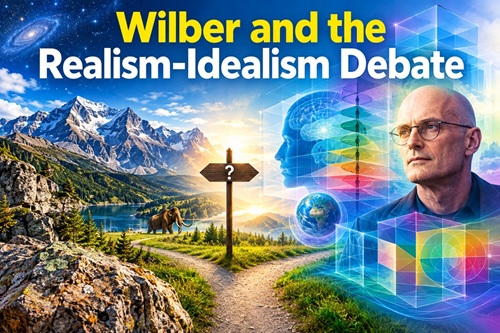 Ken Wilber has always presented Integral Theory as a way of getting beyond philosophical oppositions. Mind versus matter, subject versus object, individual versus collective, interior versus exterior, idealism versus materialism: these are, in his view, partial truths that become misleading when elevated into exclusive worldviews. The integral move is supposedly to include both sides and place them within a larger framework. This sounds attractive. It is also precisely where the philosophical trouble begins. Wilber's treatment of realism and idealism is especially revealing because it exposes a recurring weakness in his method. Rather than asking the hard ontological question—what exists independently of our knowing it?—he tends to transform the disagreement into a question of perspectives, dimensions, methodologies and enactments. The result is an impressive reconciliation on paper, but one that may leave the original philosophical problem largely untouched. His 2019 afterword, “Realism and Idealism in Integral Theory,” in Dancing with Sophia, is particularly important here. The book explicitly presents the philosophical dimensions of Integral Theory, and Wilber's contribution appears at the end under precisely this title. The irony is that Wilber's attempt to transcend the realism-idealism opposition may itself depend upon an unresolved idealist assumption. The old philosophical problemThe realism-idealism debate is, at bottom, not very complicated. Realism begins with the intuition that there is a world that exists independently of our descriptions, concepts, perceptions and theories. Mountains existed before anyone described mountains. Stars existed before astronomers discovered them. Dinosaurs did not depend upon paleontologists for their existence. Idealism, in its various forms, emphasizes the constitutive role of mind, consciousness, concepts, interpretation or experience. What we encounter as reality for us is never simply the world stripped of all mediation. We experience a world through perceptual and conceptual structures. There is therefore an important distinction between two claims: “Reality exists independently of our knowledge of it.” and “Our knowledge of reality is always mediated by structures of knowing.” There is no necessary contradiction between these propositions. Indeed, critical realism was developed precisely to hold them together. The realist does not have to believe that human beings possess a God's-eye view of reality. And the recognition that knowledge is mediated does not entail that reality itself is manufactured by the knower. This distinction becomes crucial when assessing Wilber. Wilber's attractive solution: include bothWilber's characteristic answer is to say: both are true, but from different perspectives. The exterior dimensions of reality are represented by the right-hand quadrants: observable individual behavior and objective systems. The interior dimensions are represented by the left-hand quadrants: subjective experience and intersubjective culture. Neither can legitimately be reduced to the other. This is one of the strongest intuitions behind AQAL. Consciousness cannot simply be reduced to neural firings, while neural firings cannot simply be reduced to interpretations of consciousness. Wilber therefore rejects crude materialism while simultaneously rejecting a simple subjective idealism. His integral framework is intended to accommodate both interiors and exteriors, both subject and object, both meaning and measurement. There is something philosophically sensible in this. But it does not yet answer the realist's question. It answers the question “What perspectives do we need in order to investigate reality?” It does not necessarily answer the question “What is there independently of those perspectives?” That distinction is the crux of the problem. The crucial shift from ontology to epistemologyWilber's post-metaphysical turn makes this especially complicated. In his discussion of integral epistemology, the traditional idea that we simply perceive a pregiven world is rejected. Knowing is understood as an active process involving structures, interpretations and methods. The “object” we encounter is therefore not simply delivered to us untouched. Wilber explicitly emphasizes the constructive role of the knower and argues that reality as known is partly shaped by the structures of knowing. This is hardly controversial by itself. Scientific observation is theory-laden. Perception is selective. Concepts organize experience. Different investigative methods disclose different properties of things. But there is a danger here. If we move from “we can only know reality through perspectives” to “reality itself is constituted by perspectives,” we have crossed from epistemology into ontology. And that is exactly the boundary that critical realism insists upon maintaining. Roy Bhaskar's famous distinction between the epistemological and ontological dimensions of reality was designed to prevent this slide. Scientific knowledge can be historically situated, theory-dependent and fallible without making the objects and causal mechanisms investigated by science dependent upon our theories of them. Wilber's critics have therefore argued that Integral Theory risks committing what critical realists call the epistemic fallacy: treating questions about what exists as if they could be reduced to questions about how we know. Nicholas Hedlund makes precisely this criticism in his extensive examination of Integral Theory and critical realism. The strange case of Critical RealismThis becomes particularly clear in Wilber's response to Critical Realism. Wilber's 2012 response explicitly argues that Integral Theory and Critical Realism differ because Critical Realism separates epistemology and ontology and gives ontology a special status as the domain of the real. Wilber instead argues that epistemology and ontology cannot be so neatly separated because they are dimensions of every whole occasion. He also adds his characteristic pan-interiorism: atoms do not depend upon humans knowing them, but they supposedly have their own interiors and “know” each other in some rudimentary sense. This is a fascinating move. But notice what has happened. Instead of directly accepting the realist proposition that atoms existed before human beings and that their properties were not created by our conceptual schemes, Wilber adds another layer of interpretation: atoms themselves have interiors. That may be an interesting metaphysical hypothesis. But it is not an argument against realism. It is an argument for panpsychism—or, in Wilber's preferred terminology, “pan-interiorism.” The realist question remains perfectly intact: Did atoms exist before there were human beings capable of enacting, interpreting or describing them? Wilber can answer yes. But once he does, he has already conceded an important realist point. The atom does not need to “know” usWilber's formulation is revealing because it appears designed to rescue his four-quadrant ontology from the charge of idealism. Atoms, he says in effect, are independent of human observation—but they nevertheless have interiors. This allows Wilber to say that Integral Theory is not conventional idealism. The world does not depend upon human minds. But this changes the question rather than settling it. Suppose an atom existed four billion years before human beings. There are two different propositions one could make. First: The atom existed independently of human consciousness. Second: The atom had an interiority that constituted part of its being. The first is a straightforward ontological claim. The second is a controversial metaphysical claim. Wilber tends to treat the second as if it were required to secure the first. It isn't. One can be a realist without being a panpsychist. One can believe that rocks existed before human beings without believing that rocks had proto-conscious interiors. One can believe that galaxies existed before consciousness appeared on Earth without believing that galaxies were participating in an interior Kosmic process. This is where Wilber's metaphysical commitments begin to get smuggled into what initially looks like a neutral philosophical reconciliation. The “myth of the given” is not a refutation of realismWilber's post-metaphysical vocabulary frequently invokes the “myth of the given.” This phrase, associated with Wilfrid Sellars and later philosophical developments, is used to reject the naïve idea that knowledge simply consists of receiving reality exactly as it is. Fair enough. But there is a curious tendency in Integral discourse to treat the rejection of the myth of the given as though it undermined realism itself. It does not. There is no contradiction between saying: We never encounter reality without mediation. and: Reality exists independently of our mediation. Indeed, science makes little sense without some version of the second proposition. Scientists routinely revise their descriptions because the world resists them. Theories fail. Predictions go wrong. Experiments produce unexpected results. Instruments malfunction. Models are abandoned. New evidence forces conceptual reconstruction. The fact that all this occurs through human methods does not imply that the objects being investigated are created by those methods. Quite the opposite: the stubborn independence of the object is precisely what makes scientific correction possible. The worldspace problemWilber's most controversial formulations become even more problematic when we turn to his notion of worldspaces and enactment. Within the integral framework, different developmental structures disclose different worlds. What is available to consciousness at one developmental level may not be available at another. A more sophisticated worldview can therefore disclose dimensions of reality that an earlier worldview could not perceive. Again, there is an entirely reasonable insight here. A child and an ecologist do not perceive a forest in the same way. A physicist and a casual observer do not encounter a laboratory in the same conceptual universe. A medieval Christian, a modern secularist and an Indigenous cosmologist can inhabit radically different meaningful worlds. But Wilber sometimes moves beyond the modest claim that people interpret the same world differently toward the stronger claim that the world itself is enacted through the structures of consciousness. This is where the realism problem becomes acute. Nicholas Hedlund highlights the issue with Wilber's example of ecosystems: the claim that ecosystems, in the relevant integral sense, do not exist in lower “worldspaces” because they cannot yet be conceived or enacted there. Critical realism objects that ecosystems and their causal relations existed long before human beings developed the conceptual category “ecosystem.” This is not a trivial semantic dispute. If ecosystems existed before human beings, then our later recognition of them did not bring them into existence. It brought the concept of an ecosystem into existence. Those are two very different things. Discovery versus creationThis distinction might be called the difference between discovering a structure and creating a representation of a structure. Integral Theory is at its strongest when it says that our representations are perspective-dependent. It becomes vulnerable when it suggests that what is represented is therefore perspective-dependent in the same ontological sense. Consider gravity. Newton did not create gravity. Einstein did not create gravity. A future theory of gravity will not create a new gravitational reality merely because it offers a different description. What changes is our understanding of gravity. This is the modest realist position that Wilber's more radical enactment language threatens to obscure. A theory can change without the universe changing along with it. That sounds almost embarrassingly obvious. Yet it becomes surprisingly controversial once the language of enactment is pushed far enough. Wilber's false opponentThis is perhaps the most serious problem with Wilber's treatment of realism. He often seems to oppose Integral Theory not to critical realism, but to a much cruder position: naïve realism, physicalism, materialism or what might be called “flat” realism. Then the argument becomes easy. Materialism recognizes only exteriors. Idealism recognizes only interiors. Integral Theory recognizes both. Therefore Integral Theory transcends the opposition. But this is not the actual philosophical battlefield. Critical Realism does not say that only physical objects are real. Bhaskar's ontology is explicitly stratified and allows for causal powers belonging to social structures, meanings, reasons and other non-reducible dimensions of reality. Alderman points this out in his discussion of Wilber's response: Critical Realism's “real” is not equivalent to dead physical matter, but encompasses mechanisms, events and experiences within a stratified ontology. This is devastating to the easy integral caricature. The critical realist is not saying: Exterior = real; interior = unreal. The critical realist is saying: Both interior and exterior phenomena can be real, while our knowledge of either remains fallible and mediated. That position is considerably closer to Integral Theory than Wilber's polemic sometimes suggests. The quadrants do not solve ontologyThere is another deeper problem. The AQAL quadrants are primarily a classification of perspectives. They tell us that we can investigate phenomena from first-person, second-person and third-person orientations, and that individual and collective dimensions matter. Excellent. But a map of perspectives is not automatically an ontology. The fact that we can describe something from four perspectives does not tell us what kind of thing that something ultimately is. We could construct a four-quadrant map of a chair. We could investigate the chair's physical structure, my subjective experience of sitting on it, the social meanings attached to chairs and the economic system that produces chairs. All four perspectives could be valid. But none of this answers the ontological question: What exists independently of those descriptions? The AQAL map can tell us that a chair has multiple dimensions of investigation. It cannot, simply by virtue of being comprehensive, establish the metaphysical status of the chair. This is one of the recurring confusions in integral thinking: comprehensiveness is mistaken for ontological depth. The impressive map becomes a substitute for the territoryThis is perhaps Wilber's greatest philosophical temptation. Because AQAL can accommodate almost any distinction—interior/exterior, individual/collective, levels, lines, states, types, perspectives—it can appear to have solved the underlying philosophical disagreements. But accommodating two positions is not the same as explaining their relationship. “Both” is not yet an argument. The question remains: both in what sense? If idealism means that reality is constituted by consciousness, and realism means that reality exists independently of consciousness, then one cannot simply put them in two quadrants and declare them complementary. One has to explain whether consciousness constitutes reality, discloses reality, participates in reality, interprets reality—or merely gives us access to one dimension of reality. Those are very different philosophical claims. Wilber sometimes slides between them. The evolutionary escape hatchWilber's evolutionary cosmology makes the issue even more difficult. If consciousness is intrinsic to reality from the beginning, then the evolution of consciousness becomes the progressive manifestation of something already present. This fits beautifully with Wilber's larger story of Spirit-in-evolution. But notice the price. The ontological assumption has already been built into the starting point. Matter has interiors. The Kosmos has an interior dimension. Evolution is not merely biological evolution but the progressive manifestation of increasingly complex interiors. Eventually Spirit recognizes itself. The philosophical debate has now quietly moved from realism versus idealism to a metaphysical narrative in which interiority is built into the universe from the beginning. That is no longer a neutral reconciliation. It is a substantive metaphysical hypothesis. And it requires argument and evidence of its own. From post-metaphysics back to metaphysicsThere is therefore an amusing paradox at the heart of Wilber's post-metaphysical project. Wilber wants to escape traditional metaphysics by emphasizing perspectives, enactment, interpretation and methodological pluralism. Yet he simultaneously retains some very substantial metaphysical commitments: consciousness is fundamental or ubiquitous; interiority belongs to reality itself; evolution has a developmental direction; greater complexity permits greater interiority; Spirit is somehow manifesting through evolution; and higher developmental structures disclose dimensions of reality unavailable to lower ones. The vocabulary has changed. The metaphysical ambition has not. This does not make Integral Theory worthless. It simply means that calling it “post-metaphysical” does not make its ontological commitments disappear. What Critical Realism gets rightCritical Realism offers a useful corrective precisely because it refuses this choice between naïve realism and radical constructivism. The world is real. Our knowledge of it is fallible. Reality has depth. Causal mechanisms may be unobservable. Events can occur without being observed. Structures can possess causal powers. Social and psychological realities need not be reduced to physics. And human knowledge is historically and culturally situated. This is a far more sophisticated realism than the straw-man realism sometimes attacked by Integral Theory. Indeed, Wilber and Critical Realism have considerable common ground. Wilber himself recognized this when responding to Critical Realism, even while defending the distinctive integral emphasis on the inseparability of ontology and epistemology. The disagreement is therefore not between an enlightened Integral Theory and a primitive materialist realism. It is about how far epistemological mediation reaches into ontology. And here the critical realist objection remains powerful. What Wilber could legitimately claimA more defensible version of Wilber's position would be considerably less grand. He could say: We never encounter reality from nowhere. Every human investigation is situated within a perspective, methodology, developmental structure and cultural context. Different modes of inquiry disclose different aspects of a complex reality. Therefore no single perspective should be confused with the whole. That is both profound and defensible. But it is weaker than saying that perspectives literally enact different realities. It also leaves room for a robust realism: There is one reality, but many historically situated ways of knowing it. There can be different maps of the same territory. There can be multiple descriptions of the same object. There can be multiple legitimate levels of explanation. There can be subjective, intersubjective and objective dimensions. None of this requires us to conclude that the territory itself is produced by the map. The great ironyWilber's greatest philosophical achievement may therefore be simultaneously his greatest philosophical liability. He has become extraordinarily good at showing why one perspective is never enough. But he sometimes draws from this the much stronger conclusion that there is no reality apart from the perspectives through which it is disclosed. That second proposition does not follow from the first. And once the distinction is made, much of the realism-idealism controversy becomes clearer. We can reject naïve realism without embracing idealism. We can reject reductionism without embracing panpsychism. We can reject the myth of the given without denying an independent world. We can recognize the constructed character of knowledge without claiming that reality itself is constructed. We can recognize that cultures inhabit different meaningful worlds without concluding that there were no ecosystems before ecologists. And we can recognize multiple perspectives without multiplying worlds. A modest realism would be enoughPerhaps the irony is that Wilber does not need the stronger claim. His most interesting insights survive a modest realism perfectly well. Human beings are embodied creatures. They live in physical environments. They inherit biological structures. They participate in cultures. They construct meanings. They develop increasingly complex conceptual and moral capacities. They interpret the world through historically situated perspectives. And they can be profoundly mistaken about it. All of this can be accommodated by a pluralistic, stratified and critical realism. What becomes unnecessary is the more extravagant metaphysical apparatus designed to ensure that interiority is present at every level of the Kosmos. That apparatus may be philosophically possible. But it is not forced upon us by the fact that human knowledge is perspectival. And that is the point Wilber's treatment of realism and idealism never quite settles. The existence of multiple ways of knowing reality does not entail multiple realities. The map is perspectival. The territory may still be there. And perhaps that is precisely the realist lesson that Integral Theory has spent so much effort trying to transcend. The unfinished debateWilber's 2019 “Realism and Idealism in Integral Theory” is therefore best read not as the final solution to the realism-idealism problem but as evidence of how unresolved that problem remains within Integral Theory. The afterword sits at the end of Dancing with Sophia, a volume explicitly devoted to the philosophical implications and limits of Integral Theory. Hedlund's critique is especially significant here. He argues that Wilber's use of “realism” effectively collapses realism into materialism and thereby misses the stronger ontological claims of Critical Realism. On this reading, Integral Theory's apparent transcendence of realism and idealism is achieved partly by redefining the terms of the debate. That may be the real lesson. Wilber does not so much solve the realism-idealism debate as integralize it. He takes the two opposing camps, places them on different sides of the AQAL map, declares both partial, and then moves to a higher-order framework that supposedly contains them. But philosophy does not end when we have drawn a larger map. Eventually we still have to ask the unfashionable question: What is actually there? And on that question, the old realist suspicion remains stubbornly alive: perhaps the world does not need us to enact it before it can exist.
|