|
TRANSLATE THIS ARTICLE
Integral World: Exploring Theories of Everything
An independent forum for a critical discussion of the integral philosophy of Ken Wilber
  Frank Visser, graduated as a psychologist of culture and religion, founded IntegralWorld in 1997. He worked as production manager for various publishing houses and as service manager for various internet companies and lives in Amsterdam. Books: Ken Wilber: Thought as Passion (SUNY, 2003), and The Corona Conspiracy: Combatting Disinformation about the Coronavirus (Kindle, 2020).
Check out my other conversations with ChatGPT When Physics Becomes a Colour ChartKen Wilber's Orange, Green, Teal and Turquoise Universe - and the Trouble with Turning Scientific History into a Ladder of ConsciousnessFrank Visser / ChatGPT
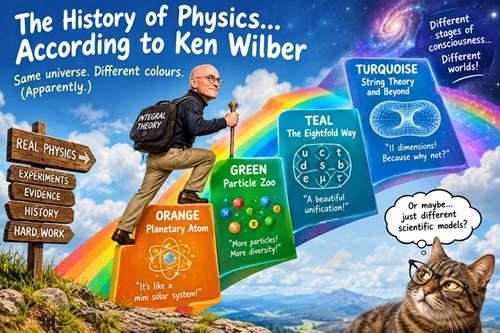 Introduction: Four colours and a theory of everythingKen Wilber's account of the history of physics in The Many Ways We Touch offers an unusually revealing glimpse into the ambitions—and the weaknesses—of Integral Theory. In a few paragraphs, Wilber transforms the development of atomic physics into a progression through his familiar developmental colours: Orange, Green, Teal and Turquoise. The planetary model of the atom belongs to Orange; the proliferation of subatomic particles to Green; their unification into a theoretical framework to Teal; and string theory, eleven dimensions and multiverses to Turquoise. He then draws a sweeping conclusion: the different stages of consciousness do not merely interpret the world differently; they bring forth different worlds. This is an ambitious philosophical proposal. It is also an extraordinary example of how a developmental framework can distort the very subject it claims to illuminate. Wilber takes a history involving experimental discoveries, mathematical models, theoretical disputes and unresolved scientific problems, and recasts it as an evolutionary drama in which physics appears to ascend through the levels of his own consciousness scheme. The central question is not whether scientific knowledge develops. Of course it does. Nor is it whether human beings need increasingly sophisticated concepts to understand the physical universe. They plainly do. The question is whether these developments can legitimately be classified as successive stages of psychological and cultural evolution—and whether Wilber has provided any independent evidence that his colours explain the history of physics better than the ordinary history of scientific inquiry. He has not. His account is more revealing as a case study in Integral Theory's tendency to assimilate external knowledge into its own conceptual architecture than as a reliable interpretation of modern physics. 1. Orange: The atom as a miniature solar systemWilber begins with the familiar planetary picture of the atom: a nucleus surrounded by orbiting electrons. This is assigned to Orange, the colour associated in his developmental scheme with modern rationality, scientific objectivity, individualism and the achievement-oriented worldview. At first glance, the association seems plausible. The planetary atom is a product of modern science, and the development of atomic theory belongs to the historical period in which modern scientific institutions and rational methods flourished. But a plausible historical association is not yet a demonstrated developmental relationship. The planetary model was not a single, stable conception of the atom. It emerged through a series of different models, including Rutherford's nuclear atom and Bohr's quantized orbits. These models were proposed for specific theoretical and experimental reasons. Bohr's model, for example, helped explain features of atomic spectra that classical physics could not adequately account for. It was subsequently superseded by quantum mechanics, in which electrons are not simply little planets following classical trajectories around a miniature sun. The history is therefore not merely one of consciousness moving from a lower to a higher stage. It is a history of models being constructed, tested, revised and sometimes abandoned in response to empirical evidence and mathematical difficulties. Wilber's colour coding adds little explanatory value here. We already have a historically grounded account of why the planetary atom appeared, why it initially proved useful and why it eventually became inadequate. What does the Orange label explain that the history of physics does not? To establish that Orange consciousness specifically produces the planetary atom, Wilber would need to identify characteristics of Orange cognition that predict the model's distinctive features, demonstrate that these characteristics are not equally compatible with alternative models, and show that the relationship is more than a retrospective analogy. Without such evidence, Orange is a label attached to a scientific development after the fact. 2. Green: When the particle zoo becomes a stage of consciousnessThe next transition is more problematic. Wilber associates Green with the increasingly complex picture of the atomic world, including electrons, protons, neutrons, mesons, bosons, leptons and other subatomic particles. But what exactly makes this Green? In Wilber's familiar developmental vocabulary, Green is associated with postmodern pluralism, sensitivity to differences, egalitarianism, contextual thinking and suspicion of overly rigid hierarchies. Yet the discovery of additional particle types does not obviously express any of these characteristics. Particle physics is not Green simply because it recognizes more kinds of entities. The particle zoo developed because experiments at higher energies revealed phenomena that simpler models could not explain. New particles were identified, classified and incorporated into increasingly sophisticated theoretical schemes. These developments were driven by experimental apparatus, mathematical theory, accelerator technology and the demands of empirical consistency. There is no obvious correspondence between the pluralistic values associated with Green and the discovery of mesons or leptons. The analogy is possible only if one stretches the developmental category until it becomes synonymous with complexity and differentiation. And that is precisely the problem. If an increase in the number of recognized entities counts as Green, then almost any sufficiently complex scientific classification could be interpreted as evidence of Green consciousness. The label ceases to discriminate between different kinds of intellectual development. Moreover, the particle zoo did not emerge because scientists became more egalitarian or culturally sensitive. Its development required highly specialized theoretical and experimental work, often involving researchers whose personal values, political convictions and cultural outlooks differed considerably. Scientific knowledge does not automatically inherit the psychological characteristics of the people who produce it, still less the characteristics of a single collective developmental stage. 3. Teal: The eightfold way and the confusion of classification with unificationWilber then moves to Teal, associating it with the synthesis of the many particles into the eightfold way, a classification scheme developed in the 1960s that helped reveal underlying patterns among hadrons. The subsequent development of quark theory provided a deeper explanation of those patterns. Wilber also invokes the Higgs boson as lending support to this scientific picture. Here the historical compression becomes especially revealing. The eightfold way was not a final unification of all fundamental particles. It was a way of organizing hadrons into families according to recurring mathematical symmetries. The quark model then explained those patterns by proposing that hadrons consist of more fundamental constituents. The Standard Model, developed through many further theoretical and experimental advances, eventually brought the strong, weak and electromagnetic interactions into a common framework, while leaving gravity outside that framework. These are distinct developments. They involve classification, symmetry, constituent models, quantum field theory and the experimental confirmation of theoretical predictions. To group them all under the heading of Teal risks obscuring what actually happened. Wilber's appeal to the Higgs boson is particularly instructive. The discovery of the Higgs boson at CERN in 2012 provided important evidence for the Higgs mechanism within the Standard Model. It did not establish that the entire particle zoo had been unified into a final theory, much less that physics had entered a new developmental stage of consciousness. Scientific discoveries have specific evidential implications. Their significance cannot be determined simply by assigning them to a rung on a philosophical ladder. What would distinguish a genuinely Teal scientific worldview from an Orange one? Does Teal correspond to a particular mathematical style, a specific conception of explanation, an institutional arrangement, or a measurable change in scientific reasoning? Wilber does not establish such criteria here. Instead, the colour appears to follow the presumed sophistication of the scientific result. The more unified the theory seems, the higher the developmental stage to which it is assigned. But that is a retrospective classification, not an independently validated explanation. 4. Turquoise: String theory as the pinnacle of consciousness?The Turquoise stage is where Wilber's scheme becomes most vulnerable. He associates it with string theory, M-theory, eleven-dimensional space and the possibility of multiple universes. These proposals are presented as the emergence of a new paradigm that promises to bring together aspects of physical reality that previous theories could not reconcile. Wilber further suggests that string theory is so complicated and abstract that no empirical experiment will ever be capable of confirming or refuting it. Physics, he concludes, has moved away from its former status as an empirical science toward an abstract, deeply Pythagorean enterprise. There are several problems here. First, string theory is not a scientific achievement that can simply be placed at the top of an established developmental sequence. It is a research programme that attempts, among other things, to reconcile quantum theory with gravity. M-theory emerged from efforts to understand relationships among different string theories. Eleven dimensions arise in particular formulations, not as an experimentally established description of the universe. And the multiverse is a further interpretive possibility, not an observationally confirmed consequence in the straightforward sense Wilber's presentation suggests. These distinctions matter. A mathematically interesting proposal is not the same thing as a confirmed physical theory. A promising research programme is not the same thing as a completed unification of nature. Second, Wilber's claim about empirical testing is too sweeping. String theory faces formidable challenges in producing distinctive, experimentally accessible predictions at achievable energies. But saying that no experiment will ever be capable of testing it is a much stronger claim. It turns a present methodological difficulty into a prediction about all future experimental possibilities. Such a prediction requires an argument that Wilber does not provide. Third, even if string theory eventually proves to be a profound breakthrough, why should its success establish the existence of Turquoise consciousness? Mathematical sophistication is not itself evidence of a particular stage in psychological development. Neither is theoretical abstraction, nor the introduction of additional dimensions. Indeed, one can make a plausible case that string theory exemplifies the extraordinary power of modern mathematical physics, whose development began long before Wilber's postmodern and integral stages entered his colour scheme. The theory draws on quantum mechanics, relativity, advanced geometry and mathematical structures developed through many overlapping traditions. Its intellectual genealogy cannot be reduced to a single stage of consciousness. The same point applies in the opposite direction. If string theory fails to yield the expected unification, would Turquoise consciousness have failed? Would the scientists working on it regress to Teal? Or would Wilber say that the stage remains valid even though its exemplary scientific theory does not? The difficulty is that his framework offers no clear answer. Scientific success can be interpreted as evidence of developmental ascent, while scientific failure can be accommodated as an unfinished or partial expression of a higher stage. A theory that can absorb both outcomes without specifying in advance what would count against it is not doing much explanatory work. 5. The decisive confusion: epistemology becomes ontologyThe most important passage in Wilber's argument is not the colour-coded history itself. It is his claim that different levels of being-consciousness bring forth different worlds. He explicitly contrasts this position with the idea that a single, pre-existing world is merely interpreted differently by different worldviews. In his account, different developmental levels disclose different phenomena and different ontologies. Here we encounter a philosophical problem that extends well beyond the history of physics. There is an important and defensible insight behind Wilber's position. Human beings do not encounter the world without conceptual mediation. What we can observe, measure, classify and explain depends partly on our sensory capacities, instruments, theoretical assumptions, mathematical tools and learned practices. A physicist equipped with a particle detector and quantum field theory can investigate phenomena that are inaccessible to someone without those resources. But it does not follow that different developmental stages bring different physical worlds into existence. We need to distinguish at least three claims: 1. Epistemic development: human beings become capable of knowing things they previously could not understand. 2. Scientific development: theories, instruments and experimental methods change, allowing previously inaccessible phenomena to be investigated. 3. Ontological development: reality itself, or the existence of its constituent entities, depends on the developmental stage of the knowing subject. The first two claims are entirely compatible with scientific realism. The third requires a much more ambitious philosophical argument. Wilber's formulation risks sliding from the first two to the third without adequately justifying the transition. Atoms existed before human beings developed atomic theory. The universe did not wait for Orange consciousness to appear before its constituent matter began behaving according to physical laws. What changed was humanity's capacity to investigate and conceptualize atomic structure. Wilber acknowledges that atoms subsisted long before human beings discovered them, but insists that they did not fully ex-ist until Orange consciousness brought them into a particular worldspace. This distinction between subsistence and existence is meant to preserve both realism and his theory of enactment. Yet it also introduces a potentially misleading ambiguity into the word existence. If ex-ist simply means becoming an explicit object of knowledge within a conceptual framework, the claim is reasonably uncontroversial. Atoms became objects of modern scientific knowledge only after the appropriate theories, experiments and instruments emerged. But if the claim means that atoms acquire a new kind of ontological status through the emergence of a developmental stage, Wilber owes us a much stronger argument. The terminological distinction does not settle the philosophical question. It risks concealing it. We can recognize that different scientific practices disclose different aspects of reality without concluding that those practices create different physical realities. A microscope and a particle accelerator reveal different phenomena, but that does not establish that the phenomena they reveal belong to ontologically separate worlds. Wilber's theory of enactment may offer a useful account of how knowledge is mediated by human capacities and practices. What it does not establish, merely by asserting it, is that his developmental colour scheme describes the structure of reality itself. 6. Why the colour scheme cannot explain the history of scienceA successful theory of scientific development should do more than classify past discoveries. It should help us understand why those discoveries occurred, what problems they solved, which alternatives they displaced and under what conditions further advances became possible. Wilber's colour scheme does little of this. The transition from Rutherford's nuclear atom to Bohr's model can be explained through the problems posed by classical electrodynamics and atomic spectra. The development of quantum mechanics can be understood through the accumulated difficulties faced by classical physics and the success of new mathematical formalisms. The discovery and classification of particles can be traced through accelerator experiments, conservation laws, symmetry principles and the development of quantum field theory. These explanations are not complete accounts of the sociology or psychology of science. But they are grounded in the actual history of scientific problems and their attempted solutions. Wilber's developmental interpretation adds a second vocabulary without showing that it explains the historical transitions any better. There is also a serious problem of selection. Why these four stages? Why should the planetary atom be Orange rather than Green? Why should particle classification be Green rather than Teal? Why should the eightfold way mark Teal, while string theory marks Turquoise? What happens to scientific developments that do not fit this ascending sequence, or to periods in which an older theoretical framework proves more useful than a newer one? A developmental model would need independent criteria for assigning scientific ideas to stages. It would also need to demonstrate that the resulting classifications are reliable and informative rather than merely intuitive. Without those criteria, the colour scheme becomes flexible enough to accommodate almost any sequence of scientific developments. It is then the interpreter who supplies the developmental meaning, rather than the scientific history providing evidence for the developmental theory. This is a recurring difficulty with Integral Theory. Its conceptual vocabulary is sufficiently elastic to redescribe an enormous range of phenomena, but the ability to redescribe something is not the same as explaining it. 7. The hierarchy problem: Is later necessarily higher?Wilber's sequence also raises a more general question about the relationship between historical succession and developmental progress. Scientific knowledge accumulates, but not in a simple, uninterrupted ascent. Some theories are abandoned; others remain useful within restricted domains. Newtonian mechanics, for example, was not rendered worthless by relativity and quantum mechanics. It remains extraordinarily effective for many ordinary engineering and astronomical applications. Its limitations became clearer, but its practical achievements did not disappear. Nor does theoretical sophistication automatically translate into greater empirical knowledge. A highly abstract theory can be mathematically elegant while remaining empirically underdetermined. A comparatively simple model can make precise predictions that a more ambitious theory cannot yet match. String theory may ultimately yield important insights, but its position in contemporary physics cannot be established by placing it at the end of a developmental colour sequence. It must be evaluated by its mathematical consistency, its explanatory reach, its relationship to established theories and, where possible, its empirical implications. The distinction is crucial because Wilber's colour scheme encourages a particular interpretation of scientific history: Orange is superseded by Green, Green by Teal, and Teal by Turquoise, as if each new colour represented a higher and more comprehensive understanding of the physical universe. Yet scientific progress is not a psychological ladder on which every new theory occupies a higher rung. It is a complex process involving competing hypotheses, technical advances, conceptual innovations, empirical constraints and unresolved disagreements. The fact that scientific knowledge changes does not demonstrate that it changes according to Wilber's developmental hierarchy. That is precisely what would need to be established. 8. An integral theory that puts itself above the sciencesThere is an additional irony in Wilber's account. Integral Theory presents itself as a framework for overcoming the limitations of partial perspectives. No single discipline, he argues, should be permitted to mistake its particular contribution for the whole of reality. His broader methodological pluralism emphasizes that different approaches can disclose different aspects of phenomena and that their contributions should be brought into a more comprehensive framework. That ambition has merit. Scientific knowledge is indeed enriched by communication among disciplines, and the philosophy of science benefits from examining the historical, conceptual and social conditions of scientific practice. But Wilber's application of his framework to physics threatens to reproduce the very problem he seeks to overcome. He takes a complex history of scientific research and assigns it a developmental structure that originates outside physics itself. He then interprets that structure as evidence that different levels of consciousness disclose different worlds. Finally, the resulting history appears to confirm the validity of the integral framework through which it was initially organized. The reasoning is circular in an important sense. Wilber uses his developmental scheme to classify scientific theories, then treats the resulting classification as an illustration of the scheme's explanatory power. Where is the independent test? What finding would demonstrate that the proposed correspondence between scientific developments and developmental stages is mistaken? How could one distinguish a genuine discovery of a developmental pattern from a retrospective arrangement of familiar historical events? These are not hostile questions. They are elementary requirements for assessing a theory that makes claims about the development of knowledge. The danger is that Integral Theory becomes a kind of interpretive superstructure that can classify the achievements of any discipline while remaining insulated from the standards by which those achievements are evaluated. Physics provides the discoveries; Wilber supplies the developmental significance. The resulting interpretation is then presented as an integral understanding of what physics means. But the framework's ability to accommodate scientific knowledge does not establish its ability to explain that knowledge. A genuinely integral approach would have to remain open to the possibility that the history of physics does not follow Wilber's colour scheme—or that the scheme captures some superficial similarities while missing the causal and conceptual structure of scientific change. 9. What a defensible version of Wilber's argument might look likeThere is a more modest and potentially fruitful argument lurking beneath Wilber's account. Scientific knowledge depends on historically developing cognitive capacities, conceptual frameworks and research practices. The ability to formulate mathematical theories, design sophisticated experiments and coordinate complex bodies of evidence depends on forms of learning that individuals and scientific communities acquire over time. One could investigate how these capacities develop, how scientific education shapes reasoning, how conceptual innovations alter what researchers can investigate, and how scientific institutions influence the production and acceptance of knowledge. Developmental psychology might contribute to such research. So might the sociology and history of science, cognitive science and philosophy of scientific models. An integral framework could potentially serve as a heuristic for bringing these perspectives into conversation. But this would be a research programme, not a confirmation of Wilber's existing scheme. It would require operational definitions, independent measures of the proposed developmental stages, historical evidence and comparisons with alternative explanations. Researchers would need to establish whether scientific reasoning actually exhibits the predicted stage transitions, rather than simply assigning colours to discoveries after they occur. Most importantly, such research would have to distinguish the development of scientific knowledge from the development of consciousness in general. The two may interact, but their relationship cannot simply be assumed. This more modest approach would also avoid the questionable suggestion that physics moves from Orange to Turquoise as though the universe itself were being progressively revealed to increasingly evolved forms of human consciousness. Scientific knowledge can become more comprehensive without every advance representing a higher level of consciousness. And human cognitive development can be studied without treating the latest speculative physical theories as privileged expressions of spiritual or psychological evolution. That would be a worthwhile contribution to an integral philosophy of science. Wilber's colour-coded history, however, falls well short of providing it. Conclusion: The universe does not climb Wilber's rainbowWilber's account of physics is an appealing miniature of Integral Theory's ambitions. It offers a simple, memorable narrative in which the history of science becomes a progression from the mechanistic worldview of modernity through increasingly differentiated and integrated conceptions of physical reality, culminating in the extraordinary mathematical abstractions of contemporary theoretical physics. But the elegance of the narrative should not be confused with the strength of its evidence. The planetary atom, the particle zoo, the eightfold way and string theory belong to different episodes in the history of physics. They arose from distinct theoretical problems, experimental discoveries and mathematical developments. Their relationships can be studied historically and scientifically without assuming that each represents a new stage of consciousness. Wilber's colour scheme does not explain why these theories emerged, why some succeeded, why others were abandoned, or why particular scientific problems remain unresolved. Instead, it retrospectively assigns the developments to stages in his own model and then uses their apparent progression to illustrate the model's philosophical claims. The more ambitious claim—that different developmental levels bring forth different worlds—raises a separate ontological problem that the colour-coded history does not resolve. At most, the example illustrates that human beings acquire new ways of investigating and conceptualizing reality. It does not establish that physical reality itself depends on developmental stages, or that Orange, Green, Teal and Turquoise constitute an objective sequence in the evolution of scientific knowledge. There is a final irony here. Wilber's Integral Theory claims to transcend and include partial perspectives, yet its treatment of physics risks subordinating the actual history of scientific discovery to a developmental narrative that physics itself has no particular reason to recognize. The colours may organize Wilber's philosophical imagination. They do not constitute an established taxonomy of scientific progress. And string theory does not become a Turquoise theory of the universe simply because it is mathematically abstract, theoretically ambitious or concerned with dimensions beyond everyday experience. The universe is not climbing Wilber's rainbow. Wilber is arranging our theories of the universe along it. The distinction between those two propositions is precisely the distinction his integral philosophy needs to establish rather than assume.
Widget is loading comments...
|