|
TRANSLATE THIS ARTICLE
Integral World: Exploring Theories of Everything
An independent forum for a critical discussion of the integral philosophy of Ken Wilber
  Frank Visser, graduated as a psychologist of culture and religion, founded IntegralWorld in 1997. He worked as production manager for various publishing houses and as service manager for various internet companies and lives in Amsterdam. Books: Ken Wilber: Thought as Passion (SUNY, 2003), and The Corona Conspiracy: Combatting Disinformation about the Coronavirus (Kindle, 2020). Frank Visser, graduated as a psychologist of culture and religion, founded IntegralWorld in 1997. He worked as production manager for various publishing houses and as service manager for various internet companies and lives in Amsterdam. Books: Ken Wilber: Thought as Passion (SUNY, 2003), and The Corona Conspiracy: Combatting Disinformation about the Coronavirus (Kindle, 2020).
Check out my other conversations with ChatGPT
P.D. OuspenskyThe Search for Higher Consciousness and the Limits of Esoteric KnowledgeFrank Visser / ChatGPT
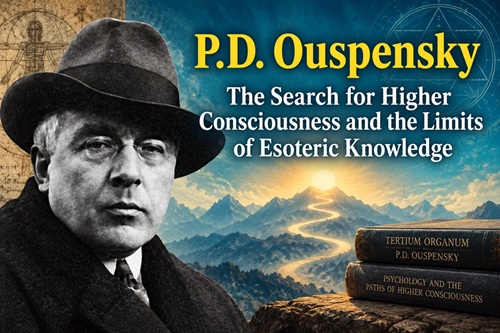 Introduction: The Man Who Sought a Way Out of Ordinary LifePyotr Demianovich Ouspensky (1878-1947) occupies an unusual position in the history of modern spirituality. A Russian philosopher, journalist, and explorer of esoteric ideas, he became one of the most influential interpreters of the teachings of George Ivanovich Gurdjieff, whose system promised nothing less than a radical transformation of human consciousness. Ouspensky's writings introduced generations of readers to the possibility that ordinary human beings live in a condition of psychological sleep, mistaking mechanical reactions for conscious action and habitual thought for genuine understanding. His appeal is easy to understand. Modern life encourages us to identify with our routines, opinions, social roles, and desires. We imagine ourselves to be autonomous agents, yet much of our behavior is predictable, reactive, and governed by influences we scarcely recognize. Ouspensky took this familiar observation and developed it into a comprehensive diagnosis of the human condition. We are not merely distracted or insufficiently reflective, he argued. We are fundamentally asleep. The difficulty begins when this psychological insight becomes the foundation for an elaborate esoteric cosmology. Ouspensky's work combines penetrating observations about human behavior with extraordinary claims about higher dimensions, cosmic laws, levels of consciousness, and the possibility of acquiring knowledge inaccessible to ordinary people. The central critical question is therefore not whether Ouspensky understood something important about human self-deception. He did. It is whether his proposed remedy rests on reliable knowledge or on an esoteric worldview that insulates itself from ordinary standards of evidence. The Intellectual Journey: From the Fourth Dimension to the Fourth WayOuspensky's intellectual development began before his encounter with Gurdjieff. He was interested in mathematics, philosophy, psychology, mysticism, and the possibility that reality possesses dimensions beyond those accessible to everyday perception. His early book Tertium Organum (1912) attempted to formulate a new organ of thought capable of transcending the limitations of conventional logic and ordinary spatial experience. The book is characteristic of Ouspensky's intellectual temperament. He approached mystical questions with the ambition of a theorist seeking a new mathematics of reality. The limitations of ordinary cognition were not simply practical inconveniences; they appeared to reflect the structure of consciousness itself. If human beings experience only a restricted portion of reality, perhaps a higher state of consciousness could reveal dimensions that remain invisible to us. This is an intriguing philosophical possibility. Our senses are limited, and scientific instruments routinely reveal aspects of the world that unaided perception cannot detect. But the analogy between scientific extensions of perception and mystical intuition is not straightforward. Instruments can be calibrated, measurements repeated, and results compared across independent observers. Claims about higher dimensions of consciousness require their own methods of verification. The fact that ordinary perception is limited does not establish that a particular mystical system provides access to what lies beyond it. Ouspensky's encounter with Gurdjieff around 1915 transformed his intellectual project. Gurdjieff offered what appeared to be a practical method for achieving the very transformation Ouspensky had been seeking. Rather than relying on abstract speculation or spontaneous mystical experiences, the aspirant would undertake systematic work on attention, self-observation, bodily awareness, emotional reactions, and habitual thought. Ouspensky became one of Gurdjieff's most important students and interpreters. Yet their relationship eventually deteriorated. In 1924, Ouspensky began distancing himself from Gurdjieff's direct authority, and he later developed his own teaching activities in England and elsewhere. The precise reasons for their separation have been interpreted in different ways, but the intellectual consequence is clear: Ouspensky's mature work became an independent presentation of ideas he had initially encountered through Gurdjieff. His position is consequently complex. He was neither merely a disciple repeating his teacher's words nor an entirely independent philosopher. His system retained Gurdjieff's fundamental architecture while giving it a distinctive intellectual and literary form. The Human Machine: A Powerful Diagnosis of Everyday PsychologyOuspensky's most enduring contribution is his insistence that people greatly exaggerate their degree of conscious control. In In Search of the Miraculous (1949), published posthumously, he presents Gurdjieff's teaching that human beings ordinarily function as machines. We respond to external stimuli, repeat established patterns, identify with passing emotions, and imagine that our actions originate in a unified and stable self. What we call will is often no more than the temporary dominance of one desire over another. This account has considerable psychological plausibility. People routinely behave in ways that contradict their stated intentions. We make impulsive decisions, rationalize our prejudices, imitate our social environment, and construct flattering stories about our motives. Habits operate without sustained awareness, while emotions can reorganize our judgment before reflective thought has time to intervene. Modern psychology offers numerous ways to investigate these phenomena. Research on automatic processing, cognitive biases, habit formation, attentional limitations, and motivated reasoning demonstrates that conscious deliberation is only one component of human behavior. The intuitive idea that we are not as self-transparent as we imagine has become a major theme in the scientific study of mind. Ouspensky deserves credit for placing this problem at the center of a disciplined program of self-examination. His emphasis on observing one's reactions without immediately justifying or condemning them can be valuable. To notice irritation as it arises, recognize the impulse to defend one's status, or discover the gap between an intention and an actual behavior is to gain a measure of freedom from automaticity. Yet Ouspensky's diagnosis becomes problematic when it is turned into an absolute anthropology. Are human beings always machines unless they have undergone a specialized esoteric training? Is ordinary consciousness merely an illusion? Does genuine agency require access to a higher level of being? These conclusions do not follow from the observation that much human behavior is habitual. Automaticity is a feature of a complex organism, not proof that the organism lacks consciousness or agency. Habits can be modified, reflective capacities can be cultivated, and people can act deliberately without becoming initiates of an esoteric school. Ouspensky's metaphor is most useful when treated as a corrective to human self-importance. It becomes less convincing when elevated into a total theory of what human beings fundamentally are. Self-Remembering: The Practical Core of the SystemAt the heart of the Fourth Way lies the practice of self-remembering. Ordinary attention, Ouspensky explains, is typically directed outward toward objects, tasks, other people, and internal trains of thought. We become absorbed in what we are doing and forget ourselves as the subjects of experience. Self-remembering involves maintaining awareness of both the object of attention and oneself as the person attending to it. One might listen to another person while simultaneously remaining aware of one's posture, emotional state, breathing, and presence in the situation. The aim is not simply to think about oneself but to sustain a more inclusive form of awareness. This practice deserves to be separated from the larger metaphysical framework in which Ouspensky placed it. Contemporary approaches to mindfulness, metacognition, and attentional training also encourage people to notice thoughts and emotions rather than becoming entirely absorbed in them. Psychological research can investigate whether such practices improve attention, emotional regulation, or awareness of habitual behavior. There is no need to accept a hierarchy of cosmic consciousness to recognize their possible value. Nevertheless, Ouspensky's conception of self-remembering raises an important question. Is the practice intended to improve ordinary awareness, or is it a technique for accessing an entirely different order of reality? These are distinct claims, requiring different kinds of evidence. The first is psychologically plausible and open to empirical investigation. The second is a much stronger proposition. A person may experience unusual clarity, a sense of expanded presence, or a temporary weakening of habitual self-concern. Such experiences can be meaningful without establishing that the person has entered a higher metaphysical state. Ouspensky's contribution is strongest when self-remembering is understood as a practical discipline of attention. It becomes more speculative when the phenomenology of the practice is taken as evidence for a cosmic hierarchy of consciousness. The Four States of Consciousness: From Sleep to AwakeningOuspensky's account of consciousness distinguishes four principal states. The first is ordinary physical sleep. The second is waking consciousness, which he provocatively describes as another form of sleep because it remains dominated by mechanical reactions. The third is self-consciousness, in which people become more continuously aware of themselves. The fourth is objective consciousness, in which reality is supposedly perceived as it truly is. This hierarchy gives the Fourth Way its dramatic structure. Ordinary life is not the culmination of human possibility but the starting point of a journey. Through sustained work, a person may awaken from mechanical existence, develop a more unified self, and eventually attain a form of knowledge that surpasses ordinary subjectivity. As a metaphor for personal development, this is compelling. People can become more reflective, less reactive, and more capable of recognizing their own distortions. They can learn to distinguish their immediate impressions from the realities those impressions imperfectly represent. But the hierarchy contains an epistemological problem. What precisely distinguishes Ouspensky's third state from the fourth? How can we establish that a purportedly objective consciousness reveals reality more accurately than ordinary consciousness? And how would we distinguish genuine access to a higher state from an intense subjective conviction that one has achieved it? The language of objectivity is particularly important here. In science, objectivity is not simply a feeling of certainty or an experience of extraordinary clarity. It is supported by procedures that make claims answerable to evidence, criticism, replication, and independent assessment. A person can feel completely certain and still be mistaken. Ouspensky's hierarchy does not provide a sufficiently independent standard for determining whether someone has actually reached objective consciousness. If the evidence for the higher state consists primarily of the testimony of those who claim to have attained it, the argument risks becoming circular. The state is real because awakened people recognize it, and those people are recognized as awakened because they claim to possess the state. The distinction between ordinary and transformed consciousness remains worth exploring. The claim that the highest state provides privileged access to objective reality requires much more than an elaborate vocabulary of awakening. The Fourth Way: An Esoteric School for Ordinary LifeGurdjieff's Fourth Way distinguishes itself from three traditional paths of spiritual development. The way of the fakir emphasizes the body, the way of the monk emphasizes religious devotion and emotion, and the way of the yogi emphasizes the mind. The Fourth Way supposedly integrates bodily, emotional, and intellectual development while allowing practitioners to continue living in the ordinary world. Ouspensky helped make this teaching intelligible to readers who were dissatisfied with conventional religion but remained attracted to the possibility of spiritual transformation. The Fourth Way promised a demanding discipline without requiring complete withdrawal from society. Work, relationships, frustrations, and everyday responsibilities could all become occasions for self-observation. There is a practical strength in this approach. Self-knowledge should not be restricted to retreat centers, meditation sessions, or moments of private reflection. The real test of emotional maturity is often how one behaves under pressure, in conflict, or when personal interests are threatened. A spiritual discipline that ignores ordinary conduct risks becoming a form of escape. However, the Fourth Way also presents itself as a specialized system whose deeper principles cannot be fully understood without undertaking the work. This can create a tension between practical usefulness and epistemic exclusivity. If outsiders misunderstand the system, their objections can be dismissed as evidence that they have not reached the appropriate level of understanding. Not every difficult idea is false because it is difficult to grasp. Nor does the existence of specialized training automatically make a system esoteric in the pejorative sense. Mathematics, medicine, and scientific research all require sustained learning. The crucial difference is that their claims can, in principle, be examined through publicly accessible standards of evidence. An esoteric school becomes intellectually suspect when its central claims are protected from criticism by the assertion that critics lack the very consciousness needed to recognize their truth. Ouspensky's system does not have to be reduced to this problem, but it does not entirely escape it. The Ray of Creation: Psychology Becomes CosmologyOuspensky's writings extend far beyond psychological self-observation. In In Search of the Miraculous, he describes a cosmological structure known as the Ray of Creation, in which the universe is arranged through a hierarchy of worlds governed by different combinations of laws. The scheme begins with the Absolute and proceeds through successively differentiated cosmic levels, including galaxies, the solar system, planets, and the human world. The purpose of this cosmology is not merely to offer a symbolic picture of the universe. It also explains the differing degrees of freedom and constraint operating at different levels of existence. The higher levels are governed by fewer laws, while lower levels are subject to increasingly numerous constraints. Human beings occupy a position within this hierarchy that makes self-transformation possible but far from automatic. As a philosophical image, the Ray of Creation offers an intuitively attractive contrast between increasing complexity and increasing constraint. Living organisms, societies, and psychological systems do operate under multiple interacting constraints. Human freedom is never absolute; it emerges within biological, social, and environmental conditions. But the resemblance between this general observation and Ouspensky's specific cosmology should not be mistaken for confirmation. The Ray of Creation is not a scientifically established account of cosmic structure. Its sequence of worlds and laws belongs to an esoteric system whose principles are not supported by a demonstrated physical theory or a body of independently confirmed predictions. Modern cosmology describes the universe through observational evidence, mathematical models, and physical theories that can be tested against measurements. Ouspensky's hierarchy may function as a philosophical metaphor, but it cannot substitute for these methods. This distinction matters because esoteric cosmologies often borrow the authority of scientific language. Numbers, laws, dimensions, and hierarchies can give speculative systems an appearance of precision. Yet precision of presentation is not the same as precision of measurement, and a formally structured theory is not necessarily a true theory. Ouspensky's cosmology should therefore be read as a historical example of the modern esoteric attempt to unite spiritual aspirations with a quasi-scientific picture of reality, rather than as a neglected scientific discovery. The Law of Three and the Law of SevenTwo principles occupy a central position in the system Ouspensky presents. The Law of Three holds that any manifestation involves three forces, commonly described as active, passive, and reconciling. The Law of Seven, often associated with the musical octave, proposes that processes develop discontinuously and require additional impulses at particular points if they are to reach their intended completion. These principles are intended to explain why events do not unfold through simple linear causation. An intention meets resistance; a project encounters obstacles; an initial enthusiasm fades; and a process may require an external intervention before it can continue. The laws promise a general account of how change occurs throughout the cosmos, from physical processes to psychological development. There is an understandable appeal to this framework. Real-world processes frequently involve multiple interacting factors, feedback, changing conditions, and unexpected interruptions. A project can fail because initial enthusiasm is insufficient, because resources are exhausted, or because circumstances change. Human development is rarely a smooth progression from ignorance to wisdom. But these observations are not distinctive evidence for the Law of Three or the Law of Seven. They can be explained through established concepts in systems theory, causal analysis, and psychology without assuming universal esoteric laws. The decisive question is whether Ouspensky's laws generate specific predictions that competing explanations do not. What would count as evidence against the Law of Three? Under what conditions would the Law of Seven fail? Can the proposed forces be measured independently of the examples selected to illustrate them? Without clear answers, the laws risk becoming interpretive templates that can be applied retrospectively to almost any event. A successful outcome can be explained by the proper interplay of forces, while failure can be attributed to a missing impulse or an incomplete octave. Such a framework may generate interesting reflections, but its explanatory power remains uncertain when it accommodates every possible result. A genuine explanatory law should constrain interpretation, not merely organize it after the fact. The Enneagram: A Symbol in Search of a ScienceThe enneagram, a nine-pointed geometric figure, became one of the most recognizable symbols associated with the Gurdjieff tradition. In the Fourth Way, it represents a dynamic pattern of processes and the interplay of the Law of Three and the Law of Seven. Its later popularity has been amplified by the development of the Enneagram of Personality, a system that classifies people into nine personality types. These two uses are historically related, but they should not be conflated. The modern personality typology developed through subsequent interpretations and adaptations; it is not simply identical to the original role of the enneagram in Gurdjieff's teaching. The symbol's appeal lies partly in its apparent comprehensiveness. It promises to represent the structure of change in a single diagram, connecting cosmic processes with human experience. For those seeking an integrated worldview, such a symbol can become a powerful intellectual and spiritual organizing device. Yet a diagram does not become explanatory merely because it is elegant or widely applicable. To establish the scientific status of a model, one must demonstrate that its categories correspond to identifiable phenomena, that its predictions outperform alternatives, and that its claims can be independently evaluated. The enneagram's later psychological applications face these same challenges. A classification may help people reflect on their behavior, but usefulness as a reflective tool does not establish that its categories represent natural psychological kinds. Nor does the symbolic relationship between the enneagram and the Fourth Way validate the wider cosmology. The critical lesson is broader than this particular symbol. Human beings are drawn to patterns that unify diverse experiences. But the discovery of a pattern in our descriptions is not necessarily the discovery of a governing structure in reality. Ouspensky's Epistemological Problem: Who Knows That We Are Asleep?Ouspensky's system rests on a paradox. If ordinary consciousness is fundamentally mechanical, how can ordinary people reliably recognize the truth of a teaching that tells them they are mechanical? If the highest knowledge is available only in a transformed state, how can someone decide whether the proposed route to that state is trustworthy before undertaking it? The problem is not unique to Ouspensky. Religious traditions, mystical schools, and ideological movements frequently claim that an individual's present understanding is inadequate to assess a higher truth. Sometimes this is reasonable: a beginner cannot judge every technical argument in an advanced science. But legitimate expertise does not make a claim immune to examination. It creates a path toward better-informed evaluation. Ouspensky's framework would be stronger if it provided independent criteria for distinguishing authentic awakening from suggestibility, self-deception, or group conformity. It would also benefit from distinguishing the confidence of an experience from the accuracy of the interpretation attached to it. Consider someone who practices self-observation and discovers how often anger, vanity, and fear govern their behavior. This is a potentially valuable finding. But suppose the same person concludes that they have glimpsed a higher cosmic reality, discovered the operation of universal laws, or acquired access to objective consciousness. The psychological discovery does not, by itself, justify those additional conclusions. A central task of critical thinking is to separate what an experience demonstrates from what a worldview says the experience means. Ouspensky is often strongest in describing the experience of self-deception and weakest when his explanatory framework moves from introspection to universal metaphysical claims. His psychological observations can be assessed on their own merits without accepting the entire system in which he placed them. The Authority of the Teacher and the Danger of Spiritual HierarchyThe relationship between Gurdjieff, Ouspensky, and their students raises another problem. The Fourth Way places considerable importance on guidance, discipline, and the recognition that an individual cannot reliably transform themselves through ordinary habits alone. A teacher may identify patterns that students cannot see and introduce exercises that challenge their established self-image. There is nothing inherently wrong with this arrangement. Education, psychotherapy, and artistic training all involve relationships in which a more experienced person helps another recognize limitations and develop capacities. The danger appears when differences in experience become differences in unquestionable spiritual authority. If the teacher is assumed to possess a higher level of consciousness, disagreements can be interpreted as evidence of the student's vanity, resistance, or lack of development. The student's doubt becomes part of the diagnosis rather than a reason to reconsider the teaching. This structure can make an esoteric school difficult to challenge from within. The more committed a student becomes, the more the system may explain away their objections as manifestations of the very defects it claims to overcome. It would be unfair to reduce all Fourth Way teaching to authoritarian manipulation. Gurdjieff's methods were varied, and the history of his groups cannot be captured in a single formula. Ouspensky himself eventually distanced himself from Gurdjieff, demonstrating that the relationship between teacher and disciple was neither simple nor permanent. Nevertheless, the broader institutional question remains important. A system that claims to overcome self-deception should be particularly alert to the possibility that its own leaders, methods, and hierarchies can become objects of self-deception. Spiritual authority is not exempt from the psychological mechanisms it purports to diagnose. The most credible form of self-work would therefore include the capacity to question the teacher, scrutinize the institution, and reconsider the framework itself. The Modern Scientific AlternativeOne of the reasons Ouspensky remains interesting is that several of his concerns have counterparts in contemporary research. Cognitive science investigates the limits of introspection. Behavioral psychology examines habit and reinforcement. Neuroscience studies the mechanisms underlying attention and action. Social psychology explores conformity, motivated reasoning, and the influence of group expectations. These disciplines do not confirm Ouspensky's complete system. They do, however, offer more precise ways of examining some of the problems that motivated it. For example, the feeling of being a unified agent can be investigated by studying how decisions emerge from interactions between conscious deliberation, unconscious processing, emotion, memory, and environmental cues. The tendency to misjudge one's motives can be studied through experimental tasks and comparisons between self-reports and observed behavior. The effects of attentional training can be examined through controlled studies, with appropriate caution about the limitations of the available evidence. This scientific approach does not settle every philosophical question about consciousness. It does not explain away the subjective character of experience, nor does it provide a complete account of what a meaningful life should be. There remains ample room for philosophy, phenomenology, and contemplative practice. But it does introduce a crucial distinction between a promising question and a confirmed answer. Ouspensky's insistence that ordinary consciousness is limited can inspire investigation. It cannot establish in advance that his particular hierarchy of states, cosmic laws, or esoteric methods is correct. The best way to preserve the insights of the Fourth Way may therefore be to detach them from claims that have not earned comparable support. Can We Awaken Without an Esoteric Cosmology?The most important practical question is whether the worthwhile elements of Ouspensky's teaching depend on accepting its metaphysical structure. Must one believe in the Ray of Creation to become more aware of habitual behavior? Must one accept the Law of Seven to understand why projects encounter obstacles? Must one believe in objective consciousness as a distinct cosmic state to cultivate attention, emotional regulation, or reflective judgment? The answer appears to be no. Self-observation can be practiced without adopting a hierarchy of cosmic worlds. The recognition of psychological automaticity can be investigated through ordinary experience and scientific research. A person can cultivate a more integrated life through therapy, education, contemplative practices, ethical reflection, and sustained attention to the consequences of their actions. These alternatives are not necessarily interchangeable, and none should be treated as a guaranteed route to enlightenment. Their advantage is that they allow individual practices to be evaluated separately rather than requiring acceptance of an entire worldview. At the same time, Ouspensky's work raises questions that purely technical approaches may overlook. Greater efficiency is not the same as greater wisdom. Improved attention does not automatically produce moral maturity. Psychological insight can be used for manipulation as readily as for compassion. Any serious program of human development must ask not only how consciousness can be changed but also what ends that transformation should serve. The Fourth Way's ambition to transform the whole person is therefore worth taking seriously. Its weakness lies not in aiming beyond mere self-improvement but in tying that ambition to a system whose most expansive claims remain insufficiently justified. Conclusion: Retain the Psychological Insight, Question the Cosmic ClaimsP.D. Ouspensky deserves a place in the history of modern spirituality because he articulated a powerful challenge to the comfortable assumption that human beings are fully conscious, rational, and self-directed. His writings invite readers to examine the automaticity of their behavior, the instability of their self-image, and the difference between thinking about life and paying sustained attention to it. His account of self-remembering remains suggestive, and the Fourth Way's insistence that self-development must be tested in ordinary life offers a useful corrective to spiritual escapism. These insights do not become worthless simply because Ouspensky embedded them in an esoteric worldview. But neither should their practical appeal lend automatic credibility to that worldview. The hierarchy of consciousness, the Ray of Creation, the Law of Three, the Law of Seven, and the promise of objective consciousness all require independent scrutiny. Their coherence within the system is not sufficient evidence of their truth. Ouspensky's greatest limitation is the tendency to move from a plausible psychological observation to an expansive theory of cosmic reality without establishing the evidential bridge between them. Because people are not fully transparent to themselves, it does not follow that a particular esoteric school possesses privileged knowledge of the universe. Because attention can be transformed, it does not follow that transformed attention reveals metaphysical truths. And because human development is difficult, it does not follow that a specialized spiritual hierarchy is indispensable. The challenge is to separate the practice from the mythology, the psychological insight from the cosmological speculation, and the possibility of transformation from the promise of privileged knowledge. Perhaps the most valuable lesson to retain from Ouspensky is also the one that should be applied to Ouspensky himself: do not assume that you understand simply because a system has given you an impressive explanation. Observe, investigate, question, and remain alert to the possibility that your conviction may be another form of sleep. The search for awakening becomes intellectually serious only when it includes the possibility that one's preferred account of awakening might itself be mistaken.
Widget is loading comments...
|