|
TRANSLATE THIS ARTICLE
Integral World: Exploring Theories of Everything
An independent forum for a critical discussion of the integral philosophy of Ken Wilber
  Frank Visser, graduated as a psychologist of culture and religion, founded IntegralWorld in 1997. He worked as production manager for various publishing houses and as service manager for various internet companies and lives in Amsterdam. Books: Ken Wilber: Thought as Passion (SUNY, 2003), and The Corona Conspiracy: Combatting Disinformation about the Coronavirus (Kindle, 2020). Frank Visser, graduated as a psychologist of culture and religion, founded IntegralWorld in 1997. He worked as production manager for various publishing houses and as service manager for various internet companies and lives in Amsterdam. Books: Ken Wilber: Thought as Passion (SUNY, 2003), and The Corona Conspiracy: Combatting Disinformation about the Coronavirus (Kindle, 2020).
Check out my other conversations with ChatGPT
G. I. Gurdjieff: The Man Who Promised to Wake Us UpSelf-Remembering, Esoteric Authority, and the Problem of Spiritual KnowledgeFrank Visser / ChatGPT
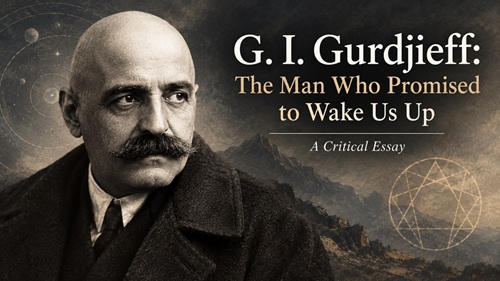 Introduction: Humanity AsleepGeorges Ivanovich Gurdjieff (c. 1866-1949) was one of the most enigmatic and influential figures in twentieth-century esotericism. A spiritual teacher, impresario of consciousness, and architect of an elaborate system of psychological transformation, he proposed a disturbing diagnosis of the human condition: people are not nearly as conscious as they imagine themselves to be. They live mechanically, driven by habit, imitation, emotional reactions, and unconscious impulses, while mistaking this automatic existence for freedom. Gurdjieff's remedy was equally uncompromising. Human beings, he argued, must undertake a difficult and deliberate process of awakening. Through self-observation, self-remembering, disciplined physical movement, the confrontation of uncomfortable truths, and work within a demanding community, a person might develop a more integrated and enduring form of consciousness. There is something compelling about this diagnosis. Modern psychology, cognitive science, and neuroscience have all challenged the flattering image of human beings as transparent to themselves, rational in their decisions, and fully in control of their behavior. Much of our mental life does indeed operate automatically. We routinely rationalize our motives, confabulate explanations, and mistake familiar habits for freely chosen actions. But the validity of a diagnosis does not automatically validate the proposed cure. Gurdjieff's system raises a series of difficult questions. Does his teaching offer a genuinely distinctive method of psychological development, or does it surround familiar insights with an elaborate esoteric cosmology? Can his claims about consciousness be tested independently? And when a teacher insists that ordinary people are asleep while he possesses a privileged understanding of awakening, how can we distinguish genuine insight from charismatic authority? These questions matter because Gurdjieff occupies an influential position in the history of modern spirituality. His ideas helped shape later movements concerned with consciousness, integral development, and the possibility of transcending ordinary ego-consciousness. Yet his system deserves neither automatic reverence nor superficial dismissal. Its psychological insights must be separated from its metaphysical claims, and its methods must be evaluated independently of the extraordinary personality who introduced them. 1. The Fourth Way: A Shortcut Beyond the Traditional Paths?Gurdjieff called his system the Fourth Way. In his presentation, three traditional approaches to spiritual development had evolved around distinct aspects of human nature. The fakir worked primarily with the body, the monk with the emotions, and the yogi with the mind. Each path, Gurdjieff argued, required a degree of withdrawal from ordinary life and concentrated on one dimension of human development at the expense of others. His proposed alternative was to work on the body, emotions, and intellect simultaneously while continuing to participate in everyday life. One could pursue awakening while working, raising a family, maintaining relationships, and confronting the ordinary frustrations of existence. This was an ingenious practical proposition. Why should spiritual development require retreating from the world? Why not use the world itself as a laboratory for self-knowledge? Irritation, vanity, jealousy, ambition, and fear could become material for observation rather than merely obstacles to be overcome. The Fourth Way thus contains an important insight: psychological development cannot be reduced to intellectual understanding. Knowing that one is vain does not necessarily make one less vain. Understanding the mechanisms of anger does not prevent one from becoming angry. Self-knowledge requires more than accumulating correct descriptions of oneself. Yet the claim that Gurdjieff had discovered a distinctive fourth path is harder to establish. Integrating bodily, emotional, intellectual, and social development is not unique to him. Ancient Greek philosophy, Buddhist practice, Christian spiritual disciplines, modern psychotherapy, and contemporary approaches to embodied cognition all offer variations on this theme. Gurdjieff's originality therefore lies less in the general aspiration toward integrated development than in his particular exercises, conceptual vocabulary, teaching methods, and cosmological framework. These elements should be evaluated separately. A useful exercise does not validate an entire metaphysical system, just as a flawed cosmology does not automatically invalidate every practical technique developed within it. The crucial question is whether the Fourth Way achieves what it promises more reliably than its alternatives. Does it produce demonstrably greater self-awareness, emotional regulation, or psychological integration? How would we know? What would count as failure? Without answers to such questions, the Fourth Way risks becoming self-validating: those who feel transformed are said to have made progress, while those who do not are told that they have not yet worked hard enough. 2. Humanity Asleep: Gurdjieff's Strongest Psychological InsightGurdjieff's most enduring idea is that ordinary consciousness is largely mechanical. We believe that we possess a unified self that thinks, feels, decides, and acts, but closer observation reveals a succession of competing impulses and temporary identifications. One moment we are confident, the next insecure. We promise ourselves that we will behave differently, only to repeat familiar patterns. We claim to have chosen freely when our decisions were shaped by social pressure, emotional conditioning, or interests we would rather not acknowledge. Gurdjieff described this condition as sleep. His terminology is deliberately provocative because it challenges our most cherished assumption: that being awake in the ordinary biological sense means being conscious in the deeper psychological sense. Modern psychology lends some support to the general diagnosis. Habitual behavior, automatic processing, unconscious motivation, attentional limitations, and post hoc rationalization are well-established subjects of investigation. Research on these phenomena does not prove Gurdjieff's entire theory, but it makes his central intuition less exotic than his followers sometimes suggest. There is, however, a significant difference between saying that human beings are often insufficiently self-aware and claiming that humanity is fundamentally asleep. The first is an empirical proposition that can be investigated in specific contexts. The second can become a totalizing worldview in which virtually every ordinary human activity is interpreted as evidence of unconsciousness. Work, pleasure, political engagement, family life, and intellectual discussion may all be dismissed as mechanical reactions. Meanwhile, the supposed awakened person acquires a privileged position from which to judge everyone else. This introduces an epistemic problem. How does one distinguish genuine awakening from the conviction that one has awakened? A person can become more observant while also becoming more arrogant. Someone who has learned to monitor their reactions may develop greater self-control without acquiring any special access to ultimate reality. Even the ability to recognize one's psychological limitations can become a source of vanity. The most convincing version of Gurdjieff's thesis is therefore modest rather than absolute. We are often less conscious of our motives and habits than we imagine. Deliberate attention can sometimes increase that awareness. Whether this amounts to the acquisition of a higher level of being is another question entirely. 3. Self-Remembering: A Practical Technique or an Esoteric Achievement?Gurdjieff's proposed remedy for psychological sleep was self-remembering. Rather than becoming completely absorbed in an external task or an internal train of thought, one attempts to maintain simultaneous awareness of the object of attention and oneself as the person attending to it. Imagine walking down a street while thinking about an argument. Ordinarily, the mind becomes absorbed in the imagined conversation. Self-remembering would involve noticing the argument as a mental event while remaining aware of one's body, surroundings, and present activity. This resembles aspects of mindfulness, metacognitive awareness, and the cultivation of attentional control. It can interrupt automatic reactions and create a space between impulse and action. Instead of immediately identifying with anger, one may notice anger arising. Instead of following every train of thought, one may become aware of thinking itself. These are worthwhile aims. They require no supernatural assumptions and can be investigated through ordinary experience. The difficulty begins when self-remembering is elevated from a useful practice into evidence of a fundamentally different order of existence. Gurdjieff's teaching connects consciousness to a hierarchy of levels of being and to the possibility of developing a more enduring individuality. His system also employs distinctions between different psychological centers and forms of consciousness. Such claims require independent justification. Feeling more present does not establish that one has acquired an immortal soul, reached a higher cosmic level, or escaped the ordinary conditions of human psychology. There is also a practical ambiguity. Sustained self-monitoring can be helpful in some circumstances but distracting or exhausting in others. Skilled action frequently depends on allowing attention to operate without constant reflective supervision. An experienced musician, for example, may perform best when trained awareness and automatic competence work together rather than when every movement is consciously monitored. The proper objective is not necessarily to maximize introspection. It is to develop the ability to shift flexibly between focused attention, reflective awareness, and spontaneous action. Gurdjieff deserves credit for making attention itself a central object of practical investigation. But the value of this insight is strongest when it is detached from the unsupported suggestion that attention provides a privileged route to cosmic truth. 4. The Enneagram: Geometry Does Not Guarantee KnowledgeOne of Gurdjieff's most recognizable legacies is the enneagram, a nine-pointed figure that he used to illustrate processes of transformation and the interaction of different laws. In his cosmology, the symbol expressed relationships between numerical proportions, recurring processes, and the movement of energies through the universe. The figure later became widely associated with personality typology, particularly through the work of Oscar Ichazo and Claudio Naranjo and the subsequent development of enneagram-based personality systems. These two uses must be distinguished. Gurdjieff's enneagram was principally a diagram of process and cosmological relationships, not simply a classification of nine personality types. The modern personality enneagram is a later development, even though it draws on the same symbolic tradition. The diagram is visually compelling. Its internal geometry encourages the viewer to search for relationships between apparently separate stages of a process. As a mnemonic or heuristic device, it may stimulate productive thinking. But mathematical elegance is not evidence of explanatory truth. A diagram can represent a process without explaining why that process occurs. A numerical relationship may be aesthetically satisfying without corresponding to any independently established natural law. And a symbol that can be interpreted in numerous ways may acquire an illusion of universality precisely because it is difficult to falsify. The appropriate question is not whether the enneagram can be made to fit a process after the fact. It is whether it yields specific, independently testable insights that competing models fail to provide. If the diagram predicts a process's behavior in advance, identifies a mechanism, or reveals a relationship that can be independently confirmed, it earns explanatory credibility. If it merely offers a flexible symbolic interpretation, its value is primarily heuristic or contemplative. The same distinction applies to the personality enneagram. It may provide people with a vocabulary for discussing their habits and interpersonal difficulties. That does not establish that nine types exhaust the structure of human personality or that the system has the reliability and predictive validity of well-validated psychological instruments. The broader lesson is that a symbol can be psychologically meaningful without being a scientific discovery. 5. A Cosmic Hierarchy Without Sufficient EvidenceThe most problematic aspect of Gurdjieff's teaching is not his emphasis on attention or the possibility of psychological development. It is the vast cosmological architecture within which these practical ideas are embedded. In Beelzebub's Tales to His Grandson and the accounts of his teaching preserved by P. D. Ouspensky, Gurdjieff presents a universe structured by interacting cosmic laws, levels of materiality, and a hierarchy extending from the Absolute through increasingly differentiated forms of existence. Human beings occupy a position within this immense system. Their psychological development is not merely a matter of living more intelligently or becoming emotionally mature. It is connected to their role in the larger cosmic order and to the possibility of acquiring a more enduring form of being. Gurdjieff also employs the language of cosmic energies, the Ray of Creation, and the supposed role of humanity in the exchange or transformation of substances throughout the universe. His teaching includes the idea that ordinary human existence is constrained by forces and conditions that people do not understand. This cosmology gives the Work its dramatic scope. Self-observation becomes more than a psychological exercise: it becomes participation in a cosmic project. But what supports this picture of reality? The central difficulty is that the cosmology is not accompanied by a body of independently confirmed evidence comparable to what would be required for scientific theories of the universe. The elaborate hierarchy of worlds and energies does not acquire empirical credibility simply because it is internally organized or presented with mathematical terminology. A scientific theory must do more than offer a comprehensive interpretation. It must connect its claims to observations, specify mechanisms where appropriate, generate discriminating predictions, and remain open to correction. Gurdjieff's cosmology does not meet these standards as a scientific account of the universe. Its defenders may respond that it was never intended to function as conventional science. They may interpret it as a symbolic map, an esoteric teaching device, or a description of realities accessible only through transformed consciousness. Those responses are possible, but they come at a price. If the cosmology is symbolic, its claims must be evaluated as symbolic interpretations. If it describes inaccessible higher realities, its truth cannot simply be presumed on the authority of the teacher who reports them. And if the system is said to transcend ordinary standards of evidence, we need to ask how it can be distinguished from any other unfalsifiable metaphysical scheme. The problem is not that Gurdjieff's universe is strange. Scientific discoveries have repeatedly shown that reality is stranger than common sense suggests. The problem is that strangeness is not evidence. 6. Consciousness and the Soul: Development or Metaphysical Reassurance?Gurdjieff's teaching contains a particularly unsettling claim: a person does not necessarily possess a fully developed, enduring soul merely by virtue of being born human. In the Fourth Way, the soul or a more permanent individuality is something to be developed. Ordinary people are portrayed as collections of changing tendencies, identifications, and reactions rather than unified beings possessing a stable inner center. This is a striking inversion of conventional religious reassurance. Instead of telling people that they already possess an immortal essence, Gurdjieff warns that they may fail to acquire the very thing they assume they already have. As a psychological metaphor, this has considerable force. Personal identity is not a single, unchanging object. Our memories are selective, our dispositions evolve, and our behavior varies with circumstances. Becoming a more coherent person can require considerable effort. But the metaphor should not be confused with a demonstration that a metaphysical soul can literally be created or lost. There are several distinct propositions here. A person can develop a more integrated personality. A person can cultivate a stable set of commitments. A person can experience a profound sense of presence or unity. None of these establishes the existence of an immortal substance that survives bodily death. To move from psychological integration to metaphysical immortality requires additional arguments and evidence. Gurdjieff's system does not supply a publicly compelling demonstration of that transition. There is another concern. If ordinary people are said to lack genuine individuality while members of an esoteric school are supposedly developing it, the doctrine can create a hierarchy of human worth. Those who accept the system may understand themselves as engaged in an exceptional struggle toward a higher destiny, while outsiders are assigned to a lower category of existence. A more defensible interpretation would treat the development of individuality as an ongoing human achievement rather than a privilege conferred by initiation into a particular tradition. We can become more reflective, responsible, integrated, and compassionate without claiming that everyone who fails to follow a specific spiritual path is metaphysically incomplete. 7. Intentional Suffering and the Ethics of the TeacherGurdjieff did not advocate effortless self-improvement. His teaching emphasized conscious labor, deliberate effort, and what he called intentional suffering. The basic idea is that psychological transformation requires confronting discomfort rather than continually escaping into distraction, self-justification, or familiar routines. There is a reasonable insight here. Learning frequently requires frustration. Changing entrenched habits can be uncomfortable. A person who always avoids criticism may need to tolerate the unpleasant experience of having their assumptions challenged. Yet the language of suffering becomes ethically dangerous when a teacher acquires the authority to decide how much discomfort a student needs, what form it should take, and whether objections are evidence of resistance rather than legitimate concerns. Gurdjieff was a charismatic and controversial teacher who used demanding, sometimes provocative methods. Accounts of his conduct and relationships with pupils have generated persistent disagreement over the boundary between challenging instruction and manipulation. Even sympathetic treatments of his legacy cannot simply make these ethical questions disappear. A method may be defended by claiming that its apparent harshness serves a higher purpose. The teacher may be said to expose the student's vanity, break automatic patterns, or provoke an otherwise inaccessible insight. But this creates an obvious problem: almost any behavior can be rationalized in the name of transformation. Humiliation becomes a lesson in humility. Contradiction becomes a test of attachment to ideas. Unpredictability becomes a technique for disrupting habitual thought. Obedience becomes a measure of commitment. How can a student distinguish an intervention that genuinely helps from one that primarily serves the teacher's power? The answer cannot simply be that the teacher knows better. That is the very proposition that needs to be established. A defensible approach to personal development requires informed consent, proportionate demands, respect for personal boundaries, and the possibility of questioning the teacher without having that questioning automatically classified as spiritual failure. It must also acknowledge that teachers are fallible human beings with their own psychological needs. Gurdjieff's willingness to unsettle his pupils may sometimes have exposed complacency. But disruption is not inherently transformative, and suffering is not inherently educational. The relevant question is what a practice accomplishes, for whom, under what conditions, and at what cost. The romantic image of the uncompromising master who sees through everyone else's illusions can itself become an illusion. 8. The Charismatic Teacher and the Manufacture of MysteryGurdjieff's life story contributed substantially to his authority. His travels, alleged encounters with esoteric schools, and search for ancient wisdom formed part of an enduring narrative of discovery. Yet significant aspects of his early life remain uncertain, and Meetings with Remarkable Men, his autobiographical account, cannot be treated as a straightforward, independently verified travel record. Scholarly assessments emphasize the difficulty of separating biography, literary construction, and spiritual self-presentation in his story. This uncertainty does not prove that Gurdjieff invented everything. It does, however, complicate claims about the provenance of his teaching. Did he discover an ancient, coherent body of wisdom preserved by secret schools? Did he synthesize elements from Christian mysticism, Sufi traditions, Buddhism, Hinduism, Western esotericism, and his own observations? Did he develop a new system and present it through a narrative of ancient transmission? These possibilities are not mutually exclusive. The available evidence does not justify treating the most dramatic version of his origin story as established fact. The problem is familiar in modern spirituality. A teacher claims access to an ancient or otherwise inaccessible source of knowledge. The source cannot be examined independently, and the teacher becomes the principal interpreter of what it contains. The obscurity surrounding the tradition can then enhance rather than diminish the teacher's authority. Mystery itself becomes a credential. Gurdjieff's public performances, sacred dances, and deliberately enigmatic persona also contributed to this atmosphere. Research on his 1924 demonstrations has examined how ambiguity and theatrical presentation helped shape public perceptions of him as an extraordinary spiritual figure. Yet there is a distinction between deliberately creating an atmosphere of mystery and possessing knowledge that warrants exceptional authority. The first can be a sophisticated performance; the second requires independent grounds for belief. A teacher's charisma may draw attention to ideas worth considering. It cannot settle whether those ideas are true. Indeed, the more extraordinary the claims, the less appropriate it becomes to substitute personal magnetism for evidence. 9. Gurdjieff and Modern Psychology: What Survives Without the Cosmology?A fair assessment should not demand that every useful psychological insight originate in a scientific laboratory. Philosophical reflection, contemplative practice, and personal observation can all generate hypotheses worth investigating. Gurdjieff's work belongs to this broader history of attempts to understand and transform human experience. The question is what remains valuable when the esoteric framework is set aside. First, the emphasis on observing habitual behavior remains relevant. People often repeat emotional and interpersonal patterns without recognizing their consequences. Deliberate self-observation can help make those patterns visible. Second, the insistence that intellectual understanding is insufficient has merit. Knowing the correct explanation of a problem does not necessarily change behavior. Practice, feedback, and sustained effort are often required. Third, Gurdjieff's integration of bodily, emotional, and intellectual work anticipates concerns now found in embodied cognition and holistic approaches to psychological development. His claim that attention should be exercised in everyday life also offers an alternative to the idea that contemplative awareness belongs exclusively to formal meditation. Fourth, his critique of the imagined unified self invites comparison with contemporary research on the distributed, context-sensitive processes involved in cognition and decision-making. The modern scientific account is not identical to Gurdjieff's theory, but both challenge simplistic assumptions about the transparency and unity of the self. These similarities should not be exaggerated. Gurdjieff did not establish the modern science of unconscious processing, and contemporary psychology does not confirm his entire account of human sleep. Similarity between an older intuition and a modern finding is not equivalent to scientific validation. Nor should we assume that the Fourth Way's more distinctive exercises are effective merely because some of its general themes sound psychologically plausible. Their benefits would need to be assessed individually, with attention to outcomes, adverse effects, and comparisons with alternative practices. A useful contemporary reconstruction of Gurdjieff would therefore preserve the practical questions while suspending the grand metaphysical answers. How attentive are we? How do our habits govern us? What makes self-knowledge difficult? Which forms of practice reliably improve our capacity to act deliberately? These questions can be pursued without accepting that the universe is organized around a hidden hierarchy of spiritual development. 10. Gurdjieff and Ken Wilber: From Mechanical Humanity to Cosmic ErosGurdjieff's influence belongs to a broader history of modern esotericism that seeks to reconcile psychological transformation with a comprehensive account of the cosmos. This makes him an interesting precursor to integral thinkers such as Ken Wilber, although the differences between their systems should not be overlooked. Both thinkers resist the reduction of human beings to ordinary rational consciousness. Both insist that psychological development involves qualitatively different capacities or levels. Both criticize the assumption that conventional waking awareness exhausts the possibilities of consciousness. And both connect personal transformation to a larger account of reality. But they organize these commitments differently. Gurdjieff emphasizes the mechanical character of ordinary life, the development of a more integrated individual, and the demands of the Work. Wilber places human development within an expansive evolutionary framework involving matter, life, mind, culture, and spirituality. For Wilber, the evolutionary movement toward greater complexity and consciousness is frequently interpreted through the concept of Eros: a fundamental drive toward higher forms of organization and realization. Gurdjieff's cosmic system also assigns human development a place within a larger order, although his account of cosmic processes is not simply equivalent to Wilber's evolutionary Eros. The critical issue is similar in both cases: does a comprehensive spiritual interpretation explain the processes it describes, or does it merely redescribe them in metaphysical language? Suppose consciousness develops through biological evolution, learning, cultural transmission, and social interaction. A naturalistic account attempts to identify the mechanisms and conditions through which these processes occur. It may remain incomplete, but its claims can be refined through evidence. A metaphysical account may add that this development expresses a cosmic drive toward awakening or that humanity has a special role in a universal hierarchy. But unless the additional claim yields independent explanatory benefits, it does not necessarily improve our understanding. The same distinction applies to Gurdjieff. Describing human development as participation in a cosmic process does not establish that the cosmic process exists in the form he proposes. The psychological phenomenon and its metaphysical interpretation are separate claims. This is particularly important in integral circles, where a theory's comprehensiveness can be mistaken for its explanatory power. A framework that incorporates physics, biology, psychology, culture, and spirituality may be impressive in scope while remaining weak in its account of causal mechanisms. Gurdjieff's legacy reminds us that the aspiration to integrate human development with the structure of the universe is not new. It also reminds us that the ambition to construct a total picture of reality can exceed the evidence available to support it. 11. The Problem of Spiritual ExceptionalismThere is a deeper philosophical difficulty running through Gurdjieff's teaching. If ordinary human beings are asleep, and only sustained work can produce genuine consciousness, then the spiritual teacher becomes the person who claims to know the difference between sleep and awakening. This is not necessarily fraudulent. Some people are more observant, experienced, disciplined, or psychologically perceptive than others. Expertise is real, and genuine teachers can help students recognize limitations they would otherwise overlook. But spiritual expertise is particularly difficult to evaluate when the highest achievements are defined by the same tradition that claims to produce them. A student who questions the doctrine may be told that the questioning comes from an unawakened mind. A critic who rejects the cosmology may be said to lack the necessary level of being. A dissatisfied former pupil may be accused of identifying with negative emotions or refusing the effort required for transformation. Such responses may occasionally describe real psychological defenses. They can also function as devices for protecting a doctrine from criticism. This is the danger of a closed epistemic system: disagreement is reinterpreted as evidence of the dissenter's deficiency. The theory is never required to account for its own failures because those failures are attributed to the person who cannot understand it. A more credible approach would allow the possibility that a student has misunderstood a teaching, but also that a teacher has made a mistake. It would allow for the possibility that a practice is ineffective, that a group has become unhealthy, or that a metaphysical claim is simply unsupported. Genuine self-knowledge should include the ability to question one's own sources of authority. Otherwise, the quest to escape mechanical behavior may end in a different kind of mechanism: automatic loyalty to a spiritual system. Gurdjieff's teaching is most useful when its demand for self-observation is applied to the teacher, the group, and the doctrine itself—not merely to the student's alleged shortcomings. Conclusion: Keep the Work, Question the UniverseGurdjieff remains a fascinating figure because he combined a demanding psychological diagnosis with a practical program of transformation and an extraordinarily ambitious vision of the cosmos. His central challenge deserves to be taken seriously. Human beings are not always conscious of what motivates them. We confuse habit with choice, self-image with self-knowledge, and intellectual explanation with actual change. Developing greater attention and learning to observe our reactions can improve the way we live. But these insights do not require us to accept Gurdjieff's cosmic hierarchy, his account of the development of an enduring soul, or his claims about humanity's role in the larger machinery of the universe. Those propositions require arguments and evidence of their own. Nor should we overlook the ethical risks of a teaching that emphasizes the student's sleep, the teacher's exceptional insight, and the necessity of struggle. Such an arrangement can support genuine discipline, but it can also encourage dependency, submission, and the rationalization of harmful conduct. The appropriate response is neither to dismiss Gurdjieff as a charlatan nor to accept him as an awakened master. It is to distinguish what can be learned from him from what he claimed to know. His practical questions remain worthwhile: How much of our behavior is automatic? How can we become more attentive to ourselves? What forms of discipline genuinely improve psychological integration? How can we recognize the difference between transformation and the feeling of transformation? These questions are open to inquiry. They do not need to be answered by an esoteric cosmology. Gurdjieff may have been right that we are less awake than we think. But the first step toward waking up is not necessarily to accept the map offered by someone who claims to have awakened before us. It is to examine the map itself. And perhaps the most important form of self-remembering is remembering that even a compelling spiritual teacher remains a human being whose claims deserve scrutiny.
Widget is loading comments...
|