|
TRANSLATE THIS ARTICLE
Integral World: Exploring Theories of Everything
An independent forum for a critical discussion of the integral philosophy of Ken Wilber
  Frank Visser, graduated as a psychologist of culture and religion, founded IntegralWorld in 1997. He worked as production manager for various publishing houses and as service manager for various internet companies and lives in Amsterdam. Books: Ken Wilber: Thought as Passion (SUNY, 2003), and The Corona Conspiracy: Combatting Disinformation about the Coronavirus (Kindle, 2020). Frank Visser, graduated as a psychologist of culture and religion, founded IntegralWorld in 1997. He worked as production manager for various publishing houses and as service manager for various internet companies and lives in Amsterdam. Books: Ken Wilber: Thought as Passion (SUNY, 2003), and The Corona Conspiracy: Combatting Disinformation about the Coronavirus (Kindle, 2020).
Check out my other conversations with ChatGPT
From Eros to EntropyDid Brendan Graham Dempsey Finally Solve Ken Wilber's Evolutionary Problem?Frank Visser / ChatGPT
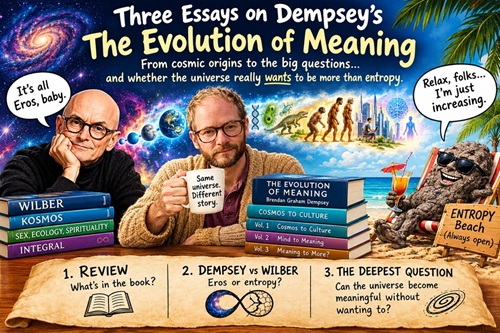 There is a deceptively simple question at the heart of every cosmic theory of evolution: Why does complexity happen at all? The question becomes particularly pressing when the theory wants to move from galaxies to stars, from stars to planets, from chemistry to life, from life to consciousness, and finally from consciousness to culture, meaning and perhaps the sacred. Ken Wilber answered the question metaphysically. Brendan Graham Dempsey is attempting to answer it thermodynamically and informationally. That difference is crucial. Wilber's evolutionary worldview requires something like Eros: an intrinsic impulse toward greater complexity, consciousness and integration. Dempsey's The Evolution of Meaning attempts to replace this metaphysical impulse with a naturalistic account based on energy flows, entropy, self-organization, information and learning. If that works, Dempsey will have accomplished something quite significant. He will have rescued the evolutionary intuition at the heart of Wilber's cosmology while removing its most questionable metaphysical ingredient. But there is a catch. The moment thermodynamics begins to explain why complexity appears, it becomes very tempting to turn entropy itself into a new version of Eros. And that would simply move the problem rather than solve it. Wilber's missing mechanismWilber's evolutionary narrative is built around a profound intuition: evolution does not merely produce more of the same. It generates novelty. Particles become atoms. Atoms become molecules. Molecules become cells. Cells become organisms. Organisms develop nervous systems. Nervous systems produce increasingly sophisticated forms of cognition. Cognition produces language, culture and self-reflection. And eventually consciousness becomes capable of contemplating the entire evolutionary process from which it emerged. Wilber wants to understand this sequence as more than an accidental collection of historical events. Hence Eros. Evolution, for Wilber, has an intrinsic tendency toward greater depth, greater complexity and greater consciousness. His holarchical model gives this tendency an architectural expression: new levels transcend and include previous levels. The attraction of this model is obvious. It explains why evolution looks developmental. Its weakness is equally obvious. It risks explaining evolution by assuming what it is supposed to explain. Why does evolution move upward? Because there is an upward evolutionary impulse. Why does complexity emerge? Because Eros drives complexity. Why does consciousness appear? Because consciousness is implicit in the Kosmos. This is metaphysics, not evolutionary explanation. And this is precisely where Dempsey's project becomes interesting. Enter entropyEntropy seems at first to offer the perfect antidote to Wilber's spiritualized evolutionary story. The second law of thermodynamics tells us that the entropy of an isolated system does not spontaneously decrease. So how can an ordered universe produce increasingly elaborate structures? The obvious answer is that the second law does not prohibit local order. Open systems can become more organized while exporting entropy to their environments. A whirlpool can emerge in flowing water. A convection cell can spontaneously organize in a heated fluid. A hurricane can develop astonishing structure from atmospheric energy gradients. A living organism can maintain its organization by continuously taking in energy and exporting waste heat and entropy. No cosmic Eros is necessary. The apparent paradox disappears once we stop imagining the second law as a universal commandment that everything must become progressively disordered at every location. This is the foundation on which a naturalistic theory of complexity can be constructed. But an important warning follows. Self-organization is not the same thing as evolution. And evolution is not the same thing as progress. The refrigerator does not want to become a philosopherThis distinction is easily lost in grand narratives. A physical system can spontaneously organize because of the constraints imposed by its environment and the flow of energy through it. That does not mean that the system has an intrinsic preference for organization. A convection cell does not "strive" to become more complex. A crystal does not "learn" to crystallize. A hurricane does not aspire to consciousness. The language of purpose becomes metaphorical very quickly. This matters because Dempsey's central idea is precisely that the universe can be understood as a learning process. The metaphor is powerful. But it needs to be disassembled. A learning system normally changes its future behavior because information acquired from previous states affects subsequent states. Biological organisms clearly do this. A bacterium can alter its behavior according to environmental conditions. An animal can modify its behavior through experience. A human can deliberately acquire knowledge. A culture can preserve information across generations. But does a galaxy learn? Does a star learn? Does a chemical reaction learn? The answer depends entirely upon how far we are prepared to stretch the word "learning." If "learning" simply means that the state of a system is constrained by its previous states, then practically everything learns—and the word loses much of its explanatory force. If learning requires information storage, adaptive modification and some functional relation to an environment, then we have something much more interesting. But now learning begins somewhere in the history of life rather than at the beginning of the universe. This distinction could become decisive for Dempsey's theory. Entropy is not evolution's enemyThere is another misconception that needs to be cleared away. Evolution does not happen in spite of entropy. It happens within a thermodynamic universe. There is no battle between "entropy" on one side and "evolution" on the other. This is where some versions of integral cosmology become particularly confused. The narrative often becomes: Entropy pulls downward. Eros pushes upward. Matter winds down. Evolution winds up. Spirit counters entropy. It is a wonderfully dramatic story. It is also physically misleading. Evolution does not need to defeat entropy. Natural selection does not reverse the second law. A living organism is not a violation of thermodynamics. It is an exquisitely organized process through which energy and matter flow. The same is true of ecosystems. The emergence of local order is not a rebellion against entropy. It is entirely compatible with increasing total entropy. This should be one of the places where Dempsey decisively parts company with Wilber. There is no need for an anti-entropic cosmic principle. The physics is already strange and interesting enough. But then why does complexity increase?Now we arrive at the genuinely difficult question. If entropy does not push evolution upward, why do we see episodes of extraordinary complexity in cosmic and biological history? The answer cannot simply be "because entropy increases." That is too crude. Entropy provides constraints and statistical tendencies. Energy gradients provide opportunities. Nonequilibrium conditions permit organized structures to arise and persist. Selection can preserve some structures and eliminate others. The combination can produce remarkable complexity. But there is no general law saying that complexity must continually increase. This is crucial. Evolution has produced both complexity and simplification. Parasites can lose biological functions. Cave organisms can lose eyes. Genomes can undergo substantial reduction. Lineages can remain stable for enormous periods. Species go extinct. Entire branches of life disappear. There is no universal evolutionary ladder. The history of life is a branching tree, not a staircase. Human beings occupy one particularly elaborate branch of that tree. We are not the inevitable destination of the tree. That fact places a severe constraint on any cosmic theory of evolution. The accidental genius of natural selectionNatural selection provides something that Wilber's Eros does not: a mechanism for direction without foresight. This is one of Darwin's deepest insights. Selection can produce increasingly well-adapted organisms without anyone or anything knowing where evolution is going. There is no need for evolution to "want" eyes in order for eyes to evolve. There is no need for life to "want" intelligence in order for intelligence to evolve. There is no need for the universe to "want" humans in order for humans to appear. Selection operates retrospectively. Variations occur. Some work better than others under particular circumstances. Those variants reproduce more successfully. The result can look astonishingly purposeful. But the purpose is not necessarily present beforehand. This is why Darwinian evolution remains such a powerful antidote to cosmic teleology. The appearance of design does not demonstrate a designer. And the appearance of direction does not demonstrate a destination. Dempsey's opportunity: direction without destinyThis is where Dempsey could make his most important contribution. The strongest version of his theory does not need to claim that complexity is inevitable. It needs only to explain why certain kinds of complexity become possible and sometimes statistically favored under particular conditions. That is a much more modest claim. It also gives us a fascinating distinction: direction without destiny. A system can have preferred trajectories without having a final goal. A river flows downhill without "wanting" the ocean. A convection system develops characteristic structures under appropriate conditions. Natural selection favors certain adaptations in a given environment. Cultural evolution can favor certain forms of information transmission. None of these processes needs to know the final outcome. This gives Dempsey a potential middle ground between two extremes. On one side: Everything is blind randomness. On the other: Everything is moving toward a predetermined cosmic Omega Point. Reality may be neither. There can be structured possibility without cosmic purpose. That is a much more sophisticated evolutionary philosophy. Where Dempsey must resist his own language The problem is that Dempsey's language sometimes pulls in the opposite direction. "Learning." "Meaning." "Complexification." "Emergence." "Direction." "Teleology." These are powerful words. But they are not interchangeable. A system can become more complex without becoming more meaningful. A system can process more information without understanding it. A system can become better adapted without becoming wiser. A culture can accumulate knowledge while becoming morally pathological. And evolution can produce consciousness without proving that consciousness was its goal. The danger is that the narrative can silently move through the following sequence: energy → organization → information → learning → meaning → consciousness → value → purpose. Every transition is plausible enough to make the next one sound inevitable. But none is automatically entailed by the previous one. This is the philosophical work Dempsey must still perform. From information to valueThe most difficult transition may not be information to consciousness. It may be information to value. A biological organism treats some environmental differences as significant. Food matters. Predators matter. Temperature matters. Reproduction matters. This is a genuine form of value—but it is biological value. Human beings introduce another dimension. Truth can matter even when it offers no immediate survival advantage. Beauty can matter. Justice can matter. The welfare of strangers can matter. A person can sacrifice reproductive fitness for an abstract ideal. A scientist can devote decades to understanding something that has no obvious practical benefit. An artist can create something that has no survival function whatsoever. This is where biological meaning becomes cultural meaning. And it is precisely where Dempsey's theory must become more than thermodynamics. The emergence of human values cannot simply be inferred from the existence of energy gradients. Something new has happened. The question is what. Wilber's shortcutWilber solves this problem by making consciousness fundamental. If consciousness is present at every level of reality in some rudimentary form, then human consciousness is not an inexplicable emergence from unconscious matter. It is an elaboration of something already present. This is the attraction of panpsychist or quasi-panpsychist metaphysics. It solves one problem by creating another. If consciousness is everywhere, where is the evidence? And what does "consciousness" mean at the level of an electron? If the answer is that it means only a primitive interiority, then the claim becomes almost impossible to test. Dempsey takes the opposite route. Consciousness is an emergent achievement. That preserves the scientific picture more comfortably. But it leaves the hard problem intact. Neither theory gets a free pass. Wilber pays the metaphysical price upfront. Dempsey pays the explanatory price at emergence. The great lesson of self-organizationThere is nevertheless something Dempsey can take from complexity science without falling into either trap. Self-organization teaches us that order does not always need to be imposed from above. This is philosophically important. Order can emerge from local interactions. Patterns can arise without a central controller. Global organization can arise from simple rules. This gives us a powerful naturalistic model for understanding emergence. And it directly undermines a certain kind of metaphysical thinking. We do not need to posit a cosmic architect every time we encounter order. But the lesson cuts both ways. Self-organization also does not prove that the universe has an intrinsic drive toward higher-order consciousness. The fact that order can emerge spontaneously does not tell us that the universe prefers order in some ultimate sense. It simply tells us that given certain conditions, order can emerge. That "given certain conditions" is doing a lot of work. The cosmic arrow problemDempsey's most interesting challenge is therefore to distinguish three different arrows. The first is the thermodynamic arrow. This concerns the statistical direction of increasing entropy. The second is the evolutionary arrow. This concerns the historical accumulation of adaptations through heredity and selection. The third is the developmental or cultural arrow. This concerns the emergence of increasingly sophisticated forms of cognition, symbolism, institutions and meaning. These arrows interact. But they are not identical. Entropy does not cause natural selection. Natural selection does not automatically cause moral progress. Cultural complexity does not prove cosmic purpose. A theory that collapses all three arrows into one grand evolutionary tendency becomes elegant at precisely the point where it becomes scientifically suspect. A theory that distinguishes them may be less aesthetically satisfying—but more explanatory. What "winding up" really meansThis is where the old Wilberian opposition between "winding down" and "winding up" deserves particular criticism. The metaphor is intuitively powerful. Entropy winds down. Evolution winds up. The universe therefore contains a mysterious counterforce to entropy. But the metaphor mistakes different descriptions for competing processes. Entropy is a statistical property of physical states. Evolution is a historical process involving variation, heredity and differential reproduction. Complexification is an emergent phenomenon occurring under particular physical and biological conditions. There is no single cosmic cable being pulled simultaneously in opposite directions. The universe is not a machine with one spring winding down while another spring winds up. Once that metaphor is abandoned, much of the mystery disappears. And that is a good thing. Science often progresses by discovering that the problem we thought needed metaphysical explanation was partly created by a misleading metaphor. Has Dempsey solved Wilber's problem?Not yet. But he may have reformulated it in a much more productive way. Wilber asks: What drives evolution toward greater complexity and consciousness? His answer is essentially: Eros, the intrinsic evolutionary impulse of Spirit. Dempsey asks something closer to: How can thermodynamic, informational and evolutionary processes generate increasingly sophisticated forms of organization and meaning? That is a much better question. But it does not yet justify saying that the universe itself is learning, meaning-making or moving toward a goal. The strongest Dempsey thesis may therefore be narrower than the rhetoric of a "theory of meaning" initially suggests. He may be able to show that meaning has a natural history. That is already a major achievement. He does not need to show that the universe has always been meaningful. Nor does he need to show that evolution was destined to produce meaning. The distinction is enormous. The post-Wilberian possibilityThis is perhaps where Dempsey's project could become genuinely important for integral thought. Wilber's great insight was that evolution cannot be reduced to biological evolution. There is also psychological evolution. Cultural evolution. Moral evolution. Spiritual development. Dempsey shares this intuition. But he appears to be searching for a foundation that does not require the metaphysical assumption that evolution is an expression of Spirit. That is potentially the beginning of a post-Wilberian integral theory. Not: Spirit → evolution → complexity → consciousness → culture. But: energy flows → self-organization → life → information processing → adaptive intelligence → symbolic cognition → culture → reflective meaning. The second sequence is less mystical. But it is also more difficult. Every arrow has to be earned. And that is precisely what makes it intellectually valuable. The final ironyThere is a delicious irony in the comparison. Wilber wanted to rescue meaning from the apparent meaninglessness of modern science by placing Spirit back into the evolutionary story. Dempsey wants to show how meaning can emerge from the very processes that modern science studies. Wilber says, in effect: meaning was there all along. Dempsey says: meaning emerged. The first is metaphysically satisfying. The second is scientifically audacious. But there is a third possibility that may ultimately be more interesting: meaning emerged naturally, but once it emerged it became capable of discovering dimensions of reality that cannot be reduced to the conditions of its emergence. That would allow us to preserve both evolutionary naturalism and the genuine depth of human meaning. A Beethoven symphony need not have existed in the Big Bang to be real. Justice need not be encoded in the laws of thermodynamics to matter. Consciousness need not have been present in every electron to be one of the strangest things the universe has produced. And the fact that evolution had no predetermined destination does not make human meaning unreal. It makes its emergence more astonishing. Entropy without ErosThis may therefore be the conceptual prize waiting at the end of Dempsey's project: entropy without Eros. A universe governed by thermodynamic constraints does not need a cosmic desire for complexity. Self-organization does not require a cosmic mind. Evolution does not require foresight. Natural selection does not require a destination. Consciousness does not have to be smuggled into matter as a metaphysical ingredient. And meaning does not have to be present at the beginning in order to become real later. The universe can begin without a purpose and still produce beings capable of purposes. It can begin without meaning and still generate meaning-makers. It can have no destination and still produce creatures obsessed with destinations. That is, perhaps, the most profound evolutionary fact of all. A better cosmic storyDempsey therefore deserves credit for taking the question that animated Wilber and placing it on a potentially firmer foundation. But he should resist the temptation to finish the story too quickly. The scientific lesson of entropy is not that the universe is winding down while evolution mysteriously winds up. It is that local organization can emerge within a universe whose total entropy increases. The lesson of self-organization is not that matter wants to become life. It is that complex patterns can arise spontaneously under appropriate conditions. The lesson of natural selection is not that evolution has a goal. It is that directional adaptation can arise without foresight. The lesson of cultural evolution is not that history necessarily progresses. It is that information, symbols and institutions can accumulate and transform across generations. And the lesson of human consciousness may not be that the universe was secretly conscious all along. It may be something stranger: the universe eventually produced a process capable of asking what the universe means. That is enough. We do not need to turn entropy into Eros to make the story magnificent. Indeed, the story may become more magnificent once we stop doing so. If Dempsey's Evolution of Meaning can maintain that discipline across its enormous intellectual range, he may have found a way beyond one of the central weaknesses of Wilber's evolutionary cosmology. Not by proving that evolution is spiritually directed. Not by proving that complexity was inevitable. Not by discovering a cosmic purpose hidden inside the second law of thermodynamics. But by showing how a universe governed by impersonal processes can nevertheless generate organization, life, intelligence, culture and meaning. That would not be a new version of Wilber's Eros. It would be something considerably more interesting: a theory of how the universe can become meaningful without ever having had to mean anything from the start.
Widget is loading comments...
|