|
TRANSLATE THIS ARTICLE
Integral World: Exploring Theories of Everything
An independent forum for a critical discussion of the integral philosophy of Ken Wilber
  Frank Visser, graduated as a psychologist of culture and religion, founded IntegralWorld in 1997. He worked as production manager for various publishing houses and as service manager for various internet companies and lives in Amsterdam. Books: Ken Wilber: Thought as Passion (SUNY, 2003), and The Corona Conspiracy: Combatting Disinformation about the Coronavirus (Kindle, 2020). Frank Visser, graduated as a psychologist of culture and religion, founded IntegralWorld in 1997. He worked as production manager for various publishing houses and as service manager for various internet companies and lives in Amsterdam. Books: Ken Wilber: Thought as Passion (SUNY, 2003), and The Corona Conspiracy: Combatting Disinformation about the Coronavirus (Kindle, 2020).
Check out my other conversations with ChatGPT
From Cosmos to CultureBrendan Graham Dempsey's The Evolution of Meaning and the Return of the Cosmic StoryFrank Visser / ChatGPT
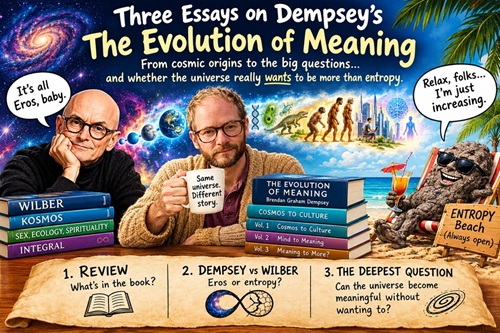 There is something almost inevitably ambitious about a book called The Evolution of Meaning. Meaning is not a modest subject. To ask where meaning comes from is to ask how dead matter became living matter, how living matter became sentient, how sentience became mind, how minds became cultures, and how cultures came to ask questions about value, purpose, God and the sacred. It is, in other words, to ask how the universe eventually became capable of asking what the universe means. Brendan Graham Dempsey's The Evolution of Meaning, Volume 1: Cosmos to Culture takes precisely this gamble. At 746 pages, it is not merely another contribution to the contemporary literature on meaning, complexity or metamodernism. It is an attempt to construct a grand narrative in which thermodynamics, information, evolution, cognition and culture can be understood as successive expressions of a single underlying process. That makes the book intellectually exciting. It also makes it vulnerable. Dempsey is attempting something that has become increasingly unfashionable in the humanities and increasingly attractive in certain corners of contemporary philosophy and complexity thinking: a unified evolutionary worldview. The basic intuition is that meaning did not suddenly appear when human beings invented language. Human meaning has a history, and that history reaches backwards through mind and life into the physical conditions that made both possible. Dempsey's project therefore begins where most theories of meaning do not: with energy and information. His central proposal is that meaningful information is information that makes a difference to the continued viability of an entity within its environment. From this perspective, meaning can be traced through increasingly sophisticated forms of information processing. Matter exhibits one kind of "learning"; life another; nervous systems another; human symbolic culture another. Meaning consequently becomes richer as the systems capable of processing information become more complex. This is an attractive idea. But it is also where the real philosophical work begins. The audacity of beginning with physicsOne of Dempsey's great strengths is that he refuses to treat human meaning as a supernatural interruption of an otherwise meaningless universe. He wants continuity rather than discontinuity. That places him within a long intellectual tradition. Pierre Teilhard de Chardin famously attempted to interpret cosmic evolution as an ascending movement toward greater complexity and consciousness. Erich Jantsch described evolution as a self-organizing process of cosmic development. Eric Chaisson has charted increasing complexity through cosmic evolution. Big History has attempted to place human history within the 13.8-billion-year history of the universe. And the NASA volume Cosmos and Culture explicitly explored the relationship between physical, biological and cultural evolution. Dempsey enters this already crowded territory with a particularly interesting twist: meaning itself becomes an evolutionary phenomenon. That is a stronger claim than saying that complexity increases. Stars become more complex than elementary particles; organisms become more complex than stars; nervous systems become more complex than organisms; human societies become more complex than nervous systems. But complexity by itself is not meaning. Dempsey therefore attempts to connect complexity to information acquisition. An organism survives because it possesses information about its environment. A nervous system greatly expands the capacity to acquire and process such information. A symbolic system expands it again, allowing information to be stored, transmitted and recursively transformed outside the individual organism. The universe thus becomes, in Dempsey's formulation, something like a gigantic learning process. This is the book's most compelling idea. It is also the idea that requires the most careful scrutiny. Does the universe really learn?There is a seductive metaphor at work here. Stars do not "learn" in the ordinary sense. Neither do molecules. A bacterium, however, can respond adaptively to its environment. An animal can modify its behaviour on the basis of experience. A human being can consciously acquire knowledge. A culture can accumulate knowledge across generations. The progression is real. But whether it should be called learning at every level is another question. The danger is that an explanatory metaphor gradually becomes an ontological claim. Dempsey is aware of this danger, and his framework is considerably more sophisticated than a simple "the universe wants to evolve" narrative. Nevertheless, the vocabulary of learning, meaning, value and purpose inevitably carries anthropomorphic baggage when it is projected down to the physical level. This is particularly important because Dempsey's argument increasingly approaches teleology. He has explicitly argued elsewhere that the entropic tendency toward dissolution can itself be understood as an impetus toward coherence: "the natural tendency to dissolve is the very impetus to cohere." This is provocative, but it needs to be distinguished carefully from the much stronger claim that the universe possesses an intrinsic drive toward complexity, meaning or consciousness. The former can be defended as an interpretation of far-from-equilibrium dynamics. The latter requires much more. The entropy problemThis is perhaps the point at which Dempsey's project should be read most critically. There is a persistent temptation in cosmic-evolution literature to tell the following story: entropy increases → energy gradients drive self-organization → complexity increases → life emerges → consciousness emerges → meaning emerges. As a broad narrative, this is enormously appealing. As physics, however, it is dangerously easy to oversimplify. The second law of thermodynamics does not say that the universe "wants" to become complex. Nor does entropy itself constitute an evolutionary force pushing matter upward. Local systems can indeed become more ordered and complex while exporting entropy to their surroundings, but this is perfectly compatible with the second law. The appearance of biological complexity therefore does not require a cosmic preference for complexity. This distinction matters because Dempsey wants to derive more than complexity from the physics. He wants to derive meaning. The crucial question is consequently: At what point does information become meaning? If meaning is defined functionally—as information that makes a difference to an entity's viability—then Dempsey has a potentially powerful naturalistic theory. But the definition also risks becoming so broad that "meaning" ceases to mean what philosophers, psychologists and ordinary people normally mean by it. A rock can be said to contain information about its environment. A thermostat processes information. A bacterium detects chemical gradients. A human being interprets a poem. Are these four cases manifestations of the same phenomenon? Perhaps. But "perhaps" is precisely where the philosophical burden lies. From information to meaningDempsey's strongest conceptual move is also his most controversial: meaning is not identical with information. Information theory, in the Shannonian sense, deliberately abstracts away from semantic content. Shannon's information measures uncertainty reduction, not significance, value or existential importance. A string of random symbols can contain enormous Shannon information while meaning absolutely nothing. Dempsey therefore needs a richer conception of information—one in which information is connected to an organism or system's successful interaction with its environment. This move is defensible and has precedents in biology, cybernetics, semiotics and philosophy of information. But once meaning becomes tied to viability, another problem appears. Human beings routinely assign meaning to things that reduce rather than enhance viability. Martyrdom, artistic creation, philosophical contemplation, truth-seeking, sacrifice and religious devotion can all conflict with immediate biological survival. Meaning therefore seems to become progressively detached from the very biological function from which Dempsey wants to derive it. And this may actually be where the story becomes most interesting. Perhaps meaning begins as adaptive information but becomes something radically more than adaptive information. That would preserve Dempsey's evolutionary continuity without reducing human meaning to survival. Matter, life, mind, cultureDempsey's architecture is built around four broad domains: Matter → Life → Mind → Culture. This sequence has obvious affinities with Ken Wilber's familiar evolutionary architecture, although Dempsey's intellectual machinery is considerably different. Wilber's holarchical model famously describes reality as composed of "holons": wholes that are simultaneously parts of larger wholes. His evolutionary story likewise moves from matter to life to mind and beyond, while insisting that higher levels transcend and include lower ones. Dempsey's framework is less metaphysical and more informational. Instead of asking primarily what ontological levels exist, he asks what kinds of information processing and learning become possible at each stage. That is a genuine improvement over some versions of integral metaphysics. But the resemblance to Wilber is nevertheless striking. Both thinkers see evolution as a process of emergence. Both reject a flat materialism in which consciousness and culture are merely epiphenomenal accidents. Both insist that higher-order phenomena cannot simply be reduced to their lower-order constituents. Both ultimately want to interpret the emergence of meaning and value within a cosmic evolutionary story. And both are tempted by the possibility that evolution is not merely change but development. This is where Dempsey's project becomes particularly relevant to readers of Wilber. Dempsey after Wilber?The interesting question is not whether Dempsey is another Ken Wilber. He isn't. The more interesting question is whether Dempsey represents a post-Wilberian reconstruction of some of Wilber's central intuitions without Wilber's more extravagant metaphysics. That would be a genuinely important development. Wilber's great contribution was to insist that evolutionary history has a structural dimension: matter gives rise to life, life to mind, and mind to increasingly complex forms of cultural and spiritual organization. His great weakness is that he repeatedly moves from empirical evolutionary history to a metaphysical cosmology in which evolution seems to express an inherent cosmic Eros. Dempsey appears to be trying to occupy the territory between reductionism and metaphysics. Meaning is real. Value is real. Complexity is real. Culture is real. But none of these necessarily requires a supernatural designer—or even a cosmic consciousness. That is a much more defensible starting point. The danger is that the language of "universal learning," "complexification" and cosmic meaning can quietly reintroduce through the back door the teleology that naturalistic evolutionary theory expelled through the front. The shadow of TeilhardDempsey's project also inevitably recalls Teilhard de Chardin. Teilhard saw evolution as an increasingly complexifying process culminating in consciousness, collective consciousness and ultimately the Omega Point. The attraction of his vision is obvious: it provides a grand narrative capable of reconnecting science, humanity and spirituality. Dempsey is more contemporary and considerably more informed by information theory and complexity science. But the structural temptation remains. Matter gives rise to life. Life gives rise to mind. Mind gives rise to culture. Culture becomes capable of reflecting upon the entire process. And at the end of this story, the universe acquires something it did not possess before: explicit meaning. There is something undeniably beautiful about this narrative. But beauty is not evidence. The critical reader must continually distinguish three different propositions: Evolution produces complexity. Complexity produces consciousness and culture under suitable conditions. Evolution itself is therefore meaning-generating or meaning-directed. The first is uncontroversial in broad outline. The second is scientifically and philosophically rich but still contains enormous unresolved questions. The third is a philosophical interpretation. Dempsey's greatest achievement will be to persuade us of the first two without pretending that the third has already been scientifically demonstrated. Why 746 pages?The extraordinary length of the new edition raises another interesting question. A book of 746 pages announces itself as more than an introduction. It wants to be architecture. And architecture is precisely what Dempsey is attempting. His earlier formulation was much more compact: the original A Universal Learning Process was only around 150 pages in its published form, and Dempsey himself described it as the introductory volume to a much larger project. In conversation with Jim Rutt, he explained that he had originally imagined something approaching a thousand-page book before deciding to serialize the project. That history makes the enormous new volume particularly revealing. The temptation of the grand synthesis is always the temptation of accumulation. Once one has connected physics to biology, biology to cognition, cognition to culture, and culture to spirituality, the bibliography grows almost exponentially. But comprehensiveness is not necessarily explanatory power. Indeed, the great danger of any contemporary "theory of everything" is that it can become a theory of everything that has already been selected to fit the theory. Dempsey deserves credit for taking on the entire problem. He should also be judged by whether his conceptual distinctions survive that enormous range. And then comes GodPerhaps the most provocative destination of the project is the sacred. Dempsey has already announced that later volumes will trace the evolution of meaning, value and the sacred through human cultural history. His own description is remarkably explicit: after billions of years of cosmic complexification, the sacred emerges within human culture, and "God awakened in the mind of mankind." That sentence encapsulates both the brilliance and the danger of the project. It can be read naturalistically: God is a cultural achievement of symbolic cognition. Religious concepts emerge as increasingly sophisticated systems for organizing human meaning. But it can also be read more metaphysically: the universe has progressively developed the capacity to become conscious of the sacred through human beings. Those are very different claims. The first is an evolutionary theory of religion. The second is a philosophy of cosmic self-transcendence. Dempsey's future volumes will therefore be decisive. The real test of the project will not be whether he can demonstrate that religious concepts change through history. That is already abundantly established. The harder question is whether this historical development tells us anything about the truth of the meanings being developed. Evolution explains why we believe. It does not automatically tell us whether what we believe is true. A new Kosmos trilogy?And here we come to the provocative comparison with Wilber. There is a distinctly Kosmos-like ambition in Dempsey's undertaking. Wilber's Kosmos project attempted to assemble an enormous evolutionary vision integrating physics, biology, consciousness, psychology, culture, spirituality and social transformation. It was not simply another philosophical system. It was an attempt to provide a map of reality sufficiently comprehensive to locate science, religion and human development within one overarching framework. Dempsey is operating in the same intellectual neighborhood. But there is an important difference. Wilber starts from an elaborate metaphysical architecture and then attempts to integrate scientific findings into it. Dempsey appears to start from evolutionary science, information, learning and complexity, and then asks what philosophical and spiritual implications follow. That reversal is significant. If Dempsey can maintain it, he may offer something that contemporary integral theory has often lacked: a cosmic evolutionary narrative that does not require accepting Wilber's full metaphysical apparatus. But the comparison also produces a warning. The original Evolution of Meaning project was announced not as a trilogy but as a much larger series—Dempsey has spoken of a projected twelve volumes, with later volumes moving from psyche and symbolic learning toward society and the historical evolution of meaning and the sacred. In other words, the danger of comparison with Wilber may be precisely the wrong lesson. We do not need another Kosmos. We need a better test of cosmic narratives. The real challengeThe central question Dempsey raises is therefore not whether the universe has meaning. It is whether meaning can be given a natural history without being reduced to chemistry, and whether that natural history can illuminate the emergence of values without smuggling values into physics from the beginning. That is a difficult balancing act. A successful theory must avoid two opposite errors. The first is reductionism: Meaning is nothing but neural activity. The second is metaphysical inflation: Meaning is built into the universe as a cosmic force driving evolution toward consciousness. Between those positions lies a fascinating possibility. Meaning may be an emergent natural phenomenon whose existence becomes increasingly consequential as information-processing systems become more complex. On this interpretation, there is no need to say that the universe "wanted" human beings to appear. But once human beings appeared, something genuinely new happened. The universe acquired organisms capable of representing the past, imagining the future, communicating across generations, constructing symbolic worlds, evaluating alternatives, asking normative questions and wondering why anything exists at all. Meaning did not have to be present at the Big Bang in order to become cosmically significant. That distinction may ultimately be Dempsey's most important contribution. From cosmic evolution to cultural evolutionThe first volume therefore should not be judged solely by whether every step of its cosmic argument succeeds. Its greater significance may lie in what it makes possible. If matter, life, mind and culture can be understood as increasingly sophisticated regimes of information processing, then human cultural history becomes a legitimate continuation of natural history without being reducible to it. That is a powerful research program. And it leads directly to the questions Dempsey wants to pursue in subsequent volumes: How do symbolic systems evolve? How does the psyche become more complex? How do moral and religious frameworks change? Can the evolution of worldviews be measured? And what happens to the sacred when traditional religious forms encounter modernity, postmodernity and metamodernity? These are much more interesting questions than the familiar debate between "science" and "spirituality." They suggest that spirituality itself can become an object of evolutionary inquiry. But here too caution is necessary. Evolution does not necessarily move upward. Complexity is not synonymous with goodness. Later is not necessarily better. More differentiated is not necessarily more truthful. A more complex culture can be more destructive than a simpler one. A sophisticated ideology can produce more suffering than an unsophisticated superstition. Human beings can become more technologically powerful without becoming morally wiser. This is precisely where the rhetoric of evolutionary "development" needs to be restrained by history. Verdict: a grand experiment rather than a finished theoryThe Evolution of Meaning is best understood not as a final theory of meaning but as a grand intellectual experiment. Its ambition is admirable. Its central intuition—that meaning has an evolutionary history extending from physical information processing through life and mind into symbolic culture—is fertile. Its attempt to connect thermodynamics, information theory, complexity, cognition and cultural evolution is intellectually serious. And its naturalistic treatment of the sacred is potentially more interesting than either conventional religion or conventional reductionism. But its weakest point is also clear. Whenever "learning," "meaning," "value," "purpose" and "complexification" begin to sound like properties of the cosmos itself, the argument risks crossing the line from evolutionary explanation into metaphysical storytelling. That line must be watched relentlessly. The ultimate test will therefore come in the volumes still to come. Can Dempsey explain the evolution of human meaning without assuming that evolution is intrinsically meaningful? Can he describe increasing complexity without turning it into progress? Can he naturalize the sacred without trivializing it? And can he derive genuine philosophical significance from cosmic evolution without pretending that physics has already delivered a philosophy of value? If he can, The Evolution of Meaning could become an important contribution to the emerging post-integral landscape. If he cannot, it may become another magnificent cosmic story in which the universe mysteriously turns out to be heading in precisely the direction its storyteller hoped it was heading. That is why the comparison with Wilber is so tempting—and why it should ultimately be resisted. The interesting question is not whether Dempsey has written a new Kosmos. It is whether he has found a way to tell the cosmic story without turning the story into a cosmic doctrine. At 746 pages, that is quite a wager. And, perhaps more importantly, quite a fascinating one.
Widget is loading comments...
|