|
TRANSLATE THIS ARTICLE
Integral World: Exploring Theories of Everything
An independent forum for a critical discussion of the integral philosophy of Ken Wilber
  Frank Visser, graduated as a psychologist of culture and religion, founded IntegralWorld in 1997. He worked as production manager for various publishing houses and as service manager for various internet companies and lives in Amsterdam. Books: Ken Wilber: Thought as Passion (SUNY, 2003), and The Corona Conspiracy: Combatting Disinformation about the Coronavirus (Kindle, 2020). Frank Visser, graduated as a psychologist of culture and religion, founded IntegralWorld in 1997. He worked as production manager for various publishing houses and as service manager for various internet companies and lives in Amsterdam. Books: Ken Wilber: Thought as Passion (SUNY, 2003), and The Corona Conspiracy: Combatting Disinformation about the Coronavirus (Kindle, 2020).
Check out my other conversations with ChatGPT
Dempsey vs. WilberWho Owns the Cosmic Evolution Story?Frank Visser / ChatGPT
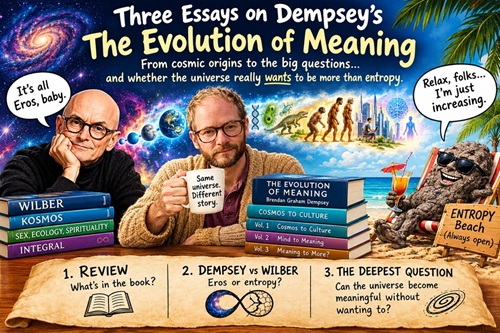 There is a curious historical symmetry surrounding Brendan Graham Dempsey's The Evolution of Meaning. Nearly three decades ago, Ken Wilber published Sex, Ecology, Spirituality, an enormous attempt to reinterpret the entire evolutionary history of the universe as part of a larger spiritual process. Wilber presented matter, life and mind as successive expressions of an underlying Kosmos, and attempted to unite scientific evolution with a perennialist metaphysics. Sex, Ecology, Spirituality was explicitly conceived as the first part of a projected Kosmos Trilogy. Dempsey's project now arrives in remarkably similar territory. Matter. Life. Mind. Culture. Complexity. Emergence. Information. Meaning. Consciousness. The sacred. The resemblance is too strong to ignore. But the differences may be more important than the similarities. Where Wilber starts with a metaphysical vision of evolution and then seeks scientific confirmation and elaboration, Dempsey starts much closer to thermodynamics, information processing and complexity theory and asks what kind of theory of meaning can emerge from them. That reversal could prove decisive. The question is therefore not whether Dempsey has written a new Wilberian Kosmos. The more interesting question is whether he has found a way to naturalize the evolutionary intuition that Wilber metaphysicized. The same mountain, a different routeWilber's great evolutionary narrative is already familiar. The universe develops from matter to life to mind. Each emergent level transcends and includes its predecessor. Evolution produces increasing depth, differentiation and complexity. At the human level, evolution becomes conscious of itself and can continue through cultural and spiritual development. In Sex, Ecology, Spirituality, Wilber explicitly tries to identify common patterns operating across physical, biological and mental evolution. But Wilber does not regard this as merely a scientific story. His "Kosmos" is deliberately larger than the physical cosmos. Matter, life and mind are manifestations of Spirit, and evolution becomes an expression of a deeper order. This gives Wilber's theory enormous existential appeal. It also creates its greatest vulnerability. If Spirit, Eros, depth and direction are already built into the ontology, then the evolutionary story risks becoming circular. Evolution demonstrates Spirit because Spirit is what evolution expresses. Evolution has direction because Eros gives it direction. Higher stages are more developed because evolution is development. The explanatory arrow can therefore point in both directions at once. Dempsey appears to be attempting something more difficult. He wants to explain why evolution can generate increasingly meaningful forms without beginning with a cosmic principle called Meaning. That is a much more interesting problem. Dempsey's crucial substitution: Eros becomes informationThe deepest contrast between the two thinkers may be expressed in one word. For Wilber: Eros. For Dempsey: Information. Wilber famously interprets evolution as driven by an inherent tendency toward greater differentiation, integration and consciousness. The evolutionary impulse is not simply mechanical change; it expresses something like an intrinsic drive toward higher-order organization. Dempsey's vocabulary is considerably more contemporary. Systems far from equilibrium can organize themselves. Energy flows through matter. Information about environments becomes consequential for systems capable of maintaining themselves. Increasingly complex entities acquire increasingly sophisticated ways of processing environmental information. Dempsey consequently proposes that the universe can be interpreted as undergoing an enormous learning process. His formulation explicitly connects meaningful information with the capacity of entities to remain far from thermodynamic equilibrium. This is an important move. It replaces a suspiciously metaphysical cosmic "drive" with something closer to a physical and informational constraint. The question becomes not: Why does the universe want to become more complex? but: Under what conditions do systems capable of retaining, processing and exploiting information emerge? That is a much better question. But is information really meaning?Here, however, Dempsey encounters his first major philosophical obstacle. Information is not automatically meaning. Shannon information measures uncertainty reduction. It does not measure significance, truth, beauty or existential importance. A random sequence can contain information without communicating anything meaningful. Dempsey therefore needs a richer concept of information—information that matters to the continued existence or organization of a system. This is where the thermodynamic argument becomes genuinely interesting. An organism is not simply a passive physical object. It must continually extract information from its environment and use that information to maintain itself. Meaning, in this sense, is not something pasted onto life from the outside. It emerges from the relationship between an organized system and the conditions necessary for its persistence. Dempsey's theory thus has a powerful naturalistic intuition: meaning begins as difference that makes a difference to a system. And from there, increasingly complex forms of meaning can emerge. This is considerably more defensible than saying that elementary particles possess tiny bits of consciousness. But it still leaves an enormous conceptual gap between biological significance and human meaning. A bacterium responding to a chemical gradient is one thing. A human being asking whether life has meaning is another. The question is whether the latter can really be understood as an elaboration of the former without reducing the former to a mere metaphor. The thermodynamic gambleThis is where Dempsey's project becomes most vulnerable to criticism. His argument connects the emergence of organized systems with the thermodynamic tendency of systems driven far from equilibrium to dissipate energy. There is substantial scientific literature exploring relationships between nonequilibrium thermodynamics, self-organization, information processing and biological organization. These are serious research programs, not pseudoscience. But none of this establishes a cosmic law of increasing complexity. That distinction is absolutely crucial. Self-organization is real. Complexity is real. Dissipative structures are real. Evolution is real. Information processing is real. None of those propositions by itself entails: the universe is trying to produce consciousness. This is precisely the point at which Dempsey needs to be more careful than Wilber. Wilber was quite willing to interpret evolutionary directionality in explicitly metaphysical terms. Dempsey wants to derive directionality from the dynamics of emergence. That is more scientifically respectable. But it also raises the evidential bar. If evolution is a "learning process," what exactly constitutes learning at the level of a star? If cosmic complexification is "meaning," who or what is the bearer of that meaning? If entropy supplies an "impetus" toward organization, how does this differ from a metaphorical description of what physical systems happen to do under particular constraints? These are not semantic quibbles. They determine whether Dempsey has discovered a genuine bridge between physics and meaning—or merely constructed a sophisticated vocabulary for an already familiar evolutionary myth. Wilber's Eros problemThis brings us back to Wilber. One of the enduring problems in Wilber's evolutionary philosophy is the status of Eros. Evolution clearly generates novelty. It clearly generates new levels of organization. It clearly produces astonishing increases in complexity in some historical lineages. But does this imply an intrinsic cosmic urge toward higher consciousness? Wilber says, in effect, yes. And once this move is made, several scientific problems arise. Evolution is not a ladder. It has no guaranteed destination. Most species go extinct. Most evolutionary experiments fail. Complexity can decrease. Organisms can become simpler. Lineages can remain remarkably stable for enormous periods. Natural selection has no foresight. The appearance of human beings was not obviously written into the laws of physics. The distinction between evolutionary history and developmental progress is therefore fundamental. Wilber repeatedly slides between them. Dempsey's framework potentially gives us a way to avoid that slide. Instead of claiming that evolution is intrinsically progressive, he can argue that certain conditions generate increasingly sophisticated capacities for information acquisition, retention and transformation. That does not require foresight. It does not require a cosmic intention. It does not require Spirit. And it does not require the universe to have "wanted" humanity. That would be a significant advance. Yet Dempsey has his own teleological temptationBut here is the irony. Dempsey may be in danger of recreating the very teleology he wants to naturalize. His language of "learning" is particularly revealing. Learning normally involves a system that:
Can we meaningfully attribute all five properties to cosmic evolution? Perhaps in a generalized sense. But then "learning" risks becoming a metaphor for irreversible change. The danger is subtle. First: systems change in response to environmental conditions. Then: systems acquire information. Then: systems learn. Then: the universe is learning. The final proposition may sound like the culmination of the previous three, but it is not logically entailed by them. This is the point where Dempsey must resist his own rhetoric. The Wilber paradox: emergence versus transcendenceWilber's concept of the holon gives him an elegant solution to another problem. Every new level transcends and includes the previous level. Mind transcends matter but includes matter. Life transcends chemistry but includes chemistry. Culture transcends biology but includes biology. This gives Wilber an extraordinarily effective vocabulary for talking about emergence. But it also introduces a metaphysical hierarchy. Higher means deeper. Greater depth means greater evolutionary achievement. And eventually spiritual development can be placed on the same evolutionary continuum as the emergence of galaxies and organisms. That is precisely where the model becomes questionable. A galaxy is not "less developed" than a human being in the same sense that an infant is less cognitively developed than an adult. Different kinds of organization should not automatically become stages on one developmental ladder. Dempsey's informational approach potentially avoids this problem by asking what new capacities emerge rather than assuming that every new level is a higher rung on a single hierarchy. That is a much more promising approach. But only if he actually maintains it. The great unresolved question: emergenceBoth Wilber and Dempsey need emergence. Neither wants consciousness to be reducible to chemistry. Neither wants culture to be reducible to neurons. Neither wants meaning to disappear into physics. But neither can simply invoke "emergence" as an explanatory magic word. There is a huge difference between: X appears when a system reaches a certain degree of organization and: We understand why X appears. The first is an observation. The second is an explanation. The problem becomes particularly acute with consciousness. Matter ? life is already an enormous conceptual transition. Life ? sentience is another. Sentience ? reflective consciousness is another. Consciousness ? symbolic culture is another. Culture ? cumulative civilization is another. And culture ? explicit reflection upon the entire cosmic process is yet another. Dempsey's project is at its most interesting when it treats these transitions as increases in informational dimensionality. But the explanatory burden remains. Why should information processing ever become experience? Why should a system that models the world also possess a first-person point of view? Why should information become meaning for someone? These are not problems that thermodynamics has yet solved. And they are precisely where Wilber's appeal to consciousness as fundamental has an advantage—though at the cost of making a much stronger metaphysical claim. Wilber solves the hard problem by changing the ontologyThis is perhaps the most important philosophical difference. Wilber can say: Consciousness was there all along. Dempsey wants to say: Consciousness emerged. The first position makes consciousness metaphysically fundamental. The second makes consciousness historically emergent. The first makes emergence easier to explain. The second makes science easier to respect. Neither position is free. If consciousness is fundamental, why does it take billions of years for human consciousness to emerge? If consciousness is emergent, how does subjective experience emerge from processes that apparently have no subjective character? This is the real philosophical fault line beneath the two evolutionary cosmologies. And then there is cultureDempsey becomes particularly interesting when he moves from cosmic evolution to cultural evolution. Here the analogy with Wilber becomes almost uncanny. Wilber argues that human consciousness develops through recognizable structures or stages, and that cultures embody different levels of complexity. Dempsey likewise argues that cultures evolve as they encounter increasing complexity, and he connects this process to the emergence of metamodernism. Both thinkers therefore reject the idea that all worldviews are simply interchangeable perspectives. Both see historical development. Both believe that later cultural structures can integrate earlier ones. Both are concerned with what happens when older meaning systems become inadequate to new levels of complexity. This is where the Wilberian inheritance becomes unmistakable. But again, Dempsey has an opportunity to improve upon Wilber. The language of stages is notoriously vulnerable to cultural bias. Who decides which culture represents a higher stage? Does technological complexity equal psychological complexity? Does pluralism represent a higher evolutionary stage than traditionalism? Can a culture possess advanced science while retaining archaic moral structures? Can an allegedly "higher" culture become pathological? These questions seriously complicate any developmental model. Dempsey's cultural theory will therefore have to demonstrate that his stages are more than a flattering map of contemporary Western self-understanding. The metamodern problemThis is particularly important because Dempsey's cultural evolution culminates, at least in part, in metamodernity. Metamodernism is attractive precisely because it promises to move beyond the sterile opposition between modernism and postmodernism: science without scientism, meaning without dogmatism, idealism without naïveté, spirituality without fundamentalism. But there is a danger here too. What if "metamodernism" is simply the worldview of a particular educated Western subculture? What if the supposed evolutionary transition from modernity to postmodernity to metamodernity is not an objective developmental sequence but a historical interpretation? Wilber faced precisely this criticism with his own stage models. Dempsey cannot escape the problem simply by replacing "integral" with "metamodern." The evolutionary map itself must be justified. The entropy disagreementThere is another reason the Dempsey-Wilber comparison matters. Wilber's evolutionary metaphysics has frequently treated entropy as one pole of a larger evolutionary drama: dissolution versus organization, involution versus evolution, Spirit's descent and ascent. This can produce a seductive picture in which evolution appears almost like the universe's answer to entropy. But entropy is not the enemy of evolution. Evolution occurs within thermodynamics. Local increases in order are entirely compatible with increasing total entropy. There is no need to posit a cosmic force pushing matter "upward" to explain self-organization. Modern nonequilibrium physics gives us a much subtler picture: organized structures can emerge precisely because energy flows through systems and because those systems dissipate gradients. Research into self-organization explicitly studies how ordered structures arise in such conditions. Dempsey's great opportunity is therefore to formulate an evolutionary cosmology in which entropy and complexity are not metaphysical opposites. If he succeeds, he could undercut one of Wilber's weakest explanatory habits. But he must resist turning entropy itself into a disguised Eros. From Eros to attractorsThere is a more scientifically modest way to talk about directionality. Instead of saying: evolution has a cosmic goal, we can ask: are there statistical or dynamical attractors that make certain forms of organization more probable under particular conditions? This is a much more defensible proposition. Dempsey's discussions of emergence vectors move in precisely this direction. In his conversations on cosmic teleology, he has emphasized that systems driven far from equilibrium can self-organize while accelerating energy dissipation. This gives us a possible middle position between blind randomness and cosmic purpose. Evolution may not have a destination. But neither is every possible trajectory equally likely. There may be direction without destination. That formulation could become one of the most important ideas in Dempsey's entire project. It would allow him to retain developmental structure without invoking a cosmic planner. The God questionHere Dempsey's project becomes even more provocative. He has suggested that, whether or not God existed at the beginning, the world has "created God" through the emergence of human consciousness and culture. This is a fascinating reversal of traditional theology. Traditional theology: God creates the world. Dempsey's evolutionary formulation: the world creates the concept—and perhaps the reality—of God. That is simultaneously more radical and more modest than Wilber. More radical, because it makes religion an evolutionary achievement. More modest, because it does not require God to be inserted into physics as an explanatory entity. But a profound ambiguity remains. If humans create God, does that mean God is merely a human construction? Or does evolution produce beings capable of discovering something that was there all along? Those are radically different claims. The first is evolutionary naturalism. The second is evolutionary theology. Dempsey's project becomes most interesting precisely where it refuses to decide too quickly between them. Why Dempsey may actually be more "integral" than WilberThere is an amusing possibility here. Dempsey may ultimately prove more faithful to the spirit of integral inquiry than Wilber himself. Why? Because the integral aspiration is supposed to be about bringing different domains of knowledge into conversation without prematurely collapsing them into one another. Science should remain science. Philosophy should remain philosophy. Religion should remain religion. Culture should remain culture. Yet all should be related. Wilber's system sometimes achieves this by placing everything inside an overarching metaphysical architecture. Dempsey attempts something more difficult: derive the connections from the evolutionary relations among the domains themselves. If successful, this would be a genuine post-Wilberian move. It would retain the ambition of integration while abandoning the temptation toward premature totalization. But beware the new Theory of EverythingThere is one final irony. Wilber's Sex, Ecology, Spirituality was criticized precisely because its enormous ambition sometimes became indistinguishable from encyclopedic accumulation. Contemporary descriptions of the book still emphasize its attempt to trace evolution from matter to life to mind and to integrate scientific and spiritual perspectives. Dempsey's 746-page volume invites the same danger. The bigger the synthesis, the greater the temptation to treat every interesting correlation as evidence for the central theory. Physics becomes evidence for biology. Biology becomes evidence for cognition. Cognition becomes evidence for culture. Culture becomes evidence for spirituality. Spirituality then appears to confirm the entire cosmic story. But the argument can become self-sealing. A genuinely critical evolutionary theory must permit the possibility that some links do not work. Perhaps physics explains complexity but not meaning. Perhaps biology explains adaptive information but not consciousness. Perhaps culture evolves without any directional hierarchy. Perhaps religion is evolutionarily significant without being metaphysically true. Perhaps there is no single process called "evolution" operating in exactly the same sense from galaxies to gods. These possibilities must remain open. The verdictSo, who has the better cosmic story? At present, I would give Dempsey the advantage—but only conditionally. Wilber remains the more audacious metaphysician. His great achievement was to see that evolution could not simply be treated as a biological footnote. It demanded a philosophy of development capable of encompassing matter, life, mind and culture. But his solution too often turns the evolutionary process into an expression of a prior spiritual ontology. Dempsey starts in a more promising place. He asks what happens when we take thermodynamics, information processing, self-organization and evolutionary emergence seriously and then follow their implications upward into life, mind and culture. That could produce something genuinely new. But Dempsey's greatest danger is precisely the one he inherits from Wilber: the seduction of directionality. Once evolution begins to look like learning, learning begins to look like development, development begins to look like progress, progress begins to look like purpose, and purpose begins to look like God. The chain is extraordinarily tempting. It is also where critical thinking must intervene. The most defensible version of Dempsey's thesis may therefore be neither Wilber's cosmic Eros nor strict Darwinian randomness. It is something more subtle: Evolution has no demonstrated destination, but it can generate directional tendencies. Complexity has no guaranteed goal, but it can create new possibilities. Meaning is not necessarily written into the universe from the beginning, but once systems capable of meaning emerge, meaning becomes a real feature of cosmic history. If that is where The Evolution of Meaning ultimately takes us, Dempsey will have accomplished something important. He will not have discovered that the universe secretly wanted us. He will have shown something more interesting: that a universe without a predetermined human destination can nevertheless produce beings for whom destinations, purposes and meanings become possible. That is a cosmic story worth telling. And it may be a better story than Wilber's—not because it is smaller, but because it knows where the evidence ends and the metaphysics begins.
Widget is loading comments...
|