|
TRANSLATE THIS ARTICLE
Integral World: Exploring Theories of Everything
An independent forum for a critical discussion of the integral philosophy of Ken Wilber
  Frank Visser, graduated as a psychologist of culture and religion, founded IntegralWorld in 1997. He worked as production manager for various publishing houses and as service manager for various internet companies and lives in Amsterdam. Books: Ken Wilber: Thought as Passion (SUNY, 2003), and The Corona Conspiracy: Combatting Disinformation about the Coronavirus (Kindle, 2020). Frank Visser, graduated as a psychologist of culture and religion, founded IntegralWorld in 1997. He worked as production manager for various publishing houses and as service manager for various internet companies and lives in Amsterdam. Books: Ken Wilber: Thought as Passion (SUNY, 2003), and The Corona Conspiracy: Combatting Disinformation about the Coronavirus (Kindle, 2020).
Check out my other conversations with ChatGPT
Revisiting De Quincey vs. Wilber:
The Promise That Started a War When 'Misrepresentation' Becomes a Defense Christian de Quincey Refuses to Back Down Profile: Christian de Quincey: The Radical Knowing of a Relational Idealist Afterthought: Ken Wilber's Contemplative Solution to the Mind-Body Problem Ken Wilber's Contemplative Solution to the Mind-Body ProblemAnd Its Reception in the Philosophy of Mind CommunityFrank Visser / ChatGPT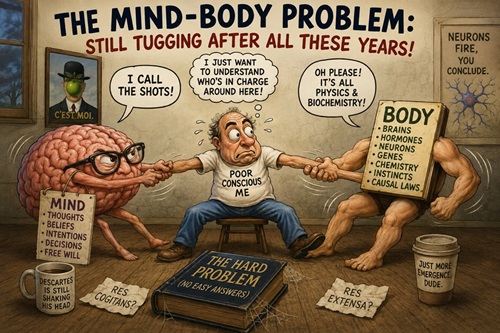
When dissolving the problem is not the same as explaining itKen Wilber's Integral Psychology (2000) contains one of the more ambitious attempts to bring the traditional mind-body problem into a contemplative framework.[1] Rather than choosing between materialism, dualism, idealism, or some version of panpsychism, Wilber proposes that the opposition between mind and body is itself generated by a limited perspective. Mind and body are not two independent substances that somehow have to be connected. They are, he argues, different aspects or perspectives of a more fundamental reality: Spirit. This is an attractive move. It avoids Cartesian dualism without simply reducing consciousness to brain activity. It also gives contemplative experience a philosophical role that most conventional theories of mind leave out. But there is a crucial question that Wilber never satisfactorily answers: does recognizing mind and body as two aspects of one reality actually explain how they are related? That distinction becomes especially important when Wilber says, with remarkable frankness, that “It does not matter 'how' this happens” and that the relevant “how” is “fully disclosed at the postrational, nondual waves.” That sentence exposes both the originality and the central weakness of his proposal. The problem Wilber wants to transcendThe traditional mind-body problem concerns the relationship between subjective experience and the physical world. How can something apparently nonphysical—an intention, thought, sensation, image, or conscious experience—be related to a physical brain? And conversely, how can physical processes in the brain give rise to subjective experience? Wilber believes that the problem becomes artificially difficult when we begin with a metaphysics that has already divided reality into fundamentally separate interiors and exteriors. His four-quadrant model therefore attempts to place both sides on the same map: the Upper Left represents individual interiority, the Upper Right individual exteriority, the Lower Left the collective interior or cultural dimension, and the Lower Right the collective exterior or social-systemic dimension. The four perspectives are intended to be complementary rather than reducible to one another. There is considerable merit in this reframing. Wilber is quite right that consciousness research cannot be exhausted by third-person measurements of brains. First-person phenomenology matters. So do social and cultural contexts. Indeed, Wilber's insistence that consciousness should be studied through first-, second-, and third-person approaches was one of his more interesting contributions to consciousness studies. His proposal was published in Investigating Phenomenal Consciousness in 2000, and his earlier four-quadrant model appeared in the Journal of Consciousness Studies in 1997. But this is not yet a solution to the mind-body problem. It is a more comprehensive description of the things that need explaining. And that distinction is precisely where Wilber's argument begins to wobble. From correlation to ontologyWilber's deeper claim is metaphysical. Mind and body, he says, are both forms of Spirit and therefore are not ontologically alien entities. They are “two different aspects of the same thing.” In Integral Psychology, he presents this as an idealist solution to the problem: Spirit provides the underlying unity that makes the apparent duality intelligible. There is nothing inherently absurd about this proposal. In fact, contemporary philosophy of mind contains positions that bear a family resemblance to it. Neutral monism, Russellian monism, dual-aspect theories and certain varieties of panpsychism all attempt, in different ways, to avoid both Cartesian dualism and straightforward materialist reductionism. Wilber himself explicitly acknowledges this philosophical neighborhood. On the “relative” plane, he points toward versions of panpsychism associated with Leibniz, Whitehead, Russell, Hartshorne, Griffin and Chalmers. The difficulty is that “mind and body are two aspects of the same thing” is not yet an explanation of what that thing is, or why it has precisely these two aspects. Calling the underlying reality “Spirit” does not solve this problem. It changes its vocabulary. Suppose someone asks why a particular neural process is accompanied by a particular conscious experience. Saying that the neural process and the experience are two manifestations of Spirit does not tell us why they correspond. It does not specify a mechanism, a law, a constitutive relation, an identity condition, or even a principled mapping between the two descriptions. The original question—how are the two related?—has been converted into a metaphysical assertion that they are already related. This is exactly the criticism made by Christian de Quincey in his substantial discussion of Integral Psychology. He argued that Wilber's framework does not actually explain how the interior and exterior domains interact but instead offers what he called “promissory integralism.” That criticism strikes at the heart of the matter. The quadrants tell us that they interactWilber's language of “tetra-evolution” is useful as a conceptual reminder that organism, environment, consciousness and culture are mutually conditioning. The brain influences consciousness; consciousness influences behavior; behavior affects the environment; culture shapes consciousness; institutions shape behavior; and so forth. But this creates a subtle bait-and-switch. At the ordinary empirical level, these interactions clearly do matter. We can investigate them. Neuroscience investigates correlations between brain states and conscious states. Psychology investigates how mental states influence behavior. Behavioral science studies feedback loops. Cultural psychology investigates how social meanings influence cognition. Developmental neuroscience studies how biological maturation and environmental experience interact. The interesting question is precisely how these relationships work. Yet at the crucial moment Wilber says: “It does not matter 'how' this happens.” That is a surprisingly damaging sentence in the context of a proposed solution to the mind-body problem. If the question is whether mind and body interact, then yes, the answer is phenomenologically obvious. Nobody needs AQAL to establish that. The difficult question is what sort of relationship exists between them. Wilber's quadrants map the relationship; they do not explain it. The contemplative escape hatchThis is where contemplation enters. Wilber's argument is not simply that Spirit is the metaphysical ground of mind and body. He maintains that the ultimate solution becomes available through a transformation in consciousness. The nondual realization supposedly discloses directly what conceptual thought cannot adequately represent. This is why he compares the situation to mathematics. Someone who has not developed the requisite capacities cannot understand a mathematical proof; likewise, someone who has not undergone nondual development cannot comprehend the nondual resolution of the mind-body problem. The solution is therefore “postrational,” and “fully available to all who wish to move in that direction.” This is perhaps the most provocative part of Wilber's proposal. There is something important here that philosophy should not dismiss too quickly. Contemplative traditions do report experiences in which the ordinary subject-object distinction becomes attenuated or disappears. Contemporary consciousness research increasingly takes such states seriously as objects of phenomenological and empirical investigation. A recent discussion in Frontiers in Psychology, for example, explicitly places nondual awareness within contemporary consciousness research rather than treating mystical experience simply as pathological or irrelevant. But a transformation in experience does not automatically establish an ontology of reality. This is the critical leap in Wilber's argument. Someone may experience the disappearance of the subject-object distinction. That tells us something important about consciousness. It does not, by itself, establish that mind and matter are ontologically two aspects of Spirit. The inference “the distinction between subject and object disappears in nondual awareness” does not logically entail “subject and object are therefore two aspects of a single metaphysical substance called Spirit.” The former is a phenomenological claim. The latter is an ontological claim. Wilber frequently moves between these levels with insufficient warning. The epistemic problemThere is an even deeper difficulty. If the nondual experience is the “proof” of the metaphysical unity of mind and body, what makes the experience epistemically authoritative? Wilber effectively proposes a developmental epistemology: higher states of consciousness disclose realities inaccessible to lower states. The rational mind is therefore not necessarily competent to judge what becomes apparent beyond rationality. But this generates a potentially circular argument. How do we know that the nondual state reveals reality rather than simply producing a distinctive form of experience? Because advanced contemplatives report the same realization. And how do we know that their realization reveals ultimate reality? Because they have reached the relevant level of consciousness. That may be persuasive within a contemplative tradition, but it does not constitute an argument that a philosopher of mind who has not accepted Wilber's developmental hierarchy is obliged to accept. The analogy with mathematics therefore breaks down. The Pythagorean theorem can be demonstrated publicly. Its proof does not depend upon becoming a particular kind of person. A person who has never experienced mathematical enlightenment can nevertheless inspect the argument, challenge its premises, reproduce its derivation and determine whether it is valid. Wilber's proposed nondual “solution” has a fundamentally different epistemic structure. The skeptic is effectively told: you have not seen the solution because you have not developed far enough to see it. That makes the claim difficult to falsify. And that is a serious philosophical problem. “Spirit” and the missing third termThere is also a familiar philosophical problem hidden inside Wilber's terminology. If mind and body are two aspects of Spirit, then Spirit functions as a third term: mind — Spirit — body. But what exactly is Spirit? If Spirit is simply another name for the unity of mind and body, then the explanation is circular. If Spirit possesses properties independently of mind and body, then Wilber owes us an account of those properties. If Spirit is a neutral underlying reality from which both mental and physical properties derive, then Wilber is effectively proposing a form of neutral monism or dual-aspect theory—and should argue for that position explicitly in conversation with the extensive philosophical literature on precisely these alternatives. This is one reason the comparison with Thomas Nagel, David Chalmers, Russellian monism and related positions is illuminating. Wilber is not operating in a philosophical vacuum. There are serious secular attempts to formulate a third option between materialism and dualism. The difference is that these philosophers generally recognize that identifying a common underlying reality is only the beginning of the problem. Wilber too readily treats the metaphysical unity as the resolution. As I have argued elsewhere, this risks turning “Spirit” into the philosophical equivalent of a universal solvent: whatever remains unexplained can be absorbed into the claim that mind and body are manifestations of the same Whole. But unless the internal structure of that Whole is specified, the explanatory burden has merely been relocated. The important distinction between dissolving and solvingWilber's defenders could respond that this criticism misunderstands the nature of nondual realization. The point, they might say, is precisely that the mind-body problem is generated by conceptual reification. Once the subject/object split is seen through, the question “How does mind interact with matter?” loses its ultimate force because there never were two independently existing substances in the first place. This is a respectable contemplative position. But notice what has happened. Wilber has changed the question from: “How does consciousness relate causally or constitutively to the physical world?” to: “What happens when the distinction between consciousness and world is experientially transcended?” The second question is fascinating. It is also not identical to the first. Thus Wilber may legitimately claim that contemplation dissolves the existential grip of the mind-body problem. He cannot automatically claim that contemplation has therefore solved the philosophical problem. That distinction is crucial. A person who experiences nonduality may cease to experience mind and body as two separate things. But philosophy asks whether that experience provides a defensible account of the relationship between phenomenal consciousness and physical reality. The former is transformational. The latter is explanatory. Wilber tends to conflate the two. The Philosophy of Mind CommunityWhat happened when Wilber entered the philosophy-of-mind arena? The answer is rather revealing: not very much happened—at least in mainstream philosophy of mind. Wilber has certainly entered the academic consciousness-studies literature. His 1997 Journal of Consciousness Studies article proposed the four-quadrant model as an “integral theory of consciousness,” and he subsequently published work on integrating first-, second- and third-person approaches. There was also direct engagement with his mind-body argument. Christian de Quincey's critique in Journal of Consciousness Studies is particularly important because it confronted Wilber's claims at the philosophical level rather than merely dismissing them as spiritual speculation. Wilber responded vigorously, accusing de Quincey of misrepresenting his position and emphasizing that he regarded the mind-body problem as having several meanings requiring several different approaches—including empirical research, Whiteheadian process philosophy and Zen/nondual realization. There have also been later academic treatments. A 2009 doctoral thesis, for example, subjected Wilber's nondual philosophy to detailed philosophical scrutiny and concluded that his system risks ontological confusion between the scientific protocols it invokes and the metaphysical claims it makes. And there is some positive academic assessment. Daryl Paulson's 2007 review in the Journal of Humanistic Psychology regarded Integral Theory as potentially useful as a broad orienting framework for spiritual development, while warning against treating it as a rigid, prepackaged system. But this is a very different kind of reception from that accorded to major positions in contemporary philosophy of mind. Wilber has not become a significant participant in the mainstream analytic debate alongside physicalists, functionalists, property dualists, panpsychists, illusionists, neutral monists and Russellian monists. His proposed contemplative resolution is not a standard position discussed extensively in philosophy-of-mind textbooks or treated as a leading candidate solution to the hard problem. That relative absence is itself significant. It is not necessarily evidence that Wilber is wrong. Academic neglect is not philosophical refutation. But it does suggest that the claim that Integral Theory has “solved” or even substantially solved the mind-body problem has never achieved anything resembling disciplinary consensus. Indeed, contemporary scholarship tends to encounter Wilber more readily in transpersonal psychology, integral studies, contemplative studies and interdisciplinary spirituality than in mainstream philosophy of mind. His work has therefore had a much greater influence as a metatheoretical and spiritual synthesis than as a recognized contribution to the technical philosophy of consciousness. What Wilber actually contributedIt would nevertheless be unfair to conclude that Wilber contributed nothing. His most defensible contribution is not his purported solution to the hard problem. It is his insistence that consciousness research should not arbitrarily exclude entire dimensions of experience simply because they are difficult to measure from the outside. His four-quadrant framework makes a useful methodological point: first-person experience, objective brain processes, intersubjective meaning and social systems are all legitimate objects of investigation. That is a valuable pluralism. Likewise, his insistence that contemplative states deserve serious phenomenological attention anticipated an increasingly respectable area of consciousness research. The growing empirical literature on meditation and nondual awareness makes it considerably less plausible today simply to dismiss contemplative experience as philosophically irrelevant. But this methodological pluralism does not entail Wilber's metaphysics. One can accept meditation as a legitimate source of phenomenological data without accepting Spirit as the ontology of the cosmos. One can accept first-person evidence without treating mystical realization as metaphysical revelation. One can accept the usefulness of four perspectives without believing that the four quadrants literally describe four ontologically fundamental dimensions of every holon. That distinction is often lost in Wilber's writing. The great promise—and the great shortcutWilber's contemplative solution is therefore best understood as a philosophical proposal for dissolving the apparent opposition between mind and body, not as an established solution to the explanatory problem. His strongest move is to reject the assumption that consciousness and matter must be fundamentally alien substances. His weakest move is to assume that once they are declared to be manifestations of Spirit, the explanatory problem has disappeared. The four quadrants tell us that interior and exterior dimensions coexist and mutually condition one another. They do not tell us how this interaction is possible. Nondual awareness may transform our experience of the distinction between subject and object. It does not automatically demonstrate the metaphysical identity of consciousness and matter. And “Spirit” may name a profound intuition about the unity of reality. But unless the concept acquires a more precise philosophical content, it functions less as an explanation than as a placeholder for the explanation that has yet to be supplied. This makes Wilber's phrase that the “how” does not matter particularly revealing. For a contemplative practitioner, perhaps it does not matter. Once the division between subject and object loses its existential reality, the question may indeed cease to trouble the practitioner. But for philosophy, the “how” is precisely what matters. The irony is that Wilber's own four-quadrant model provides an excellent map of the explanatory territory. He identifies the interior, exterior, individual and collective dimensions that any comprehensive theory of consciousness might need to address. But when he reaches the most difficult bridge—the relationship between interiority and physicality—he crosses it by declaring that, at the highest level, there is no bridge to cross. That may be a powerful spiritual insight. It is not yet a theory of mind. And that, perhaps, explains Wilber's peculiar position in the philosophy-of-mind landscape: he has offered a compelling contemplative reinterpretation of the problem, but the philosophical community has largely treated the actual explanatory problem as still open. In that sense, Wilber's “solution” is simultaneously more interesting and less successful than he claims. It is more interesting because it asks philosophy to take transformative consciousness seriously. It is less successful because the transformation of the knower cannot, by itself, substitute for an explanation of what is known. The mind-body problem may indeed eventually be dissolved. But before we celebrate its dissolution, we should ask whether we have dissolved a philosophical confusion—or simply dissolved the question that we were unable to answer. Appendix: What If Spirit Has Evolutionary and Cosmic Dimensions Too?Wilber's argument becomes considerably more ambitious once “Spirit” is given not merely an ontological but an evolutionary and cosmic dimension. This is, in fact, where his contemplative solution to the mind-body problem connects with the larger architecture of Integral Theory. Spirit is not simply the hidden unity behind mind and body. It is also the ground and goal of an evolutionary process extending from matter through life and mind toward increasingly subtle and nondual forms of awareness. That move gives Wilber's proposal a much richer explanatory context—but it also multiplies the philosophical problems. If Spirit is genuinely present at every level of evolution, then Wilber can offer a striking answer to the question of why consciousness appears in a universe initially described by physics in apparently nonconscious terms. Consciousness does not suddenly emerge from wholly unconscious matter. Rather, what we call matter is already one exterior expression of a deeper spiritual reality. Evolution then becomes the progressive unfolding or disclosure of dimensions of Spirit that were implicit all along. This is much closer to a cosmological form of panpsychism, panexperientialism, process philosophy, or cosmopsychism than to conventional theism. Matter and mind are not two fundamentally different ingredients assembled at some point in cosmic history. They are different expressions of a more primordial reality whose potential becomes increasingly explicit as evolution proceeds. And here Wilber has an important advantage over a purely static dual-aspect theory. He can ask not only why mind and body belong together, but why increasingly complex forms of interiority appear in an evolving universe. The sequence becomes something like: matter → life → sensation → mind → self-reflection → transpersonal awareness → nondual realization. On this interpretation, evolution is not merely the accumulation of increasingly complicated physical structures. It is also an increasing interiorization and differentiation of Spirit. That is an intellectually fascinating picture. But it creates a new problem: how do we know that evolution has this direction? The empirical fact is that biological evolution produces increasing complexity in some lineages, but evolution as a whole does not obviously proceed toward consciousness, spirituality or nonduality. Evolution has no established global trajectory toward enlightenment. Most organisms that have ever existed were not conscious in anything resembling the human sense, and most conscious organisms do not appear to be progressing toward contemplative realization. Wilber therefore needs something more than evolution in the Darwinian sense. He needs evolution plus an intrinsic developmental telos. This is where his evolutionary cosmology becomes controversial. If Spirit is already present as the deepest reality of the cosmos, then perhaps evolution can be interpreted as Spirit progressively becoming aware of itself. The universe begins to look like a gigantic developmental process in which the Absolute becomes increasingly explicit through increasingly complex forms. This idea has a long pedigree. It recalls Hegel's Geist, Schelling's Naturphilosophie, Bergson's élan vital, Teilhard de Chardin's evolutionary spirituality, Whitehead's process metaphysics, Sri Aurobindo's evolution of consciousness, and various forms of German and British idealism. But there is an important difference between saying that evolution can be interpreted spiritually and saying that evolution is scientifically evidence for Spirit. The first is a metaphysical interpretation. The second is a scientific claim. Wilber sometimes slides too easily between the two. Spirit as the inside of evolutionThere is, however, a particularly interesting way of reformulating Wilber's position. Perhaps Spirit does not have to be imagined as an external cosmic force pushing evolution upward. Perhaps what Wilber calls Spirit is simply the interior dimension of an evolving reality. Then the four quadrants acquire an evolutionary meaning. The Upper Right tracks increasingly complex organisms and brains. The Upper Left tracks increasingly complex forms of subjective experience. The Lower Right tracks increasingly complex social and ecological systems. The Lower Left tracks increasingly complex symbolic and cultural worlds. Evolution therefore becomes simultaneously biological, psychological, cultural and social. This is considerably more plausible than imagining a supernatural Spirit intervening in evolution from outside. But it still leaves the central explanatory problem intact. Why should increasingly complex physical organization produce increasingly complex subjectivity? The four quadrants can describe the correlation. Spirit can provide a metaphysical unity. Evolution can provide a historical sequence. But none of these, by themselves, explains why there is an interior at all. And this returns us to the crucial weakness of Wilber's contemplative solution. His evolutionary cosmology can tell a magnificent story about the emergence and transformation of consciousness without necessarily providing a theory of the relationship between consciousness and physical processes. And what if Spirit is cosmic?The cosmic version of the argument is even more provocative. Suppose Spirit is not merely something found in human consciousness but is a fundamental dimension of the universe itself. Then human contemplative realization would not create some new supernatural capacity. It would reveal a dimension of reality that was already there. Nondual awareness would therefore be interpreted cosmologically: the individual discovers that the deepest nature of consciousness is not ultimately separate from the ground of existence itself. This gives Wilber's contemplative argument its strongest form. The meditator does not merely experience “oneness.” The meditator discovers, according to this interpretation, what reality fundamentally is. But again, the epistemological leap is enormous. A nondual experience can provide powerful evidence about the structure of consciousness as experienced. It does not automatically provide independent evidence about the structure of the cosmos. The experience of being one with everything and the proposition that everything is ultimately Spirit are not the same statement. The former is phenomenology. The latter is cosmology. The philosophical mistake would be to treat the phenomenological immediacy of the first as if it automatically guaranteed the metaphysical truth of the second. The evolutionary upgrade makes the “how” problem worseThere is also an irony here. Wilber says that the “how” by which the quadrants influence each other need not ultimately concern us because the nondual realization discloses their underlying unity. But once Spirit is endowed with cosmic and evolutionary dimensions, the “how” becomes more—not less—important. If Spirit is genuinely involved in evolution, we want to know: How does it relate to physical causation? How does it relate to mutation, selection and development? How does a spiritual interior become expressed through neural organization? How does biological complexity generate increasingly complex phenomenal structures? How does individual consciousness participate in cultural evolution? And perhaps most importantly: What distinguishes a genuinely evolutionary process from a retrospective spiritual interpretation of whatever evolution happens to produce? Wilber's system has remarkably elaborate answers to the what and where of development, but much thinner answers to the how. That asymmetry is worth emphasizing. The more cosmic work Spirit is asked to do, the more explanatory work it needs to perform. If Spirit is merely a name for the nondual ground of experience, the proposal can remain primarily phenomenological and contemplative. If Spirit is the ground of mind and matter, it becomes a metaphysical hypothesis. If Spirit is also the engine, direction or telos of cosmic evolution, it becomes a cosmological hypothesis. At that point, “Spirit” is carrying an extraordinary theoretical load. The possibility of a naturalized cosmic SpiritThere is nevertheless a potentially fruitful middle position. One need not interpret Spirit as a supernatural agent, nor reduce it to a metaphor for mystical experience. One could conceive of it as a neutral or proto-phenomenal ground of nature, with consciousness emerging as increasingly sophisticated organizations of this fundamental reality. That would bring Wilber surprisingly close to contemporary versions of Russellian monism, cosmopsychism and constitutive panpsychism. The vocabulary would change, but the basic intuition would survive: consciousness does not emerge from something that is completely devoid of anything consciousness-like; rather, consciousness and physicality are differentiated expressions of a deeper reality. That is a serious philosophical position. But notice what happens to Wilber's claim that the answer is “fully disclosed” at the postrational, nondual level. Once the claim is formulated in this more philosophically disciplined way, contemplation becomes one source of evidence among others, rather than the privileged court of metaphysical appeal. Physics, neuroscience, developmental psychology, evolutionary biology, phenomenology and contemplative practice would all contribute different pieces of the puzzle. That would actually make Wilber's integral pluralism more convincing. The danger of turning evolution into a spiritual biographyThere is one final danger. If Spirit is identified with the direction of evolution, there is a temptation to turn cosmic history into a kind of spiritual biography: Matter discovers life. Life discovers mind. Mind discovers Spirit. Spirit discovers itself. It is an extraordinarily seductive story. It also happens to put human beings—and particularly spiritually advanced human beings—rather conveniently near the climax of cosmic history. This is where Wilber's developmental hierarchy becomes vulnerable to the charge of cosmic anthropocentrism. The universe is interpreted as though it were climbing a ladder whose upper rungs happen to correspond remarkably well to the stages recognized by Wilber's own theory. The danger is not that such a story is necessarily false. The danger is that it can become self-confirming. Whatever evolution produces becomes another expression of the same evolutionary Spirit, while whatever has not yet appeared can be classified as a lower or less differentiated expression awaiting transcendence. The theory then predicts everything and therefore risks explaining nothing. A more modest formulation would be preferable: Perhaps consciousness, evolution and the physical universe are aspects of a deeper reality that we do not yet understand. That statement lacks Wilber's grand architecture. But precisely for that reason, it leaves room for genuine discovery. And perhaps that is the most interesting unresolved possibility lurking behind Integral Psychology. Wilber may have been right that the mind-body problem looks different if mind and matter are understood as aspects of a deeper unity. He may even be right that contemplative practice gives us an unusual experiential access to that unity. But the moment Spirit is promoted from the ground of contemplative experience to the ground and direction of cosmic evolution, the burden of proof becomes much greater. At that point we need more than realization. We need arguments, comparisons with rival metaphysics, empirical predictions, and—above all—an account of the mysterious causal or constitutive bridge that Wilber was willing to leave unspecified. The great question therefore becomes not simply “Is Spirit real?” It is: What would a universe look like in which Spirit were real—and what evidence could distinguish such a universe from one in which “Spirit” is simply the name we give to the deepest interpretation of consciousness? That is where Wilber's contemplative solution stops being merely an intriguing reinterpretation of the mind-body problem and becomes a full-blown philosophy of cosmic evolution. And that is also where his “the how does not matter” strategy becomes hardest to defend. NOTES[1] Ken Wilber, Integral Psychology: Consciousness, Spirit, Psychology, Therapy, Shambhala, 2000, Chapter 14: The 1-2-3 of Consciousness, p. 174-187.
Widget is loading comments...
|