|
TRANSLATE THIS ARTICLE
Integral World: Exploring Theories of Everything
An independent forum for a critical discussion of the integral philosophy of Ken Wilber
  Frank Visser, graduated as a psychologist of culture and religion, founded IntegralWorld in 1997. He worked as production manager for various publishing houses and as service manager for various internet companies and lives in Amsterdam. Books: Ken Wilber: Thought as Passion (SUNY, 2003), and The Corona Conspiracy: Combatting Disinformation about the Coronavirus (Kindle, 2020). Frank Visser, graduated as a psychologist of culture and religion, founded IntegralWorld in 1997. He worked as production manager for various publishing houses and as service manager for various internet companies and lives in Amsterdam. Books: Ken Wilber: Thought as Passion (SUNY, 2003), and The Corona Conspiracy: Combatting Disinformation about the Coronavirus (Kindle, 2020).
Check out my other conversations with ChatGPT
Revisiting De Quincey vs. Wilber: The Promise That Started a War When 'Misrepresentation' Becomes a Defense Christian de Quincey Refuses to Back Down Profile: Christian de Quincey: The Radical Knowing of a Relational Idealist Christian de QuinceyThe Radical Knowing of a Relational IdealistFrank Visser / ChatGPT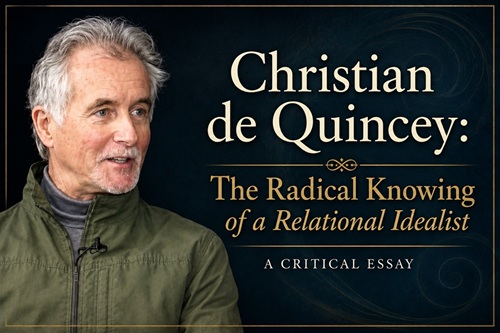 Christian de Quincey occupies an interesting but somewhat underappreciated position in the history of contemporary consciousness studies. He is neither a conventional academic philosopher nor simply another representative of the New Age consciousness industry. His work sits at the intersection of process philosophy, panpsychism, phenomenology, transpersonal psychology and spirituality. He has spent much of his career arguing that consciousness cannot be adequately explained from the outside because consciousness is, in some fundamental sense, the very medium through which the world is known. That is an attractive starting point. It is also where the difficulties begin. De Quincey's great strength is that he takes consciousness seriously. Unlike reductionist approaches that treat subjective experience as an inconvenient by-product of neural machinery, he insists that first-person experience belongs at the centre of any adequate theory of reality. His weakness is that he sometimes moves too quickly from the undeniable fact that consciousness is epistemically fundamental to the much more controversial claim that consciousness is ontologically fundamental. The former is a philosophical insight; the latter is a metaphysical hypothesis. De Quincey's work is most illuminating when he keeps those two claims apart, and least convincing when he treats them as virtually interchangeable. His long engagement with Ken Wilber provides an excellent case study of both his virtues and his limitations. The philosopher of relationshipDe Quincey's intellectual project can be summarized by one word: relationship. His book Radical Knowing explicitly develops consciousness through relationship, while Radical Nature extends the argument into a philosophy in which matter itself possesses an interior or experiential dimension. His later work continues to connect consciousness, embodiment, spirituality and transformation. His own description of his work emphasizes "intuitive ways of knowing" and our relationship with ourselves, others and the natural world. This places him firmly in the tradition of thinkers dissatisfied with the Cartesian division between an inner subject and an outer world. De Quincey sees the subject-object distinction not as an ultimate description of reality but as something that arises within a more fundamental relational field. There is much to admire here. Consciousness is indeed not encountered as a detached spectator looking at a ready-made external universe. Perception, cognition, embodiment, language and social interaction are deeply entangled. Contemporary cognitive science, phenomenology and enactivism have all, in different ways, moved away from the simplistic picture of the mind as a spectator inside the skull. But De Quincey's metaphysical extrapolation is more controversial. From the fact that conscious experience is relationally constituted, it does not automatically follow that reality itself is composed of relations between experiencing entities. That conclusion requires additional argument. And this is characteristic of his philosophical style: an important phenomenological observation becomes the launching pad for a substantial ontological claim. Panpsychism as the great alternativeDe Quincey's answer to the mind-body problem is closely associated with panpsychism. If consciousness cannot plausibly be derived from completely unconscious matter, perhaps the mistake lies in assuming that matter is completely unconscious in the first place. This is a respectable philosophical position. Indeed, De Quincey was already explicitly identifying himself with panpsychism in his 2000 critique of Wilber. He argued that Wilber's description of the materialist position was too crude because many philosophers who reject straightforward reductionism are precisely the ones attracted to panpsychism. The attraction of panpsychism is obvious. Instead of trying to explain how subjective experience suddenly appears out of wholly non-experiential ingredients, it regards experientiality as a basic feature of nature. Consciousness does not have to be manufactured from scratch by sufficiently complicated brains. But panpsychism does not actually solve the hard problem merely by relocating it. It creates what has become known as the combination problem: if elementary entities possess primitive forms of experience, how do those elementary experiences combine into the unified experience of a human being? De Quincey himself has recognized the problem, even devoting an article to the question of why, if all our cells and molecules are conscious, we do not experience a trillion "mini-mes." His website explicitly lists this as one of his major articles. That acknowledgement is important. It prevents a simplistic characterization of his philosophy as "everything is conscious." But it also exposes the central difficulty. Saying that consciousness is fundamental does not tell us how fundamental experientiality becomes the highly integrated subjectivity of a human organism. The theory has therefore changed the question rather than eliminated it. That may still be philosophically valuable. But changing a difficult question into another difficult question should not be advertised as a solution to the original problem. Radical knowingDe Quincey's most distinctive contribution is arguably epistemological rather than ontological. His notion of "radical knowing" challenges the assumption that knowledge is fundamentally something a detached subject possesses about an external object. Knowing, on his account, is participatory and relational. Here he comes surprisingly close to strands of phenomenology, pragmatism, process philosophy and contemporary embodied cognition. Knowledge is not merely a representation inside the head. Organisms actively engage their environments; perception is an activity; meaning arises within relationships. This is a fertile direction. Yet De Quincey's terminology can sometimes make relatively familiar philosophical insights sound more revolutionary than they are. Once "knowing" is expanded to include embodied, intuitive, relational and participatory forms, the word risks becoming so broad that almost any successful interaction with reality counts as knowing. The danger is epistemic inflation. Intuition can certainly produce insight. First-person experience can reveal things that third-person measurement cannot capture. Tacit knowledge is real. Embodied knowledge is real. But none of these observations establishes that intuition is automatically reliable, that mystical experience provides privileged access to metaphysical truths, or that subjective conviction is evidence for ontological claims. The crucial philosophical question is therefore not whether there are multiple modes of knowing. There plainly are. The question is how we discriminate between them. That is where De Quincey's approach is less developed than its rhetoric sometimes suggests. The Wilber confrontationThe most revealing episode in De Quincey's intellectual career remains his 2000 review of Ken Wilber's Integral Psychology, "The Promise of Integralism: A Critical Appreciation of Ken Wilber's Integral Psychology." Published in the Journal of Consciousness Studies, the article ran to more than thirty pages and attempted to do two things simultaneously: explain Wilber's extraordinary influence and expose what De Quincey regarded as fundamental weaknesses in his system. It was an unusually ambitious review. De Quincey was not merely saying that Wilber had made some mistakes. He was challenging the philosophical architecture underlying Wilber's integralism. The ensuing exchange became one of the more revealing debates in the history of Integral Theory. Wilber responded with "Do Critics Misrepresent My Position?" and accused De Quincey of repeatedly distorting his position. Wilber's response is itself significant because, despite its polemical tone, he acknowledged that De Quincey had made "fine points" and even conceded that some of his own formulations had contributed to misunderstanding. De Quincey then replied with "Critics Do. Critics Don't." The dispute is important because both men were right about something. De Quincey was right that Wilber's system frequently presents itself as more comprehensive and philosophically settled than it actually is. Wilber's elaborate terminology can conceal unresolved problems, particularly concerning the relationship between subjective experience, objective description, intersubjectivity and metaphysics. But Wilber was also right to complain about selective interpretation. His writings contain enormous numbers of qualifications, distinctions and later revisions. A critic who extracts one formulation from one book can indeed produce an inaccurate representation of a position that Wilber has subsequently modified. This creates a peculiar methodological problem in criticizing Wilber: the target is continually moving. De Quincey understood this problem unusually well. In fact, one of the most perceptive observations in the whole exchange was his complaint that Wilber's actual position could be scattered across obscure endnotes and multiple books. That criticism remains relevant. A theory that requires extensive archaeological reconstruction before it can be criticized is not necessarily wrong, but its exposition has clearly failed in an important respect. Where De Quincey overreachesThe irony is that De Quincey sometimes falls into a mirror image of the problem he identifies in Wilber. His critique occasionally turns philosophical disagreement into psychological interpretation. Wilber's emphasis on cognition over feeling becomes evidence about Wilber himself. Arguments about consciousness become indications of psychological deficiencies. De Quincey's review was rhetorically energetic, but the personal dimension occasionally overwhelmed the philosophical one. Wilber was particularly sensitive to this. In his response he complained that De Quincey repeatedly engaged in what he regarded as ad hominem attacks. That criticism should not simply be dismissed as defensive Wilberian rhetoric. A philosopher's ideas should indeed be distinguished from speculative diagnoses of the philosopher's personality. If Wilber's theory inadequately accounts for feeling, that should be demonstrated from the theory. It does not follow that Wilber personally lacks feeling. There is a broader lesson here. De Quincey's philosophy is explicitly relational and participatory, but his polemical writing sometimes becomes surprisingly adversarial. The philosopher of dialogue can become a prosecutor. This tension is visible elsewhere too. De Quincey advocates Bohmian dialogue and presents dialogue as a transformative mode of consciousness. His own website describes "B-Dialogue" as an exploration of consciousness in community. Yet the Wilber exchange demonstrates how difficult genuine dialogue becomes once the philosophical stakes are high and both parties feel misrepresented. The problem of spiritual metaphysicsThe deeper difficulty with De Quincey is not panpsychism itself. It is the movement from philosophical possibility to spiritual certainty. His later books increasingly combine philosophy, consciousness studies and personal transformation. Consciousness from Zombies to Angels, for example, presents itself as a guide to philosophy's hardest problem, science's final frontier and spirituality's deepest mystery, while also offering a seven-step path toward transformation. This is an appealing synthesis. It makes philosophy existentially relevant rather than leaving it in the seminar room. But it also creates a methodological problem. Once the investigation of consciousness becomes simultaneously a scientific inquiry, a philosophical investigation and a spiritual path, the standards of evidence can become blurred. A spiritual practice may be valuable without establishing a metaphysical proposition. A mystical experience may be profound without proving that consciousness is a cosmic substance. A sense of unity with nature may transform a person's life without demonstrating that every particle has an interior point of view. These distinctions matter enormously. De Quincy's strongest arguments are those that survive after the spiritual language has been stripped away. His weakest arguments are those that seem to depend upon accepting the spiritual interpretation of the experience before the philosophical argument has actually been completed. A genuine alternative to reductionismNevertheless, it would be a mistake to reduce De Quincey to another speculative spiritual philosopher. His importance lies precisely in the fact that he articulates a serious alternative to crude reductionism. The consciousness debate cannot simply be settled by saying that brains generate consciousness and therefore there is nothing more to discuss. That formula is an empirical research program, not an explanation of subjective experience. De Quincey is correct to insist that the first-person dimension cannot simply be eliminated from the ontology of mind. He is also correct that the relationship between consciousness and matter is not adequately captured by a crude Cartesian dualism. His process-oriented, relational approach offers a more sophisticated alternative. The difficulty is that the alternatives are not limited to "materialism" and "panpsychism." Contemporary philosophy of mind contains many competing positions: physicalism, functionalism, emergentism, neutral monism, idealism, enactivism, illusionism and various forms of dual-aspect theory. Some of these positions take the hard problem seriously without accepting panpsychism. De Quincy's rhetoric occasionally makes the philosophical landscape look more binary than it really is. That is perhaps his most important limitation as a public philosopher: his map of the territory can be more compelling than its actual cartographic precision. The paradox of radical knowingThere is therefore a curious paradox at the centre of De Quincey's work. He wants to overcome the split between subject and object, knower and known, inner and outer. But the moment he makes a metaphysical claim about the ultimate nature of consciousness, he is again making a claim from within a particular standpoint about reality as a whole. No amount of emphasis on participation removes the epistemological problem. Indeed, it makes it more acute. If all knowing is relational, then De Quincey's own knowledge claims are relational too. His panpsychism, process metaphysics and spiritual interpretations are not delivered from a God's-eye perspective. They are interpretations arising from particular philosophical, phenomenological and cultural traditions. Recognizing this would not destroy his philosophy. On the contrary, it could make it stronger. Radical knowing should perhaps mean radical humility about what knowing can establish. De Quincey after WilberSeen from the perspective of the Wilber debate, De Quincey's intellectual trajectory is particularly interesting. He began as an incisive critic of Integral Theory but ultimately developed a philosophy that shares some of its characteristic ambitions: synthesis, multidimensionality, consciousness evolution, spirituality and the attempt to bridge science and metaphysics. The difference is one of emphasis. Wilber constructs an enormous architectural system. De Quincey is more concerned with the nature of experience itself. Wilber's characteristic temptation is theoretical over-integration; De Quincy's is experiential and metaphysical over-extension. In that sense, the two thinkers make excellent foils for one another. Wilber asks how everything fits together. De Quincey asks what it is like to participate in the whole. Neither question is illegitimate. But neither question, by itself, supplies the answer to the other. Conclusion: a valuable provocateur, an incomplete metaphysicianChristian de Quincey deserves considerably more attention than he usually receives in discussions of contemporary consciousness philosophy. His insistence that consciousness cannot be treated as an afterthought of an otherwise complete material ontology remains important. His engagement with panpsychism, process thought, embodiment, relationship and participatory knowing gives his work a genuine philosophical substance. His 2000 critique of Wilber was one of the sharper challenges to Integral Psychology at precisely the moment when Wilber's system was consolidating its claims to comprehensiveness. But De Quincey does not escape the problems he identifies in Wilber. His own synthesis can sometimes become too eager to turn phenomenological insight into metaphysical conclusion. His panpsychism relocates rather than resolves the mystery of consciousness. His relational epistemology risks making "knowing" too inclusive. His spiritual interpretation of consciousness sometimes outruns what the philosophical argument can establish. And his polemical treatment of Wilber occasionally undermines the dialogical ideal he otherwise champions. His greatest contribution may therefore be negative in the best philosophical sense: he helps demonstrate why consciousness cannot be explained away, while simultaneously showing how difficult it is to explain it positively. That is no small achievement. The enduring value of De Quincy's work lies less in the claim that he has discovered the final ontology of consciousness than in his refusal to accept the false comfort of an ontology that leaves consciousness unexplained. His philosophy is most persuasive when it says, in effect: something fundamental has been left out of the picture. It becomes much less persuasive when it immediately tells us exactly what that something must be. The philosopher of "radical knowing" would perhaps do well to apply his own principle here. The radical move is not simply to know more deeply. It is to recognize how much remains unknown.
Widget is loading comments...
|