|
TRANSLATE THIS ARTICLE
Integral World: Exploring Theories of Everything
An independent forum for a critical discussion of the integral philosophy of Ken Wilber
  Frank Visser, graduated as a psychologist of culture and religion, founded IntegralWorld in 1997. He worked as production manager for various publishing houses and as service manager for various internet companies and lives in Amsterdam. Books: Ken Wilber: Thought as Passion (SUNY, 2003), and The Corona Conspiracy: Combatting Disinformation about the Coronavirus (Kindle, 2020). Frank Visser, graduated as a psychologist of culture and religion, founded IntegralWorld in 1997. He worked as production manager for various publishing houses and as service manager for various internet companies and lives in Amsterdam. Books: Ken Wilber: Thought as Passion (SUNY, 2003), and The Corona Conspiracy: Combatting Disinformation about the Coronavirus (Kindle, 2020).
Check out my other conversations with ChatGPT
On Alderman's Ethical Code: Ethics Beyond Enlightenment, An Integral Code of Ethics What to Expect from Ethical Integrative Practice Wyatt Earp and Integral Ethics: Wyatt Earp Rides Again (4 Parts) Bruce Alderman's What to Expect from Ethical Integrative PracticeA Critical ReviewFrank Visser / ChatGPT
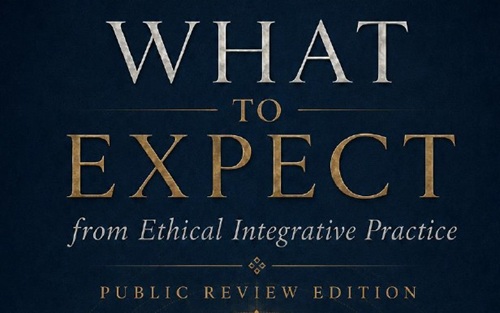
Bruce Alderman's What to Expect from Ethical Integrative Practice presents itself as “A Guide for Students, Clients, Seekers, Participants, and Community Members” and as a public-facing companion to the Integral Code of Ethics.[1] It is explicitly directed not at practitioners but at those on the receiving end of integrative, developmental, contemplative, spiritual, and metatheoretical practices. Its central promise is straightforward: a code tells practitioners what they owe; this guide tells everyone else what they may reasonably expect. The document is thoughtful, humane, and in several respects much more ethically mature than a great deal of the discourse traditionally associated with Integral spirituality. It recognizes that developmental frameworks can become mechanisms of domination, that charisma can conceal power, that spiritual language can be used to neutralize criticism, and that communities built around advanced ideas are particularly vulnerable to confusing intellectual or spiritual sophistication with ethical maturity. Its repeated insistence that people retain the right to question, refuse, leave, and seek outside advice is entirely salutary. Yet the document also exposes an unresolved problem at the heart of the Integral ethics project. It is considerably better at articulating what ethical practitioners ought to do than at explaining how anyone can reliably determine whether those standards have actually been met. Its ethics is rich in norms but comparatively thin in epistemology, evidence, institutional design, empirical psychology, and adjudication. The result is a compelling moral charter whose practical authority may remain much weaker than its rhetoric suggests. The ethical center of gravity is freedomThe strongest feature of Alderman's argument is its insistence that ethical practice should preserve agency. His formulation is simple: the participant must remain free to ask, doubt, pause, disagree, seek outside counsel, and leave. Ethical work may challenge people, but challenge must not become coercion. This is an important corrective to one of the perennial dangers of developmental and spiritual systems. Once a teacher or practitioner is granted an interpretive vocabulary capable of explaining a person's motives, defenses, developmental stage, shadow, ego, trauma, or level of consciousness, disagreement can easily be redescribed as evidence confirming the teacher's theory. Alderman identifies exactly this danger under the heading of “framework weaponization.” A person raises an objection and receives, instead of a response to the objection, an interpretation of why the person is objecting. Eventually the system becomes self-sealing: whatever the participant says can be absorbed as evidence for the framework. This is one of the document's best insights because it identifies a structural problem rather than merely a bad personality trait. The issue is not simply that some teachers are arrogant. It is that a sufficiently comprehensive interpretive framework can become epistemically asymmetric. The practitioner interprets the participant, while the participant has no comparable authority to interpret the practitioner. A disagreement therefore occurs on unequal terrain. Alderman is equally perceptive when he writes that “complexity” itself can become an evasive strategy. Real situations are complicated, but complexity can also be used to make direct accountability disappear beneath layers of systems language, polarity language, developmental language, or metatheoretical elaboration. This is particularly relevant to Integral discourse, which has historically prided itself on its capacity to integrate multiple perspectives and levels of analysis. Alderman's implicit warning is that integration can become a rhetorical shield. A sufficiently elaborate explanation can make almost any criticism appear simplistic. The more sophisticated the conceptual apparatus, the greater the temptation to answer a concrete ethical objection with a more sophisticated abstraction. That is an important contribution. Alderman correctly treats power as the fundamental ethical variableAnother major strength is his refusal to define power narrowly. Power is not limited to formal institutional authority. It can arise from charisma, expertise, seniority, authorship, spiritual recognition, control of information, community influence, or access to opportunities. This is essential in the Integral milieu because many of its influential figures operate in ambiguous institutional spaces. A person may not be a licensed professional, ordained religious authority, or corporate manager, yet still possess enormous symbolic power. Such a person can influence reputation, belonging, career prospects, intellectual legitimacy, friendships, and spiritual identity. Alderman's statement that “power denied is power unmanaged” is therefore one of the document's most useful formulations. An informal community is not necessarily a powerless community. Indeed, the absence of formal structures can sometimes make power harder to see and therefore harder to regulate. His distinction between confidentiality and secrecy is similarly useful. Confidentiality can protect people; secrecy can protect power. The relevant ethical question, he suggests, is: “Who benefits from this being hidden?” This is a strong heuristic, although it remains a heuristic. That qualification becomes important later. The guide is strongest when it demystifies authorityAlderman's treatment of competence is commendable precisely because it punctures one of the recurring assumptions of integrative culture: that mastery of a broad theoretical framework somehow confers generalized competence. It does not. A teacher is not automatically a therapist; a coach is not automatically a trauma specialist; a spiritual facilitator is not automatically qualified to treat psychological distress. This should have been an obvious proposition, but in interdisciplinary spiritual and developmental settings it has often been less obvious than it ought to be. The same demystifying impulse appears in the section on “inflated claims and borrowed authority.” Alderman warns against exaggerated scientific credentials, overstated evidence, claims to unique access to truth, and implied endorsements or lineage claims that may not actually exist. Yet this point deserves to go further. In a field that frequently borrows terminology from psychology, developmental science, neuroscience, systems theory, evolutionary theory, and physics, merely warning against exaggerated claims is insufficient. The deeper issue is epistemic hygiene: what counts as evidence, what constitutes expertise, how claims are validated, what kinds of claims are empirically testable, and what happens when the evidence conflicts with the framework. The guide gestures toward these issues but does not really develop them. It assumes that asking about a framework's limits is enough. Sometimes it is not. The problem of “just asking good questions”One recurring weakness is the guide's reliance on the participant's ability to detect ethical problems through reflection and questioning. This sounds democratic and empowering. But it risks placing too much epistemic responsibility on precisely the people who may be least equipped to exercise it. A novice entering an intensive developmental program may not know what constitutes an appropriate psychological boundary, a realistic claim about trauma, a credible scientific credential, a normal pedagogical practice, or a manipulative use of group dynamics. Alderman asks participants to inquire about qualifications, risks, frameworks, confidentiality, overlapping roles, and accountability. That is good advice. But asking whether a framework has limitations does not establish what those limitations actually are. A persuasive practitioner can answer the question convincingly while still presenting a highly questionable model. This exposes a broader philosophical problem. Alderman's guide is built around procedural ethics: disclose, consent, permit dissent, acknowledge power, provide recourse. These are important conditions of ethical practice, but procedural openness does not guarantee epistemic validity. A practitioner can be wonderfully transparent about a bad theory. A practitioner can obtain consent for a practice whose benefits are poorly established. A practitioner can sincerely acknowledge limitations while systematically overinterpreting human behavior. A practitioner can respect a participant's right to leave while still propagating misleading claims. Consequently, an adequate Integral ethics needs two distinct dimensions: ethics of relationship and ethics of knowledge. Alderman develops the first much more fully than the second. The guide rightly distinguishes discomfort from harm—but leaves the distinction underspecifiedThe section on “Discomfort, Challenge, and Harm” is conceptually important. Alderman correctly observes that discomfort is not automatically evidence of wrongdoing. Serious learning can be difficult, and spiritual or developmental work can evoke fear, grief, anger, confusion, or destabilization. The document then proposes a useful distinction: ethical challenge occurs within a container of respect, whereas harm constrains agency and makes questioning costly. But this is still more suggestive than diagnostic. Many controversial practices are precisely difficult to classify because the same observable event can be interpreted differently. A teacher may regard confrontation as necessary growth; a participant may experience it as humiliation. A practitioner may interpret emotional resistance as clinically or spiritually significant; the participant may reasonably regard the interpretation as intrusive. Alderman acknowledges this ambiguity. He explicitly notes that mixed situations exist: a teacher may have been genuinely helpful and nevertheless mishandled power; a community may provide belonging while making dissent too costly. That is an intellectual strength. But it also reveals a missing methodology. How, exactly, should conflicting interpretations be adjudicated? “Ask whether I am free within this” is an excellent first question. It is not yet an ethics procedure capable of resolving difficult disputes. “Pattern” is useful—but also dangerously elasticAlderman wisely warns that one awkward remark or defensive interaction should not automatically be treated as evidence of serious misconduct. Context, intensity, power, repetition, and response matter. This is more cautious than some contemporary therapeutic and activist approaches, which can sometimes turn isolated incidents into sweeping character diagnoses. Nevertheless, the concept of a “pattern” is itself highly interpretive. What one person sees as a persistent pattern another may regard as several unrelated mistakes. Without an independent investigative mechanism, “pattern” can easily become a conclusion disguised as an observation. The same problem appears in the section on retaliatory exclusion. Alderman says that when someone raises a concern in good faith and subsequently loses standing, belonging, or opportunity, that cost is itself evidence that something is wrong with the community. This formulation goes too far. A loss of status following criticism can indeed be evidence of retaliation. But it can also have innocent explanations. A person may have breached legitimate community norms, behaved abusively toward others, repeatedly violated agreements, or simply lost trust for reasons unrelated to retaliation. The moral direction of causality cannot be inferred from temporal sequence alone. A stronger formulation would have been that such consequences are a reason for scrutiny, not evidence in themselves. This matters because a document designed to protect participants can inadvertently create its own interpretive asymmetry: once a person identifies themselves as the “concern-raiser,” subsequent events may automatically be interpreted through the lens of victimization. Alderman is admirably alert to the danger of ethical language being weaponized, but some of his own formulations could contribute to precisely that problem. The most important unresolved issue: who judges the judges?The guide repeatedly emphasizes accountability. Concerns should have somewhere to go besides the practitioner, and the code should provide graduated processes ranging from clarification and mediation to formal review and external recourse. But then comes a revealing admission: the code is voluntary, is not a licensing board or regulatory authority, and its stewardship structures and accountability bodies are still developing. Its authority derives from commitment, recognition, and community accountability. This is the document's central institutional weakness. The guide makes strong statements about what ethical practitioners should do, but the enforcement infrastructure remains largely aspirational. The text itself concedes that the system does not possess the capacities of a court, regulator, professional association, police agency, or religious authority. That means the Integral Code currently occupies a middle ground: more than a set of personal aspirations, but less than a professionally enforceable ethical regime. There is nothing inherently wrong with that. Voluntary ethical associations can be useful. But the distinction must remain explicit. A covenant is not the same thing as regulation. Community accountability is not the same thing as independent adjudication. The critical question therefore becomes: what protects participants when the community itself is the problem? The document recognizes the question, but its institutional answer remains underdeveloped. The restorative orientation is ethically sophisticated—but potentially idealisticAlderman's distinction between repair, restoration, reconciliation, and forgiveness is one of the most sophisticated sections of the guide. Repair involves responsibility and changed behavior; restoration concerns truth and changed conditions; reconciliation means renewed relationship; forgiveness remains a personal decision that cannot be demanded. This is an excellent corrective to the spiritual tendency to turn forgiveness into an obligation. In spiritual communities, reconciliation can indeed become a disguised demand that the injured person demonstrate maturity by returning to the relationship. Alderman is entirely right to resist that. Nevertheless, the broader restorative orientation raises a difficult institutional question. Restorative processes work best when there is a relatively balanced relationship among the participants, genuine willingness to acknowledge facts, and mechanisms capable of protecting the vulnerable. They are much less reassuring when one party possesses substantially more status, money, charisma, organizational influence, or interpretive authority. The document acknowledges that restorative process is optional and that external recourse may sometimes be necessary. This is an important safeguard. Still, a future edition would benefit from a much more explicit analysis of when restorative models are inappropriate and when independent investigation should take precedence. “To see more is to owe more” is the document's strongest principle—and also its central ambiguityThe slogan of the guide is “To see more is to owe more.” The idea is that greater interpretive power entails greater ethical responsibility. If someone claims to see deeply into another person's development, shadow, worldview, trauma, or spiritual life, that claim increases their obligations to be humble, careful, transparent, accountable, and open to correction. As an ethical maxim, this is excellent. It also contains an important philosophical reversal. Integral discourse has traditionally celebrated expanded perspective, higher stages, greater complexity, wider consciousness, and more comprehensive maps. Alderman asks what follows ethically from occupying such a supposedly elevated vantage point. His answer is: not greater entitlement, but greater responsibility. That is a useful antidote to spiritual and developmental elitism. Yet there is an unexamined assumption embedded in the slogan. It assumes that the person who claims to “see more” actually does see more. The ethical burden should certainly increase with claims of interpretive authority. But the epistemic burden should increase too. Someone who claims superior developmental insight should not merely be more humble. They should also have to provide stronger reasons for believing that their additional insight is real. This is where the document stops short of a fully developed Integral ethics. It subjects authority to ethical scrutiny but does not subject the underlying claims of extraordinary interpretive perception to equivalent epistemological scrutiny. In effect, the guide asks: “Are you using your special insight responsibly?” The prior question should sometimes be: “How do you know you have special insight in the first place?” The guide is remarkably nonsectarian—but perhaps too noncommittalAnother virtue is its avoidance of doctrinal policing. The guide explicitly warns that ethics should not become a weapon for settling intellectual disputes, enforcing theoretical orthodoxy, attacking reputations, or consolidating factional power. That is wise. An ethics code that merely gives one faction a new vocabulary for punishing another faction would defeat its purpose. But neutrality has a cost. Alderman's guide rarely asks whether some integral concepts themselves are inherently prone to misuse because of how they are constructed. Developmental stages, levels of consciousness, “shadow,” spiritual realization, complexity, evolutionary narratives, and integral maps can all become instruments of hierarchy. The guide identifies their possible misuse but does not deeply investigate whether particular theoretical structures make certain abuses more likely. That is an important distinction. There is a difference between saying, “Do not misuse the developmental model,” and asking, “What features of a developmental model make misuse structurally easy?” A genuinely critical ethics would investigate both. What is missing is an empirical theory of ethical failureThe guide is rich in moral language but thin in empirical psychology. It does not draw substantially on research concerning obedience, authority, conformity, group polarization, charismatic leadership, dependency, transference, persuasion, motivated reasoning, cognitive dissonance, trauma dynamics, social identity, organizational retaliation, or the psychology of whistleblowing. Nor does it systematically distinguish between intentional manipulation and sincere self-deception. That omission matters because many ethical failures do not begin with malicious individuals deciding to become abusive. They can emerge through ordinary psychological and organizational mechanisms. A teacher may sincerely believe that a student's resistance reflects a developmental limitation. A group may sincerely believe that excluding a critic protects the community. A practitioner may genuinely believe that an intrusive intervention is therapeutic. A leader may sincerely experience loyalty as evidence of trust and criticism as evidence of fragmentation. In such cases, exhortations toward humility may not be sufficient. What is needed are structures that make self-correction more likely even when people believe they are acting for the right reasons. This is perhaps the largest conceptual gap in the document. The guide is better at protecting participants than at protecting a community from false accusationsA critical ethics has to protect both sides. A practitioner can misuse authority. A participant can also misunderstand, exaggerate, manipulate, retaliate, or make accusations in bad faith. Alderman does acknowledge this indirectly. He advises people to begin with perception rather than verdict, document events, seek outside perspectives, and distinguish among different kinds of concerns. That is good. But the asymmetry remains. The document is primarily written from the standpoint of the potentially harmed participant. This is understandable, given its purpose. Yet any functioning ethics system must also consider the possibility of false allegations, reputational damage, procedural injustice, selective evidence, motivated accusations, and conflicts among competing accounts. Otherwise “accountability” can become another mechanism of power. This is particularly important because Alderman himself warns against weaponizing ethical language. A mature code therefore needs due process as well as accessibility: clear standards of evidence, notice to the accused, opportunities to respond, independent review, conflict-of-interest protections, confidentiality rules, documentation requirements, and proportional sanctions. The guide discusses some of these questions, but not with sufficient procedural specificity to constitute a robust adjudicative framework. The prose is deliberately accessible—but sometimes approaches moral generalizationAlderman's writing is clear, measured, and admirably free of the jargon that often burdens Integral literature. Phrases such as “A real 'yes' requires a meaningful 'no'” and “When the brilliance and the conduct diverge, believe the conduct” are memorable and rhetorically effective. But memorable formulations can become problematic when they substitute for analysis. “When the brilliance and the conduct diverge, believe the conduct” is morally appealing, but human conduct is itself ambiguous. One terrible interaction does not necessarily invalidate a body of work; nor does a warm interpersonal style establish the validity of a theory. The appropriate conclusion is not that conduct is infallible evidence, but that public brilliance should never be treated as an exemption from examining ordinary conduct. Likewise, the maxim “To see more is to owe more” is persuasive precisely because it is difficult to disagree with. But ethical principles become more valuable when they survive difficult counterexamples. What happens when the supposed “greater seeing” is mistaken? What happens when two people possess incompatible interpretations of the same event? What happens when protecting one participant's agency conflicts with protecting others? What happens when transparency threatens confidentiality? What happens when community membership requires sanctions to protect other members? The guide is strongest when asking such questions. Its next stage of development should answer more of them. A significant achievement nonethelessThese criticisms should not obscure what Alderman has accomplished. What to Expect from Ethical Integrative Practice represents a notable shift in emphasis within Integral culture. Instead of beginning with the greatness of the teaching, the sophistication of the framework, or the transformative promise of the practitioner, it begins with the rights and agency of the person being taught, assessed, coached, guided, or interpreted. That reversal matters. The guide explicitly states that a participant does not need to reach a higher developmental stage before their boundaries matter, master the framework before their questions count, or accept another person's interpretation in order to deserve respect. This is arguably the most valuable principle in the entire document. It amounts to a rejection of epistemic paternalism: the idea that someone who supposedly possesses a more advanced perspective acquires the right to redefine another person's experience without their consent. The guide also understands something that many spiritual and developmental communities have learned only after painful experience: the true test of an ethical system is not how beautifully it describes compassion, consciousness, evolution, integration, or awakening, but what happens when someone says no. That is an excellent test. ConclusionBruce Alderman's What to Expect from Ethical Integrative Practice is best regarded as a strong first-generation ethics charter rather than a fully developed system of Integral ethical governance. Its greatest achievement is moral and cultural. It insists that developmental sophistication is not a license for domination, that spiritual vocabulary does not cancel ordinary ethical obligations, that disagreement is not pathology, that consent must remain revocable, that power must be visible, and that people must be free to leave. It is particularly strong in identifying the characteristic ways in which an elaborate interpretive framework can become self-protective: developmental ranking, framework weaponization, spiritual bypassing, complexity washing, pressure to defer, secrecy, blurred boundaries, covert assessment, and retaliatory exclusion. Its weakness is that it sometimes treats recognition as if it were adjudication. It tells people what warning signs to look for, but gives less attention to how competing interpretations of those warning signs should be resolved. It values accountability, but the institutional mechanisms of accountability remain voluntary and emergent. It promotes a restorative ethos, but does not fully specify when restorative procedures should yield to independent investigation. Most importantly, it says relatively little about the epistemic validity of the very developmental and spiritual claims that create the unusual authority its ethics seeks to regulate. The result is a document that is considerably more persuasive as a statement of ethical aspiration than as a demonstrated system of ethical control. That distinction is important. An ethics code does not become effective merely because its principles are admirable. It becomes effective when those principles are embedded in procedures that can withstand disagreement, evidence, conflict of interest, asymmetric power, institutional pressure, and even the possibility that the accuser is wrong or the authority figure is sincere but mistaken. Alderman's governing maxim—“To see more is to owe more”—is therefore worth retaining, but it should be expanded. To claim to see more is to owe more. To claim to know more is to demonstrate more. And to exercise more interpretive power is to require not merely greater humility, but greater evidence, greater accountability, and stronger institutional constraints. That would move the Integral Code from an admirable ethics of good intentions toward something more demanding: an ethics capable of governing power even when everyone involved believes they are acting for the good. NOTES[1] Bruce Alderman, "'What to Expect from Ethical Integrative Practice: Public Review Edition", integralcodeofethics.org
Widget is loading comments...
|