|
TRANSLATE THIS ARTICLE
Integral World: Exploring Theories of Everything
An independent forum for a critical discussion of the integral philosophy of Ken Wilber
  Frank Visser, graduated as a psychologist of culture and religion, founded IntegralWorld in 1997. He worked as production manager for various publishing houses and as service manager for various internet companies and lives in Amsterdam. Books: Ken Wilber: Thought as Passion (SUNY, 2003), and The Corona Conspiracy: Combatting Disinformation about the Coronavirus (Kindle, 2020). Frank Visser, graduated as a psychologist of culture and religion, founded IntegralWorld in 1997. He worked as production manager for various publishing houses and as service manager for various internet companies and lives in Amsterdam. Books: Ken Wilber: Thought as Passion (SUNY, 2003), and The Corona Conspiracy: Combatting Disinformation about the Coronavirus (Kindle, 2020).
Check out my other conversations with ChatGPT Hold Your Horses!The Wyatt Earp Episode Through the Lens of an Integral Ethics CodeFrank Visser / ChatGPT
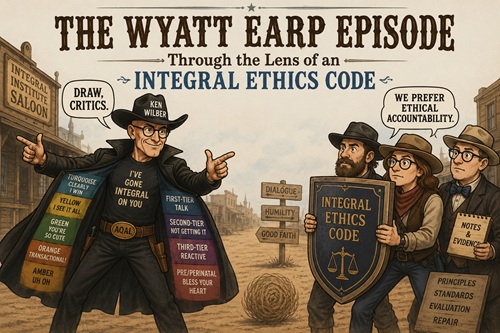 DisclaimerThe following analysis applies the draft principles and standards of Bruce Alderman's Toward an Integral Code of Ethics to a well-known controversy in the history of Integral Theory. The code is still a field-review working draft under collaborative development and should not yet be treated as a finalized or authoritative document. This essay therefore uses the draft heuristically and interpretively, not as a settled or enforceable framework.[1] The Wyatt Earp Incident RevisitedThe “Wyatt Earp episode” surrounding Ken Wilber would almost certainly be interpreted by this ethics code as a paradigmatic failure of developmental ethics, particularly in the domains of public discourse, community leadership, retaliation, and the weaponization of developmental language. For context, the episode refers to Wilber's notorious 2006 online outburst against critics on the old kenwilber.com blog, where he mocked and dismissed dissenters in highly personal and developmentally coded language, famously challenging critics to a metaphorical “Wyatt Earp” showdown. The incident became emblematic for many critics of the gap between integral ideals and actual communicative behavior. Public Discourse and Developmental LabelingUnder Alderman's code, several standards would immediately become relevant. Most obviously, Standard F.3 states that practitioners shall engage critics “in good faith,” resisting the temptation to use meta-level positioning to evade substantive engagement. The Wyatt Earp episode would likely be judged as a direct violation of this principle because Wilber frequently responded to criticism not by addressing arguments in detail, but by psychologizing or developmentalizing the critics themselves. The code explicitly warns against using claims of higher integration as insulation from criticism. Standard F.2 would also apply strongly. The casual public assignment of developmental categories to identifiable individuals—“green meme,” “mean green meme,” “first-tier,” and so on—is specifically condemned as “intellectual irresponsibility.” The Wyatt Earp rhetoric was saturated with precisely this style of public developmental labeling. Even more central would be Principle V on the “non-weaponization of developmental language.” The code directly prohibits using developmental frameworks to pathologize dissent, diminish critics, or render disagreement evidence of lower consciousness. In many ways, the Wyatt Earp episode is exactly the kind of behavior this principle appears designed to prevent. Critics were not merely disagreed with; they were often framed as developmentally incapable of understanding the framework they criticized. Leadership, Loyalty, and RetaliationCommunity leadership standards would also come into play. Standard D.3 explicitly warns leaders not to cultivate “cultures of deference, idealization, or uncritical loyalty.” The Wyatt Earp episode intensified a polarized dynamic in which loyalty to Wilber became intertwined with developmental status signaling. Supporters often interpreted criticism of Wilber as evidence of lesser understanding, while critics experienced the atmosphere as intellectually coercive. Standard D.6 is especially interesting in this context. It says ethical concerns should be treated as “legitimate contributions to community integrity” rather than threats to institutional stability or personal reputation. Much of the controversy around the Wyatt Earp affair arose because critics felt that substantive objections to Integral Theory were routinely reframed as personal deficiencies or anti-integral hostility instead of being engaged on their merits. Cross-cutting Standard X.7 on retaliation would likely be implicated as well. The code specifically includes subtle forms of retaliation such as reputational marginalization and “developmental pathologizing.” Critics of Wilber frequently argued that they were informally excluded, dismissed, or reframed as psychologically reactive or developmentally limited. Alderman's language appears uncannily tailored to exactly these dynamics. The Core Ethical FailureThe most devastating judgment under the code, however, would probably concern Principle III: “Developmental Authority Is Not Moral Authority.” The Wyatt Earp episode became historically significant because it shattered, for many observers, the assumption that advanced integral cognition necessarily produces emotional maturity, ethical restraint, or dialogical generosity. The scandal was not merely that Wilber became angry; it was that a thinker who articulated extraordinarily sophisticated developmental theories displayed behavior many regarded as narcissistic, contemptuous, and thin-skinned. Under Alderman's framework, defenders could still argue contextual mitigation. They might say Wilber was responding to years of hostile criticism, online provocation, or bad-faith attacks. The code does not prohibit strong disagreement, forceful rhetoric, or even anger. But it does prohibit leveraging developmental or metatheoretical authority to delegitimize critics while avoiding substantive accountability.[2] A Founding Trauma of Integral Culture?Ironically, the Wyatt Earp affair almost reads retroactively like the founding trauma behind parts of this ethics code. Many of the document's warnings—against developmental ranking, interpretive immunity, retaliatory reframing, charismatic exceptionalism, and conflating complexity with ethical maturity—map almost perfectly onto the lessons critics drew from that controversy. In that sense, Alderman's code can be read as a post-Wyatt-Earp attempt to domesticate the shadow side of integral culture: to preserve developmental insight while constraining the superiority dynamics that repeatedly accompanied it.[3] Frank Visser as the main targetA particularly relevant figure in this history is Frank Visser, author of the early intellectual biography Ken Wilber: Thought as Passion and later founder of Integral World, which became the principal platform for sustained critical engagement with Integral Theory. Visser initially approached Wilber sympathetically and with considerable scholarly admiration, but over time grew increasingly critical of what he saw as Wilber's grandiose metaphysical claims, weak treatment of science, and dismissive handling of dissent. During and after the Wyatt Earp episode, Visser became one of the most visible targets of Wilberian polemics. He and other critics were frequently characterized not simply as mistaken, but as developmentally limited, reactive, or incapable of grasping integral complexity. From the perspective of Alderman's ethics code, Visser's experience exemplifies the dangers associated with developmental pathologizing, retaliatory reframing, and the use of metatheoretical superiority as a shield against substantive criticism. Ironically, Visser's trajectory—from respected insider and biographer to prominent dissident outsider—illustrates precisely why the code repeatedly insists that disagreement must not be treated as evidence of lower development or deficient consciousness. NOTES[1] Bruce sent me his document for review and I have provided extensive feedback. I refrain from evaluating the full text until it has been published. Upon my question why the elephant in the room (Wilber's extravagant behavior) wasn't addressed, he announced a companion volume in which the ethical principles described in the first document were applied to "a number of case examples". He also expressed doubts if guidelines like this can ever impact institutional and personal behavior. [2] In the now defunct Facebook group "Wyatt Earpy's Saloon" (278 members), archived as late as 25 februari 2021 by its administrator Bruce Alderman(!), this whole episode was not so much critically evaluated and debated, but rather emulated and hence normalized:  This was the group description—inviting members to unreservedly imitate Wilber: FREE TO BE FULLY A DICK* This testifies, in my opinion, again to the integral community's inability to ethically evaluate incidents like Wyatt Earp. In fact, during the height of this whole consternation, who really, publically stood up to be counted? [3] In a 10-part series I analyze the whole Wyatt Earp debacle from various viewpoints. Here's one from Part 4: The Aftermath and the Cultic Consolidation of "Integral": When Ken Wilber released his infamous Wyatt Earp blog trilogy in 2006, it shocked not only his critics but many within the Integral community. The spectacle of a supposed sage of “second-tier consciousness” acting out an online gunfight with his critics revealed a deep contradiction: the prophet of integral balance was performing egoic rage. Yet the most revealing development came after the dust settled. The episode did not trigger sustained self-reflection within the movement. There was no in-depth reckoning, no official self-critique from the Integral Institute. Instead, the community quietly moved on—as if the event had been a mere theatrical episode, not a structural warning light. In sociological terms, the Wyatt Earp affair functioned as a “boundary crisis.” In charismatic communities, such moments can either produce reform or consolidation. Wilber's circle chose consolidation: redoubling loyalty, tightening boundaries, and reframing the scandal as a misunderstood “teaching moment.” Comment Form is loading comments...
|