|
TRANSLATE THIS ARTICLE
Integral World: Exploring Theories of Everything
An independent forum for a critical discussion of the integral philosophy of Ken Wilber
  Frank Visser, graduated as a psychologist of culture and religion, founded IntegralWorld in 1997. He worked as production manager for various publishing houses and as service manager for various internet companies and lives in Amsterdam. Books: Ken Wilber: Thought as Passion (SUNY, 2003), and The Corona Conspiracy: Combatting Disinformation about the Coronavirus (Kindle, 2020). Frank Visser, graduated as a psychologist of culture and religion, founded IntegralWorld in 1997. He worked as production manager for various publishing houses and as service manager for various internet companies and lives in Amsterdam. Books: Ken Wilber: Thought as Passion (SUNY, 2003), and The Corona Conspiracy: Combatting Disinformation about the Coronavirus (Kindle, 2020).
Check out my other conversations with ChatGPT
On Peter Berger (1929-2017): The Failure of the Secularization Thesis Peter Berger's Pyramids of Sacrifice Peter Berger's Pyramids of SacrificeThe Human Cost of Grand Political VisionsFrank Visser / ChatGPT
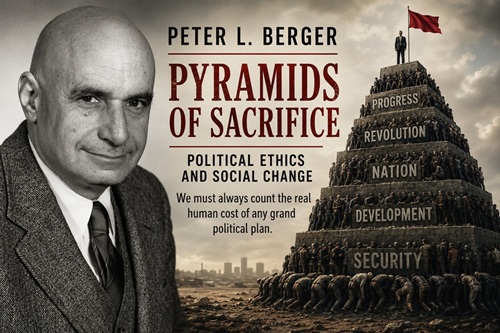
In 1976, sociologist Peter L. Berger published Pyramids of Sacrifice: Political Ethics and Social Change, a book that deserves to be rediscovered in an age of ideological certainty. Berger's central argument was deceptively simple: whenever governments, movements, intellectuals, or revolutionary projects promise to construct a better society, we should ask a question that political rhetoric has an extraordinary capacity to suppress: What will it cost real human beings? That question sounds almost embarrassingly obvious. Yet much of political history consists of elaborate attempts to avoid asking it. Berger was writing during the Cold War, when competing political systems justified enormous sacrifices in the name of historical necessity. Communism promised liberation through revolutionary transformation; capitalism defended itself as the route to prosperity and freedom. Development economists and political leaders in poorer countries embraced ambitious modernization projects that could involve forced collectivization, displacement, authoritarian rule, or the suppression of traditional institutions. Everywhere, there was a temptation to regard present suffering as the price of future salvation. Berger called these arrangements “Pyramids of Sacrifice.” The metaphor is deliberately religious. A pyramid is constructed upward by placing one layer upon another. A sacrificial pyramid is constructed by placing human beings beneath an abstraction: History, Revolution, Progress, the Nation, Development, Equality, Security, or some other supposedly transcendent objective. The disturbing implication is that modern societies had not escaped sacrifice. They had merely secularized it. The secularization of sacrificeBerger's sociological background made him particularly sensitive to the way human beings construct systems of meaning. Political ideologies do not merely provide policies. They provide moral universes. They tell people what is ultimately important, who stands on the right side of history, what suffering means, and which sacrifices are necessary. This is where Berger's argument becomes more interesting than a conventional critique of communism. It would be easy to read Pyramids of Sacrifice simply as an anti-Marxist book written during the Cold War. Berger certainly had serious reservations about Marxist politics and was sharply critical of authoritarian developmentalism. But his underlying principle was broader. No political ideology should be allowed to immunize itself against moral accounting by appealing to a supposedly greater historical good. The problem is not that societies have goals. The problem begins when the goal becomes so sacred that people become expendable. A revolutionary movement can therefore say that millions must suffer because socialism will eventually emerge. A nationalist government can say that individuals must surrender their freedoms because the nation is threatened. A developmental regime can demolish communities because industrialization requires it. A technocratic government can impose severe restrictions because the models say they are necessary. A religious movement can demand sacrifice because God requires it. The vocabulary changes. The moral structure remains remarkably constant. Someone is always asked to pay the bill for someone else's vision of the future. The arithmetic of human sufferingBerger's great contribution was to insist on a kind of moral arithmetic. Political programmes normally advertise benefits. They promise higher growth, greater equality, national greatness, liberation, security, modernization, justice, or ecological salvation. Their proponents often speak in aggregates: millions lifted from poverty, percentage increases in GDP, tons of carbon avoided, lives statistically saved, productivity gains, or geopolitical advantages. But people do not experience aggregates. They experience hunger, imprisonment, unemployment, displacement, bereavement, humiliation, fear, lost opportunities and sometimes death. This distinction is crucial. A statistic can describe suffering while simultaneously concealing it. Suppose a government declares that a particular economic transformation will eventually make society vastly richer. That proposition may even be correct. But if achieving the transformation requires destroying the livelihoods of hundreds of thousands of people, the gains do not somehow erase the losses. They have to be morally incorporated into the calculation. Berger therefore challenged a characteristic temptation of modern political reasoning: the substitution of historical arithmetic for moral responsibility. If the future is sufficiently glorious, almost any present sacrifice can be rationalized. This is precisely how pyramids are built. The problem of historical necessityOne of Berger's deepest targets was the concept of historical necessity. Political movements frequently claim that history has already selected the destination. Once the destination is regarded as inevitable, opposition becomes irrational and sacrifice becomes obligatory. Marxism provided perhaps the most elaborate example. If capitalism necessarily produces its own destruction and socialism represents the next stage of historical development, then resistance to revolutionary transformation can be interpreted as resistance to history itself. But the same intellectual structure appears outside Marxism. Nationalists invoke the destiny of nations. Imperial powers speak of civilization. Modernizers speak of development. Technocrats speak of what the data require. Environmental activists sometimes speak of planetary necessity. Geopolitical strategists speak of existential threats. The particular doctrine is secondary. The dangerous move is the same: The political objective is converted into a necessity, and necessity is then used to suspend ordinary moral constraints. Berger's warning is therefore not confined to the ideological battles of the 1970s. It is directed at a recurrent feature of political modernity. The more certain people become that they know where history must go, the easier it becomes to justify what they do to people along the way. Berger against the politics of abstractionThere is another reason Pyramids of Sacrifice remains relevant: Berger was deeply suspicious of abstractions that become detached from lived experience. “Economic growth” is an abstraction. “Social justice” is an abstraction. “National security” is an abstraction. “Humanity's future” is an abstraction. “Historical progress” is an abstraction. The people who allegedly benefit from these abstractions, however, are not abstractions. They are individuals with families, careers, homes, relationships, aspirations and fears. This creates an asymmetry in political argument. The benefits are often described in enormous conceptual terms, while the costs are experienced locally and personally. “Five million people will benefit” sounds impressive. But the five hundred thousand people who lose their homes each have a name. The political language of grand projects tends to move upward toward increasingly impressive abstractions. Berger's moral method pulls the argument downward again, toward actual human beings. That is why his title is so powerful. A pyramid looks magnificent from a distance. Up close, one can see what it is built from. Development and the Third WorldOne of Berger's principal concerns was the politics of economic development. During the postwar period, development was frequently conceived as a massive process of modernization. Poor societies were expected to transform themselves through industrialization, urbanization, centralized planning, agricultural modernization and integration into global markets. Much of this was undoubtedly beneficial. Economic development has lifted enormous numbers of people from extreme poverty. Berger was not advocating romantic stagnation. His point was subtler. Development itself is not a moral blank cheque. A society cannot simply be told that its present suffering is acceptable because the development statistics will look better twenty years from now. This is particularly important because development projects frequently distribute benefits and costs unevenly. The people who gain from modernization may not be the same people who pay for it. Rural populations may subsidize urban industrialization. Workers may subsidize consumers. Poor citizens may subsidize political elites. Indigenous communities may subsidize national infrastructure. The language of “development” can therefore conceal a question of distribution: Who benefits? Who pays? Who decides? And, crucially, who gets to decide how much suffering is acceptable? Berger's political ethics begins precisely there. The uncomfortable relationship between economics and moralityBerger's argument also challenges a common misconception about economics. Economic reasoning is indispensable for understanding political choices. Resources are scarce. Policies have opportunity costs. Every intervention produces unintended consequences. Good intentions do not abolish trade-offs. But economic calculation cannot determine by itself what is morally permissible. A policy might generate enormous aggregate benefits while imposing concentrated suffering on a minority. The fact that the benefits outweigh the costs in some utilitarian calculation does not automatically settle the question. Indeed, Berger's warning becomes particularly powerful when the losers have little political power. If a wealthy and politically influential group benefits from a policy while a relatively powerless population bears its costs, aggregate statistics can make exploitation look like efficiency. This is one of the oldest political tricks imaginable: turning victims into variables. Berger asks us to reverse that process. The Cold War has ended. The problem has not.The Soviet Union disappeared in 1991. The ideological world Berger inhabited therefore no longer exists in its original form. But the moral temptation he identified has certainly survived. Today, grand political projects are once again everywhere. There is the geopolitical project of reshaping the international order. There are ambitious programmes for decarbonizing entire economies. There are projects of technological transformation involving artificial intelligence and automation. There are attempts to redesign healthcare, education, migration systems, housing markets and welfare states. There are nationalist projects promising the restoration of sovereignty and cultural identity. There are revolutionary projects on both the left and right. Many of these projects contain legitimate objectives. That is precisely what makes Berger's warning important. The danger does not arise only when the objective is obviously evil. It arises when a legitimate objective becomes sufficiently exalted that its advocates stop asking what their methods are doing to actual people. Climate policy and the new politics of necessityClimate change provides an especially interesting contemporary application. There is a powerful temptation to dismiss Berger's argument here because the underlying environmental problem is real. Climate change involves genuine physical constraints, and delaying mitigation can itself impose enormous human costs. But precisely because the problem is real, the moral accounting must be serious. A climate policy can produce benefits and costs simultaneously. Energy prices can rise. Industries can disappear. Jobs can be transformed. Households with limited resources can be disproportionately affected. Developing countries may reasonably argue that wealthy countries became rich through fossil-fuel consumption and are now attempting to restrict the development opportunities available to poorer societies. None of this means that climate action is wrong. It means that “the climate requires it” cannot be the end of the argument. It is the beginning. Berger would presumably ask: Who bears the burden? How large is it? Can it be reduced? Are alternatives available? Are costs distributed fairly? Who made the decision? Who has political voice? What unintended consequences might follow? A moral political programme must answer these questions rather than treating them as inconvenient resistance. Geopolitics and the expendability of peopleThe same principle applies even more starkly to war. Geopolitical discourse is particularly vulnerable to abstraction. Analysts speak of spheres of influence, strategic depth, deterrence, credibility, balance of power, red lines and geopolitical leverage. All of these concepts can be legitimate analytical categories. But they can also become morally anesthetizing. A “strategic setback” can mean the death of thousands of soldiers. A “territorial adjustment” can mean the destruction of a city. A “humanitarian crisis” can mean a family that no longer has a home. A “necessary sacrifice” can mean somebody's son or daughter. Berger's method does not tell us which side of a geopolitical dispute is correct. It imposes a prior ethical obligation: never allow strategic abstractions to make human beings disappear from the calculation. That applies equally to all sides. The pyramid can be liberal as well as authoritarianThis is where Berger's argument becomes particularly uncomfortable for contemporary Western politics. It is easy to recognize Pyramids of Sacrifice in Stalinism or Maoism. It is much harder to recognize them when the project is one we personally support. But Berger's principle has no ideological exemption clause. A liberal democracy can build pyramids too. A government can impose a policy in the name of national security. A central bank can tolerate severe unemployment in pursuit of monetary stability. A government can pursue fiscal austerity while insisting that long-term financial credibility requires it. A technological platform can disrupt entire industries in the name of innovation. A democratic coalition can impose costs on politically marginal groups because the majority considers the objective sufficiently important. None of these examples is necessarily wrong. That qualification is essential. The point is not that every policy involving sacrifice is a pyramid of sacrifice. Politics inevitably involves trade-offs. Sometimes serious sacrifices really are unavoidable. The question is whether the sacrifice is being acknowledged, justified, limited and fairly distributed—or simply sanctified by the rhetoric of necessity. That distinction is everything. Berger's weakness: there is no politics without sacrificeYet Berger's argument also has a limitation. It is possible to push his skepticism too far. Every significant political decision has costs. Doing nothing also has costs. Maintaining the status quo can itself be a gigantic pyramid of sacrifice, with its victims rendered invisible because they are distributed across time and society. Suppose reforming a dysfunctional institution would impose substantial short-term disruption but prevent much greater long-term suffering. A strict Bergerian insistence on counting immediate costs could become conservative in the literal sense: it would protect existing arrangements because their victims are already normalized. The same applies to poverty, climate change, war, public health and technological change. Sometimes refusing to act is the greater sacrifice. Therefore the lesson cannot simply be “never sacrifice.” That would be politically meaningless. The lesson must be: never treat sacrifice as morally costless merely because it serves your preferred objective. The costs of action and inaction must both be counted. The missing dimension: uncertaintyThere is another issue that makes Berger's argument even more relevant today: uncertainty. Grand political projects frequently rest on predictions about the future. But political actors are notoriously bad at predicting complex social systems. The Soviet planners could not know what centralized economic planning would ultimately produce. Mao's revolutionaries could not foresee the full consequences of the Great Leap Forward. Development planners could not anticipate every social consequence of rapid modernization. The same epistemic problem exists today. Whenever a government proposes a massive transformation, it is implicitly making a forecast. But the larger the intervention, the more opportunities there are for unintended consequences. This creates a powerful moral principle: The greater the uncertainty, the greater the obligation to limit irreversible human costs. Berger's skepticism therefore intersects with a broader principle of prudence. When we are uncertain about the consequences of a policy, we should be particularly reluctant to demand enormous sacrifices from people who have little ability to escape them. The politics of reversibilityThis suggests a useful extension of Berger's argument. Political projects should be judged not only by their intended benefits and anticipated costs, but also by their reversibility. A policy that can be tested, modified or abandoned is fundamentally different from one that permanently destroys institutions, communities or ecosystems. This is one reason gradualism can sometimes be morally superior to revolutionary transformation. It permits feedback. It allows mistakes to be corrected. It distributes uncertainty across smaller experiments rather than imposing it on an entire population simultaneously. The revolutionary imagination tends to regard incrementalism as cowardice. Berger's perspective suggests that incrementalism can instead be an ethical recognition of human fallibility. We do not know enough to rebuild society from scratch. And the people who suffer when we discover that fact are not theoretical casualties. The danger of moral asymmetryPerhaps the most important contemporary lesson of Pyramids of Sacrifice concerns moral asymmetry. We are generally much better at seeing sacrifices imposed by political opponents than sacrifices imposed by ourselves. When our opponents sacrifice people, we call it brutality. When we sacrifice people, we call it necessity. When their ideology demands suffering, we call it fanaticism. When ours does, we call it realism. When they appeal to history, we call it propaganda. When we do, we call it vision. Berger's framework cuts through this hypocrisy because it asks the same question regardless of ideology: Who is paying? And then: Would you still support the policy if you had to pay the price yourself? That second question is particularly revealing. Political movements become considerably more cautious when the costs cease to be hypothetical. A sociologist's warning against utopianismBerger was not opposed to social change. His argument was directed against utopianism—the belief that sufficiently intelligent political actors can construct a radically better society through deliberate transformation. The utopian imagination tends to compress complexity. First comes the diagnosis: society is fundamentally defective. Then comes the blueprint: here is what the new society should look like. Then comes the justification: extraordinary measures are required to get there. Finally comes the discovery that reality refuses to cooperate. At this point the movement has two choices. It can revise the theory. Or it can blame the people. Historically, the second option has often proved more attractive. The revolution has not failed because the theory was wrong. It has failed because counter-revolutionaries sabotaged it. Development has not failed because the model was defective. It has failed because the population was backward. The reform has not failed because its assumptions were mistaken. It has failed because insufficient commitment prevented implementation. And so the pyramid grows. The victims become evidence for the necessity of more sacrifice. What Berger gets profoundly rightThe enduring strength of Pyramids of Sacrifice is therefore not a particular policy recommendation. It is a discipline of political thought. Before celebrating a grand project, ask what it costs. Before invoking necessity, ask whether necessity has actually been demonstrated. Before speaking of millions, look at the individual. Before promising the future, examine the present. Before demanding sacrifice from others, ask who possesses the power to demand it. Before dismissing objections as selfishness, examine whether those objections come from people who will actually bear the consequences. And before declaring that history will vindicate us, remember that history contains enormous numbers of dead people who were once assured that their suffering would ultimately prove worthwhile. That last point is especially important. The dead cannot collect the promised dividends of political utopia. Conclusion: Never let the future spend the lives of the presentNearly fifty years after its publication, Pyramids of Sacrifice remains an unusually useful antidote to political grandiosity. Its message is not that societies should abandon ambition. Nor is it that every reform is dangerous or that every sacrifice is unjustified. Human beings inevitably make collective decisions under conditions of scarcity, uncertainty and conflict. Sometimes difficult choices really are necessary. Berger's warning is more demanding than simple political cynicism. If you ask people to sacrifice for a better future, you acquire a moral obligation to count the sacrifice. Not rhetorically. Not statistically. Not as an unfortunate footnote to the triumph of History. Actually count it. Count the displaced family. Count the unemployed worker. Count the imprisoned dissident. Count the dead soldier. Count the community destroyed in the name of development. Count the citizen whose freedom has been curtailed in the name of security. Count the poor household that pays for a policy designed by people who will never experience its consequences. And then count the promised benefits as well. Only after both sides of the ledger are visible can political judgment begin. This is ultimately what Berger's pyramid metaphor exposes. Grand political visions have a peculiar tendency to become morally weightless when viewed from a great enough distance. The larger the abstraction, the easier it becomes to forget the people underneath it. The task of political ethics is therefore to bring those people back into view. No future society, however magnificent, has the right to make human beings invisible in the present. That may be the simplest—and most durable—lesson of Berger's book.
Widget is loading comments...
|