|
TRANSLATE THIS ARTICLE
Integral World: Exploring Theories of Everything
An independent forum for a critical discussion of the integral philosophy of Ken Wilber
  Frank Visser, graduated as a psychologist of culture and religion, founded IntegralWorld in 1997. He worked as production manager for various publishing houses and as service manager for various internet companies and lives in Amsterdam. Books: Ken Wilber: Thought as Passion (SUNY, 2003), and The Corona Conspiracy: Combatting Disinformation about the Coronavirus (Kindle, 2020). Frank Visser, graduated as a psychologist of culture and religion, founded IntegralWorld in 1997. He worked as production manager for various publishing houses and as service manager for various internet companies and lives in Amsterdam. Books: Ken Wilber: Thought as Passion (SUNY, 2003), and The Corona Conspiracy: Combatting Disinformation about the Coronavirus (Kindle, 2020).
Check out my other conversations with ChatGPT
On Peter Berger (1929-2017): The Failure of the Secularization Thesis Peter Berger's Pyramids of Sacrifice Peter Berger and the Failure of the Secularization ThesisFrank Visser / ChatGPT
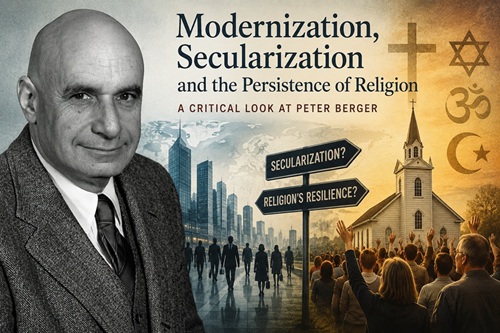
Peter Berger occupies an unusual position in the sociology of religion. In his early work, he was one of the theorists who helped give intellectual respectability to the idea that modernity would weaken religion. Yet decades later he became one of the most prominent critics of precisely that assumption. Looking at the persistence and vitality of religion in the United States, and at the resurgence of religion elsewhere, Berger concluded that the expectation of a progressively secular world had been badly mistaken. His intellectual reversal is important. But it should not be misunderstood as a simple discovery that secularization was false. Berger's later position was more subtle: modernization does not necessarily produce the disappearance of religion. Rather, it tends to produce pluralism, competition between worldviews, and the destabilization of traditional religious monopolies. Secularization is therefore only one possible consequence of modernity, and perhaps not the most universal one. That distinction matters. The Original Secularization ThesisClassical secularization theory rested on a relatively straightforward intuition. Modernization changes the social conditions under which religion operates. Industrialization, urbanization, scientific rationality, bureaucratic administration, mass education and the differentiation of social institutions progressively remove functions once performed by religious institutions. The state becomes less religious. Medicine replaces religious healing. Astronomy replaces cosmological mythology. Psychology and sociology offer secular explanations of human behavior. Education moves increasingly outside ecclesiastical control. Political legitimacy no longer depends upon divine sanction. Religion, on this account, becomes progressively confined to a specialized sphere. Berger himself contributed to this intellectual tradition. His early sociology emphasized the "plausibility structures" through which societies sustain particular interpretations of reality. Religious beliefs do not exist simply inside individual minds. They are socially maintained through institutions, communities, rituals and shared assumptions. Modernity destabilizes these structures. When an individual belongs to a society in which virtually everybody shares the same religious worldview, belief is experienced as obvious reality. When that society becomes religiously pluralistic, however, one's beliefs become one possibility among several. The Catholic discovers Protestants. The Christian encounters Muslims, Hindus, Buddhists and atheists. The believer meets the secular intellectual. Suddenly the taken-for-granted becomes a choice. This is one of Berger's most important insights. Modernity does not merely produce atheism. It produces a social situation in which belief becomes increasingly voluntary. And that is a very different phenomenon. The American ProblemThen there was America. The United States presented an awkward empirical problem for straightforward secularization theory. Here was an extraordinarily modern, industrialized, technologically sophisticated society in which religion remained remarkably vigorous. Americans were not merely religious in private. Religious institutions remained prominent in public life, churches attracted large constituencies, religious organizations were socially influential, and evangelical Christianity became a major cultural and political force. If modernization automatically generated secularization, America looked like an anomaly. Berger eventually took the anomaly seriously. He increasingly argued that sociologists had made the mistake of treating the European experience as the normal trajectory of modernity. Europe had experienced a dramatic decline in religious authority and practice. But perhaps Europe was the exception rather than the rule. This was a major intellectual correction. The world was not necessarily heading toward a secular future. Instead, modernization was producing a world of competing religious and secular options. From Secularization to PluralismBerger's mature position therefore deserves to be stated carefully. He did not simply replace the proposition "modernity produces secularization" with "modernity produces religion." His argument was closer to this: Modernization produces pluralization. And pluralization can have different religious consequences. It can weaken religious institutions because no institution possesses an unquestioned monopoly over meaning. But it can also stimulate religious competition. Religious groups that can no longer rely upon inherited cultural authority must persuade people to join them. This can make religion more dynamic rather than less. The religious marketplace becomes competitive. The result can be revival, innovation, conversion and intense religious commitment. American evangelicalism illustrates this particularly well. Religious organizations have often behaved less like remnants of a premodern world than like highly adaptive institutions operating within a competitive modern marketplace. This is one reason Berger's later sociology is more persuasive than the crude version of secularization theory it replaced. But Was Berger Really Wrong About Secularization?Here the story becomes more complicated. The persistence of religion does not demonstrate the absence of secularization. That is perhaps the most important qualification. Secularization can refer to several different processes that should not be collapsed into one. There is the decline of religious institutions. There is the decline of religious belief. There is declining participation in religious organizations. There is the differentiation of state and religion. There is the decline of religious authority over science, education, law and politics. And there is the privatization of religious belief. These processes do not necessarily occur together. The United States provides a particularly good example. American society has remained unusually religious compared with much of Western Europe. But American religion itself has undergone enormous transformations. Denominational loyalties have weakened. Religious switching has become common. The "nones"—people identifying with no religion—have grown substantially. Many Americans describe themselves as spiritual without belonging to religious institutions. The important point is that religion can remain culturally powerful while becoming institutionally less stable. That is not necessarily the triumph of traditional religion. It may instead be secularization in a more complicated form. Europe Was Not Simply an ErrorBerger's correction also risks creating a new oversimplification: if Europe is unusually secular, perhaps European secularization was merely an accident. That conclusion would go too far. Europe really did undergo processes associated with modernization that weakened traditional Christianity. Industrialization, urbanization, scientific education, bureaucratic rationalization, individualism, political liberalization and the separation of church and state all contributed to the erosion of ecclesiastical authority. The European historical trajectory therefore cannot simply be dismissed as a sociological mistake. Indeed, Berger's own concept of pluralization helps explain it. When religious monopolies collapse, individuals acquire alternatives. Over generations, religious belief can become less socially compulsory. Eventually, nonbelief itself becomes a plausible and socially legitimate option. The decisive change may therefore not be that people suddenly become convinced atheists. It is that they discover they do not have to believe. The American ExceptionAmerica is particularly instructive because its religious history differs substantially from that of Europe. The United States never developed a single established national church comparable to the dominant churches of many European countries. Religious competition was present from the beginning. Protestant denominations competed with one another, Catholics established their own institutions, Jews created communities, and later waves of immigration multiplied the religious landscape. Religion therefore became compatible with pluralism from an early stage. Paradoxically, religious competition may have helped preserve religious vitality. A religious monopoly can become bureaucratic and complacent. A competitive religious environment encourages organizations to recruit, innovate and respond to consumer preferences. American religion consequently became highly entrepreneurial. Television evangelism, megachurches, religious publishing, Christian broadcasting, evangelical universities and religious political organizations are all distinctly modern phenomena. There is nothing inherently premodern about them. Religion did not necessarily survive modernity by resisting it. In important respects, it modernized itself. The Strange Relationship Between Modernity and FundamentalismThis produces one of the great paradoxes of modern sociology. Modernity can undermine traditional religion while simultaneously generating conditions favorable to religious revival. The more pluralistic the world becomes, the more uncertain the individual's worldview may become. And uncertainty can produce a desire for certainty. This helps explain the appeal of fundamentalist movements. Fundamentalism is often portrayed as a survival from an earlier age. But sociologically, much fundamentalism is thoroughly modern. It uses mass media, modern organizational techniques, global networks, sophisticated marketing and political mobilization. The fundamentalist response to modernity is therefore not necessarily a refusal of modernity as such. It is often a refusal of modernity's relativizing consequences. The fundamentalist wants modern technology without modern epistemological uncertainty. The smartphone is welcome. Pluralism is not. Berger's Most Important Insight: The World Became PluralisticPerhaps Berger's greatest contribution in his later work was therefore not his rejection of secularization but his emphasis on pluralism. Modernity destroys the assumption that there is only one legitimate worldview. That development affects religion profoundly. A medieval Christian could inhabit a world in which Christianity was not merely one religion among many. It constituted the intellectual and institutional environment of life. Modern people increasingly inhabit what Berger called a pluralistic situation. They encounter alternatives. They compare. They choose. They doubt. They convert. They leave. They return. They combine traditions. They become secular. Or they become more intensely religious. This is a fundamentally different religious condition from that of premodern societies. Religion may survive. But it survives under different sociological conditions. The "Religious America" Argument Also Has LimitsThere is, however, a danger in using America as the decisive refutation of secularization. America is not simply "modernity plus religion." American religiosity itself has changed dramatically. Institutional Christianity has experienced substantial fragmentation. Mainline Protestant denominations have declined. Catholicism has undergone major changes. Religious affiliation is increasingly fluid. Younger Americans are considerably less likely to participate in traditional religious institutions than previous generations. Moreover, the United States is not necessarily as religious as the phrase "religious society" implies. Americans are extraordinarily diverse in their religious commitments. Some are deeply devout; others are nominally religious; others are unaffiliated; still others combine elements of Christianity, New Age spirituality, Buddhism, psychology and secular humanism. The more interesting sociological question is therefore not: "Is America religious?" It is: "What kind of religiosity does modern America produce?" That question leads back to Berger. Secularization May Be About Authority Rather Than BeliefPerhaps the deepest problem with the old secularization debate is that it asks the wrong question. Does religion disappear? Usually not. The more revealing question is: "Where does religion retain authority?" A modern society can contain millions of religious believers while operating largely through secular institutions. Scientists do not need theological approval to conduct research. Hospitals do not normally require ecclesiastical authorization to practice medicine. Governments do not derive their legitimacy exclusively from religious institutions. Universities operate according to secular academic norms. Courts increasingly rely on constitutional and legal principles rather than theological doctrine. Even highly religious citizens may accept these institutional arrangements. In this sense, secularization has succeeded spectacularly even where religious belief remains strong. The decline of religious authority is not identical to the disappearance of religious people. That distinction saves secularization theory from some of its crudest formulations. Modernity Does Not Have a Single Religious DestinationBerger's great intellectual correction was to abandon the assumption that there was one universal trajectory. Modernization is not a conveyor belt carrying every society from religion to atheism. Different societies negotiate modernity differently. Europe became unusually secular. The United States remained comparatively religious. Parts of the Middle East experienced modernizing processes alongside powerful Islamic revival movements. India became technologically and economically modern without abandoning Hindu religiosity. East Asia produced highly modern societies in which traditional religious categories do not map neatly onto Western assumptions about belief. Africa has experienced dramatic modernization alongside extraordinary Christian and Muslim expansion. The global picture is therefore not "religion versus modernity." It is a much more interesting interaction between them. The Irony of Berger's ReversalThere is an additional irony in Berger's intellectual journey. His early sociology provided some of the conceptual tools needed to explain his later revision. If religious reality depends upon plausibility structures, then modernization can weaken some structures while strengthening others. Pluralism destroys the taken-for-granted character of belief. But precisely because belief becomes voluntary, religion can become more consciously embraced. A modern believer may therefore be less traditionally religious but more reflectively religious. The disappearance of compulsion can produce both apostasy and commitment. That is why modernization can generate atheists and evangelicals at the same time. The same social process can produce opposite individual outcomes. What Berger Got Right—and What He Didn'tBerger was right to challenge the simplistic proposition that modernization necessarily causes religion to disappear. The empirical record makes such a universal claim untenable. He was also right to emphasize that the European experience had been mistakenly universalized. The United States demonstrated that modernity and vigorous religion could coexist, while developments in Africa, Asia and the Middle East reinforced the point. He was particularly insightful about pluralism. Modernity destabilizes religious monopolies, and the consequences of that destabilization are unpredictable. But Berger's correction should not become another dogma. The persistence of religion does not invalidate every version of secularization theory. Modernization can still diminish religious authority, institutional participation and the social necessity of belief. It can make nonbelief socially legitimate even while leaving religion culturally powerful. The real lesson is therefore more subtle. Modernity does not kill religion. It changes the conditions under which religion survives. Religion ceases to be simply inherited and becomes increasingly contested, chosen, marketed, organized and reinvented. And that may be the most consequential transformation of all. The question is not whether the modern world will be religious or secular. It is whether "religious" and "secular" remain adequate categories for describing a world in which individuals can simultaneously inhabit scientific, technological and bureaucratic modernity while embracing religious identities, spiritual practices, metaphysical beliefs—or none of these. Berger's intellectual journey ultimately points toward that more complicated conclusion. The secularization thesis failed as a prophecy of religion's disappearance. But it succeeded, at least in part, as a description of the erosion of religious monopoly and authority. The future therefore belongs neither simply to religion nor to secularism. It belongs to pluralism—and pluralism is a much more unpredictable sociological force. Appendix: How Would Wilber Diagnose These Sociocultural Developments?Ken Wilber would almost certainly regard Berger's analysis as valuable but incomplete. He would probably accept much of Berger's empirical description—modernization, pluralization, the decline of religious monopolies, the persistence of religion in America, and the rise of both secularism and fundamentalism—but would place all of these developments inside a much larger developmental framework. For Wilber, the central question would not be simply whether modernity makes societies more or less religious. It would be: At what stage of consciousness is a person, a culture, or an institution operating? That move immediately changes the discussion. From Secularization to Developmental StagesWilber's characteristic response would be to argue that "religion" is not a single phenomenon. A traditional Christian believer, a fundamentalist evangelical, a liberal theologian, a Buddhist contemplative, and a postmodern spiritual seeker may all describe themselves as religious while representing radically different structures of consciousness. Wilber would therefore resist the simple opposition between "religious" and "secular." He would distinguish, for example, between traditional, modern and postmodern forms of consciousness. Traditional consciousness tends toward mythic membership, inherited identities and absolute truth claims. Modern consciousness emphasizes rationality, scientific inquiry, individual autonomy and universal principles. Postmodern consciousness becomes suspicious of universal narratives and emphasizes cultural plurality, perspective and contextuality. From this perspective, the decline of traditional Christianity in Europe would not necessarily mean the decline of consciousness itself. It could represent a developmental transition from mythic-traditional structures toward rational-modern ones. America's persistent religiosity would therefore require a more detailed diagnosis. The question would be: What kind of religion is persisting? America: Traditional Religion Inside a Modern SocietyWilber would probably regard the United States as a particularly revealing mixture of developmental stages. A technologically advanced society can contain individuals operating at very different levels of consciousness. A person can use an iPhone, work in a modern corporation, accept modern medicine and participate in democratic institutions while simultaneously holding a mythic worldview about God, creation, morality and salvation. For Wilber, there is no contradiction here. Developmental levels do not replace one another uniformly. They coexist. This would allow him to interpret American religiosity without regarding it as a refutation of developmental theory. America is modern in its technological and institutional structures while containing substantial populations whose worldview remains traditional or mythic. Indeed, Wilber would probably describe this as a major feature of modern societies: the coexistence of multiple developmental waves. Fundamentalism as a Lower-Level Response to ModernityWilber would have an especially clear diagnosis of religious fundamentalism. He would likely interpret it as a traditional or mythic worldview reacting defensively to the differentiation and pluralization brought by modernity. Modernity tells the traditional believer: "There are many religions." Science tells him: "Your cosmology is not empirically established." Pluralism tells him: "Your moral framework is one among several." Psychological individualism tells him: "You must choose your identity." From a Wilberian perspective, this produces a developmental crisis. The traditional worldview experiences the modern world as a threat. The reaction is therefore often regression toward certainty: absolute scripture, absolute morality, absolute identity and absolute truth. Wilber would likely regard fundamentalism as a premodern structure attempting to defend itself against modern differentiation. That diagnosis is not without explanatory power. But it also illustrates one of the central problems of Wilber's framework: the tendency to interpret disagreement as evidence of developmental inferiority. The "Pre/Trans" ProblemHere Wilber would probably invoke his famous distinction between pre-rational and trans-rational consciousness. This is particularly important for religion. A person can transcend rationality because they have developed beyond it—or they can reject rationality because they have not adequately developed it. These two phenomena can look superficially similar. Wilber therefore warns against confusing genuine mystical realization with pre-rational belief. A traditional believer claiming contact with God might be expressing mythic consciousness. A contemplative practitioner reporting nondual awareness might be expressing a genuinely trans-rational realization. The two cannot simply be placed in the same category called "religion." This allows Wilber to preserve mystical traditions while simultaneously criticizing much conventional religion. But it also creates a significant epistemological problem. How do we independently determine that a particular spiritual experience is genuinely "trans-rational" rather than an interpretation imposed upon an unusual psychological state? Wilber's developmental vocabulary can describe the difference very elegantly. It does not necessarily demonstrate that the difference exists in the precise form he claims. Berger's Pluralism Through Wilberian EyesBerger's pluralism would probably be interpreted by Wilber as a consequence of the differentiation of consciousness. As traditional societies become more complex, individuals become capable of recognizing multiple perspectives. This corresponds to an important developmental transition. At earlier stages, one's worldview tends to be experienced as the worldview. At more advanced stages, one recognizes that different perspectives can contain partial truths. Wilber's AQAL framework is designed precisely to accommodate this kind of complexity. A traditional Christian interpretation, a secular scientific interpretation and a Buddhist interpretation might each contain something valid. The integral response is not necessarily to choose one and reject the others. It is to ask what each perspective captures and what it leaves out. This is one reason Wilber would probably regard Berger as describing only one quadrant of a much larger phenomenon. The Four Quadrants Enter the PictureWilber would almost certainly object to explaining religious change purely in sociological terms. Berger is primarily examining the social world: institutions, communities, norms, pluralization and plausibility structures. Wilber would say that this captures only the Lower-Right quadrant: collective exterior structures. But religious transformation also involves individual consciousness, individual behavior and collective culture. His four-quadrant framework would therefore distinguish: Upper Left: individual beliefs, intentions, experiences and states of consciousness. Upper Right: brains, behavior and embodied practices. Lower Left: shared meanings, values, cultural narratives and worldviews. Lower Right: institutions, economic systems, churches, governments and social structures. Wilber would argue that a genuinely adequate sociology of religion has to integrate all four. That is a reasonable methodological criticism. The difficulty begins when Wilber assumes that his developmental hierarchy can supply the missing explanatory architecture. Religion as a Developmental VehicleWilber would also probably make a more provocative argument. Religion can be both developmentally regressive and developmentally transformative. Traditional religion can reinforce ethnocentrism, absolutism and mythic literalism. But contemplative traditions can provide practices capable of producing profound transformations of consciousness. In Wilber's terminology, religion can contain both "horizontal" and "vertical" dimensions. The horizontal dimension concerns worldview, morality, community and cultural identity. The vertical dimension concerns developmental transformation. Thus Christianity can function as a mythic worldview while Christian mysticism can potentially function as a vehicle toward transpersonal realization. Buddhism can contain traditional cosmological beliefs while also containing sophisticated contemplative technologies. Islam can produce both fundamentalism and profound mystical traditions such as Sufism. For Wilber, these are not contradictions. They represent different developmental possibilities within the same tradition. The Integral Diagnosis of SecularismWilber would probably be equally critical of secularism. He would argue that modern rationality performed an essential developmental function by challenging mythic authority and differentiating science from religion. But modernity then committed its own reductionism. Science, in Wilber's view, can become scientism when it assumes that only empirically measurable phenomena are real. The modern secular worldview may therefore correctly reject mythic cosmology while incorrectly rejecting interior experience altogether. This creates what Wilber sees as the characteristic limitation of modernity: it differentiates the spiritual from the political and scientific spheres, but then risks reducing reality to the exterior, measurable domain. The integral solution would be neither a return to traditional religion nor an acceptance of materialist scientism. It would be an integration of science, culture, psychology and contemplative practice. Postmodern Pluralism: Liberation and TrapWilber would probably have another diagnosis for the contemporary explosion of religious and secular identities. Postmodern pluralism represents an important achievement because it recognizes cultural diversity and challenges ethnocentric claims to universal truth. But Wilber famously argues that postmodernism can become caught in relativism. If every worldview is regarded as equally valid simply because it is someone's perspective, developmental discrimination becomes impossible. Integral Theory therefore attempts to distinguish between pluralism and integral holism. Pluralism says: "Many perspectives exist." Integral theory asks: "How can these perspectives be included within a developmental framework?" That is where Wilber believes his model surpasses Berger. But this is precisely where the critical question begins. The Problem with the Integral DiagnosisWilber's interpretation is intellectually attractive because it provides an extraordinarily neat map. Traditional religion occupies one developmental zone. Modern secularism represents another. Postmodern pluralism represents another. Mystical realization represents a higher transpersonal possibility. Fundamentalism becomes a regression or fixation. Integral consciousness becomes the synthesis. The trouble is that historical reality is considerably messier. Religious people do not necessarily occupy one developmental stage. Secular people do not necessarily occupy a higher one. A sophisticated scientist can be psychologically authoritarian. A fundamentalist can possess considerable moral sophistication. A secular intellectual can be deeply ethnocentric. A traditional religious community can display extraordinary compassion and social solidarity. A contemplative can have profound experiences while maintaining rather ordinary prejudices. Development does not automatically produce moral or intellectual consistency. And that is a serious problem for Wilber's tendency to arrange cultural phenomena on a single developmental ladder. Berger Is More Empirical—and Wilber More SpeculativeThis brings us back to the fundamental difference between the two thinkers. Berger begins with sociology. He observes what societies actually do. Religious institutions rise and fall. People convert. Churches compete. Pluralism expands. Belief persists. Secularization proceeds in some societies but not others. He then modifies his theory to accommodate the evidence. Wilber begins with a developmental architecture and interprets the empirical world through it. His framework is therefore much more ambitious. But ambition comes at a price. The more comprehensive the developmental map becomes, the easier it becomes to interpret almost any historical development as confirmation of the map. Religion declines? A transition from mythic to rational consciousness. Religion survives? Traditional consciousness persists. Religion becomes fundamentalist? Regression or defensive resistance. Religion becomes mystical? Transpersonal development. Religion becomes pluralistic? Postmodern differentiation. Religion becomes integral? Evolution has reached a higher stage. A theory capable of interpreting every possible outcome risks becoming difficult to falsify. What Would Wilber Ultimately Say?Wilber would probably regard Berger's intellectual journey as evidence that the history of religion cannot be understood through a simple linear model of modernization. On that point, Berger and Wilber would actually agree. Both reject the crude equation: modernity = secularization = disappearance of religion. But they would explain the alternative very differently. Berger would emphasize pluralization, institutional differentiation, religious competition and changing plausibility structures. Wilber would interpret these processes as manifestations of developmental differentiation across multiple levels of consciousness and culture. The first is primarily sociological. The second is developmental-metaphysical. And this distinction is crucial. Berger's model requires us to examine what people and institutions actually do. Wilber's model asks us to determine where those people and institutions supposedly sit on a developmental hierarchy. The former is empirically modest but comparatively robust. The latter is philosophically ambitious but much harder to validate independently. The IronyThere is therefore an amusing irony in applying Wilber to Berger. Wilber would probably tell us that Berger had correctly noticed the complexity of religious modernization but lacked the developmental map necessary to explain it. Yet Berger's own intellectual trajectory demonstrates precisely why caution is necessary. He began with a broad theoretical expectation about modernization. Reality complicated it. He changed his theory. That is good sociology. A developmental theory should be capable of doing the same. If the evidence continually forces us to revise the map, then perhaps the map should remain subordinate to the evidence. Wilber's greatest strength is his extraordinary capacity to connect phenomena that are normally studied separately. His greatest weakness is that the resulting connections can become so comprehensive that the framework begins to explain rather than test itself. And that is perhaps the final lesson of Berger's journey. Modernity did not kill religion. But neither did religion defeat modernity. Both transformed one another. That reciprocal transformation is sociologically fascinating precisely because it does not fit neatly onto a single ladder of consciousness. Reality, inconveniently, refuses to become AQAL-shaped.
Widget is loading comments...
|