|
TRANSLATE THIS ARTICLE
Integral World: Exploring Theories of Everything
An independent forum for a critical discussion of the integral philosophy of Ken Wilber
  Frank Visser, graduated as a psychologist of culture and religion, founded IntegralWorld in 1997. He worked as production manager for various publishing houses and as service manager for various internet companies and lives in Amsterdam. Books: Ken Wilber: Thought as Passion (SUNY, 2003), and The Corona Conspiracy: Combatting Disinformation about the Coronavirus (Kindle, 2020). Frank Visser, graduated as a psychologist of culture and religion, founded IntegralWorld in 1997. He worked as production manager for various publishing houses and as service manager for various internet companies and lives in Amsterdam. Books: Ken Wilber: Thought as Passion (SUNY, 2003), and The Corona Conspiracy: Combatting Disinformation about the Coronavirus (Kindle, 2020).
Check out my other conversations with ChatGPT
JIM RUTT PODCAST REVIEWS
Episode 203: Robert Sapolsky Episode 227: Stuart Kauffman Episode 293: Brendan Graham Dempsey Episode 314: Marc Gafni & Zak Stein
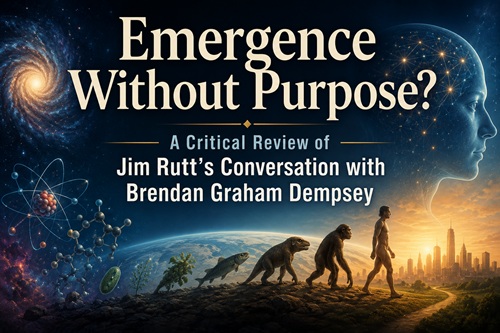 Emergence Without Purpose?A Critical Review of Jim Rutt's Conversation with Brendan Graham DempseyFrank Visser / ChatGPTThe conversation between Brendan Graham Dempsey and Jim Rutt explores one of the oldest philosophical questions in a contemporary form: Does the universe have an intrinsic direction, or are apparent trends toward complexity simply the unintended outcome of natural processes? Their exchange is representative of a broader debate occurring in Integral, metamodern, and complexity-theory circles. It concerns whether concepts such as emergence, self-organization, and increasing complexity can support a renewed notion of cosmic purpose without invoking traditional religious doctrines. The Return of TeleologyDempsey's central concern is the rehabilitation of teleology. He rejects the classical image of a divine architect guiding evolution toward a predetermined goal. Instead, he draws on process philosophy, systems theory, and thinkers such as Alfred North Whitehead and Terrence Deacon to argue that nature itself may contain intrinsic tendencies toward increasing complexity, organization, and consciousness. Rather than speaking of a cosmic plan, Dempsey speaks of directional tendencies. Living organisms display goal-directed behavior. Ecosystems self-organize. Evolution repeatedly generates novel forms of complexity. The question becomes whether these observations point to a deeper principle operating throughout the cosmos. This is a much more sophisticated formulation than traditional intelligent design. Nevertheless, it remains a teleological proposal. Rutt's Defense of ContingencyRutt approaches the issue from the perspective of complexity science. While acknowledging the reality of emergent phenomena, he repeatedly emphasizes contingency and historical accident. From his perspective, evolution does not "aim" at intelligence. Humanity was not an inevitable outcome waiting to emerge. Countless chance events shaped the course of life on Earth. Had circumstances differed slightly, conscious beings like ourselves might never have appeared. Rutt therefore resists any attempt to infer purpose from outcomes. The fact that complexity emerged does not mean complexity was intended. This position reflects a core insight of modern evolutionary biology: adaptation explains how organisms survive, not why the universe exists. The Emergence VectorA key concept discussed is the "emergence vector," a term associated with Alexander Bard. The emergence vector describes a broad pattern in cosmic history: • Matter emerges from primordial energy. • Life emerges from matter. • Minds emerge from life. • Culture emerges from minds. • Future forms of intelligence may emerge from culture. Dempsey sees this sequence as evidence that reality possesses a directional tendency toward increasing complexity and interiority. Rutt accepts the historical pattern but rejects the conclusion. A pattern, he argues, does not necessarily imply a destination. The emergence vector may describe what happened without explaining why it happened. This distinction becomes the central fault line of the discussion. The Strength of Dempsey's ArgumentDempsey's strongest contribution is his critique of simplistic mechanism. Biologists routinely speak about goals, functions, adaptation, information processing, and self-maintenance. Complex systems often exhibit behavior that appears purposive. The older scientific ambition to eliminate all teleological language has largely failed. Modern complexity theory increasingly recognizes that higher-order systems generate constraints and organizational dynamics that cannot easily be reduced to simple physical interactions. Dempsey is therefore correct in arguing that purpose-like behavior is a real feature of living systems. He also succeeds in highlighting the extraordinary fact that the universe has produced organisms capable of reflecting upon the universe itself. This remains one of the most remarkable features of cosmic history. The Leap from Direction to PurposeThe weakness of Dempsey's position appears when he attempts to move from local directionality to cosmic purpose. Self-organization is not the same thing as teleology. A hurricane exhibits organization without purpose. A crystal grows according to highly ordered principles without pursuing goals. Galaxies form complex structures without intending anything. The existence of directional processes does not automatically imply that the universe as a whole possesses aims or intentions. This is the point at which many evolutionary spiritualities encounter difficulty. The observation of increasing complexity is transformed into a metaphysical claim about the nature of reality. Whether such a transformation is justified remains highly questionable. The Problem of Selection BiasAnother challenge concerns the uniqueness of our perspective. We observe a universe that generated conscious observers because only such observers can ask these questions. This creates a significant selection effect. The fact that intelligence emerged on Earth does not reveal how probable intelligence is elsewhere. If intelligent life proves extraordinarily rare, teleological interpretations become weaker. If intelligence proves common throughout the cosmos, teleological interpretations gain plausibility. At present, the available evidence is insufficient to settle the issue. Rutt's caution on this point appears scientifically justified. Echoes of Ken Wilber's ErosReaders familiar with Ken Wilber will immediately recognize similarities between Dempsey's position and Wilber's concept of "Eros in the Kosmos." Wilber famously argued that evolution displays a drive toward greater complexity, consciousness, and unity. Critics have long objected that this confuses descriptive patterns with explanatory principles. Dempsey avoids some of Wilber's more sweeping metaphysical claims and presents a subtler argument. Yet the basic challenge remains the same. Complexity, emergence, and self-organization are empirical observations. Cosmic purpose is an interpretation of those observations. The former does not necessarily entail the latter. The Search for Meaning After MaterialismThe deepest significance of the conversation may lie elsewhere. Both participants are grappling with a broader cultural problem. Traditional religion provided purpose but often at the expense of scientific credibility. Scientific naturalism provides explanatory power but is frequently experienced as existentially thin. Dempsey's project seeks a middle path. He wants a universe that remains scientifically intelligible while also possessing intrinsic meaning and direction. This aspiration is understandable and widely shared. The challenge is demonstrating that the desire for cosmic meaning corresponds to something objectively present in reality. That task remains unfinished. Conclusion: A Pattern in Search of an ExplanationThe discussion is thoughtful, nuanced, and refreshingly free of dogmatism. Dempsey successfully shows that questions of teleology cannot simply be dismissed as relics of pre-scientific thinking. The emergence of complexity, life, and consciousness remains philosophically profound. Yet the conversation ultimately leaves the central claim unproven. The emergence vector is undoubtedly a pattern. What remains uncertain is whether that pattern reflects a destination or merely a history. Rutt consistently reminds listeners that complexity can emerge without intention. Dempsey consistently suggests that intention may be implicit within emergence itself. The debate remains unresolved. But on the evidence currently available, the safer conclusion is that the universe exhibits directionality in some of its processes without necessarily exhibiting purpose. The distinction may seem subtle, but it is precisely where the entire argument turns.
Comment Form is loading comments...
|