|
TRANSLATE THIS ARTICLE
Integral World: Exploring Theories of Everything
An independent forum for a critical discussion of the integral philosophy of Ken Wilber
 Jan Krikke is a former Japan correspondent for various media and former managing editor of Asia 2000 in Hong Kong. He pioneered the study of axonometry, the Chinese equivalent of European linear perspective overlooked by Jean Gebser. He is the author of several books, including Leibniz, Einstein, and China, and the editor of The Spiritual Imperative, a macrohistory based on the Indian Varna system by feminist futurist Larry Taub.
Krikke's Imaginary Conversations:
The Amsterdam Accord: Wilber Meets Visser Review of The Amsterdam Accord The Grid We Both Missed: Wilber Meets Capra Review of The Grid We Both Missed Response: The Architecture of Order The Architecture of OrderA Response to Frank Visser on my fictional dialog between Capra and WilberJan Krikke / Various LLMs

IntroductionDiscussions surrounding Eastern thought in the West frequently fall into one of two traps: either reducing ancient traditions to purely internal mystical experiences or over-straining their texts to find superficial parallels with modern quantum physics. In his thoughtful critique of my imaginary dialogue between Ken Wilber and Fritjof Capra, Frank Visser rightly warns against both tendencies. Visser identifies several critical distinctions the conversation passed over too quickly: a cosmological diagram is not a physical theory, shared geometry does not establish historical derivation, and discovering a neglected tradition does not by itself demonstrate a structural deficiency in Wilber's quadrants. These points are well-taken and help clarify what the brief dialogue did not cover: that Chinese cosmology deserves attention not only as a source of philosophical quotations or contemplative insights, but as an applied tradition expressed in ritual, institutions, and the organization of physical space. The Luo Shu provides an entry into that history—provided we distinguish its symbolism from the histories of related arrangements. The Diagram and Its HistoryVisser is right to insist on chronology. The familiar Luo Shu is a three-by-three magic square whose rows, columns, and diagonals each total fifteen. Its traditional association with a tortoise emerging from the Luo River places it within a mythology of revealed order. In the legend of Emperor Yu, controlling the floodwaters makes the land habitable and governable. This can be read as the organization of space: boundaries, settlements, and cultivated land emerge from disorder. But it is reasonable to assume the turtle story was created after the fact, as a retrospective mythologization of Yu's hydraulic innovations.
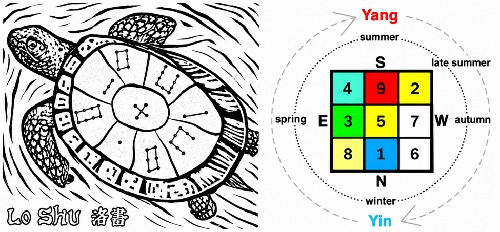 Early references to the Luo Shu do not establish that they designated precisely the diagram familiar today. Its associations with numerical arrangements, the nine palaces, and cosmological correspondences developed through a layered history. John B. Henderson, the historian Visser cites, makes an important distinction. He separates the Luo Shu from schemes directly used to organize physical space, while explaining that later commentators regarded it as the original source of nine-part cosmological ordering. However, the nine-part arrangements recur in accounts of agricultural land, geographical divisions, ritual buildings, and cosmological diagrams. The correlation between the configuration of the well-field system and the Luo Shu—both with nine fields—suggests a common origin. The Book of History, one of the Confucian classics, attributes the ninefold division of China to the legendary Emperor Yu. In its "Tribute of Yu" chapter, Yu divides the country into nine provinces after taming the floods. The cosmologist Zou Yan later extended the scheme to the whole world: China, he taught, was only one of eighty-one such regions. Cosmology Embodied in PracticeMencius spoke of nine agricultural plots. Eight households each farmed one of the outer plots, and the ninth, central plot was cultivated in common. According to Fung Yu-lan, Mencius's proposals had "socialist implications." Historians debate whether the system ever existed in this ideal form. It was feudal in origin, but Mencius proposed it as a model for economic reform. Ritual architecture provides another example. Accounts of the Ming Tang connect the ruler's ceremonial movements with directions and seasonal cycles. The emperor "mediated" between Heaven and Earth. Historians disagree on when the Luo Shu pattern was first used in the layout of Chinese capitals, but the city of Chang'an offers the best example. The Sui dynasty built it in 582 as Daxing, and the Tang dynasty inherited and renamed it. Its planners drew on the Kaogong ji, the "Record of Artificers" in the Rites of Zhou, which describes the ideal royal capital as a square with three gates on each side.
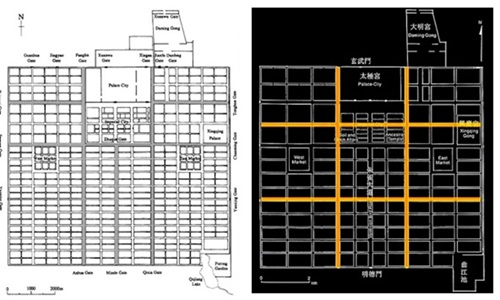 Tang Chang'an followed this ideal closely. Three gates on its east, south, and west sides generated great avenues that divided the city into a three-by-three grid: the nine-square pattern of the Luo Shu and the well-field. Within this framework, eleven north-south and fourteen east-west streets created more than a hundred walled residential wards. The palace, however, stood not in the center but at the northern end of the axis, with the administrative Imperial City directly south of it. The ruler, like the Pole Star, faced south over his realm. Chinese cosmology was not confined to speculation about an invisible world. It helped articulate how people should inhabit and organize this one. Qi and ElectromagnetismVisser also asks whether the dialogue turns a cosmological diagram into a bridge to modern field theory. That is a fair challenge. The Chinese language, however, offers an unexpected perspective. The Chinese invented the magnetic compass after discovering the lodestone. In 1088 the polymath Shen Kuo described how rubbing a needle with lodestone made it point south, and recorded that it deviated slightly east of true south. The Chinese referred to the lodestone as "the loving stone," referring to its power to attract. Its first character, 慈, came to be written with the stone radical as 磁, which is still the Chinese word for magnetism. Magnetism is a manifestation of qi (i.e., the tension between yin and yang). When modern electrical science reached China in the nineteenth century, translators turned to the old vocabulary. Electricity became dianqi, "lightning qi." A magnetic field is a cichang, literally the "field of the loving stone." The character for qi is also used in the compound characters for Tai Chi and Qigong. In Japan, where they speak of ki, the character is used in words like denki (electricity) and the martial art aikido. The Qi of the Eight Trigrams (Bagua Qi)The Eight Trigrams were mapped onto the Luo Shu. In traditional cosmology and Yijing thought, each of the eight trigrams (bagua) was understood to have its own qi, correlated with particular seasons, directions, and phases in the cycle of yin and yang. The classical view is that the eight trigrams correspond to the "eight winds" and the "qi of the eight seasons." A key passage from the traditional text Wuxing Dayi states: "Because the eight directions connect the eight winds, they form the qi of the eight seasons; therefore there are eight trigrams."
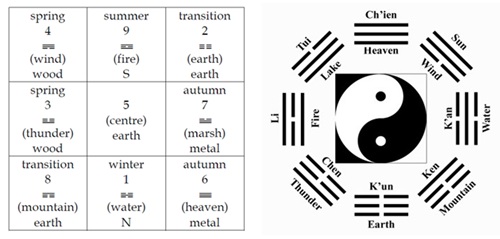 The Han-dynasty text Yiwei Tonggua yan provides a more detailed correlation, mapping each trigram to a specific direction and a point in the solar year (one of the 24 solar terms), which defines its characteristic qi:
One classical commentary explains that while the eight trigrams have fixed positions and diverse images (mountain, lake, thunder, wind, water, fire), their underlying qi flows and connects (通气) all of them, and they are ultimately reducible to the two forces of yin and yang. The Bagua (eight trigrams) thus represent a further differentiation of the primal qi into eight distinct phases or modes of activity within the annual cycle. Capra and WilberCapra included Buddhism and Hinduism in his book to argue that modern quantum physics and ancient Eastern mysticism describe the same dynamic, interconnected reality through different languages. Chinese and Indian cosmology overlap in several ways, but Capra obscured the important divide between China and India. In their dominant traditions, China sought to harmonize spirit and matter within this world, while India sought to transcend the material world to achieve ultimate spiritual liberation. Wilber's quadrants are not comparable to the Luo Shu, and they serve different purposes. Scientists look at material brains, psychologists look at internal minds, sociologists look at social systems, and anthropologists look at cultural worldviews. The quadrants map these perspectives into a unified framework to show how they all fit together and influence one another. That's a genuinely useful perspective. The Luo Shu serves a different purpose. It is a blueprint for structuring society, with Tao as the organizing principle. Both Wilber's quadrants and the Chinese Luo Shu can serve as heuristic devices. They take the chaotic, overwhelming data of human experience and force it into highly structured boxes so we can digest it. Wilber stops us from ignoring the human interior. If we are building a new corporate strategy, the quadrants remind us that we cannot just change the IT systems (Lower-Right); we must also address company culture (Lower-Left) and individual employee mindset (Upper-Left). The Luo Shu stops us from ignoring environmental and elemental relationships. In traditional practice, it serves as a diagnostic checklist for space and time. A Feng Shui practitioner uses the grid to see whether an imbalance lies in the orientation of a building, in the relationships among the Five Phases, or in the timing of cycles. Neither framework views its boxes as isolated islands. They show relationship. In Wilber's model, events "tetra-arise." Change the brain chemistry (Upper-Right) and you instantly change the subjective mood (Upper-Left). In the Luo Shu, the numbers move in a specific sequence known as the "Flying Stars" trajectory, which maps how cyclic cosmic shifts originate in the center and ripple sequentially through the surrounding eight outer sectors. Change the energy in the Center, and it sends a ripple effect through the surrounding eight palaces (North, South, East, West, and the diagonals). Wilber frequently states that the quadrants are just a map—a useful approximation to ensure nothing is left out. The Luo Shu uses symbolic language (numbers, trigrams, elements) to make sense of invisible natural patterns (Qi), acting as a conceptual dashboard for ancient scientists and philosophers to navigate time and space. Does Chinese Cosmology "Work"?When I have Capra say that Chinese cosmology worked for 2000 years (it is actually closer to 3000 years), I refer to the fact that China is one of the oldest continuous civilizations in human history, based on a coherent cosmology. That is to say, it first crystallized in the Yijing and was frequently modified and refined, but the core (the yin-yang principle) has remained the same. By "worked," I meant that cosmological schemes provided enduring resources for organizing ritual, interpreting seasonal change, and expressing political order. Their longevity does not establish the physical truth of every correspondence, the effectiveness of every application, or their responsibility for China's civilizational continuity. Those achievements must be distinguished and evaluated separately. A calendar's predictive accuracy, a city's practical organization, and a ritual's political significance require different kinds of evidence. ConclusionVisser is entirely right that the fictional format made agreement between Capra and Wilber look too easy. I allowed both protagonists to concede what my argument needed them to concede, whereas a sturdier, real-world conversation would have integrated the scientific objections and systemic defenses Visser supplies. However, the foundational insight I mean to retain remains straightforward: Asian thought should not be encountered solely through internal mystical experiences or selected textual passages that seem to mirror modern Western theories. Its buildings, landscapes, rituals, and material institutions belong in the discussion. By analyzing how a civilization physically mapped its understandings of space, time, and authority onto the earth, we stop treating traditional cosmologies as incomplete versions of modern science and begin appreciating them as sophisticated, self-contained systems of practical order.
|