|
TRANSLATE THIS ARTICLE
Integral World: Exploring Theories of Everything
An independent forum for a critical discussion of the integral philosophy of Ken Wilber
  Frank Visser, graduated as a psychologist of culture and religion, founded IntegralWorld in 1997. He worked as production manager for various publishing houses and as service manager for various internet companies and lives in Amsterdam. Books: Ken Wilber: Thought as Passion (SUNY, 2003), and The Corona Conspiracy: Combatting Disinformation about the Coronavirus (Kindle, 2020).
Check out my other conversations with ChatGPT
Krikke's Imaginary Conversations:
The Amsterdam Accord: Wilber Meets Visser Review of The Amsterdam Accord The Grid We Both Missed: Wilber Meets Capra Review of The Grid We Both Missed The Grid That Explains Too MuchA Critical Review of Jan Krikke's Imaginary Dialogue Between Wilber and CapraFrank Visser / ChatGPT
 Introduction: Two intellectual giants discover a missing pieceJan Krikke's The Grid We Both Missed: Capra, Wilber, and the Luo Shu is an intriguing contribution to the ongoing discussion about Eastern cosmology, Western systems thinking, and the limitations of integral philosophy. Presented as an imaginary conversation between Ken Wilber and physicist and systems theorist Fritjof Capra, it stages a meeting of two intellectual traditions that have long been interested in the relationship between consciousness, nature, and the cosmos. The central conceit is attractive. Both men, Krikke suggests, have spent decades looking for Eastern wisdom but have overlooked something important: the Luo Shu, the ancient Chinese nine-square magic diagram, and its supposed application in architecture, urban planning, ritual, and imperial cosmology. Capra admits that his earlier investigations into the parallels between modern physics and Eastern mysticism missed the material and architectural dimensions of Chinese cosmology. Wilber, in turn, acknowledges that his emphasis on interior developmental stages led him to neglect the concrete spatial arrangements through which Chinese civilization expressed its understanding of cosmic order. The conversation culminates in a shared revelation: the Luo Shu provides a missing link between qi, spatial organization, political order, and the relational understanding of the cosmos. It is an appealing story, especially for readers interested in cross-cultural philosophy. But there is a problem. The dialogue is more successful as an imaginative intellectual exercise than as a demonstration of its central historical and philosophical claims. Its most interesting insights are also the ones that require the most careful examination. 1. The Luo Shu: An ancient diagram or a universal key?The Luo Shu is traditionally represented as a three-by-three numerical arrangement in which every row, column, and diagonal adds up to fifteen. Its familiar configuration is:
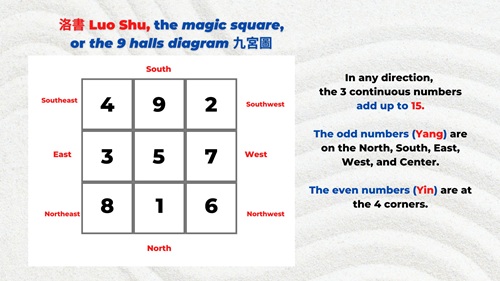 Its associations with Chinese cosmology, divination, the Yijing tradition, and later systems of geomancy make it an important historical and symbolic object. Krikke wants us to see something more consequential. The Luo Shu was not merely a diagram used for divination or mathematical speculation. It allegedly informed the physical organization of imperial space, including the Ming Tang, the ritual complex in which the emperor performed ceremonies associated with the ordering of the seasons and the relationship between Heaven and Earth. This is potentially an important subject. Chinese cosmological thinking was not simply speculative philosophy. It informed ritual, political authority, architecture, calendrical practices, and the organization of social space. However, several distinct claims need to be separated. First, there is the existence of the Luo Shu as a traditional cosmological diagram. Second, there is its historical relationship to particular architectural arrangements. Third, there is the claim that it represents a practical application of qi. Fourth, there is the much more ambitious suggestion that it provides a conceptual bridge between ancient Chinese cosmology and modern physics. These claims do not automatically follow from one another. A diagram can express a cosmological worldview without having served as the literal blueprint for an imperial building. An architectural arrangement can embody symbolic correspondences without demonstrating the existence of a physical energy field. And a mathematical pattern can be interesting without having any significant relationship to the mathematics of modern physics. Krikke's dialogue tends to slide across these distinctions rather too easily. The historical question deserves more attention than the fictional conversation gives it. 2. A historical complication: how old is the Luo Shu in its familiar form?There is a particularly important historical complication that Krikke's dialogue overlooks. The association between the Luo Shu, the nine-palace system, and the Ming Tang did not necessarily originate as one unified system in remote antiquity. The historical development is more complicated. The Da Dai Liji (Record of Rites of the Elder Dai), generally dated to around the first century CE, contains a numerical arrangement associated with the nine halls of the Ming Tang. But the identification of this early arrangement with the familiar Luo Shu diagram developed through a longer historical process. Research on Chinese cosmography indicates that the familiar diagrams and their interpretations underwent significant development, particularly during the Song dynasty. This matters because the dialogue repeatedly speaks as though the Luo Shu had always been a clearly defined architectural blueprint, waiting for modern intellectuals to discover its significance. That is too simple. The relationship between numerical symbolism, cosmological diagrams, imperial architecture, and geomancy is historically layered. The existence of a nine-part cosmological arrangement does not establish that every architectural application was derived from the same diagram, or that the diagram itself was the original organizing principle. Indeed, historical research on Chinese cosmography shows that the Ming Tang was conceived as an architectural microcosm, incorporating correspondences between spatial divisions, seasonal cycles, and celestial arrangements. That is fascinating in its own right. But it does not establish the stronger claim that the Luo Shu was the single underlying blueprint for Chinese civilization. Krikke would have strengthened his argument considerably by distinguishing the historical evidence from the more speculative reconstruction. 3. Capra's old problem returns in a new disguiseThe imaginary Capra is unusually candid. He admits that his earlier work, particularly The Tao of Physics (1975), concentrated too heavily on parallels between Eastern mysticism and modern physics. This is a welcome admission. Capra's project was enormously influential in popularizing the idea that contemporary physics was rediscovering insights already anticipated by Eastern spiritual traditions. The problem was that philosophical similarities were frequently presented as though they constituted scientific correspondences. Quantum nonlocality, for example, is not equivalent to Buddhist interdependence. The uncertainty principle does not demonstrate the wisdom of Taoism. And the mathematical descriptions of physical fields cannot simply be identified with traditional concepts of qi. This criticism is not new. Philosophers and historians of science have repeatedly questioned the methodological foundations of the physics-mysticism parallels. Critics have pointed out that Capra sometimes selects particular interpretations of physics that happen to resemble his preferred spiritual worldview, without adequately demonstrating why those interpretations should be privileged. But Krikke's fictional conversation introduces a curious twist. Instead of abandoning the search for parallels, Capra supposedly discovers a more concrete one: the Luo Shu. The argument now runs something like this: Ancient Chinese cosmology developed a sophisticated spatial model of cosmic order. This model informed architecture, ritual, and political organization. Modern physics subsequently developed relational models of nature. Therefore, the Luo Shu offers a historical link between qi and the physics of fields. But where exactly is the connection? A spatial arrangement is not a physical field. A symbolic representation of cosmic harmony is not a mathematical description of electromagnetic or gravitational interactions. And a traditional conception of qi does not become scientifically validated simply because it is associated with an elaborate numerical diagram. The distinction is crucial. One can admire the intellectual sophistication of Chinese cosmology without turning it into an anticipation of modern physics. Indeed, this would be a more interesting contribution to the dialogue: showing how different civilizations have constructed elaborate systems for representing order, without insisting that they were all describing the same underlying physical reality. 4. Wilber's quadrants: does the Luo Shu really transcend AQAL?
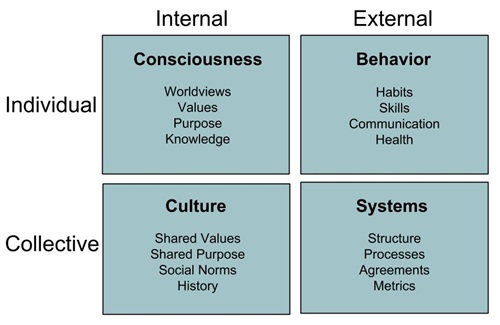 The most revealing part of the conversation concerns Wilber's response. He admits that his emphasis on interior developmental stages has led him to neglect the spatial and material dimensions of Chinese cosmology. Capra suggests that the Luo Shu integrates interior and exterior, individual and collective, and therefore does not fit neatly into Wilber's four quadrants. Wilber's response is characteristically accommodating: perhaps a new quadrant, a new level, or a new way of thinking about the relationship between the individual and the collective is required. This is an entertaining exchange, but philosophically it raises a more fundamental question: what exactly would the Luo Shu add to AQAL? Wilber's four quadrants already distinguish between individual and collective perspectives, as well as interior and exterior dimensions. A traditional Chinese cosmological arrangement could certainly be studied through all four. Its symbolic meaning belongs partly to the interior domain. Its institutional and political functions belong partly to the collective exterior domain. Its interpretation by individual practitioners involves individual interiority, while its material embodiment in buildings and cities belongs to the individual or collective exterior domains, depending on the unit of analysis. There is no obvious reason why such a system would require an additional quadrant. More importantly, Wilber's framework is not supposed to be an encyclopaedia of every cultural diagram ever devised. It is a metatheoretical classification of perspectives and dimensions of reality. Discovering a previously neglected cultural artefact does not automatically expose a structural deficiency in the framework. The dialogue therefore risks confusing two different things: the incompleteness of our empirical and historical knowledge, and the incompleteness of a conceptual model. The former is inevitable. The latter has to be demonstrated. There is also a more serious problem. Wilber's notorious tendency to incorporate almost every new intellectual development into his existing framework is not necessarily evidence of its explanatory power. A sufficiently flexible model can accommodate virtually anything after the fact. If the Luo Shu fits the four quadrants, AQAL has accommodated it. If it does not fit, perhaps AQAL needs another dimension. Either way, the framework risks becoming immune to genuine criticism. A more productive question would be whether AQAL actually explains anything about the Luo Shu that competing historical, anthropological, or architectural approaches cannot explain equally well or better. 5. The political dimension: cosmic harmony and imperial authorityOne of the more promising aspects of Krikke's dialogue is its recognition that Chinese cosmology was also a technology of political authority. The emperor was not simply a ruler operating within a pre-existing political order. He was understood as occupying a privileged position between Heaven and Earth. His rituals, movements, clothing, and ceremonial activities were embedded in a cosmological system. The Ming Tang was consequently more than an architectural curiosity. It represented an attempt to translate cosmic order into political and institutional order. This is worth emphasizing because Western discussions of Eastern spirituality often concentrate on meditation, mystical experience, enlightenment, and the unity of existence. They neglect the institutional and political dimensions of traditional religious cosmologies. Krikke is right to draw attention to this neglected material. But there is another side to the story. Cosmological order can legitimize political hierarchy. The emperor's central position was not merely a neutral representation of spatial harmony. It also reinforced a particular conception of authority. The alignment of political and cosmic order could make the existing social hierarchy appear natural, necessary, and divinely sanctioned. In other words, the Luo Shu was not simply a grid of harmony. It belonged to a worldview in which cosmic centrality and political centrality were closely connected. This raises questions that the dialogue never explores. Who benefited from this cosmological arrangement? What happened when political authority was challenged? Did the system facilitate genuine ecological sensitivity, or did it primarily provide symbolic legitimacy for imperial rule? A critical examination of Chinese cosmology should not romanticize its achievements while overlooking its political functions. 6. The problem of the word "worked"Perhaps the most revealing sentence in the dialogue occurs near the end. Capra says that the Chinese cosmological system worked for two thousand years. Wilber does not challenge the assertion. But what does worked mean here? Did the system successfully predict astronomical events? Did it produce more effective urban planning? Did it improve agricultural productivity? Did it create political stability? Did it generate a scientifically accurate understanding of nature? Or did it simply provide a durable symbolic framework through which successive dynasties interpreted their place in the cosmos? These are very different achievements. A cosmological system can be culturally influential without being scientifically correct. A political ideology can survive for centuries without being a reliable description of social reality. And a symbolic system can organize collective life effectively without its underlying metaphysical assumptions being true. The longevity of an idea is not evidence of its correspondence with reality. This is particularly important when comparing traditional Chinese cosmology with modern science. The latter is not distinguished simply by offering another map of the universe. Its distinctive strength lies in systematic observation, mathematical formulation, experimental testing, predictive success, and the possibility of correcting established theories. The Luo Shu may be an impressive historical example of mathematical and symbolic ordering. But it does not thereby become a precursor to modern field theory. 7. An imaginary dialogue with real limitationsThe fictional format deserves some consideration in its own right. Krikke openly describes the piece as a reconstructed transcript of a meeting that may or may not have taken place. The disclaimer makes clear that this is not a historical document. It is an imaginative exercise, and the author should be allowed some literary freedom. Nevertheless, the format has consequences. Both protagonists are made to concede precisely the things necessary for Krikke's thesis. Capra acknowledges the limitations of his earlier approach. Wilber admits the inadequacies of his treatment of Chinese cosmology. Together they arrive at the conclusion that the Luo Shu is the missing link. This makes for a smooth conversation, but not necessarily a convincing philosophical encounter. Real intellectual disagreements are rarely resolved so conveniently. Capra might have questioned whether the Luo Shu had any relevance to quantum physics at all. Wilber might have argued that the four quadrants already accommodate the phenomenon. Both might have demanded stronger historical evidence for the proposed architectural connections. Instead, the dialogue gives us two unusually agreeable intellectual celebrities discovering a common insight. There is also a stylistic irony in the article's acknowledgement of its AI-assisted production. The fictional participants discuss the inadequacy of inherited conceptual maps, while the dialogue itself is constructed through contemporary language models. This is not necessarily a weakness, but it makes the article particularly appropriate for critical examination: does the synthesis represent a genuine advance in understanding, or merely the ability of generative AI to produce an attractive convergence of familiar ideas? The answer, I suspect, is closer to the latter. 8. What Krikke gets right — and what he missesIt would be unfair to dismiss Krikke's contribution. There is a genuinely interesting argument buried in this imaginary encounter. Western intellectuals have often approached Chinese and other Asian traditions through categories that reflect their own philosophical preoccupations. Capra searched for parallels with quantum physics. Wilber searched for developmental stages of consciousness and universal structures of spiritual experience. Both approaches risked interpreting unfamiliar traditions through concepts they had already developed. Krikke's emphasis on architecture, spatial organization, political institutions, and material practices offers a welcome corrective. There is something important to be learned from examining how cosmological ideas become embodied in actual buildings, cities, rituals, and political arrangements. This is a more historically grounded approach than simply collecting quotations from Taoist, Buddhist, or Hindu texts that appear to anticipate modern physics. But the corrective should not become another grand synthesis. The Luo Shu does not automatically unite physics, architecture, spirituality, politics, and systems theory. It provides a historically interesting example of how a civilization represented relationships between space, time, nature, and political authority. That is already significant enough. The temptation to elevate every fascinating cultural discovery into a missing key to the universe is precisely the tendency that both Capra and Wilber should have learned to resist. Conclusion: Another map of the territory, or another territory of maps?Jan Krikke's imaginary dialogue is an enjoyable intellectual experiment, and it raises a worthwhile question about the neglected material and architectural dimensions of Chinese cosmology. Its strongest insight is that Eastern traditions should not be reduced to mystical experiences or interpreted exclusively through modern Western philosophical categories. Their historical institutions, mathematical systems, architecture, and political practices deserve independent investigation. Its weakest argument is the suggestion that the Luo Shu provides a missing link between qi and modern physics, or that it exposes a fundamental deficiency in Wilber's integral framework. The first claim confuses symbolic correspondences with scientific explanations. The second confuses an interesting addition to our cultural knowledge with a necessary revision of a metatheoretical model. There is a further irony here. Wilber tells Capra that the Luo Shu is still a map, not the territory. Capra replies that it is a better map than the one they had before. But is it? A map is better only relative to what it is intended to represent. A traditional Chinese cosmological diagram may be an excellent representation of a particular system of symbolic, political, and spatial correspondences. It is not thereby a better map of physical reality than modern scientific theories. And perhaps that is the most important distinction Krikke's dialogue could have explored. We do not need to establish that ancient Chinese cosmology anticipated modern physics in order to appreciate its intellectual achievements. Nor do we need to incorporate every cultural discovery into Wilber's AQAL architecture to recognize its significance. Sometimes a historical diagram is simply a fascinating historical diagram. The real intellectual achievement would be to understand it on its own terms, without making it carry the weight of an entirely new theory of everything. Appendix: The broader problem of integral synthesisKrikke's essay also illustrates a recurring tendency in the post-Wilber integral movement: the search for additional conceptual frameworks that promise to complete, correct, or extend the existing integral model. This is understandable. AQAL was never an exhaustive inventory of human knowledge, and its categories can be useful for organizing interdisciplinary discussions. But there is a danger in treating every new intellectual discovery as another missing component of an increasingly comprehensive synthesis. We have seen similar tendencies in discussions of systems theory, complexity science, evolutionary spirituality, metamodernism, and various attempts to construct a naturalistic spirituality. The recurring pattern is familiar: a particular discipline or cultural tradition offers an interesting insight; that insight is then interpreted as evidence of a deeper universal structure; and finally, the universal structure is presented as a contribution to an emerging integral worldview. But the crucial question is often left unanswered: What does the new framework actually explain that existing approaches cannot? In the case of the Luo Shu, the answer remains unclear. Its historical and cultural significance can be investigated without invoking an underlying universal field of qi. Its mathematical properties can be appreciated without identifying them with modern physics. Its political applications can be studied without turning it into a new quadrant of AQAL. A genuinely integrative approach should be able to preserve differences rather than dissolve them into a supposedly universal synthesis. That would be a more convincing form of integral thinking. Editorial assessment: Krikke's dialogue is imaginative and raises an interesting neglected subject. Its historical premise deserves further investigation, but its philosophical conclusions are premature. The Luo Shu is potentially a valuable contribution to comparative cosmology, not yet a missing piece of a theory of everything. For historical context, research on Chinese cosmography is particularly relevant[1], as are critical studies of Capra's physics-mysticism parallels. NOTES[1] John B. Henderson, "Chinese Cosmographical Thought: The High Intellectual Tradition", Chapter 8 of The History of Cartography, Volume 2, Book 2: Cartography in the Traditional East and Southeast Asian Societies, edited by J. B. Harley and David Woodward, University of Chicago Press, 1994. Henderson discusses both the development of this cosmographical tradition and its subsequent criticism and decline, especially during the seventeenth century. This complicates any suggestion that the Luo Shu represented an unchanging, universally accepted Chinese worldview for thousands of years.
Widget is loading comments...
|