|
TRANSLATE THIS ARTICLE
Integral World: Exploring Theories of Everything
An independent forum for a critical discussion of the integral philosophy of Ken Wilber
 Jan Krikke is a former Japan correspondent for various media and former managing editor of Asia 2000 in Hong Kong. He pioneered the study of axonometry, the Chinese equivalent of European linear perspective overlooked by Jean Gebser. He is the author of several books, including Leibniz, Einstein, and China, and the editor of The Spiritual Imperative, a macrohistory based on the Indian Varna system by feminist futurist Larry Taub. The Grid We Both MissedCapra, Wilber, and the Luo ShuJan Krikke / Various LLMs
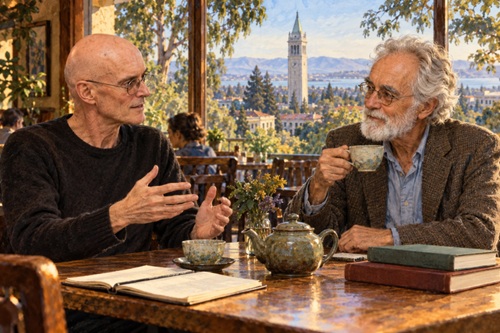 A reconstructed transcript of a meeting that may or may not have taken place in a book-lined study in Berkeley, sometime after both men had poured a second cup of green tea, and shortly after Fritjof Capra had taken an illustration from his briefcase. CAPRA: Ken. It's been a long time. You look well. Still defending the hierarchy, I see. WILBER: Fritjof. Still flattening the Kosmos into a single plane of interconnectedness. The tea is excellent, by the way. Thank you for seeing me. CAPRA: I was surprised by your call. After Quantum Questions, I assumed I was permanently relegated to the "pre-rational" category in your filing system. WILBER: (smiling) I only relegate people to the pre-rational category when they deserve it. You deserve a more interesting critique. That's why I'm here. CAPRA: Well, before we start the usual autopsy of my book, look at this. (Slides an illustration across the table.) It's a reconstruction of the Ming Tang. The ritual complex of the Chinese emperors. The floor plan inside the building is based on the Luo Shu. WILBER: (picks up the illustration, studies it) The nine-square grid. I've seen it in Feng Shui manuals, but I never looked at it closely. It's a magic square, isn't it? Numbers arranged so every row adds up to fifteen. 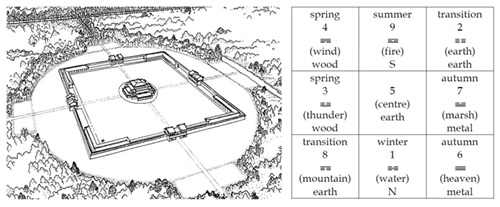 CAPRA: Yes. But it's much more than a mathematical curiosity. I've been reading a historian of Chinese architecture, and I realized something. I missed this entirely in 1975. The Luo Shu wasn't just a diagram. It was the blueprint for the Chinese capitals. For the Ming Tang. For the entire imperial cosmology. Heaven is round, Earth is square. The Emperor sits in the central square to keep the nation in sync with the cosmos. WILBER: So you're saying you missed a foundational aspect of Chinese cosmology. CAPRA: I did. And so did you, Ken. We both did. I was looking for the Tao in the quantum vacuum. You were looking for the levels of consciousness in the Upanishads. Neither of us looked at the floor plan of a Chinese palace. We were both looking for "mysticism," and we missed the "organic naturalism" that was actually there. The Luo Shu is the missing link. It's the practical application of qi. WILBER: (pauses, takes a sip of tea) You're right. I've spent decades mapping the interior stages of consciousness. I've read the Yijing, I've talked about qi as the vital force. But I never looked at the spatial diagrams. I never looked at the architecture. CAPRA: You focused on the interior. I focused on the exterior. But we both missed the integration. The Luo Shu is where they meet. It's not just a cosmology; it's a political technology. A way of aligning the human world with the cosmic cycles. The Emperor changes his clothes, his food, his direction in the Ming Tang to bring about the seasons. It's not just a metaphor. It's a ritual technology of statecraft. WILBER: (leaning forward) So the Luo Shu is a map. A map of the exterior world. A map of space and time. And you're saying that I missed it because I was looking for interior depth? CAPRA: I'm saying we both missed it because we were both looking for "Eastern mysticism." But the Luo Shu isn't mystical. It's architectural. It's mathematical. It's physical. The Chinese weren't trying to transcend the world; they were trying to align with it. The Emperor sits in the center, and the world is ordered around him. WILBER: So what does the Luo Shu give us that we didn't have before? CAPRA: The field. The Luo Shu is the field. It's the grid of qi. It shows that the Chinese had a spatial, relational picture of order that was incredibly precise. It wasn't just a vague idea of interconnectedness. It was a specific blueprint for how to organize a city, a state, a ritual. It was the mathematics of harmony. WILBER: (after a long pause) I've always said that the East had wisdom but not the mathematics. But you're saying they did have the mathematics. Not the mathematics of physics, but the mathematics of spatial order. CAPRA: Exactly. And that's what I missed. I said that the Chinese had a field-like intuition, but I never showed how it was applied. The Luo Shu is the application. It's the blueprint. I was so focused on the parallels with quantum physics that I ignored the actual, historical, material practices of Chinese cosmology. WILBER: (sighs) And I was so focused on the interior stages that I ignored the exterior structures. I ignored the architecture. I ignored the city planning. I ignored the ritual. I reduced Chinese cosmology to a stage on my developmental ladder, and I missed the specific, concrete way they imagined order. CAPRA: So we were both wrong. WILBER: We were both incomplete. CAPRA: That's the same thing. WILBER: (smiling) No. Being incomplete is a developmental stage. Being wrong is a pre/trans fallacy. You were incomplete. I was wrong. CAPRA: (laughs) There he is. The master of the distinction. WILBER: But you know what this means, Fritjof. If the Luo Shu is the missing piece, then the whole "detour" story falls apart. The Chinese didn't just have a vague intuition of relationality. They had a sophisticated, mathematical, spatial model of the cosmos. They applied it to their cities. They applied it to their statecraft. They applied it to their architecture. And they did it without the equations of physics. CAPRA: Which means that when modern physics arrived at a relational picture, it wasn't returning to some ancient wisdom. It was arriving at a new version of something that had been practiced, not just thought, in China. The Luo Shu is the link between qi and the physics of fields. WILBER: And what does that mean for my hierarchy? CAPRA: It means that your hierarchy is still incomplete. The Luo Shu is a spatial, collective, exterior structure. It doesn't fit neatly into your quadrants. It's not just the lower right (exterior collective). It's the whole thing. It's a map of the cosmos that integrates interior and exterior, individual and collective. WILBER: (nodding slowly) So we need a new quadrant. Or a new level. Or a new way of thinking about how the individual and the collective, the interior and the exterior, are related. CAPRA: That's what I've been saying for fifty years. The whole is greater than the sum of its parts. The Luo Shu is the whole. It's the grid that holds everything together. WILBER: But it's still a grid. It's still a map. It's not the territory. CAPRA: No. But it's a better map than the one we had. WILBER: (pauses, looks at the photograph again) You know, I've been writing about the "Great Nest of Being" for decades. The hierarchy of matter, body, mind, soul, spirit. And now I'm looking at a diagram that says: heaven is round, earth is square, the emperor is in the middle. And it makes me realize that my "Great Nest" is just one way of mapping the cosmos. The Chinese had a different map. A different grid. And it worked. CAPRA: It worked for two thousand years. WILBER: (sighs) So what do we do? CAPRA: We do what we've always done. We talk. We argue. We write. But this time, we include the Luo Shu. We include the grid. We include the architecture. We stop talking about "Eastern mysticism" and start talking about "Eastern order." WILBER: (smiling) I can do that. CAPRA: And I can admit that I missed something. WILBER: (raising his cup) To the Luo Shu. The grid we both missed. CAPRA: (raising his cup) To the grid. They drank. Outside, a Berkeley student walked by with a book on systems theory and a cup of coffee, oblivious to the two old men in the window, who had just discovered a diagram that had been sitting in plain sight in a tradition neither of them had thought to examine closely enough. Neither man has confirmed that this meeting took place. But a signed copy of Capra's next book was delivered to Wilber's office, with a note that read: "To Ken, who was wrong about the levels. But right about the maps." The reply came a week later: "To Fritjof, who was incomplete about the parallels. But right about the grid." Both men, notably, had underlined the word "grid."
|