|
TRANSLATE THIS ARTICLE
Integral World: Exploring Theories of Everything
An independent forum for a critical discussion of the integral philosophy of Ken Wilber
 Ray Harris is a frequent contributor to this website. He has written articles on 9/11, boomeritis, the Iraq war and Third Way politics. Since 2007 he took to writing his novels Navaratri, Wild Child and Eden. Harris lives in Ballarat, Victoria, Australia. Ray Harris is a frequent contributor to this website. He has written articles on 9/11, boomeritis, the Iraq war and Third Way politics. Since 2007 he took to writing his novels Navaratri, Wild Child and Eden. Harris lives in Ballarat, Victoria, Australia.
This essay should be read in conjunction with Frank Visser's essay:
Russophobia and the Problem of the Self-Sealing Narrative. Misreading Russian HistoryDillard's RussophobiaRay HarrisI'll begin this essay by confessing that I lean towards being a bit of a Russophile. My formative political heroes were Russian - the anarchists Peter Kropotkin, Mikhael Bakunin and the Russian emigre to New York, Emma Goldman. The figures of Lenin and Trotsky also figured large. But it wasn't just political theory. I was also reading Tolstoy and Dostoyevsky, and as a film maker I was critically aware of the contributions to cinema of Sergei Eisenstein and Andrei Tarkovsky. I was also fully aware of the contributions to the arts of the playwright Anton Chekov, the composers Tchaikovsky, Mussorgsky, Rimsky-Korsakov, Rachmaninoff, Stravinsky, Prokofiev and Shostakovich (all of whom form a substantial part of the Western classical canon). In ballet: the status of the famous Bolshoi, Nijinsky, Nureyev, Baryshnikov and of course , Anna Pavlova (who has an Australia desert named after her). Not to forget important modern artists such as Kandinsky and Chagall. And as a student of Jung, the significance of Sabina Spielrein.
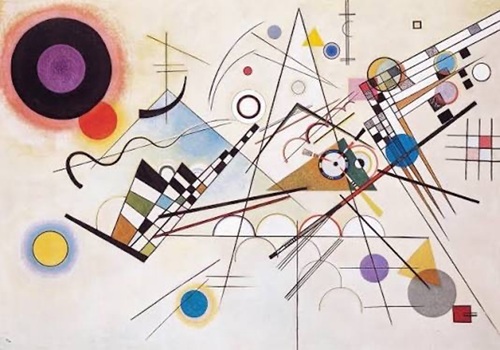
Composition VIII, Kandinsky, 1923
So you can understand why Dillard's argument about Russophobia didn't land with me. Phobia and PhiliaFear and brotherly love. Two suffixes added to describe the tendency to either negatively or positively stereotype any group of people: homophobe, Islamophobe, Russophobe - Francophile, Anglophile, Russophile. The simple fact, which Dillard recognises, is that any given group can stereotype any other group. The French and British for example, have a famous love/hate relationship. It works both ways. Nations stereotype Russians and Russians stereotype other nations. If this is the case, why is Russophobia in anyway unique? PART ONE: MISREPRESENTING HISTORYI've challenged Dillard on his interpretation of history in the past. He either listens to the wrong people and falls for disinformation and propaganda or he doesn't research deeply or widely enough. His essay on Russophobia repeats the same pattern. Misreading Marshall Poe.Dillard claims that historian Marshall Poe has exposed the early origins of Russophobia: “European travelers of the sixteenth and seventeenth centuries repeatedly portrayed Muscovy as despotic, culturally backward, Asiatic, servile, and fundamentally outside European civilization. Historian Marshall Poe has traced the stereotype of Russians as a people naturally inclined toward submission to these early-modern ethnographic accounts.” However, when I researched Poe I found something quite different. In a review of 'A People Born to Slavery' the Cornell Press Review concludes: “With his findings, Poe challenges the notion that all Europeans projected their own fantasies onto Russia. Instead, his evidence suggests that many early travelers produced, in essence, reliable ethnographies, not works of exotic 'Orientalism.'” Reliable ethnographies. This is the opposite to Dillard's interpretation. In the How to be Wrong podcast titled 'Marshall Poe on Getting Post Soviet History Wrong' Poe retracts (10:00 +) the final chapters of his 2003 book, 'The Russian Moment in World History'. Shifting from the book's optimism to pessimism, Poe argues that Russia is indeed inherently autocratic. Getting slavery wrong.Dillard writes: “The word “slave” comes from Slav, and Russians are primarily slavic peoples. Slavic populations were extensively enslaved during the early Middle Ages by multiple peoples and traded through European, Byzantine and Islamic markets.” He is right that the word slave comes from Slav, but he gets a vital part of the story utterly wrong. The Slavs also enslaved people. The word Rus is Old Norse for 'the men who row', a description of the Swedish Vikings - the Varangians - who raided and traded along the Dnieper and Volga rivers. They eventually settled and adopted the local Slavic language, forming the Rurikid Dynasty. But rather than being the victims of slavery, the Rus were slave traders, raiding Slavic and Baltic tribes and transporting them to the slave markets in Asia Minor. They weren't the victims of the slave trade, they profited from it. And whilst the Russians banned chattel slavery, they developed the institution of serfdom, which is a form of indentured labour in which peasants belonged to an estate. Russia really was backwards.There was a reason Russia went through a revolution. The educated elites had seen the advances made in the rest of Europe and pressure began to build to abolish the institution of serfdom and undertake a program of modernisation and industrialisation. Dillard complains that the characterisation of Russians as “despotic, culturally backward, Asiatic, servile, and fundamentally outside European civilization” is a negative stereotype, yet these are the very words Lenin used to describe Russia. Does that make Lenin and the other Bolsheviks Russophobes? Lenin frequently used the term Asiatic to describe the Russian social system. In his book Two Tactics of Social-Democracy in the Democratic Revolution he said: “…the democratic reforms … will, for the first time, really clear the ground for a wide and rapid, European, and not Asiatic, development of capitalism … [The democratic dictatorship] may bring about a radical redistribution of landed property in favour of the peasantry, establish consistent and full democracy including the formation of a republic, eradicate all the oppressive features of Asiatic bondage, not only in village but also in factory life … [the Bolsheviks]… want the people, i.e., the proletariat and the peasantry, to settle accounts with the monarchy and the aristocracy in the 'plebeian way,' ruthlessly destroying the enemies of liberty, crushing their resistance by force, making no concessions whatever to the accursed heritage of serfdom, of Asiatic barbarism and human degradation.”
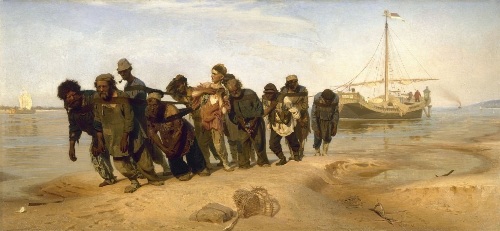
Barge Haulers on the Volga, Ilya Repin
Anyone who has made a serious study of pre-revolutionary Russia understands that it was not just the Bolsheviks who wanted to reform a backwards Russia. They were just one of many factions seeking change: Cadets, Narodniks, Mensheviks, Anarchists, etc. We know what happened next. The Bolsheviks won. The feudal system was violently dismantled, the Romanovs summarily executed, rival factions brutally purged and Moscow became the capital of a United Soviet Socialist Republic. The Russian Enlightenment.Dillard makes this extraordinary claim: “Serving this Russophobia was the fundamental ambiguity of Russian identity—was Russia European or something fundamentally different? This ambiguity has persisted for centuries, largely fueled by European ethnosupremacy.” 'Largely' fuelled by European ethnosupremacy? Again, this is just plain wrong. Whilst it is true that Europeans thought that their culture was superior (who doesn't?), it is also true that Russian intellectuals agreed that Europe was indeed superior. Just as Europeans had travelled to Russia, Russians had travelled to Europe and they liked what they saw. Peter the Great travelled to Europe twice, first to Holland and Britain in 1697 and Denmark, Holland and France in 1716. (See the Grand Embassy of Peter the Great). These journeys inspired Peter to undertake a substantial program to Europeanise Russia known as the Russian Enlightenment. The most dramatic reform was to build a new capital on a former Swedish outpost at a great cost in blood and treasure. It is estimated it cost the lives of between 30,000 - 100,000 peasant conscripts. St Petersburg (Petrograd, Leningrad) was built in the European style with the aid of several European architects.
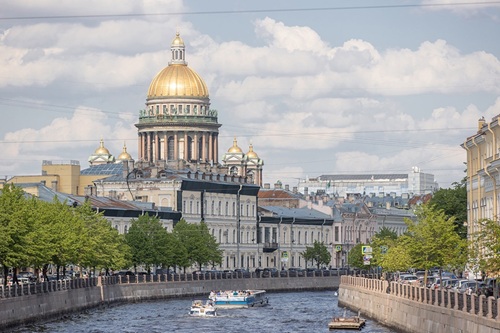
London, Paris? No, St Petersburg
The process of reform was continued under the reign of Peter's daughter Elizabeth of Russia and Catherine the Great, with Catherine inviting European intellectuals, scientists and artists to her court. Her close relationship with the French philosopher Voltaire is well known. During this period the Russian Empire underwent a rapid period of expansion, taking territory to the east, west and south. Note: The Bolsheviks continued the process of modernisation, industrialisation and Europeanisation - remembering that Marxism was a European political innovation.
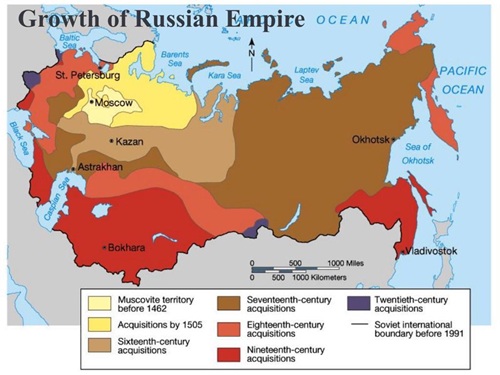 The Slavophiles.Of course, not everyone was happy with the Romanov's embrace of Europe. Peter the Great had been influenced by the Protestant Reformation and Catherine the Great had promoted secularisation and challenged the power of the Russian Orthodox Church. It was only natural for conservative Orthodox intellectuals to oppose the Romanov and Soviet policy of Europeanisation. This group is known as the Slavophiles and they argued for a return to a romanticised past that placed the Orthodox Church at the moral centre supported by an autocratic Tsar. They opposed industrialisation in preference for an idealised rural life based around the concept of the obshchina or mir - a rural community. They also believed in a unique Russian soul. Dillard is right in one respect. There has always been a tension between European style modernism and a conservative, romanticised Slavic identity. But was this due to European or Slavic ethnosupremacy? That tension exists to day with Putin's embrace of the Slavophilia of Ivan Ilyin and Aleksander Dugin - restated as Eurasianism. This is an issue I have explored in my essay The Struggle Against Modernity and Frank Visser in Alexander Dugin and the Metaphysics of Empire. Here I have to note that Dillard's position seems remarkably close to the Slavophiles. Claiming that Russophobia is a special case is precisely the type of rhetorical ploy that a Slavophile would use. The two great empires: Britain and RussiaDillard again deals in selective history by implying that Britain and Russia were natural rivals. The reality is that for the most part they were allies. There were important exceptions. European geopolitics were volatile and allies could quickly become enemies and then, just as easily, switch back again. A good example is the Great Game and the contest for control of Persia, Afghanistan and India. All true, but how many know that in 1907 Russia and Britain signed the Anglo-Russian Convention, which divided Iran in two, assigning the north to Russia and the south to Britain? And that during WW2 the Soviets allied with Britain to invade Iran and depose the Shah - see the Anglo-Soviet invasion of Iran. Russia also allied with the British to form part of the Eight-Nation Alliance against China during the Boxer Rebellion. Britain and Russia were also allies during the major European wars: the Napoleonic, WW1 and WW2. The Crimean war was something of an exception. I can think of no greater example of Russian integration with Britain (and Germany) than the fact that Tsar Nicholas II and George V were close cousins who knew each other during childhood and who addressed each other affectionately as Nikki and Georgie.
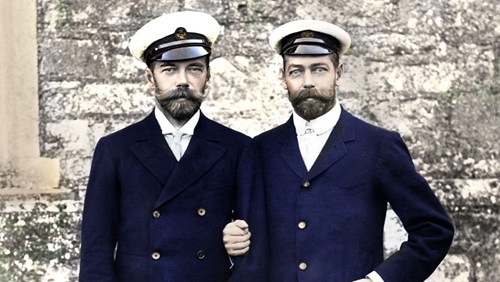
Nicholas (L) and George (R).
Far from being under the influence of a supposed Russophobia, Britain has inclined to the opposite, Russophilia, with the British continuing to celebrate Russian culture (Chekhov's play are a regular feature in British theatres with the Cherry Orchard currently playing in London until January '27, 2027) . And after the collapse of the Soviet Union, the newly rich Russian oligarchs invested heavily in British property and business, to the point that some high end real estate agents employed Russian speaking sales staff. It was about communism, not Russians.Dillard makes another extraordinary claim: “However, an important psychological substitution occurred: Soviet ? Russian.11 A multinational communist state gradually became represented in popular consciousness as simply “Russia.” When communism disappeared, therefore, the accumulated imagery did not disappear with it. That matters enormously. Institutions can abandon doctrines much faster than populations abandon narratives.” Again, this is just plain wrong. The first objection is that Dillard fails to define which 'popular consciousness'. Here I think he confuses the situation in the US with the situation in other countries. Such a substitution may have been part of US popular culture during the Cold War, but it was not necessarily the case elsewhere. I grew up in Australia where the distinction between communism, the Soviets, Russia and individual Russians was clearly understood. An attempt to ban the Australian Communist Party in 1951 was rejected by popular referendum. Nor do I agree that when the Soviet Union collapsed that the 'accumulated imagery' remained. In fact we have seen elements of the Western far-right turn to Russia in admiration. This reversal is the most notable within the US Christian Nationalist movement who have openly admired Putin's embrace of the Russian Orthodox Church and his rejection of what they see as Western 'liberal' degeneracy. In the paper The Religious Right and Russia, the authors write: “Other prominent leaders on the Christian Right have praised Putin as a warrior for traditional Christian culture. Pat Buchanan (2014) explained, “In the culture war for the future of mankind, Putin is planting Russia's flag firmly on the side of traditional Christianity.” Similarly, former GOP Senate candidate for Delaware, Lauren Witzke (a catechumen to Russian Orthodoxy) explained,“Russia is a Christian nationalist nation so... I actually support Putin's right to protect his people and always put his people first, but also protect their Christian values. I identify more... with Putin's Christian values than I do with Joe Biden.” The pejorative 'communist' is now being used by Republicans to describe Democrats. What really happened when the Soviet Union collapsed?The curious thing about Dillard's essay is that the obviously AI generated endnotes often directly contradict the point he is making. This is no more obvious than his argument about the post Soviet era. In the body of the article he says: “It was clear that many Russians considered themselves European and wanted to be included in a broader European identity. However, powerful forces within Europe and the US prevented this resolution from occurring. 14” But note 14 contradicts him. “14. The statement that “powerful forces within Europe and the US prevented this resolution from occurring” goes beyond the evidence cited here.” His misreading continues: “One scholarly analysis of Obama-era foreign-policy discourse argues that anti-Russian assumptions survived even during periods of attempted cooperation and contributed, among many other causes, to the deterioration of the relationship. 15” Note that Dillard does not identify the scholar, but the AI notes do and they state: “15. Political scientist Kari Roberts argues that anti-Russian attitudes persisted within American foreign-policy discourse even during the Obama-Medvedev reset and constituted one among several factors undermining normalization. Importantly, Roberts does not attribute the deterioration of relations solely to Russophobia and explicitly recognizes Russian actions and other sources of conflict.” “Explicitly recognises Russian actions” is a significant correction to Dillard's vague 'among many other causes'. The fact is that the post-collapse period was marked by considerable mistrust on both sides. The West needed assurance that the new political order would be stable enough to allow the investment of large amounts of capital. The EU required strict regulation reform to avoid corruption and meet a range of financial and business best practice standards. Some have argued that these reforms were too harsh and punitive, others have argued that Russia would/could not undertake the necessary reform. (The EU placed strict conditions on Greece before it would provide a rescue package, so Russia was not singled out). Ukraine expressed a desire to join the EU in 2005, it has still not undergone the necessary reform to be accepted. Western concerns about internal stability were reinforced by the Russian Constitutional Crisis of 1993, which ended when Yeltsin ordered an armed assault on the parliament building. It was further eroded when Yeltsin invaded Chechnya in 1994 to prevent it gaining independence. Summary to part one.Marshall Poe argues that the supposed negative stereotypes of Russians presented by European visitors were largely accurate. The Rus were slave traders, not the victims of slavery. The Romanov dynasty under Peter and Catherine the Great understood that Russia was backward and undertook a massive program of Europeanisation that transformed Russia. Russian radicals agreed that Russia was backward and in need of reform. This included Lenin and the Bolsheviks. There has long been a nativist Slavophile tradition opposed to integration with Europe. Putin has adopted the Slavophile tradition and rebranded it Eurasianism. PART TWO: EUROPHOBIA.“I hate the West. They are bastards and scum. They want death to us, Russia, and as long as I'm alive, I will do everything to make them disappear.” Dmitry Medvedev, June 7, 2022 Dillard asks: “The more consequential question is, ‘How much Western policy toward Russia is being generated by testable assessments of Russian conduct, and how much by inherited narratives that convert Russian identity itself into evidence of threat?’” Let's change a few words around. How much Russian policy toward Europe is being generated by testable assessments of European conduct, and how much by inherited narratives that convert European identity itself into evidence of threat? You see, the massive hole in Dillard's analysis is that it is entirely one-sided. He argues that Russophobia informs Western policy but doesn't examine if Europhobia - or its variations: Westernophobia, Natophobia, etc - informs Russian policy towards Europe. Just as Europeans had developed negative stereotypes of Russians, Russians had developed negative stereotypes of Europeans. To the Slavophiles Europeans are morally bankrupt, individualistic, rationalistic, secular and fragmented. The writer Pyotr Chaadayev wrote a series of philosophical letters that explored the differences at some length. In On the Nature of European Culture and on its Relationship to Russian Culture, written in 1852, he summarises his views of European culture: “This state of European minds had the opposite effect in Russia from what it eventually had in the West. Only a few Russians, and then only for a moment, were fascinated by the superficial glitter of these foolish systems; were deluded by this artificial comeliness that was rotten to the core.” He ends the letter: “My only wish is that the principles of life that are preserved in the doctrine of the Holy Orthodox Church should permeate the beliefs of all estates and strata of our society; that these lofty principles, in prevailing over European culture, should not force it out but embrace it in their fullness, thus granting it a higher meaning and bringing it to its ultimate development; and that the wholeness of being that we observe in ancient Russia should forever be the destiny of our present and future Orthodox Russia.”
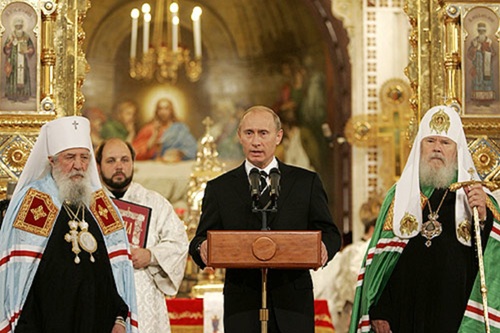
Putin has embraced the Orthodox Church
Putin is regurgitating the Slavophile script. He has rejected the secularism of the Soviet era and has returned to the Orthodox worldview. The idea that Russia is engaged in a holy war against a Satanic West is being used to justify its attack on Ukraine. "The dictatorship of the Western elites is targeted against all societies, including the Western peoples themselves. This is a complete denial of humanity, the overthrow of faith and traditional values. Indeed, the suppression of freedom itself has taken on the features of a religion: outright Satanism." Vladimir Putin, September 30, 2022 In a speech delivered at the Orthodox Church's World Russian People's Council in March, 2024, Patriarch Kirill declared that the war against Ukraine was a holy war with the aim of: “…protecting the world from the onslaught of globalism and the victory of the West, which has fallen into Satanism.” He also stated: “The possibility of the existence of a Russophobic political regime hostile to Russia and its people on this territory, as well as a political regime controlled from an external center hostile to Russia, should be completely excluded.” Such polemic is constantly repeated on Russian state media by leading personalities such Vladimir Solovyov and Margarita Simonyan. Both have used extremist polemic that directly threatens the use of nuclear weapons. This is clearly incitement to genocide. Threat assessment.Dillard argues that Russophobia matters when it comes to the accurately assessing if Russia poses a threat. He is right to point out that prejudices of all kinds can affect how we assess the motives of others. And whilst he does acknowledge that it works both ways… “There are multiple grounds on which this critique can be fairly criticized as partial or biased. However, to do so generally focuses on the particular example of Russophobia and misses the more general argument regarding how and why narratives that demonize opponents are created, regardless of who the opponent is or who is creating the narrative.” … he is the one who focuses on Russophobia. He fails to explore the ways that Russia demonises the West (calling the West 'Satanic' is literal demonisation) and the way that impacts their ability to realistically assess the threat posed by either the West, the US, NATO or Ukraine. NATO is a good example. Does it actually pose a threat to Russia? It is a purely defensive pact and there is no evidence of NATO ever acting aggressively against Russia. Nor for that matter is there any evidence that Ukraine was acting aggressively. Quite the contrary, it got rid of its nuclear arsenal and was not seeking to join NATO at the time Russia invaded. However, what the expansion of NATO did was to 'constrain' Russia from retaking territory it lost after the collapse of the Soviet Union. Many of the countries that had once been part of the Warsaw Pact lobbied to join NATO in order to protect themselves from future Russian aggression and expansion. From that perspective one can argue that the only threat that Ukraine ever posed was that one day it might become part of the 'Satanic' West and thus upset some imagined Slavophile ideal of a greater Russia. The invasion can be read as preemptive - attacking Ukraine before it could begin the process of Europeanisation. It seems clear that the historical Slavophile mistrust of Europe has developed into a severe form of Europhobia which has lead to a paranoid threat assessment. The function of propaganda.Dillard reminds us of the anti-Russian propaganda pamphlet The Testament of Peter the Great. It's true, but what he does not mention is that the Russians have perfected the use of propaganda. A few decades later the Russians would produce The Protocols of the Elders of Zion. This antisemitic 'hit piece' has been so effective that it is still cited as evidence in far-right and Islamist circles. I don't need to explain the purpose of propaganda here. Safe to say that all sides use it to manipulate public opinion. This is especially the case with autocratic regimes who use it to control their own people. And what better way to control a population than through generating a fear that they are about to be invaded by a 'Satanic' enemy? Isn't it all a bit obvious? The US used the fear of communism to great effect during the Cold War. But the communist world also used fear of the capitalist West. Such propaganda typically exaggerates national and racist stereotypes and relies heavily on the glorification of their nation and the demonisation of the chosen other.
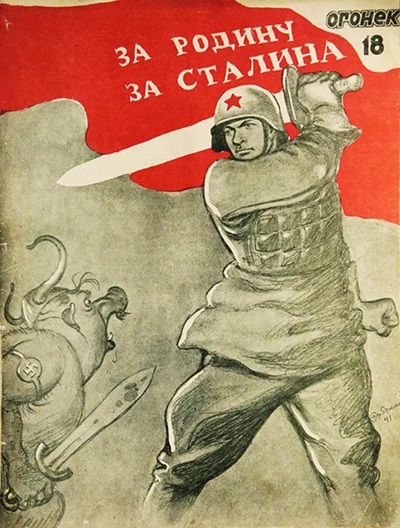
This early poster depicts the Nazis as Mongols,
who had subjugated the Rus in the 13th century. A tale of two empiresAt the beginning of the 20th century Britain and Russia were the largest and second largest empires respectively. As the century progressed their fortunes changed dramatically. By the end of the century Britain had lost its empire almost completely, and whilst Russia had lost some of its European assets, it retained most of its southern and eastern territories. 1905 was a particularly interesting year for Russians. It marked the formation of the Ballets Russe in Paris. A touring company that showcased the talents of several Russian creatives: the famed dancers, Vaslav Nijinsky and Anna Pavlova; composers Igor Stravinsky, Sergei Prokofiev; and artists Konstantin Korovin, Nicholas Roerich and Leon Bakst. It was a collaboration with the noted French composers and artists: Debussy, Satie, Ravel, Matisse, Picasso and the designer Coco Chanel. Known for its avant-garde aesthetic, it marks the near total integration of Russian and European artistic culture.
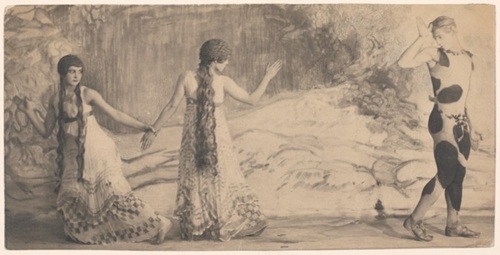
Ballets Russe. Afternoon of the Faun featuring Nijinsky
At the same time Russian intellectuals and radicals were fully engaged in European politics, especially Marxists and Anarchists. They were hopping from one European city to another attending meetings and organising. This included Vladimir Lenin who at the beginning of 1905 was living in Geneva. He travelled to London to chair the third congress of the Russian Social Democratic Labour Party. At the end of the year he returned to Russia in the aftermath of the 1905 Revolution. (The 1905 Revolution was a reaction to the disastrous Russo-Japanese War). I cannot emphasise this enough. During the late 19th and early 20th centuries Russia was fully part of Europe. My point here is that Russia has seen the way Britain has diminished and does not want to loose the empire it so zealously and violently holds onto. Turns out the Russians couldn't be trusted after all.The theme of Dillard's essay is a repeat of his apologetics. He is holding onto a belief that Russia has been subject to a prejudiced analysis. He makes this clear from the beginning: “More broadly, it can mean a persistent tendency to interpret Russian behavior through unusually hostile assumptions:” 'Unusually' hostile assumptions? There is a saying: actions speak louder than words. If we consider that this conflict began with the invasion and annexation of Crimea in February 2014, then this war has been going for more than 12 years. If we want to talk about accurate threat assessment, doesn't the invasion of Ukraine prove that the former Warsaw Pact nations were justified in seeking to join NATO? Doesn't the fact that the 'special military operation' has lasted close to 5 years prove that Russia has vastly underestimated Ukraine's determination and ability to defend itself? Doesn't the support Ukraine has received from Europe disprove Russia's assessment that Europe was too divided, weak and would cave under sustained pressure? Using the standards of international humanitarian law how should we assess Russian conduct? Answer - it has violated every law and convention. As I write this Russia has been relentlessly bombing Ukrainian towns and cities without regard for civilian lives. It has deliberately targeted civilian infrastructure to terrorise Ukrainians into submission. They then lie and say they are only targeting military infrastructure when everyone can see the destruction. Here is a comprehensive list of war crimes committed by Russia. Genocide Watch has declared that Russia is committing genocide against Ukraine. They state that: “Russia has committed every war crime and crime against humanity, including relentless, indiscriminate attacks against civilians, systematic torture, mass rape, and the forced transfer of Ukrainian children to Russia.” The ICC has indicted six Russian officials for war crimes, this includes Putin. Organisations such as Amnesty International have issued reports detailing Russia's brutal treatment of its own soldiers. “Many observers believe that the Russian army today is a prison-like, GULAG style institution, where the treatment of soldiers is not much different from the treatment of prisoners, and in many cases much worse. Torture methods such as "torture by hunger", rape, beatings, and other humiliating and degrading punishments continue to be practised in the army.” (As an anecdotal side note. I had a Russian work colleague confirm that he was brutalised when he was in the army). Russia has suffered a significantly high death toll. With an estimated 1.4 million casualties and 450,000 dead, this represents nine times to total casualty rate in all its wars since WW2. It demonstrates a callous disregard for Russian lives. The long term effects of trauma and injury will have a devastating effect on Russian society.
Soldiers beaten, starved, and chained by their own commanders | Break The Fake
Does Dillard accept these allegations or does he think they are examples of an 'unusually hostile' Russophobia?
Widget is loading comments...
|