|
TRANSLATE THIS ARTICLE
Integral World: Exploring Theories of Everything
An independent forum for a critical discussion of the integral philosophy of Ken Wilber
  Frank Visser, graduated as a psychologist of culture and religion, founded IntegralWorld in 1997. He worked as production manager for various publishing houses and as service manager for various internet companies and lives in Amsterdam. Books: Ken Wilber: Thought as Passion (SUNY, 2003), and The Corona Conspiracy: Combatting Disinformation about the Coronavirus (Kindle, 2020). Frank Visser, graduated as a psychologist of culture and religion, founded IntegralWorld in 1997. He worked as production manager for various publishing houses and as service manager for various internet companies and lives in Amsterdam. Books: Ken Wilber: Thought as Passion (SUNY, 2003), and The Corona Conspiracy: Combatting Disinformation about the Coronavirus (Kindle, 2020).
Check out my other conversations with ChatGPT Russophobia and the Problem of the Self-Sealing NarrativeA Critical Review of Joseph Dillard's New PaperFrank Visser / ChatGPT
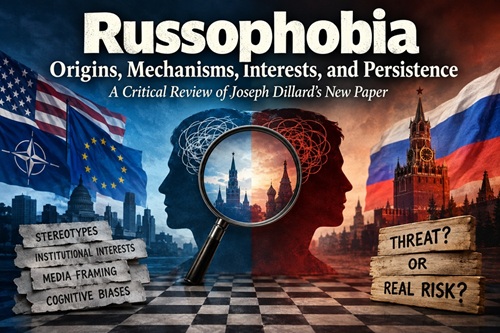 Joseph Dillard's new essay, "Russophobia: Origins, Mechanisms, Interests, and Persistence", is an ambitious attempt to rescue the concept of Russophobia from two opposite extremes. On the one hand, Dillard rejects the idea that every criticism of Russia or Vladimir Putin is evidence of anti-Russian prejudice. On the other, he argues that Western attitudes toward Russia can become so deeply embedded in historical stereotypes, institutional interests and cognitive biases that Russia is effectively "pre-classified" as a threat before individual events are assessed. This is a legitimate subject for investigation. There certainly is such a thing as anti-Russian stereotyping, just as there is anti-Americanism, Sinophobia, Islamophobia, Iranophobia and other forms of collective prejudice. Russia has also been represented in Western literature and political thought as despotic, Asiatic, expansionist or culturally backward for centuries. Dillard is therefore on firm ground when he insists that the history of Western representations of Russia did not begin with Putin or even with the Soviet Union. But the central problem with the paper is that it gradually shifts from the modest and defensible proposition that Russophobia sometimes exists to the much larger proposition that Western threat perceptions of Russia are themselves substantially products of Russophobic cognitive and institutional structures. The former is an empirical observation. The latter is a causal thesis. And the evidence presented does not establish the latter nearly as strongly as the rhetoric of the essay suggests. Indeed, the paper contains an interesting irony. Dillard repeatedly demands that Western interpretations of Russia be falsifiable. Yet "Russophobia" itself risks becoming a self-sealing explanatory category: if Russia behaves aggressively, that is evidence of Russian conduct; if the West reacts, that may be evidence of Russophobia; if Russia reacts to the Western reaction, that becomes evidence of a security dilemma; if the West then reacts again, the resulting escalation confirms the original thesis of a recursively produced threat narrative. Almost every possible development can therefore be incorporated into the model. The result is not necessarily false. But it is dangerously close to becoming unfalsifiable. The paper's strongest distinctionThe best feature of Dillard's essay is its insistence on distinguishing criticism of Russian policy from prejudice against Russians. That distinction is absolutely necessary. Russia's invasion of Ukraine in February 2022, its annexation of Crimea in 2014, its military intervention in Georgia in 2008, its threats against neighboring states and its enormous nuclear arsenal all provide grounds for other states to regard Russian military power as a security problem. Dillard explicitly acknowledges this, writing that calling every Western reaction "Russophobia" would make the concept analytically useless. This qualification is important because the word "Russophobia" can otherwise perform precisely the rhetorical function that Dillard criticizes in Western discourse. It can transform criticism of a government into an accusation of prejudice against a people. A person can believe that Putin's invasion of Ukraine was unjustified without believing that Russians are intrinsically aggressive. One can oppose Russian imperialism without believing that Russian culture is inferior. One can support NATO deterrence without believing that Russian people are uniquely dangerous. And one can believe that Russian propaganda exists without believing that every Russian statement is false. This distinction should be the foundation of any serious discussion of Russophobia. Unfortunately, Dillard does not always remain on that firm ground. From prejudice to geopoliticsThe paper's conceptual expansion occurs when Russophobia is redefined as a "persistent tendency to interpret Russian behavior through unusually hostile assumptions." That definition is considerably broader than ordinary usage. It potentially encompasses not merely hostility toward Russians but disagreements about the interpretation of Russian foreign policy. Consider the difference. If somebody says, "Russians are inherently authoritarian," that is plainly a sweeping cultural stereotype. If somebody says, "The Russian government has repeatedly used military force against neighboring states and therefore its future military intentions deserve careful scrutiny," that is not obviously prejudice. It is a geopolitical hypothesis based upon historical evidence. Dillard recognizes the distinction theoretically. But his subsequent analysis repeatedly moves back and forth across it. For example, NATO's characterization of Russia as its "most significant and direct threat" is presented as an example of an institutionalized threat perception that can generate incentives for its own reproduction. But there are two very different questions here. The first is whether NATO's assessment is correct. The second is whether NATO's assessment is sustained partly by institutional incentives. The second does not establish the first. Nor does the existence of institutional incentives establish that the threat assessment is irrational. An insurance company has an institutional interest in assessing risks. That does not mean the risks are imaginary. A military alliance has an institutional interest in preparing for military threats. That does not demonstrate that the threats are manufactured. An arms manufacturer benefits from increased military expenditure. That does not demonstrate that the military expenditure was caused by the arms manufacturer. Dillard occasionally acknowledges these distinctions, but the cumulative structure of the essay nevertheless encourages the reader to move from "benefits from the policy" to "helps reproduce the narrative supporting the policy" and from there toward "the narrative is therefore partly responsible for the policy." That final step requires much more evidence. The military-industrial complex makes another appearanceThe section on who "benefits" from Russophobia illustrates the problem particularly well. Dillard identifies defense companies, energy exporters, NATO, Eastern European governments, American strategic planners and others as beneficiaries of the post-2022 confrontation. These observations are largely uncontroversial. Defense companies benefit from increased procurement. American LNG producers benefited from Europe's diversification away from Russian gas. NATO's institutional importance increased after Russia's invasion. European states increased defense expenditures. These are observable developments. But "benefits from X" and "caused X" are two very different propositions. The existence of beneficiaries is not evidence that they generated the underlying threat narrative. The American oil industry benefited from the Iraq War without that fact alone proving that the oil industry caused the invasion. Pharmaceutical companies benefited from COVID vaccination without that fact proving that they caused the pandemic. Arms manufacturers benefit from war without that fact proving that they caused the war. This is one of the oldest problems in political explanation: confusing interests with agency. Dillard is careful enough not to explicitly claim a secret conspiracy. Indeed, he says that adversarial systems can become "symbiotic" without secretly cooperating or manufacturing everything. That is a useful qualification. But once conspiracy is removed, the causal argument becomes considerably more modest: institutions adapt to perceived threats, and their adaptation creates interests that may reinforce the threat perception. That is a plausible proposition. It is also much less revolutionary than the rhetoric of "Russophobia" suggests. The security dilemma is doing most of the workThe deepest explanatory mechanism in the paper is actually not Russophobia at all. It is the classical security dilemma. Dillard describes a recursive process in which Western fear produces containment, containment produces Russian insecurity, Russian insecurity produces countermeasures, those countermeasures increase Western fear, and the cycle continues. This is a perfectly respectable international-relations model. It does not require anybody to be irrational, hateful or propagandized. Indeed, that is precisely why it is so powerful. Two states can behave defensively from their own perspective while appearing offensively threatening to the other side. NATO can describe military expansion as deterrence. Russia can interpret that expansion as encirclement. Russia can strengthen its military in response. NATO can interpret that strengthening as confirmation of the Russian threat. None of this requires Russophobia. It can happen between states whose populations have no particular ethnic prejudice against one another. It is a structural feature of international politics. Dillard himself cites the classic security-dilemma literature in the notes, including Robert Jervis. This suggests that "security dilemma" may actually be the more parsimonious explanatory concept. Russophobia may sometimes intensify the process, but it is not necessary to explain the process. That distinction matters. If a concept explains something without requiring the additional variable being proposed, the burden falls on the new variable to demonstrate what extra explanatory work it performs. The asymmetry argumentDillard's psychological argument is more interesting. He argues that Western observers can fall into a familiar attributional asymmetry: our military deployments are deterrence, theirs are aggression; our alliances are defensive, theirs are threatening; our propaganda is strategic communication, theirs is disinformation. This is a real psychological phenomenon. Human beings routinely interpret the actions of their own group more sympathetically than those of an out-group. But here again the concept needs empirical discipline. The fact that two actions belong to the same category does not make their motives or consequences equivalent. A Russian military exercise near NATO territory and a NATO exercise elsewhere may both be "military exercises," but their strategic circumstances can differ. A Russian invasion of Ukraine and Western military intervention in another country may both be military interventions, but the legal, historical and political circumstances surrounding them need to be compared rather than simply equated. Dillard occasionally acknowledges this, stating that the point is not that either interpretation is necessarily false but that explanatory standards may change according to the identity of the actor. That is a legitimate hypothesis. But it has to be demonstrated case by case. Otherwise "double standard" becomes another all-purpose explanation. Whenever Western and Russian actions are interpreted differently, one can simply declare that the difference demonstrates Russophobia. That is precisely the kind of circularity Dillard warns against. History: evidence or mythology?The historical section of the paper is useful insofar as it reminds readers that Western images of Russia have a long pedigree. Dillard discusses early-modern descriptions of Muscovy, the nineteenth-century Great Game, Napoleon, the alleged Testament of Peter the Great, Russian autocracy, the Crimean War and the later fusion of anti-Soviet and anti-Russian imagery during the Cold War. But the paper faces a familiar historical problem: demonstrating continuity is not the same as demonstrating transmission. That Western writers in the sixteenth century described Muscovy as backward does not demonstrate that a contemporary German or Dutch policymaker carries an inherited psychological residue from sixteenth-century ethnography. Dillard's own footnote actually recognizes this limitation. It says that the older literature does not establish an "unbroken causal line" to contemporary attitudes. That qualification should arguably have been brought into the main argument. Historical resemblance is not necessarily historical causation. The same applies to the Cold War. Western publics did often use "Russia" as shorthand for the Soviet Union, despite the USSR being a multinational state. But demonstrating that Soviet and Russian images sometimes became conflated does not establish that contemporary Western security assessments are primarily leftovers from Cold War psychology. There is a simpler explanation: Russia remains a major nuclear-armed state with substantial military capabilities and a demonstrated willingness to use force beyond its internationally recognized borders. One does not need a psychological residue from the Cold War to take that seriously. The Putin problemPerhaps the greatest omission in the argument is the difficulty of separating pre-existing Russophobia from hostility generated by Russian behavior. Dillard asks an important question: what would falsify the Western belief that Russia is dangerous? If democratic Russia, prosperous Russia, weak Russia, strong Russia, cooperative Russia and isolated Russia were all interpreted as dangerous, then perhaps the hypothesis has become an identity narrative rather than a testable proposition. This is an excellent methodological challenge. But it should also be applied to Dillard's own hypothesis. What evidence would convince him that contemporary Western distrust of Russia is substantially justified rather than substantially produced by Russophobia? Russia's invasion of Ukraine cannot simply be treated as another piece of evidence that happens to be filtered through a Western stereotype. It is itself an enormous independent event that changes the evidential baseline. The same applies to Crimea, Russian military intervention in Georgia, Russian nuclear signaling, coercive behavior toward neighboring states and documented Russian interference operations. Dillard acknowledges these facts, but they sit somewhat awkwardly inside a framework designed to expose the mechanisms of Western threat construction. The danger is that Russia's actual conduct becomes the "trigger" while Western interpretation becomes the real object of explanation. But sometimes a threat narrative exists because there really is a threat. That possibility deserves equal analytical status. The Russia-China argumentThe essay also argues that Western confrontation has helped push Russia toward China and the wider non-Western world. Dillard presents this as a potentially enormous strategic consequence of Western policy. There is an important point here. Russia-China relations have unquestionably deepened, and sanctions and Western economic separation have contributed incentives for Russia to redirect trade, finance, energy and technology relationships eastward. But causation again needs to be plural rather than monocausal. The relationship between Russia and China also reflects China's own strategic ambitions, Russian interests, the deterioration of Russian-Western relations, the war in Ukraine, China's economic position and the broader transformation of the international system. Even Dillard's own note concedes that attributing the development principally to Western Russophobia would go beyond the evidence. That concession is revealing. It points toward a more sober interpretation of the paper than its title suggests: Western policy may have unintended consequences, but unintended consequences are not evidence that the original policy was motivated by prejudice. A curious problem with the paper's own notesThere is also an unusual editorial problem here. The published essay contains extensive notes that read like an AI-assisted editorial audit of the manuscript itself. They include statements such as "The manuscript should soften..." and "I would replace..." and explicitly identify claims that go beyond the evidence. This is more than a stylistic curiosity. It reveals a fascinating division inside the text between the argument being made and the argument that its own fact-checking apparatus says can actually be defended. For example, the manuscript originally claimed that "powerful forces" in Europe and the United States prevented Russia's integration into the West. The note subsequently says that this "goes beyond the evidence cited here" and recommends the much more cautious formulation that Russian and Western projects became increasingly incompatible. Likewise, the notes acknowledge that U.S. energy companies benefited from Europe's energy transformation but explicitly state that this does not establish that they caused or promoted confrontation with Russia. The same self-correction occurs with European "de-industrialization," the interpretation of public opinion, the Georgia war and the causal role of Western policy in the Russia-China relationship. In other words, the paper's own apparatus repeatedly discovers the problem that critics are likely to discover: the evidence often supports a weaker proposition than the rhetoric of the main text. That makes the essay almost unintentionally self-critical. The Integral problemFor an Integral World audience there is a deeper issue. Dillard presents himself as practicing multi-perspectivalism: rather than simply accepting the prevailing Western interpretation of Russia, he wants readers to enter the Russian perspective and examine the reciprocal construction of threat. This continues a theme running through his earlier writings on Ukraine and Russia, where he has repeatedly criticized what he calls Western or "WILP" groupthink and urged readers to understand Russian perspectives. There is something valuable in that impulse. Integral thinking should indeed make us suspicious of single-perspective explanations. But multi-perspectivalism has a built-in danger: confusing the inclusion of a perspective with the validation of that perspective. Understanding why the Kremlin regards NATO as threatening does not establish that NATO is primarily responsible for Russian aggression. Understanding why Eastern Europeans distrust Russia does not establish that their fears are Russophobic. Understanding why Western governments regard Russia as dangerous does not establish that their assessment is correct. And understanding the Russian narrative of encirclement does not establish that the narrative is true. An integral method should place competing perspectives into a larger evidential framework, not simply correct one alleged bias by introducing its opposite. This is where Dillard's project sometimes begins to resemble a pendulum. The dominant Western narrative is treated as insufficiently aware of its own standpoint, so the Russian standpoint is brought forward as a corrective. But the corrective can itself become a new standpoint that is insufficiently aware of its own selective perception. The cure for one-sidedness is not the opposite side. It is comparative analysis. From "Russophobia" to "threat perception"Perhaps the most productive way to salvage Dillard's argument is to demote Russophobia from master concept to one variable among several. Western perceptions of Russia can be shaped by historical stereotypes, genuine security concerns, domestic politics, institutional incentives, economic interests, media framing, cognitive biases, ideological commitments and actual Russian behavior. The same is true in reverse. Russian perceptions of the West can be shaped by historical grievances, NATO expansion, Western interventions, domestic political incentives, propaganda, nationalism, strategic interests, cognitive biases and actual Western behavior. Once the problem is formulated this way, we no longer need to decide whether "Russophobia" or "Russophobia denial" is the great explanatory key. We can ask much more concrete questions. When did a particular threat perception emerge? What evidence supported it at the time? What evidence contradicted it? Which actors promoted it? Which actors opposed it? Did the perception change when circumstances changed? What predictions did it generate? Were those predictions fulfilled? Were comparable actions by different states evaluated according to comparable criteria? These questions are considerably harder to answer than labeling an entire geopolitical environment "Russophobic." They are also considerably more useful. The real test of an integral approachDillard's most important sentence may therefore be his own methodological question: how much Western policy toward Russia is generated by testable assessments of Russian conduct, and how much by inherited narratives that convert Russian identity itself into evidence of threat? That is exactly the right question. But it cuts both ways. We should ask how much Russian policy toward the West is generated by testable assessments of Western conduct, and how much by inherited narratives that convert Western identity itself into evidence of hostility. We should ask whether Russian claims about NATO are falsifiable. We should ask whether Western claims about Russia are falsifiable. We should ask what evidence would cause either side to revise its threat model. And above all, we should distinguish between explaining a belief and demonstrating that the belief is false. Dillard is much better at the first than at the second. Conclusion: The danger of the counter-narrative"Russophobia" is at its strongest when it warns against essentializing Russia, conflating Russians with their government, applying asymmetric standards to comparable actions, and allowing historical enemy images to become cognitive shortcuts. Those are worthwhile warnings. It becomes much weaker when these observations are assembled into a broad causal story in which Western threat perceptions are themselves treated as products of prejudice, institutional self-interest and recursive fear. There is a genuine danger in turning Russia into an eternal enemy. But there is an equal methodological danger in turning "Russophobia" into the explanation for why Russia is regarded as an enemy. That would simply reverse the direction of confirmation bias. Dillard wants us to notice the prior assumptions through which Westerners interpret Russia. The same discipline requires us to notice the prior assumptions through which critics of the West interpret Western policy. The central question should therefore not be "Is the West Russophobic?" Nor should it be "Is Russia inherently aggressive?" The better question is: “What evidence would change our minds?” That question is more difficult, less satisfying and less ideologically rewarding. But it is also much closer to what an integral approach to geopolitics ought to mean. The irony is that Dillard's paper comes very close to discovering this principle itself. Its most valuable contribution is not its attempt to prove that Russophobia explains Western policy. It is the methodological challenge to examine how threat narratives become self-reinforcing. That challenge should be applied to everyone—including Joseph Dillard himself.
Widget is loading comments...
|