|
TRANSLATE THIS ARTICLE
Integral World: Exploring Theories of Everything
An independent forum for a critical discussion of the integral philosophy of Ken Wilber
 Dr. Joseph Dillard is a psychotherapist with over forty year's clinical experience treating individual, couple, and family issues. Dr. Dillard also has extensive experience with pain management and meditation training. The creator of Integral Deep Listening (IDL), Dr. Dillard is the author of over ten books on IDL, dreaming, nightmares, and meditation. He lives in Berlin, Germany. See: integraldeeplistening.com and his YouTube channel. He can be contacted at: joseph.dillard@gmail.com Dr. Joseph Dillard is a psychotherapist with over forty year's clinical experience treating individual, couple, and family issues. Dr. Dillard also has extensive experience with pain management and meditation training. The creator of Integral Deep Listening (IDL), Dr. Dillard is the author of over ten books on IDL, dreaming, nightmares, and meditation. He lives in Berlin, Germany. See: integraldeeplistening.com and his YouTube channel. He can be contacted at: joseph.dillard@gmail.com
Check out my other conversations with ChatGPT RussophobiaOrigins, Mechanisms, Interests, and PersistenceJoseph Dillard / ChatGPT
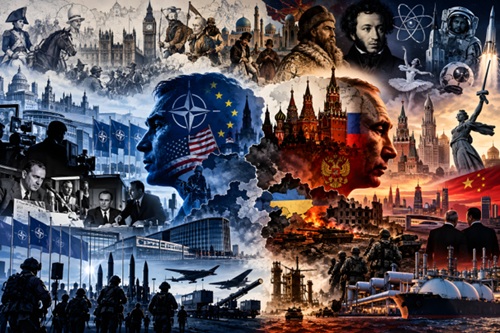 The word Russophobia is difficult because it is used to describe several different phenomena. At its narrowest, it means prejudice against Russians as a people or against Russian language and culture. More broadly, it can mean a persistent tendency to interpret Russian behavior through unusually hostile assumptions: Russia is presumed expansionist when another great power would be called security-conscious. It is assumed to be inherently authoritarian rather than contingently authoritarian, culturally backward rather than differently developed. It is presumed to be uniquely imperial despite the imperial histories of other major powers. At its broadest—and most politically problematic—the term is sometimes applied to virtually any criticism of the Russian government. Those meanings need to be kept separate. Russia has pursued imperial policies, committed serious abuses, invaded neighboring states, and employed coercion. Criticism of those actions is not in itself Russophobia. At the same time, the existence of legitimate reasons to criticize Russian governments does not mean that anti-Russian stereotyping is imaginary. Indeed, the most effective forms of political prejudice generally attach themselves to genuine events. Their power comes not from inventing everything but from placing real events inside a pre-existing interpretive structure in which contradictory evidence becomes increasingly difficult to perceive. Events either become evidence of Russian aggression/threat or they are ignored because they conflict with an entrenched, pre-established worldview. Russophobia is therefore most useful to understand not as a conspiracy or simply as hatred, but as a historically accumulated threat narrative. It has been periodically reinforced by Russian behavior, Western geopolitical interests, ideological conflict, institutional incentives, and mutually reinforcing propaganda on both sides. The roots of Russophobia are much older than Putin or communism Western suspicion of Russia substantially predates the Soviet Union. European travelers of the sixteenth and seventeenth centuries repeatedly portrayed Muscovy as despotic, culturally backward, Asiatic, servile, and fundamentally outside European civilization. Historian Marshall Poe has traced the stereotype of Russians as a people naturally inclined toward submission to these early-modern ethnographic accounts.1 The word “slave” comes from Slav, and Russians are primarily slavic peoples. Slavic populations were extensively enslaved during the early Middle Ages by multiple peoples and traded through European, Byzantine and Islamic markets. The later Crimean Tatar slave trade was another enormous episode. It establishes a long history in which Slavic peoples could be regarded as commodities and outsiders, which helped lay the foundations for Western Russophobia.2 Serving this Russophobia was the fundamental ambiguity of Russian identity—was Russia European or something fundamentally different? This ambiguity has persisted for centuries, largely fueled by European ethnosupremacy. Scholarship on European representations of Moscow shows that by the late eighteenth and early nineteenth centuries Western writers were already debating whether Russia belonged to enlightened Europe or represented something between Europe and Asia.3 Then geopolitics amplified the cultural stereotype. Napoleon's confrontation with Russia helped produce one of the more remarkable early examples. The so-called Testament of Peter the Great, purporting to reveal a centuries-long Russian plan for continental and ultimately global domination, appeared in France in 1812.4 Historians regard it as a forgery, yet it circulated repeatedly during later confrontations with Russia and helped establish the idea that Russian expansion followed an almost timeless master plan. French anti-Russian journalism intensified after the Napoleonic Wars.5 Historian Raymond McNally describes an explicitly fear-producing literature about Russia developing between 1812 and 1830 and contributing to the political atmosphere preceding the Crimean War. Britain developed its own version during the nineteenth-century Great Game, when British and Russian imperial expansion approached one another across Central Asia. Russian movement toward Afghanistan or Persia could be interpreted in London as preparation for an eventual threat to India. Anglo-Russian rivalry over Persia and India was already intense in the early nineteenth century, and by the 1830s Britain regarded Russian expansion as threatening Persia and potentially India.6 Nineteenth-century Russophobia and the Great Game were initially driven principally by imperial rivalry and protection of India by Britain; petroleum subsequently became an additional strategic interest. Whether these fears were realistic or not is debatable, but they were definitely useful. The result was not invented rivalry—Britain and Russia really were competing empires—but rivalry generated a cultural vocabulary through which almost any Russian movement could confirm the expectation of further Russian expansion. That mechanism is worth remembering, because it recurs. Here is the basic psychological dynamic: Actual rivalry generates fear. Fear generates an interpretive framework. The framework then makes ambiguous actions appear threatening. Those perceptions justify countermeasures. The countermeasures appear threatening to the other side, which responds. Its response then confirms the original diagnosis. The system begins producing the evidence that validates its assumptions. Autocracy, revolution, and the Cold War added successive layers. Nineteenth-century liberal Europe contrasted its evolving constitutional institutions with Russian tsarist autocracy. Russia could therefore be portrayed simultaneously as geopolitical rival and ideological opposite: the reactionary guardian of monarchy against European liberalism and revolution.7 The Bolshevik Revolution added another layer. Russia was no longer merely supposedly Asiatic, autocratic, expansionist, or culturally alien; the Soviet Union explicitly promoted a revolutionary ideology opposed to capitalism. The Western fear of Russia and the Western fear of communism increasingly fused.8 After 1945 that fusion became institutionalized by the Cold War. Communism, which was supported by many mainstream Americans prior to WWII, became anathema and many people were targeted for censorship or persecution, with the McCarthy hearings providing the most public example of a movement that continued long after that historical episode ended in the early 1950's.9 For more than four decades, generations of Western military planners, intelligence agencies, universities, think tanks, journalists, politicians, a captured media, and citizens organized geopolitical reality around a Soviet adversary. There is substantial documented evidence of CIA relationships with American media organizations and journalists during the Cold War. Declassified material records roughly fifty U.S. journalists or media personnel maintaining covert CIA relationships as of the mid-1970s, with about half involving paid relationships, and documents media organizations providing cover for agents.10 CBS chairman William Paley also permitted CIA agents to use CBS credentials, according to Daniel Schorr. There were substantial reasons for doing so: nuclear confrontation, Soviet domination of Eastern Europe, interventions in Hungary and Czechoslovakia, espionage, proxy wars, and ideological competition were real. However, an important psychological substitution occurred: Soviet → Russian.11 A multinational communist state gradually became represented in popular consciousness as simply “Russia.” When communism disappeared, therefore, the accumulated imagery did not disappear with it. That matters enormously. Institutions can abandon doctrines much faster than populations abandon narratives. What followed was the missed post-Cold-War reset. The collapse of the Soviet Union created a remarkable historical experiment. If Western hostility had been principally about communism, antagonism should have declined dramatically once communism disappeared. For a time it did.12 Russia joined Western institutions, sought investment, cooperated with the United States on some security issues, participated in the G8, established NATO-Russia mechanisms, and under Dmitry Medvedev participated in the Obama administration's “reset.” There is good contemporary evidence that Putin publicly entertained Russian NATO membership in 2000. Asked whether Russia could join NATO, he answered that he did not see why not, provided Russia were treated as an equal partner, and explicitly located Russia within European civilization. Putin later claimed that he personally raised Russian membership with Bill Clinton.13 It was clear that many Russians considered themselves European and wanted to be included in a broader European identity. However, powerful forces within Europe and the US prevented this resolution from occurring.14 One scholarly analysis of Obama-era foreign-policy discourse argues that anti-Russian assumptions survived even during periods of attempted cooperation and contributed, among many other causes, to the deterioration of the relationship.15 The Russian side developed its own mirror-image narrative. Russian officials increasingly attributed Western criticism to “Russophobia,” particularly after 2014.16 Researchers examining official Russian discourse have found a significant increase in use of the concept, making it an instrument for interpreting Western opposition as prejudice rather than as a response to specific Russian policies. This qualification is essential. Western Russophobia and Russian claims about Russophobia are two different questions. The existence of the second does not disprove the first, any more than the existence of actual prejudice proves every Russian accusation of prejudice correct. Both sides can simultaneously engage in threat amplification. What does political Russophobia sound like? Some statements commonly described as Russophobic are actually criticisms of the Russian government or Putin and should not automatically be classified as prejudice against Russians. Others go considerably further. John McCain supplied perhaps the clearest modern example when he repeatedly described Russia as “a gas station masquerading as a country,” later adding that it was a “mafia-run gas station.”17 That formulation does something different from criticizing a particular policy. It reduces an extraordinarily large society—with major scientific, artistic, industrial, educational, military, agricultural, and technological traditions—to hydrocarbons, corruption, and criminality. Mitt Romney's 2012 description of Russia as America's “number one geopolitical foe” was much narrower.18 Barack Obama's 2014 characterization was different again. Responding to Russia's annexation of Crimea, he described Russia as a “regional power” threatening neighboring states “not out of strength but out of weakness.”19 This was geopolitical belittlement, but whether it deserves the label Russophobic is interpretive rather than factual. Hillary Clinton's 2014 comparison between Putin's justification for intervention in Crimea and Hitler's invocation of ethnic Germans in neighboring countries is another frequently cited example. Clinton subsequently stressed that she was comparing a particular political tactic rather than equating Putin generally with Hitler.20 How did the average American and European interpret her remarks? After February 2022, Western rhetoric became dramatically harder. Boris Johnson repeatedly described Putin's invasion as “barbaric,” but he also explicitly distinguished the Russian government from Russian citizens, telling Russians that he did not believe Putin was acting in their name.21 NATO Secretary General Mark Rutte told Europeans that without higher defense expenditure they had “better learn to speak Russian.”22 This can be, and has been, interpreted as cover for Russophobia. The implication is that Russia is barbaric, while later clarifications insist this only applies to the government, or more specifically, to the policies of its leader, than to the general public. However, these promoters know full well the public is likely to hear such comments in their broader context. Similarly, Olaf Scholz has repeatedly called Putin's policies “imperialism,” while NATO formally designated Russia the alliance's “most significant and direct threat.”23 Those are extraordinarily consequential characterizations, but they concern state behavior and security policy rather than Russian ethnicity. Again, the protestations are that such remarks do not apply to Russia itself, when it is not difficult to work out how they are most likely to be understood by the majority of media consumers in the West. This distinction actually strengthens the case for examining Russophobia rather than weakening it. The strongest evidence is not that Western leaders criticize Russia. They plainly have substantial grounds for doing so. The relevant question is when criticism becomes essentialization: Russia always expands, Russians only understand force, Russia cannot be trusted, Russia is intrinsically outside civilization, or negotiation itself is evidence of weakness. Those are much more consequential assumptions than insults. How does Russophobia actually change minds? It works primarily through categorization before evaluation. Suppose a person already possesses the schema: Russia is inherently expansionist, authoritarian, imperialist. New information enters that schema: A Russian military buildup becomes preparation for aggression. A military reduction becomes concealment or temporary weakness. A request for negotiations becomes an attempt to divide the West. A rejection of negotiations becomes proof of aggression. Russian economic cooperation becomes dependency-building. Russian withdrawal from economic integration becomes evidence of autarkic hostility. A Russian security concern becomes propaganda. Russian denial becomes disinformation. Russian confirmation becomes proof. The hypothesis has become progressively difficult to falsify. In addition, rationality is tamped down by labeling any questioning of these conclusions as “Russophilia,” a defense of enemies. These tactics are not peculiar to Russia. This pattern is by no means limited to Russophobia by the West. It is common throughout history. Humans process enemy images this way everywhere. It works because it appeals to fundamental aspects of human cognition: fear and collective identity. The important mechanism is asymmetric attribution. Our actions are responses to circumstances; their actions reveal character. Our military deployments are deterrence; theirs are aggression. Our alliances are defensive; theirs are blocs. Our interventions are exceptional responses to emergencies; theirs reveal imperial nature. Our propaganda is strategic communication; theirs demonstrates systematic deceit. This is a failure of at least two fundamental characteristic of stable evolution: reciprocity and confirmation. Russia is not judged by the same standards Westerners judge themselves.Once that asymmetry becomes culturally embedded, the same empirical fact can generate opposite moral interpretations depending on who performs the action. Westerners maintain Russophobia by ignoring or discounting information that does not confirm their preconceived assumptions. This fact highlights how Russophobia, as well as similar phenomena, such as Islamophobia and the current Iranophobia, involve the weaponization of inherited cognitive and perceptual structures we call cognitive biases. Repetition makes the category feel like perception due to the cognitive biases of illusory-truth effect, availability heuristic, confirmation bias, schema-consistent processing, and affect heuristic. Repeated propositions become cognitively fluent; fluency can be mistaken for truth or familiarity with reality. Threat-associated information is particularly memorable and retrievable, while confirmation bias preferentially notices information consistent with the established Russian-threat schema.24 People rarely acquire geopolitical beliefs by examining primary sources. They acquire them culturally A vocabulary repeated across governments, newspapers, television, entertainment, academia, social media, intelligence commentary, and think tanks acquires the character of common knowledge via the cognitive biases of social proof, informational conformity, availability cascades, authority bias, reputational cascades, group polarization, and pluralistic ignorance. Once sufficiently many prestigious institutions repeat an interpretation, individuals no longer need independently to evaluate its evidential foundations. The fact that everyone serious appears to believe it becomes secondary evidence that it must be true. People who privately doubt it may remain silent because they assume everyone else accepts it, which further exaggerates apparent consensus.25 Words such as aggression, authoritarianism, revanchism, hybrid warfare, malign influence, imperialism, disinformation, and threat may describe real phenomena, but repeated exclusively within one national frame, they also create a cognitive environment in which Russia arrives pre-classified before any particular event is evaluated.26 NATO's 2022 doctrine is an unusually clear institutional example. Once Russia is formally designated the alliance's “most significant and direct threat,” an enormous bureaucratic ecosystem, including force planning, procurement, intelligence, exercises, budgets, diplomacy, and military infrastructure, is appropriately reorganized around that assessment in the US, the EU, and UK.27 The doctrine may be correct, incorrect, or partly correct. The structural point is different: Once a threat perception becomes institutionalized, it begins generating incentives for its own reproduction. Why? One reason is that it makes certain desired policies easier to implement.27 A durable Russian threat narrative creates political support for policies that would otherwise encounter greater resistance: NATO expansion and reinforcement; larger defense budgets; troop deployments nearer Russia; weapons transfers to Russia's adversaries; sanctions; financial exclusion; technology controls; intelligence operations; restrictions on Russian media and institutions; energy decoupling; reduced diplomatic contact; and the replacement of economic interdependence with strategic separation. Again, none of those policies becomes illegitimate simply because hostile perceptions help sustain it. States can rationally sanction another state or rearm against it, but threat narratives lower the political cost of those decisions.28 The transformation following 2022 has been immense. NATO explicitly linked its new force posture to Russia, including increased forward deployment, higher readiness and expanded stockpiles.29 Military expenditure subsequently surged. SIPRI estimates European military spending increased another 14 percent in real terms in 2025 after very large earlier increases.30 Right now, in September 2026, the common theme among European elites is, “The Russians are coming!” “We have to prepare ourselves for an inevitable and eminent attack!”31 Economic separation has been comparably dramatic. EU-Russia trade fell by roughly three quarters from its pre-war volume; Russia's share of EU external trade declined from 5.7 percent in 2021 to 1.4 percent in 2024.32 The European energy system was also transformed. U.S. LNG exports to Europe increased 141 percent in 2022, and Europe became the destination for 64 percent of American LNG exports that year.33 In the face of this, the evidence that Russia is preparing to attack Europe is minimal to entirely absent. So the question becomes, “Why this enormous current escalation of Russophobia?” These developments have obvious security explanations following Russia's invasion of Ukraine. But they also create constituencies whose economic and institutional interests increasingly align with long-term confrontation. So, who benefits from Russophobia? It would be a mistake to answer, “the military-industrial complex,” and stop there. That is one beneficiary, but the network is much broader. Defense companies clearly gain from sustained rearmament. SIPRI reports that the world's hundred largest arms companies generated $679 billion in arms revenues in 2024; U.S. companies accounted for $334 billion, while European firms experienced substantial growth associated partly with Ukraine and heightened perceptions of Russian threat.34 Energy exporters also benefited from Europe's forced diversification. American LNG suppliers gained a vastly enlarged European market. Norway, Qatar and other suppliers also acquired greater strategic importance. NATO itself benefits institutionally in the narrower sense that a powerful external adversary clarifies its mission and reinforces alliance cohesion. An alliance created primarily to deter the Soviet Union faced an obvious identity question after the Soviet collapse. Renewed confrontation with Russia largely removes that uncertainty.35 Eastern European governments that sincerely perceive Russia as an existential danger benefit from stronger American commitments and increased NATO deployments. That does not make their fears cynical; Poland and the Baltic states possess historical experiences that understandably produce different assessments of Russia from those common in Germany, France or Italy. American strategists who have long sought to prevent any single continental power from dominating Eurasia also gain from continued European reliance on the United States for security. Russian political elites benefit too, in the sense that they can present themselves as victims of extreme claims of Russian aggression. This in turn consolidates their public support within Russia. This is one way that charges of Russophobia can backfire—by hardening opposition within Russia. Western hostility strengthens the Kremlin's claim that Russia faces permanent external encirclement, allows domestic dissent to be associated with foreign influence, strengthens arguments for military expenditure, and reinforces nationalist solidarity. Research on Russian official discourse documents the increasing political usefulness of “Russophobia” as an explanation for Western behavior.36 For example, if Putin were deposed, died, or resigned tomorrow, would someone more like Western-friendly Gorbachev or Yeltsin replace him, or someone more like past Russian president Medvedev, a vocal Russian hawk? Western policymakers cannot assume that replacing Putin would necessarily produce a more accommodating Russian government, particularly after years of war and deteriorating relations.37 The antagonism is therefore mutually incentive-compatible for important actors on both sides. While that does not mean they secretly cooperate or manufacture everything, it does mean adversarial systems can become symbiotic. Each side supplies evidence for the other's worldview. A common counter-argument is that Russia has itself created much of this hostility toward it. This is the most important objection, and any serious argument about Russophobia has to confront it. Russia invaded Ukraine in February 2022. Russia annexed Crimea in 2014. Russia fought a war with Georgia in 2008. Russian officials regularly employ threatening language toward neighboring states. Russia maintains a massive nuclear arsenal and has used military power beyond its internationally recognized borders. Those facts provide rational grounds for fear and deterrence. Calling every Western reaction “Russophobia” would therefore be analytically useless.38 However, this objection does not settle the larger question. A state's objectionable behavior can simultaneously be real and interpreted through inherited stereotypes. American invasion of Iraq did not prove that Americans are intrinsically expansionist. French colonial wars did not prove a timeless French national pathology. British imperial conquest did not prove British people biologically inclined toward domination. The corresponding question is whether Russian actions are being interpreted as the behavior of a particular government within particular strategic circumstances, or as revelations of what Russia eternally is. The latter is where analysis crosses toward essentialism. Another objection to this critique of Russophobia is that perhaps the West has simply learned from history, This objection says there is nothing pathological here. Poland, Finland, the Baltic states, Ukraine and others possess extensive historical experience of Russian or Soviet domination. Distrust is learned prudence. However, historical learning contains a danger: lessons can become scripts. France and Germany also possessed hundreds of years of reasons to distrust one another. Had each treated historical experience as proof of immutable national character, European integration would have been impossible. History provides evidence about what states have done. It does not automatically establish what states must always do. Adaptive foreign policy therefore has to preserve historical memory without turning historical regularities into metaphysical identities. Perhaps the most pragmatic issue is whether or not Russophobia has damaged Western interests. Western governments argue that the economic costs of sanctions, rearmament and energy diversification purchase something more valuable: reduced dependence on Russia, protection of Ukraine, deterrence of further aggression and greater resilience.39 At the same time, the ECB has concluded that the energy shock following Russia's invasion substantially worsened euro-area competitiveness, particularly in energy-intensive industry. At the height of the crisis, European benchmark gas prices reached roughly twenty times their historical average and around ten times U.S. benchmark prices.40 IMF modeling estimates that a complete Russian gas cutoff could substantially reduce German output, with effects propagated through industrial supply chains as well as energy prices. Europe has also exchanged one form of energy dependence for a less diversified and more expensive structure, while simultaneously committing substantially greater resources to defense.41 Those may be judged worthwhile security expenditures, but by whom? The average European voter appears to be tilting decisively against war in polls.42 Russophobia is one of many factors that has caused Russia to become much more economically and strategically oriented toward China and the non-Western world. Preventing this near alliance has been a major foreign policy goal of multiple US administrations for both parties, yet it has not only happened; it continues to grow stronger and more formidable economically and militarily. A central question for future historians will therefore be whether Western policy successfully contained an aggressive Russia or inadvertently accelerated the consolidation of a Eurasian coalition that Western grand strategy had long sought to prevent.43 The next question is, “Why continue when Russophobia-related policies have become costly?” Institutions do not optimize a single variable called “national interest.” They optimize many competing objectives. German manufacturers may prefer inexpensive energy while Polish security planners may prefer maximum military separation from Russia. American LNG producers may prefer European energy diversification while European defense contractors may prefer larger procurement budgets. NATO planners may prefer greater force readiness while Ukrainians may prioritize survival over Western economic efficiency. American geopolitical strategists may prioritize alliance cohesion while Russian elites may prefer strategic autonomy over integration with the West.44 Consequently, saying “this hurts the West” does not necessarily produce policy reversal because there is no single Western interest. There are constituencies, institutions, countries and time horizons. What damages one can benefit another. This can help us to understand why Russophobia can become resistant to reason. Once conflict becomes moralized, contradictory evidence acquires a peculiar status. Compromise starts to look like appeasement. Understanding the adversary's security concerns becomes “repeating Russian talking points.” Negotiation looks like weakness. Acknowledging Western mistakes appears to “both-sides” aggression. Questioning sanctions becomes support for Putin. Questioning military escalation becomes defeatism. Meanwhile on the Russian side, criticism of Russian policy becomes Russophobia, Western journalism becomes information warfare, domestic dissent becomes foreign influence, NATO actions become proof of an eternal Western encirclement strategy, and concessions can look like surrender. Both sides progressively restrict what counts as admissible evidence. This is not primarily failure of intelligence; it is identity-protective cognition. Once a belief becomes bound to group membership, professional status, moral virtue and institutional legitimacy, changing one's mind is no longer merely intellectual. It becomes socially expensive. An analyst who says, “I underestimated Russia” loses little. An analyst who says, “The conceptual framework on which my career, institution and government's policy have been built for twenty years may be seriously mistaken” faces a very different threshold. Russophobia is therefore best understood neither as an inexplicable Western hatred nor simply as a Kremlin invention. It is instead a recursive security phenomenon. Western fear produces containment and containment then produces Russian insecurity. Russian insecurity produces military and political countermeasures. Those measures increase Western fear. Fear strengthens anti-Russian political constituencies. Those constituencies support further containment. Russian elites cite containment as proof of Western hostility. That strengthens nationalism and centralization inside Russia. The resulting Russian political system appears still more alien and threatening to the West. The cycle repeats. The tragedy is that each side can produce evidence proving itself right because each side is partly creating the behavior it fears. This does not mean responsibility is equal at every stage or in every episode. It plainly is not. It means causation can be reciprocal without moral responsibility being identical. What if the negative interpretation of Russia is simply correct? What if Russia really is persistently expansionist, authoritarian and revisionist, and Western suspicion therefore represents realism rather than Russophobia? This conclusion creates an empirical obligation. A serious theory of Russia should specify what observation could falsify it. If democratic Russia would still be considered dangerous, a prosperous Russia would still be considered dangerous, a weaker Russia dangerous, a stronger Russia dangerous, a Russia cooperating with Europe dangerously infiltrating Europe, and a Russia separating from Europe dangerously isolating itself, then we are no longer dealing with an ordinary falsifiable geopolitical hypothesis. Instead, we are approaching an identity narrative. The most useful question is therefore not whether “Russophobia exists”—it clearly does in some meanings and is clearly exaggerated in others. The more consequential question is, “How much Western policy toward Russia is being generated by testable assessments of Russian conduct, and how much by inherited narratives that convert Russian identity itself into evidence of threat?” This question matters because nuclear powers cannot safely organize their relationships around unfalsifiable stories about one another. The danger is not simply that such stories can be wrong; it is that, through recursive interaction, they can eventually make themselves true.48 Russophobia need not require conscious hatred of Russians. A German policymaker can sincerely admire Russian literature, reject ethnic prejudice, distinguish Putin from ordinary Russians, and nevertheless operate within an interpretive architecture in which Russian behavior is systematically assigned more threatening motives than comparable Western behavior. In that sense, Russophobia can operate structurally without requiring individual animus. The relevant diagnostic is therefore not, “Do you dislike Russians?” It is, “Are equivalent actions interpreted according to equivalent standards, and what evidence would cause the underlying threat model to be revised?” So how does the narrative of Russophobia perpetuate itself while intelligent people sincerely believe that they are following the evidence while doing so? The answer is that a mature threat narrative becomes a prior rather than a conclusion. Evidence is no longer evaluated first and interpreted second. The interpretive structure determines what counts as evidence in the first place. Russian military exercises become evidence; NATO exercises become deterrence. Russian influence operations become subversion; Western influence operations become democracy promotion. Russian spheres of influence become imperialism; Western alliance expansion becomes sovereign choice. The issue is not that either interpretation is necessarily false. It is that the explanatory standard changes with the identity of the actor. The ultimate pathology is not having a center or even having an enemy model. The pathology begins when the assumptions that generate Russophobia become progressively less capable of registering the information that would require its own reorganization. Therefore, Russiaphobia can be entirely rational locally for a weapons manufacturer, Baltic defense ministry, NATO planner, Russian nationalist, energy exporter, politician seeking coalition cohesion, or journalist working within prevailing assumptions, while at the same time producing potentially maladaptive outcomes systemically. That's the real problem with Russophobia. Authentic and even rational incentives to perpetuate it can outweigh broader evidence of its negative consequences. There are multiple grounds on which this critique can be fairly criticized as partial or biased. However, to do so generally focuses on the particular example of Russophobia and misses the more general argument regarding how and why narratives that demonize opponents are created, regardless of who the opponent is or who is creating the narrative. It also tends to ignore the genuine and massive negative consequences for the West of Russophobia. These include the ongoing de-industrialization of Europe, and industrial relocation, resulting in growing unemployment and a reduced standard of living.46 EU-Russia goods trade fell from €257.5 billion in 2021 to €58.1 billion in 2025. Russia's share of EU trade is now only 1.1 percent.47 Russian gas supplied approximately 45 percent of EU gas imports in 2021; by 2025 the figure was about 12 percent, and EU legislation now envisages eliminating Russian LNG and pipeline gas altogether ECB analysis finds evidence of persistent damage to energy-intensive European industries, including manufacturing and chemicals.48 After Western governments froze a large share of Russian central-bank reserves and excluded Russian banks from SWIFT, investors became more likely to park their assets elsewhere.49 The significance of the growing alignment of Russia and China cannot be underestimated. Separating Russia from European economic integration therefore hasn't simply removed Russia from the Western system; it has resulted in Russia finding another system. Remember that this is a case example of a much wider phenomenon. The same analysis applies to Russian perspectives that villainize the US or combined West as a whole. The same analysis applies to Islamophobia, Chinophobia, or Iranophobia. The reason Russophobia is singled out is because it is not only the most historically prominent example from a Western standpoint, but arguably the most significant, due to the consequences of irrational fears determining the policies of the two most powerful nuclear states on the planet.
Notes1. Western representations of Muscovy as despotic, servile, culturally backward, and only ambiguously European long predate either Soviet communism or Vladimir Putin. Marshall Poe's work on early-modern Western descriptions of Russia is particularly important here because it examines how travelers' reports contributed to a durable Western image of Russian political culture rather than treating twentieth-century anti-Soviet ideology as its starting point. This older literature does not establish an unbroken causal line to contemporary Western attitudes, but it demonstrates that important elements of the stereotype existed centuries earlier. 2. The English word slave derives through Old French esclave and Medieval Latin Sclavus, originally denoting a Slav; the semantic transition reflected the extensive enslavement of Slavic peoples during the medieval period. This linguistic history demonstrates the extraordinary scale and historical visibility of Slavic enslavement. It does not, by itself, establish that medieval slavery caused modern Russophobia. The safer formulation is that it belongs to a much longer European history in which Slavic populations could be represented as subordinate or culturally peripheral. 3. Russia's ambiguous positioning between “Europe” and “Asia” became a recurring element of European intellectual discourse. Nineteenth-century travel literature provides especially vivid examples. Astolphe de Custine's enormously influential La Russie en 1839, for example, repeatedly represented Russian autocracy as an organized system of oppression fundamentally different from Western political life. Such writings combined observation of actual autocratic institutions with broader civilizational generalizations about Russia and Russians. 4. The purported Testament of Peter the Great was a forgery describing an alleged Russian grand strategy for eventual world domination. Albert Resis documents both its spurious origins and its remarkable longevity in Western political discourse. Its importance for the present argument lies less in whether policymakers literally believed the document than in the narrative structure it embodied: contemporary Russian behavior could be interpreted as another stage in a centuries-old expansionist design. 5. Raymond T. McNally found that French journalistic portrayals of Russia became markedly fear-producing during and after the Napoleonic Wars and intensified after Nicholas I's accession. He argues that these anti-Russian campaigns became one contributing element in the political climate that ultimately aligned France against Russia in the Crimean War. 6. British concerns about Russian expansion toward India were not simply invented. By the early 1830s British policymakers regarded Russian advances as threatening Persia, Afghanistan, and ultimately Britain's Indian possessions. Persia consequently acquired importance as a strategic buffer. Encyclopaedia Iranica notes that protection of India, rather than petroleum, was the principal nineteenth-century British interest; oil became a major factor only in the early twentieth century. 7. Western portrayals of Russia as Europe's reactionary antithesis became especially pronounced under Nicholas I. Russia's role in suppressing the Hungarian Revolution of 1849 and its support for conservative monarchical order strengthened its identification with European counterrevolution. Karl Marx and Friedrich Engels, writing during the Crimean War period, repeatedly described Russia as the principal reactionary threat to European political emancipation and “European civilisation.” De Custine's Russia in 1839 supplied a different but complementary liberal-aristocratic portrayal of Russian autocracy as systematic oppression. These examples demonstrate that Russia was already simultaneously represented as a strategic and ideological adversary decades before Bolshevism. 8. The Bolshevik Revolution transformed an older geopolitical and civilizational rivalry by adding an explicitly revolutionary ideological conflict. The Soviet state claimed an international mission for socialism and supported communist parties abroad, while Western governments increasingly treated Soviet power and international communism as interconnected security problems. The resulting Cold War fused “Russian,” “Soviet,” and “communist” imagery in popular discourse even though the Soviet Union was a multinational state and communism was an ideology rather than an ethnicity. 9. The manuscript should soften “Communism…was supported by many mainstream Americans.” The Communist Party USA never commanded anything approaching majority support, although communist and communist-aligned organizations achieved considerably greater influence during the Popular Front era than their formal membership suggests. A 1945 U.S. diplomatic assessment estimated Communist Political Association membership at about 100,000 while arguing that its influence extended into unions and front organizations representing substantially larger populations. McCarthyism subsequently extended suspicion far beyond actual Communist Party membership, affecting government employees, entertainers, academics, unionists, and others accused—sometimes with evidence and sometimes without—of communist affiliation or sympathy. 10. The Church Committee documented extensive CIA relationships with journalists and media personnel during the Cold War. Declassified records describe approximately fifty CIA relationships with U.S. journalists or employees of American media organizations; fewer than half would have been terminated under the agency's new 1976 restrictions. The largest category included freelancers, stringers, authors, propaganda writers, and agents using publishing employment as cover. A later Associated Press retrospective in CIA files likewise reports the Senate finding that approximately fifty American journalists had maintained CIA relationships, with roughly half involving paid arrangements. This establishes substantial intelligence-media relationships but does not establish that mainstream nightly news broadcasts were routinely “cleared by the CIA.” 11. The substitution of “Russian” for “Soviet” is best treated as an interpretive proposition rather than a discrete empirical event. The Soviet Union contained fifteen union republics and many nationalities, yet Western popular usage frequently employed “Russia” as shorthand for the USSR. The analytical significance is that national stereotypes can survive the disappearance of the ideological and institutional system with which they had become associated. 12. Post-Cold-War Russia was incorporated into numerous Western and Western-linked institutions. NATO and Russia signed the Founding Act in 1997 and established the NATO-Russia Council in 2002, explicitly describing Russia and NATO members as “equal partners” in areas of common interest. The Obama-Medvedev “reset” later produced New START, cooperation concerning Iran, Russia's WTO accession, and other initiatives; Obama himself described the reset as having produced “concrete fruit.” 13. In a March 2000 interview with David Frost, Vladimir Putin said Russia was part of European culture, that he found it difficult to imagine NATO as an enemy, and that deeper integration was conceivable if Russia were treated as an equal partner. Asked whether Russia might join NATO, he replied, “I do not see why not.” Putin later claimed that he raised possible Russian membership directly with Bill Clinton; that particular episode rests substantially on Putin's retrospective account. 14. The statement that “powerful forces within Europe and the US prevented this resolution from occurring” goes beyond the evidence cited here. A stronger formulation would be: “That possibility never developed into a serious accession process. NATO continued enlarging eastward while Russia sought a security role commensurate with what its leaders regarded as great-power status, and the two projects ultimately proved increasingly incompatible.” This preserves the substantive issue without asserting an undocumented coordinated effort to exclude Russia. 15. Political scientist Kari Roberts argues that anti-Russian attitudes persisted within American foreign-policy discourse even during the Obama-Medvedev reset and constituted one among several factors undermining normalization. Importantly, Roberts does not attribute the deterioration of relations solely to Russophobia and explicitly recognizes Russian actions and other sources of conflict. 16. Neil Robinson's study of official Russian discourse documents increasing use of accusations of “Russophobia” by Putin, senior Foreign Ministry officials, and official communications. This supports distinguishing the empirical question of anti-Russian prejudice from the political use of Russophobia as a rhetorical category capable of delegitimizing criticism of Russian policy. 17. John McCain repeatedly characterized Russia as a “gas station masquerading as a country,” later amending this to a “mafia-run gas station.” The formulation appears in his discussion with Walter Russell Mead at the Hudson Institute and was embedded in a broader argument about corruption, hydrocarbon dependence, Crimea, Ukraine, and Putin's foreign policy. 18. Mitt Romney told CNN in March 2012 that Russia was “without question our number one geopolitical foe,” adding that Moscow opposed American positions internationally. The word geopolitical matters: Romney was describing strategic opposition, not explicitly making an ethnic or cultural claim about Russians. 19. On March 25, 2014, Barack Obama rejected Romney's earlier characterization and instead described Russia as a “regional power” threatening immediate neighbors “not out of strength, but out of weakness.” Obama explicitly argued that Russia did not constitute America's greatest national-security threat. 20. Hillary Clinton compared Putin's justification for intervention in Crimea to Hitler's use of claims concerning ethnic Germans during the 1930s. She subsequently emphasized that she was comparing a tactic rather than equating Putin personally with Hitler. The manuscript's question about how “the average American and European” interpreted the comparison cannot be answered confidently without polling specifically testing that interpretation. It is better presented as a question about the likely rhetorical associations generated by Hitler analogies rather than as a demonstrated mass-public effect. 21. Boris Johnson's April 2022 address to Russians explicitly distinguished Putin from the Russian population, stating that he could not believe Putin was acting in their name. Consequently, Johnson's rhetoric provides evidence of intense condemnation of the Russian government and military conduct but weaker evidence for generalized hostility toward Russians. 22. NATO Secretary General Mark Rutte stated in June 2025 that countries unwilling to meet the alliance's proposed defense-spending requirements could retain existing social expenditures but had “better learn to speak Russian.” He immediately connected the statement to NATO assessments that Russia could acquire the capability to mount a credible attack on NATO territory within approximately five years if NATO failed to strengthen deterrence. The distinction between future capability, present intention, and an operational decision to invade is important; political rhetoric can blur these analytically different propositions. 23. Olaf Scholz explicitly characterized Putin's war against Ukraine as “imperialism,” arguing that its objective was seizure of Ukraine and denial of Ukrainian self-determination. NATO's 2022 Strategic Concept separately designated the Russian Federation the alliance's “most significant and direct threat,” while also stating that NATO did not seek confrontation with Russia. Whether such descriptions constitute accurate threat assessment, rhetorical amplification, or some combination is analytically separate from documenting that they were made. 24. Experimental psychology provides substantial support for the illusory-truth effect: repeated claims tend to be judged more truthful than novel claims. A 2026 meta-analysis covering 182 studies, 366 effect sizes, and 31,184 participants found a small but robust repetition-induced increase in perceived truth after adjustment for small-study effects. Processing fluency—the increased ease with which familiar information is cognitively processed—is one leading explanation. This research supports the general mechanism described in the essay but does not demonstrate that any particular Western belief about Russia was produced by it. 25. Kuran and Sunstein define an availability cascade as a self-reinforcing process in which a perception gains apparent plausibility as its public repetition increases. Their model combines informational effects—people infer truth from what others apparently believe—with reputational effects—people suppress disagreement to avoid social costs. This provides a well-established theoretical mechanism for the essay's description of elite, media, and public narratives becoming mutually reinforcing without requiring centralized coordination. 26. The essay's “our actions are situational; theirs reveal character” formulation resembles attribution biases studied in social psychology and enemy-image formation. Applied cautiously, the concept helps explain why identical categories of behavior—military deployments, alliances, influence campaigns, interventions—may receive different causal interpretations depending upon the actor performing them. It should be presented as a hypothesis to be tested against specific cases rather than proof that Western and Russian actions are actually equivalent. 27. NATO's 2022 Strategic Concept formally identifies Russia as the “most significant and direct threat” to Allied security and links this assessment to Russian coercion, aggression, annexation, cyber and hybrid activities, military buildup, and nuclear signaling. Because the Strategic Concept guides NATO's political and military activities, the designation necessarily influences planning, force posture, procurement, readiness, exercises, and resource allocation. 28. The post-2022 confrontation has involved sanctions, financial restrictions, export controls, increased weapons transfers, expanded NATO deployments, greater defense expenditure, reduced energy dependence on Russia, and restrictions on Russian state media. The EU, for example, suspended RT and Sputnik broadcasting in March 2022, explicitly describing them as instruments of Kremlin information manipulation. Whether individual measures were necessary security responses or examples of threat-driven overreach requires separate evaluation. 29. NATO describes its post-2022 transformation as its largest collective-defense overhaul since the Cold War, including more forward-deployed formations, pre-positioned weapons and equipment, forces assigned to particular allies, and substantially increased high-readiness forces. 30. SIPRI estimates that European military expenditure increased by 14 percent in real terms in 2025, reaching $864 billion. European expenditure had approximately doubled over the decade 2016-2025. SIPRI attributes the increase principally to the Russia-Ukraine war, geopolitical insecurity, rearmament by European NATO members, and uncertainty concerning U.S. security guarantees. 31. The sentence “The Russians are coming!” should clearly be identified as the author's characterization of a broader discourse rather than a quotation representing all European elites. Rutte's warning that Europeans might otherwise need to “learn to speak Russian” provides a documented example of unusually stark threat rhetoric. NATO's underlying position is more qualified: it assesses Russia as its principal direct threat and warns about future attack capability while simultaneously stating that NATO does not seek confrontation. I would replace “inevitable and imminent attack” with “a possible Russian attack within several years unless deterrence is strengthened,” which more accurately reflects the documented NATO claim. 32. EU-Russia goods trade contracted dramatically after 2021. European Commission figures show total trade falling from €257.5 billion in 2021 to €58.1 billion in 2025; Russia represented only 1.1 percent of EU goods trade in 2025. 33. U.S. LNG exports to Europe increased 141 percent in 2022, and Europe received 64 percent of all U.S. LNG exports that year. The U.S. Energy Information Administration attributes the change to falling Russian pipeline supplies, high European prices, strong LNG demand, and expanded American liquefaction capacity. The figures establish that U.S. LNG exporters benefited from the market transformation; they do not by themselves establish that energy companies caused or promoted confrontation with Russia. 34. SIPRI estimates that the world's 100 largest arms-producing and military-services companies generated $679 billion in arms revenues in 2024, a record in its dataset. Thirty-nine U.S. companies accounted for $334 billion. SIPRI attributes the broader rise to heightened security concerns, wars, and expanding military budgets. These figures establish economic beneficiaries of rearmament but do not establish that profit explains the underlying security policies. 35. External threats can increase the organizational relevance of military alliances, but saying that “NATO benefits” requires specifying the meaning of benefit. Russia's post-2014 and especially post-2022 actions strengthened NATO cohesion, encouraged higher military spending, and contributed to Finnish and Swedish accession. NATO itself describes the Russian invasion as having radically changed the security environment. Institutional reinforcement should not be confused with evidence that NATO sought or engineered the threat. 36. Russian officials have increasingly used Russophobia to interpret Western criticism and policy. Robinson's analysis documents this official discourse and cautions against simply assuming either that all accusations are propaganda or that all Western criticism reflects prejudice. Such rhetoric can serve domestic political functions by integrating foreign pressure into a narrative of national encirclement. 37. The counterfactual question of who would succeed Putin cannot presently be answered reliably. The defensible claim is narrower: Western policymakers cannot assume that regime or leadership change would necessarily produce a more pro-Western Russia. Long wars, sanctions, elite restructuring, public attitudes, security institutions, and accumulated grievances can outlast individual leaders. 38. The strongest case here is Russia's February 2022 invasion of Ukraine: the UN General Assembly adopted Resolution ES-11/1 by 141 votes to 5, deploring Russia's aggression and demanding withdrawal of Russian forces. Crimea likewise produced UN General Assembly Resolution 68/262 affirming Ukraine's territorial integrity and rejecting the validity of the territorial change. The 2008 Georgia case requires more qualification: the EU-sponsored fact-finding inquiry concluded that open large-scale hostilities began with Georgia's attack on Tskhinvali on August 7-8, while emphasizing a much longer chain of provocations and finding that responsibility for the conflict could not simply be assigned to one side. The manuscript should therefore say “Russia fought a war with Georgia in 2008 and subsequently entrenched its military presence in Abkhazia and South Ossetia” rather than using the Georgia case as an uncomplicated equivalent of February 2022. 39. Robert Jervis's classic formulation of the security dilemma describes precisely the recursive mechanism relevant here: measures taken by one state to increase its security can reduce another state's security, provoking countermeasures that leave both worse off. Later scholarship describes the associated “spiral model,” in which states whose fundamental goals may be compatible nevertheless generate escalating competition through reciprocal insecurity. This does not establish equal responsibility for individual crises; it explains how reciprocal causation can coexist with unequal responsibility. 40. ECB analysis concludes that the post-2022 gas-price shock hit Europe asymmetrically and “substantially worsened” euro-area competitiveness relative to major trading partners. At the peak of the crisis in the third quarter of 2022, the EU benchmark gas-price index stood approximately twenty times its historical average and ten times the U.S. benchmark. These effects resulted from the war, reduced Russian supplies, sanctions and countermeasures, and European diversification policies; attributing them exclusively to Russophobia would therefore overstate the causal case. 41. IMF modeling of a complete Russian gas cutoff estimated substantial German economic losses transmitted both directly through energy scarcity and indirectly through production networks. One scenario estimated German GDP relative to baseline lower by approximately 1.5 percent in 2022, 2.7 percent in 2023, and 0.4 percent in 2024. These were modeled counterfactual effects rather than direct measurements of losses actually realized. 42. European opinion is not uniformly “against war.” A February 2026 YouGov survey across Britain, Denmark, France, Germany, Italy, and Spain found substantial national differences: Britons and Danes tended to favor supporting Ukraine until victory, whereas respondents in France, Germany, Italy, and Spain were more inclined toward a negotiated settlement even if Russia retained some conquered territory. The stronger manuscript formulation is therefore that public support for indefinite war varies considerably across Europe, with important electorates increasingly favoring negotiation. 43. Russia-China strategic cooperation has unquestionably deepened, although attributing that development principally to Western Russophobia would exceed the evidence. China and Russia officially describe their relationship as a “comprehensive strategic partnership of coordination,” and sanctions and reduced Western economic integration have increased Russia's incentives to redirect trade, finance, energy, and technology relationships toward China and other non-Western partners. The appropriate causal formulation is that Western confrontation is one contributing accelerator of a relationship also driven by independent Russian and Chinese strategic interests. 44. The essay's account of apparently self-reinforcing consensus is consistent with research on availability cascades: people infer information from others' expressed beliefs while also facing reputational incentives to conform publicly, causing perceived consensus to become partially self-reproducing. Research on the illusory-truth effect separately demonstrates that repetition itself modestly increases perceived truth. Neither mechanism proves that the Russian-threat narrative is false; they explain why true, partly true, or false narratives can all become resistant to reconsideration. 45. The nuclear dimension makes errors in adversary perception unusually consequential. SIPRI estimates that Russia and the United States together possess approximately 83 percent of the world's stockpiled nuclear warheads and warns that nuclear modernization is proceeding while risks of miscalculation and escalation are increasing. At the beginning of 2026 the world's nine nuclear-armed states possessed an estimated 12,187 nuclear weapons, with roughly 2,100-2,200 deployed warheads maintained on high operational alert, overwhelmingly Russian and American. 46. The concluding trade figures should use the latest Commission data: EU-Russia goods trade fell from €257.5 billion in 2021 to €58.1 billion in 2025, and Russia represented 1.1 percent of EU goods trade in 2025. This contraction demonstrates economic decoupling; determining how much constitutes harmful lost trade versus strategically beneficial reduction of dependence requires a separate judgment. 47. Russian gas accounted for approximately 45 percent of EU gas imports in 2021 and about 12 percent in 2025, falling from roughly 152 bcm to 36 bcm. EU policy now provides for complete elimination of Russian LNG by the end of 2026 and Russian pipeline gas by late 2027. The European Commission emphasizes that diversification reduced vulnerability to a single supplier, while also acknowledging that the shift toward globally traded LNG increased Europe's exposure to global LNG-price shocks. 48. The ECB finds that Europe's asymmetric gas shock significantly impaired competitiveness, especially in energy-intensive sectors. The evidence supports describing industrial pressure, reduced competitiveness, production losses, and incentives for relocation. “Ongoing de-industrialization of Europe” is a broader causal claim and should preferably be described as a risk or partial trend because European industrial performance also reflects Chinese competition, interest rates, regulation, technological change, demographic conditions, and weak global demand. 49. Following Russia's invasion, Western governments froze nearly half of the Russian central bank's foreign-exchange reserves and excluded several Russian banks from SWIFT. ECB researchers note arguments that countries fearing future sanctions may consequently diversify toward nontraditional currencies, gold, alternative payment arrangements, or currency blocs, while emphasizing that replacing the dollar and euro faces major obstacles. The evidence therefore supports “created additional incentives for reserve and payments diversification”, not the stronger assertion that investors generally moved their assets away from the West. Widget is loading comments...
|