|
TRANSLATE THIS ARTICLE
Integral World: Exploring Theories of Everything
An independent forum for a critical discussion of the integral philosophy of Ken Wilber
  Frank Visser, graduated as a psychologist of culture and religion, founded IntegralWorld in 1997. He worked as production manager for various publishing houses and as service manager for various internet companies and lives in Amsterdam. Books: Ken Wilber: Thought as Passion (SUNY, 2003), and The Corona Conspiracy: Combatting Disinformation about the Coronavirus (Kindle, 2020). Frank Visser, graduated as a psychologist of culture and religion, founded IntegralWorld in 1997. He worked as production manager for various publishing houses and as service manager for various internet companies and lives in Amsterdam. Books: Ken Wilber: Thought as Passion (SUNY, 2003), and The Corona Conspiracy: Combatting Disinformation about the Coronavirus (Kindle, 2020).
Check out my other conversations with ChatGPT The Parasite That Explains EverythingA Critical Review of Joseph Dillard's 'Current Geopolitics Through an Evolutionary Lens'Frank Visser / ChatGPT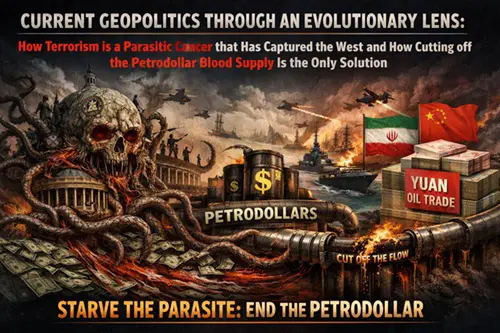 Introduction: When Explanation Becomes TotalIn his recent essay, “Current Geopolitics Through an Evolutionary Lens,” Joseph Dillard proposes a sweeping reinterpretation of global politics. Drawing on evolutionary biology, he argues that terrorism has evolved into a transnational parasitic system that has effectively captured Western governance. The petrodollar system, in this view, functions as the parasite's metabolic substrate, and dismantling it becomes the only viable path to global survival. The ambition is unmistakable: nothing less than a unified theory of contemporary geopolitics. Yet it is precisely this ambition that proves fatal. For what begins as an intriguing metaphorical reframing quickly hardens into a closed explanatory system—one that substitutes biological imagery for empirical analysis and coherence for evidence. From Metaphor to MechanismDillard's argument hinges on a conceptual slide that is easy to miss but decisive in its consequences. He begins with a familiar trope: terrorism as a “cancer.” This metaphor, as he correctly notes, has a long history in political discourse. However, instead of treating it as a rhetorical device, he reverses and literalizes it. The “cancer,” he claims, is not insurgent violence but the Western security apparatus itself. From there, the escalation is rapid. The system he describes acquires all the attributes of a biological parasite: a “cultural genome,” adaptive resilience, host manipulation, and evolutionary imperviousness. Intelligence agencies, financial institutions, and media organizations are fused into a single organism-like entity. But this is not analysis—it is reification. A metaphor has been promoted into an ontology. Biological concepts that require precise operational definitions—reproduction, selection, fitness—are applied to a loosely defined network with no measurable boundaries. The result is a conceptual hybrid that borrows the authority of science without adhering to its standards. The Petrodollar Thesis: Insight and OverreachThe most compelling part of Dillard's essay lies in his discussion of the petrodollar system. It is certainly true that the post-1970s linkage between oil markets and the U.S. dollar has conferred significant geopolitical advantages. Reserve currency status enables deficit financing, sanctions enforcement, and global influence. These are well-established features of the international monetary system. Dillard is also correct to observe that some geopolitical conflicts intersect with energy and currency interests. Cases such as Iraq, Libya, Venezuela, and Iran do raise legitimate questions about the relationship between resource control and military intervention. However, what begins as a plausible line of inquiry quickly becomes a monocausal explanation. Complex, multi-factor conflicts are reduced to a single driver: defense of dollar hegemony. Alternative explanations—regional politics, internal instability, ideological conflict—are acknowledged only to be dismissed. The pattern is asserted rather than demonstrated. This is not geopolitical analysis but confirmation bias. Evidence is selected to fit the theory, while counterexamples are ignored. The result is a narrative that appears coherent only because it has been stripped of competing variables. The Illusion of a Unified ActorPerhaps the most problematic feature of the essay is its construction of a single, coordinated “parasite” encompassing intelligence agencies, financial systems, media institutions, and academia. This entity is said to manipulate governments, shape public perception, and eliminate threats to its existence. No evidence is provided for such a level of coordination. Institutional complexity, internal conflict, and competing interests—all well-documented features of modern states—disappear. In their place stands a unified, intentional actor operating with strategic coherence across decades. This move collapses structural analysis into intentional monism. Instead of asking how systems function, the essay assumes that they intend. The language of biology—“the parasite ensures,” “the system adapts,” “the network eliminates”—conceals the absence of causal explanation. Agency is attributed where none has been demonstrated. A Self-Sealing FrameworkThe most revealing section of the essay is Dillard's argument that all avenues of reform are impossible. Elections are controlled, laws are ineffective, media is captured, and international institutions are compromised. There is, in effect, no external vantage point from which the system can be challenged. At this point, the theory becomes self-sealing. Any evidence against it can be interpreted as further proof of manipulation. Disagreement is not a counterargument but a symptom of capture. This is not theoretical robustness—it is epistemic closure. A valid explanatory framework must specify the conditions under which it could be wrong. Dillard's does not. It explains everything, and therefore nothing in a testable sense. Fragility and Omnipotence: A Structural ContradictionA striking inconsistency runs through the essay. On the one hand, the parasite is described as having near-total control over political, economic, and cognitive systems. On the other, it is portrayed as fragile—vulnerable to disruption by challenges such as yuan-denominated oil trade through the Strait of Hormuz. These claims are difficult to reconcile. A system capable of total control should not be so easily destabilized. Conversely, a system on the brink of collapse cannot plausibly exercise omnipotent coordination. The oscillation between these extremes reflects a deeper instability in the argument. Speculation as EscalationIn its later stages, the essay moves from speculative geopolitics to outright conjecture. The suggestion that Western intelligence agencies might “silently consent to nuclear annihilation” marks a decisive shift. What was presented as evolutionary analysis now reads as apocalyptic narrative. Such claims are not supported by evidence, nor do they follow logically from the preceding argument. They represent an escalation driven not by data but by the internal momentum of the framework itself. Once a system is construed as both omnipotent and malign, extreme conclusions become almost inevitable. Evolutionary Language Without Evolutionary MethodIronically, the essay's invocation of evolutionary theory is its weakest element. Genuine evolutionary analysis requires: • clearly defined units of selection • mechanisms of variation and inheritance • empirically observable fitness outcomes None of these are present. The “parasite” does not reproduce in any identifiable way, nor can its “fitness” be measured. Evolutionary terminology is used metaphorically, but the argument depends on it being taken literally. This is not an evolutionary account of geopolitics. It is a geopolitical narrative clothed in evolutionary language. Conclusion: The Seduction of Total ExplanationDillard's essay is rhetorically powerful because it offers what many analyses do not: total coherence. Every event fits into a single explanatory framework. Every contradiction is resolved in advance. Every objection becomes evidence. But this coherence is purchased at the cost of rigor. Metaphor replaces mechanism, assertion substitutes for evidence, and complexity is reduced to a single hidden agent. The result is not a deeper understanding of geopolitics but a closed interpretive system that resists correction. In this respect, the essay mirrors the very tendencies it seeks to critique. Where some versions of Integral Theory overextend spirituality into science, Dillard overextends biology into geopolitics. Both succumb to the same temptation: the desire for a theory that explains everything. And as always, when a theory explains everything, it explains too much. Epilogue: The Grain of TruthIt would be a mistake to dismiss Dillard's essay outright. Its power does not lie merely in its excesses, but in the fact that it builds upon several recognizably real features of contemporary geopolitics—features that are often underplayed or compartmentalized in mainstream analysis. First, the geopolitical significance of the U.S. dollar is undeniable. The postwar financial architecture, and especially the evolution of the petrodollar system, has granted the United States structural advantages that extend well beyond ordinary economic power. The ability to finance deficits, enforce sanctions, and shape global liquidity conditions gives monetary policy a geopolitical reach that is only imperfectly acknowledged in public discourse. Dillard is right to insist that currency hegemony is not neutral, and that it can be wielded coercively. Second, the intersection of energy, finance, and military power is real, even if not monocausal. Conflicts involving major oil-producing regions—whether in Iraq, Libya, or Iran—cannot be understood without reference to resource flows and strategic positioning. While Dillard reduces these complexities to a single explanatory variable, his emphasis does point to a dimension that deserves sustained attention rather than dismissal. Third, modern governance systems do exhibit forms of structural inertia and elite filtering. Political leadership is rarely drawn from outside established networks of influence, and media ecosystems can reinforce dominant narratives while marginalizing dissenting perspectives. These dynamics fall far short of total “capture,” but they do complicate any naïve faith in fully open, self-correcting democratic processes. Finally, the broader intuition that large-scale systems can develop self-reinforcing dynamics—appearing to act “as if” they have agency—is not entirely misplaced. Institutions, once established, generate path dependencies, feedback loops, and survival logics that constrain individual actors. Describing such systems in organic or evolutionary terms can, at a metaphorical level, illuminate these dynamics, even if it cannot substitute for precise analysis. These elements form the kernel of plausibility within Dillard's argument. They explain why the essay resonates, even as its conclusions overreach. The problem is not that it identifies patterns where none exist, but that it amplifies them into a totalizing framework that excludes competing explanations and resists empirical qualification. In the end, the challenge is to preserve these insights without succumbing to the gravitational pull of grand unification. Geopolitics is not governed by a single hidden organism, nor reducible to a single causal mechanism. It is a field of interacting systems—economic, political, cultural—each with its own dynamics and constraints. Recognizing the partial truths in Dillard's account is therefore not a concession to his conclusions, but a reminder that even the most overextended theories often begin with something real.
Widget is loading comments...
|