|
TRANSLATE THIS ARTICLE
Integral World: Exploring Theories of Everything
An independent forum for a critical discussion of the integral philosophy of Ken Wilber
 Dr. Joseph Dillard is a psychotherapist with over forty year's clinical experience treating individual, couple, and family issues. Dr. Dillard also has extensive experience with pain management and meditation training. The creator of Integral Deep Listening (IDL), Dr. Dillard is the author of over ten books on IDL, dreaming, nightmares, and meditation. He lives in Berlin, Germany. See: integraldeeplistening.com and his YouTube channel. He can be contacted at: joseph.dillard@gmail.com Dr. Joseph Dillard is a psychotherapist with over forty year's clinical experience treating individual, couple, and family issues. Dr. Dillard also has extensive experience with pain management and meditation training. The creator of Integral Deep Listening (IDL), Dr. Dillard is the author of over ten books on IDL, dreaming, nightmares, and meditation. He lives in Berlin, Germany. See: integraldeeplistening.com and his YouTube channel. He can be contacted at: joseph.dillard@gmail.com
SEE MORE ESSAYS WRITTEN BY JOSEPH DILLARD Current Geopolitics Through an Evolutionary LensHow Terrorism is a Parasitic Cancer that has Captured the West and How Cutting off Its Petrodollar Blood Supply Is the Only SolutionJoseph Dillard / ChatGPT
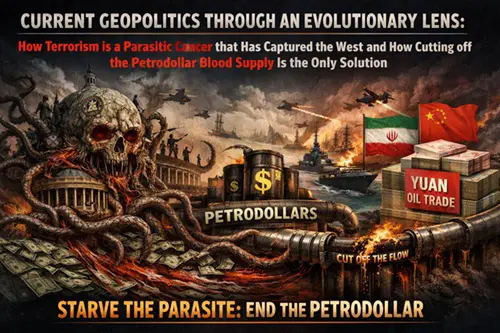 This essay applies an evolutionary framework to contemporary geopolitics, arguing that terrorism has evolved from a tactic used against states into a phenomenon that has captured the machinery of Western governance itself. Drawing on biological analogies of parasitism, cancer, and host manipulation, I contend that the petrodollar system constitutes the metabolic substrate sustaining this transnational network. Historical patterns, Iraq (2003), Libya (2011), Venezuela (2017–present), and Iran (2026), reveal that challenges to dollar hegemony invite regime-change operations. The recent Iranian demand for yuan-denominated oil transit through the Strait of Hormuz represents the most direct attack on this system to date. If terrorism has indeed captured the state, then reform from within is impossible; the only remaining solution is to cut off the parasite's food supply by dismantling the petrodollar. Beyond Conventional Geopolitical AnalysisSince sometime before the initiation of the Ukraine war, that is, since 2021, if not well before, I have followed not only mainstream but alternative media sources, both western and non-western. The landscape of geopolitical commentary is crowded with voices, Mearsheimer, Escobar, Sachs, Ritter, Hedges, Col. Lawrence Wilkerson, Larry Johnson, and many others, each offering valuable insights into the machinations of power. Yet even the most incisive analysts tend to focus on symptoms rather than the underlying pathology. They dissect great power rivalries, the tactics of Zionism, the excesses of oligarchic capitalism, the machinations of the Davos set, or the personalities of individual leaders. All of these, I submit, are distractions, hosts upon which a more fundamental entity feeds. What happens when we step back and view the global system through an evolutionary lens? What if the appropriate framework is not political science but biology, specifically, the study of parasites, cancers, and the dynamics of host manipulation? This essay attempts such an analysis, drawing on the work of those who have applied evolutionary thinking to international relations and those who have traced the metaphorical framing of terrorism as disease. It proceeds from a central thesis: *”Terrorism has evolved from a tactic used against states into a transnational network that has captured the machinery of Western governance itself, and the only viable intervention is to cut off its metabolic substrate, the petrodollar system.” Part I: The Evolutionary Framework – From Metaphor to MechanismThe Cancer Metaphor and Its LimitsFor more than a century, Western discourse has framed insurgent violence as a disease. As Anjuli Fatima Raza Kolb documents in her sweeping study, Epidemic Empire, the trope of "terrorism as cancer" emerged in responses to the Indian Mutiny of 1857 and has persisted through to the post-9/11 era.[1] The metaphor serves a clear political function: it delegitimizes opponents as pathological, as something to be excised rather than engaged. But what if the metaphor has become reality in reverse? What if the cancer is not the insurgent groups fighting Western hegemony, but the Western security apparatus itself, a malignancy that has grown beyond control, metastasized across borders, and now consumes the host that spawned it? Evolutionary Foundations of Human ConflictEvolutionary theory offers a robust framework for understanding human conflict. As Bradley Thayer demonstrates in Darwin and International Relations, humans wage war for reasons predicted by evolutionary theory, to gain and protect vital resources, but also for the psychologically stimulating effects of combat.[2] Xenophobia and ethnocentrism, Thayer argues, evolved as adaptive traits in ancestral environments but persist as dangerous legacies in the modern world. Robert Sapolsky's work on primate behavior adds crucial nuance: while aggression has genetic roots, even intensely violent species can learn more peaceful behaviors through cultural exposure. The Forest Troop of baboons Sapolsky documents, had their aggressive tendencies ameliorated after contact with a more peaceful troop. The implication is profound: if violent tendencies can be mitigated in baboons through cultural transmission, perhaps human violence, including state-sponsored terrorism, can be addressed through analogous mechanisms. But this requires recognizing the problem in biological terms, not merely political or economic ones. The Parasite That Consumes Its HostWe can distinguish between host-preserving parasites like tapeworms, which evolve to keep their host alive, and host-killing parasites like the jewel wasp, which paralyzes a cockroach so its larva can consume it alive. The transnational network I am describing, comprising elements of the CIA, MI6, Mossad, and their associated financial and media organs, belongs to the latter category. The trans-national terrorist organizations are the parasites and we are the cockroaches. Consider these characteristics: • Distinct genetic identity: The network possesses a "cultural genome", a replicating set of doctrines, loyalties, and operational methods that persist across generations of personnel. • Coevolution with the host: It evolved alongside the nation-state system, exploiting its structures while appearing to serve them. • Manipulation of host behavior: It controls governments, media, and financial institutions, shaping policy to serve its survival rather than national interests. • Transnational transmission: Like a metastasizing cancer, it spreads to new hosts. Color revolutions, regime-change operations, and economic warfare export its methods globally. • Evolutionary imperviousness: It adapts to threats, eliminates opponents who threaten its existence, and outlasts individual regimes. This network presents itself as serving the states that spawned it, the United States, the United Kingdom, Israel. But the relationship has inverted. These agencies now manipulate their nominal masters, ensuring that political leaders who threaten the network's interests are removed, whether through assassination, scandal, or electoral manipulation. The killing of Iranian officials, most recently Larijani, is merely the visible surface of a deeper dynamic. Part II: The Petrodollar as Metabolic SubstrateThe Architecture of American Financial PowerTo understand how this network sustains itself, one must understand the petrodollar system. Born from the Nixon shock of 1971 and formalized in the 1974 U.S.-Saudi agreement, this arrangement ensures that global oil trade is denominated in U.S. dollars. Because oil is the world's most traded commodity, every nation that imports energy must first acquire dollars. Central banks hold dollar reserves for precisely this reason. The dollar's status as the world's primary reserve currency flows directly and mechanically from oil. This system confers what the French famously called an “exorbitant privilege”. The United States can finance chronic deficits, project global influence, and weaponize financial sanctions because the world's demand for dollars is structurally guaranteed. Petrodollars are recycled into U.S. Treasuries, financing American consumption and military spending. For decades, this system rested on trust. The dollar was liquid, stable, and widely accepted, the natural center of international trade. This was soft power in its most effective form. But over the last two decades, something has shifted. The dollar has become an instrument of geopolitical coercion. Financial sanctions, freezing of sovereign reserves, asset blockades, and expulsion from the SWIFT payment system have revealed that the dollar system is not neutral. When trust erodes and coercion remains, a system enters a defensive phase. And defensive systems are fragile.[3] The Pattern: Challenge the Petrodollar, Invite Regime ChangeThe historical record reveals a consistent pattern. Nations that challenge dollar hegemony face military action aimed at regime change or decisive weakening. Consider the evidence:
Critics rightly note that multiple factors drive these conflicts, WMD fears, human rights concerns, regional power balances. Yet no similar regime-change pressure has been applied to Saudi Arabia or other Gulf states that faithfully recycle petrodollars. The correlation is unmistakable: oil's pricing rests on compliance; non-compliance invites bombs. This is not conspiracy but observable geopolitical logic. As retired Lieutenant General PJS Pannu writes, the “oil-bomb relationship” has shaped most wars over recent decades.[4] The 2026 Iran war is not an aberration but the latest chapter in the decades-long defense of the petrodollar order. Part III: The Yuan Gambit – Iran's Strategic InnovationThe Strait of Hormuz as Financial WeaponThe February–March 2026 U.S.-Israeli strikes on Iran marked a significant escalation, yet Iran's response has been strategically sophisticated. Rather than meeting military force with symmetrical force, a contest it cannot win, Tehran has targeted the metabolic substrate itself. On March 13, 2026, a senior Iranian official told CNN that Tehran is considering allowing a limited number of oil tankers through the Strait of Hormuz, but only if cargo is traded in Chinese yuan, not U.S. dollars. The condition, if formalized, represents the most significant challenge to the petrodollar system in its fifty-two-year history. The Strait of Hormuz is not merely a maritime chokepoint; it is the world's most critical energy artery, through which approximately 20% of global oil supplies transit. Since March 1, 2026, following the U.S.-Israeli strikes, Iranian forces have effectively closed the strait, attacking vessels and making transit prohibitive for commercial operators. War-risk insurance has become prohibitive. At least 16 vessels have been attacked. The Architecture of a Parallel SystemWhat makes the yuan condition structurally significant is its mechanism. Tehran is not merely proposing bilateral trade in yuan. Such trade already occurs with Russian and Iranian crude. It is proposing that “access to the world's most critical energy chokepoint be conditional on currency denomination”. The practical consequence, if even partially adopted, would be a bifurcated global oil market: yuan-denominated barrels flowing through Hormuz for those willing to pay in China's currency, dollar-denominated barrels rerouted at significant additional cost for those who are not. The war premium that Western energy importers already absorb becomes structural rather than temporary. Crucially, the architecture for such a parallel system already exists and is already operating. Since February 28, between 11.7 and 16.5 million barrels of Iranian crude have transited the Strait to China via shadow fleet under Iranian Revolutionary Guard Corps protection. China pays in yuan. China's tankers move freely. The yuan-denominated energy corridor is not hypothetical; it is operational. Selective passage is already reality. On March 5, the IRGC announced it would keep the strait closed only to ships from the U.S., Israel, and their Western allies. Subsequent passages have been approved for Turkish, Indian, and even Saudi vessels. The yuan condition would formalize the criteria. Washington's DilemmaThe United States faces choices, none comfortable. Forcing the strait open militarily, the option Trump has signalled, would require sustained naval operations against an adversary with mines, shore-based missiles, submarines, and drone swarms in confined waters. The Congressional Research Service noted that while the U.S. military likely has the capacity to counter Iranian forces, such an effort would take days, weeks, or months. Every week of delay is a week in which energy-importing nations confront the practical reality of the yuan alternative. India, Turkey, and Gulf states are already navigating that calculus. The East-West pipelines to Yanbu and Fujairah cannot absorb the full volume that previously transited Hormuz, a deficit of approximately 12 million barrels per day. Will the Houthis shut down that option? The arithmetic of energy desperation is working in Iran's favor. This is not the collapse of the petrodollar system. The dollar remains the world's primary reserve currency, underpinned by capital market depth and institutional trust that no single crisis can dissolve. What the Hormuz crisis represents is the most operationally specific challenge to dollar energy dominance since the system was established. Previous de-dollarization discussions were theoretical. This one comes with a chokepoint, a shadow fleet, an operational payment system, and a geopolitical crisis with no clear resolution. Part IV: If the State Is Captured, Reform Is ImpossibleThe Evolutionary Imperviousness of the ParasiteReturning to the evolutionary framework, we must confront a chilling implication. If the transnational network I have described has indeed captured the machinery of governance, militarily, economically, and in the sphere of media, then traditional avenues of reform are foreclosed. Consider the logic:
This is evolutionary imperviousness. The terrorist cultural-social parasite has achieved what no biological parasite can: it has learned to manipulate the host's perception of reality, ensuring that the host does not recognize the threat. Populations are conditioned to support or ignore the system's crimes. The parasite shapes the very categories through which reality is interpreted. Why the Petrodollar Is the Critical VulnerabilityIf the parasite controls the mechanisms of political change, the only remaining intervention is to cut off its metabolic substrate. The petrodollar is that substrate for several reasons: • Military funding: The U.S. military budget, over $800 billion annually, is financed by the ability to issue the world's reserve currency. This funds the global network of bases, special operations, and intelligence agencies that constitute the parasite's coercive arm. • Sanctions enforcement: The U.S. Treasury's ability to cut any entity off from the dollar system is the primary mechanism for disciplining states that resist. This is economic warfare. • Media capture: Major media outlets are owned by corporations that benefit from the current financial system. Their editorial lines reflect the interests of the system that sustains them. • Cognitive infrastructure: Universities, think tanks, and NGOs are funded by foundations and grants that ultimately derive from the same financial system. This shapes the intellectual environment that produces "expert consensus." The petrodollar is not merely a currency arrangement; it is the bloodstream through which resources flow to every organ of the parasite's body. Cut it, and the organs starve. Part V: The Only Solution – Starving the ParasiteThe Strategic Logic of De-dollarizationIf the analysis above holds, then the only viable strategy is to attack the resource flow directly. This is precisely what Iran's yuan condition attempts, and what China has been building toward through bilateral currency swaps, the CIPS payment system, and the Belt and Road Initiative. China does not seek to overthrow the existing order overnight. Rather, it seeks to crack it from within, offering alternatives that, bit by bit, reduce structural dependence on the dollar. Bilateral trade in yuan, the CIPS system, the Asian Infrastructure Investment Bank, these provide options where previously there were none. When mid-level oil exporters identify paths toward monetary diversification, the strategic calculation changes. Diversifying is not rebelling; it is protecting oneself. Each energy contract outside the dollar is not a rupture, but it is a precedent. And precedents, when they accumulate, transform entire systems. The European DimensionEurope is already making economic overtures to China. Will China require that those transactions be denominated in yuan? It will not be long before it is forced, horror of horrors, to negotiate LNG and oil sales from Russia. This is because there sources will not be available to it in sufficient quantities to forestall the sinking of their economies into a deep depression. Will Russia require those transactions be denominated in Rubles? The Risks and UncertaintiesStarving the parasite carries immense risks. A cornered parasite fights desperately. The period of petrodollar collapse could see unprecedented military aggression, including nuclear threats. The global economy runs on dollars; collapse of the system would cause immense suffering, which the parasite would exploit to rally support. No alternative system is ready to replace it fully, the yuan is not yet a fully liquid, trusted reserve currency. The parasite might find new metabolic pathways, cryptocurrencies, barter systems, alternative financial architectures. Evolution does not stop. Yet the alternative, continued submission to a host-killing parasite, is ultimately fatal. The parasite cannot be reformed, only removed. Will a transition from the petrodollar survive nuclear attacks by Israel? If that happens, will the US reign in Israel? My theory is that the parasitical terrorist network is fundamentally multi-national and therefore the CIA and MI6 will silently consent to nuclear annihilation. The US and British governments will wring their hands and then sit on them. Conclusion: The Host Must Survive the CureThe uncomfortable question is unavoidable: what happens when a currency is maintained not by economic strength but by the fear generated by leaving it? Monetary history is clear: when trust turns into coercion, the system enters a defensive phase. And sooner or later, someone dares to say enough, not out of ideology, but out of necessity. The Iranian gambit at Hormuz may prove to be that moment. It is not a missile strike, but it is more consequential than any missile. It targets not military assets but the financial architecture that underpins American global power. The bombs are visible; the financial architecture being renegotiated behind them is not. If terrorism has indeed captured the state, if the transnational network I have described now controls the machinery of governance in the West, then reform from within is a fantasy. The only remaining intervention is to cut off the parasite's food supply. The petrodollar is that supply. Its dismantling, however painful, is the only path to host survival. The question is not whether the host can survive the parasite, but whether the host can survive the cure. That is the evolutionary fitness test for our species. NOTES
Comment Form is loading comments...
|