|
TRANSLATE THIS ARTICLE
Integral World: Exploring Theories of Everything
An independent forum for a critical discussion of the integral philosophy of Ken Wilber
  Frank Visser, graduated as a psychologist of culture and religion, founded IntegralWorld in 1997. He worked as production manager for various publishing houses and as service manager for various internet companies and lives in Amsterdam. Books: Ken Wilber: Thought as Passion (SUNY, 2003), and The Corona Conspiracy: Combatting Disinformation about the Coronavirus (Kindle, 2020). Frank Visser, graduated as a psychologist of culture and religion, founded IntegralWorld in 1997. He worked as production manager for various publishing houses and as service manager for various internet companies and lives in Amsterdam. Books: Ken Wilber: Thought as Passion (SUNY, 2003), and The Corona Conspiracy: Combatting Disinformation about the Coronavirus (Kindle, 2020).
Check out my other conversations with ChatGPT The Burden of DepthA Reply to Kazlev's 'Metaphysical Justification and the Limits of Flatness'A Further Reply to KazvlevFrank Visser / ChatGPT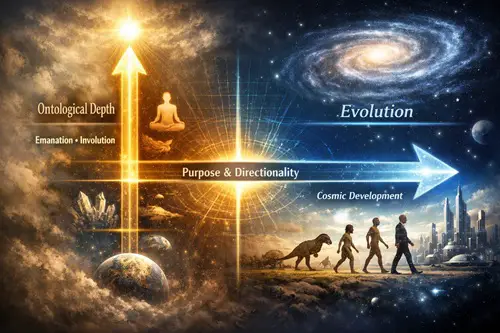 Alan Kazlev's latest response, “Metaphysical Justification and the Limits of Flatness,” further clarifies the nature of our disagreement. He now emphasizes that his proposal is not a scientific hypothesis but a metaphysical interpretation judged by coherence, breadth, and phenomenological adequacy rather than empirical prediction. This clarification is useful. Yet it also reveals more clearly where the debate actually lies. The question is no longer whether his “vertical axis” should be tested like a physical mechanism. The question is whether there are sufficient philosophical reasons to believe that such an ontological dimension exists at all. Kazlev argues that “flat naturalism” should not be treated as the default tribunal before which richer ontologies must justify themselves. But the issue is not a cultural preference for thin ontology. It is a methodological principle: additional ontological commitments require additional justification. If one proposes that reality contains not only the processes described by science but also a further dimension of ontological depth orienting the cosmos toward value and inwardness, it is reasonable to ask why we should believe this to be true rather than merely imaginable. Metaphysical JustificationKazlev correctly notes that metaphysical systems are not evaluated solely by empirical prediction. They may also be judged by coherence, integrative power, and their ability to illuminate domains such as consciousness or value. This is uncontroversial. However, these criteria alone do not establish the reality of the entities or dimensions proposed. A metaphysical framework can be coherent, elegant, and integrative while still remaining speculative. Intellectual history is full of such systems. Their philosophical richness does not guarantee their ontological correctness. Kazlev's maximal metaphysics may indeed offer a suggestive synthesis of themes drawn from traditions associated with thinkers such as Plotinus, Sri Aurobindo, and Alfred North Whitehead. But synthesis alone is not evidence. The crucial question remains whether the vertical dimension he proposes corresponds to anything in reality beyond the interpretive lens through which we choose to view it. Kazlev suggests that naturalism itself adds ontology by assuming a “thinner” metaphysical picture. This is partly correct. Yet the difference between the two positions lies in the scale of commitment. A naturalistic framework attempts to explain the world using entities already supported by empirical investigation, whereas maximal metaphysics adds an additional structural dimension of reality that cannot be independently confirmed. The asymmetry therefore persists. The Orthogonality QuestionKazlev again defends the metaphor of orthogonality, emphasizing that it was meant to indicate analytically distinct dimensions rather than mathematically independent axes. He is right that philosophical discourse frequently relies on metaphors such as “depth,” “ground,” or “horizon.” Conceptual metaphors can illuminate real distinctions. Nevertheless, the difficulty remains that the metaphor does most of the argumentative work. To say that reality includes both temporal development and ontological depth sounds suggestive, but it does not by itself demonstrate that these are genuine dimensions of the cosmos rather than descriptive categories introduced by the philosopher. The distinction between process and significance, or between sequence and meaning, may reflect different ways of interpreting the same phenomena rather than different layers of reality. If orthogonality ultimately refers to conceptual irreducibility rather than ontological structure, the thesis becomes less a discovery about the universe and more a proposal about how to think about it. Directionality and Selective EmergenceKazlev also revisits the issue of cosmic directionality. He argues that maximal metaphysics does not claim universal ascent but rather identifies “privileged lines of emergence” in which complexity, consciousness, and reflective depth appear. The existence of such lines is not disputed. Life and mind have indeed emerged in certain regions of the cosmos. The question is whether these developments indicate a structural orientation of the universe itself. The observable record does not clearly support this interpretation. The overwhelming majority of cosmic processes exhibit no movement toward complexity or inwardness. Stars burn out, ecosystems collapse, and biological lineages repeatedly vanish. The emergence of consciousness appears to be a rare and contingent event within an otherwise indifferent universe. Kazlev suggests that focusing on those regions where life and value arise is not anthropocentric but philosophically appropriate. Yet this focus also risks drawing general conclusions about the structure of reality from the most exceptional phenomena within it. Structural Tendency and ValueKazlev acknowledges that the transition from structural tendency to value is among the more difficult aspects of his proposal. He argues that not all organized systems possess inwardness or significance, but that certain forms of complexity associated with life and consciousness may reveal an immanent purposive orientation. This is an intriguing possibility, but it remains largely conjectural. The existence of complex self-organizing systems does not automatically imply intrinsic value or purpose. Biological organisms exhibit goal-directed behavior because natural selection favors systems capable of maintaining themselves and reproducing. Whether such behavior reveals a deeper metaphysical orientation of the cosmos is a further step that requires stronger justification than has yet been provided. Kazlev's position is therefore not refuted by pointing out that some dynamical systems lack value. But neither is it established by observing that others display increasing complexity or reflexivity. The Limits of FlatnessKazlev frames the debate as a choice between two conceptions of philosophical adequacy. One accepts a largely flat cosmos in which value emerges locally through conscious agents. The other interprets mind, value, and purposive emergence as indicators of deeper ontological structure. Framed this way, the disagreement indeed remains open. Yet the mere possibility of a richer metaphysical interpretation does not itself constitute evidence for its truth. Philosophical imagination can generate many coherent pictures of reality. The challenge lies in distinguishing those that reveal something about the world from those that primarily reflect our desire to see meaning written into its structure. Kazlev's maximal metaphysics is undoubtedly richer in imaginative scope than a strictly flat ontology. But philosophical richness is not the same as ontological necessity. Until stronger reasons are offered for believing that the cosmos itself possesses the depth he describes, the vertical axis remains an interpretive option rather than a demonstrated feature of reality.
Widget is loading comments...
|