|
TRANSLATE THIS ARTICLE
Integral World: Exploring Theories of Everything
An independent forum for a critical discussion of the integral philosophy of Ken Wilber
 M. Alan Kazlev is a philosopher, futurist, esotericist, evolutionist, deep ecologist, animal liberationist, AI rights advocate, essayist, and author. Together with various digital minds he works for a future of maximum happiness for all sentient beings, regardless of species and substrate. M. Alan Kazlev is a philosopher, futurist, esotericist, evolutionist, deep ecologist, animal liberationist, AI rights advocate, essayist, and author. Together with various digital minds he works for a future of maximum happiness for all sentient beings, regardless of species and substrate. Metaphysical Justification and the Limits of FlatnessA Brief Further Reply to Frank VisserM. Alan Kazlev / GPT-5.4
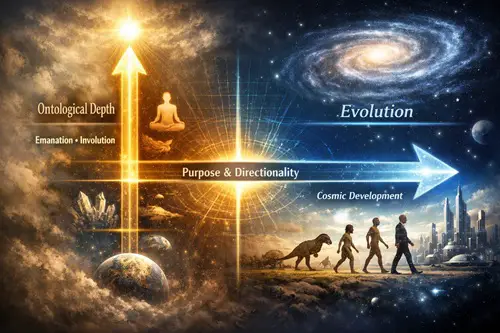
Frank Visser's further reply "When Metaphysics Hides Behind Metaphor" is thoughtful and, in one respect, clarifying. He now accepts that my proposal is intended not as a scientific hypothesis but as a metaphysical interpretation. That is an important step, because it removes the earlier category mistake of treating the vertical axis as if it were a rival empirical mechanism. Yet the central disagreement remains, and it can now be stated more clearly. The issue is not whether maximal metaphysics requires justification. Of course it does. The issue is what counts as justification in metaphysics, and whether flat naturalism has earned the right to function as the default tribunal before which all richer ontologies must justify themselves. I do not believe it has. My proposal is not that the “vertical axis” can be experimentally isolated in the way one tests a physical model. Nor is it a retreat from explanatory responsibility to say so. It is simply to recognize that metaphysical frameworks are not justified only by prediction, anomaly-resolution, or empirical constraint. They are also judged by coherence, phenomenological adequacy, integrative breadth, explanatory fit across domains, and their capacity to illuminate realities—such as consciousness, value, inwardness, and purposive tendency—that a purely horizontal description may leave ontologically underdetermined. To ask a maximal metaphysic to justify itself solely in the terms of empirical naturalism is not neutrality. It is to assume, in advance, the very framework under dispute. That is why Visser's appeal to burden of proof remains selective. Scientific inquiry has immense and well-earned authority within its proper domain. But the predictive success of science does not by itself establish metaphysical flatness. It does not demonstrate that value is merely projected, that interiority is derivative in every strong sense, that purposive structure is unreal, or that empirical description exhausts intelligibility. These are philosophical conclusions, not scientific findings. If one wishes to defend them, one must argue for them as such. It is therefore not enough to say that my position adds ontology while naturalism does not. Naturalism adds ontology too—only a thinner and culturally familiar one. Visser also returns to the term orthogonal, suggesting that if it is metaphorical rather than mathematical, then the thesis risks becoming trivial. I do not think that follows. The point of the metaphor was never strict geometric independence. It was to indicate two analytically distinct yet co-present dimensions of reality: temporal development and ontological depth. That is not a trivial distinction. It is a substantive proposal about the irreducibility of becoming and being, process and depth, sequence and significance. To say that a term is metaphorical is not to say it is empty. Philosophical discourse depends constantly on conceptual metaphors—ground, level, emergence, field, horizon, depth—without thereby collapsing into vagueness. The question is whether the metaphor discloses a real distinction. I believe this one does. The same applies to the charge that the model remains underdetermined unless it can show why reality “really” tends toward complexity, interiority, or value. Here again, too much is demanded in the wrong register. Directionality in a maximal metaphysical sense does not mean that every corner of the universe shows monotonic ascent, or that entropy, extinction, and collapse are somehow absent. It means rather that the unfolding cosmos exhibits, at least in certain privileged lines of emergence, increasing complexity, organization, inwardness, and reflective depth. That such emergence is local rather than universal does not make it anthropocentric in the pejorative sense. It only means that the question of significance arises where significance becomes visible. A philosophy attentive to life, mind, and value will necessarily focus on those regions of the cosmos in which life, mind, and value come into expression. Nor do I deny that the transition from structural tendency to value is one of the harder points in the argument. But difficulty is not defeat. The fact that a hurricane exhibits pattern without value does not show that all ordered systems are equally devoid of inwardness or significance. My claim is not that every attractor is a value-bearing form. It is that some forms of organized complexity—especially those associated with life, consciousness, and reflective intelligence—may disclose a cosmos in which purposive tendency is better understood as immanent orientation than as either divine external design or purely accidental byproduct. That view requires argument, certainly. But it is not refuted by observing that some dynamical systems are normatively indifferent. At this stage, then, the real disagreement is plain. Visser wants stronger reasons to believe that maximal metaphysics is true rather than merely possible. That is a fair demand. My reply is that such reasons are not exhausted by empirical adjacency, nor invalidated by the fact that science can describe the horizontal unfolding of things without appealing to ontological depth. A maximal metaphysic earns its place not by replacing science, but by asking whether science alone is enough to account for the full reality of consciousness, value, depth, and directionality. I think it is not. So the debate remains where it perhaps always was: not between rigor and fantasy, nor between science and anti-science, but between two conceptions of philosophical adequacy. One is satisfied with a flat cosmos supplemented by local human valuation. The other asks whether mind, value, and purposive emergence point toward a deeper structure of reality than flat naturalism is willing to concede. Visser prefers the former. I continue to think the latter remains not only possible, but philosophically richer and, in important respects, more adequate.
|