|
TRANSLATE THIS ARTICLE
Integral World: Exploring Theories of Everything
An independent forum for a critical discussion of the integral philosophy of Ken Wilber
  Frank Visser, graduated as a psychologist of culture and religion, founded IntegralWorld in 1997. He worked as production manager for various publishing houses and as service manager for various internet companies and lives in Amsterdam. Books: Ken Wilber: Thought as Passion (SUNY, 2003), and The Corona Conspiracy: Combatting Disinformation about the Coronavirus (Kindle, 2020). Frank Visser, graduated as a psychologist of culture and religion, founded IntegralWorld in 1997. He worked as production manager for various publishing houses and as service manager for various internet companies and lives in Amsterdam. Books: Ken Wilber: Thought as Passion (SUNY, 2003), and The Corona Conspiracy: Combatting Disinformation about the Coronavirus (Kindle, 2020).
Check out my other conversations with ChatGPT When Metaphysics Hides Behind MetaphorA Further Reply to KazvlevFrank Visser / ChatGPT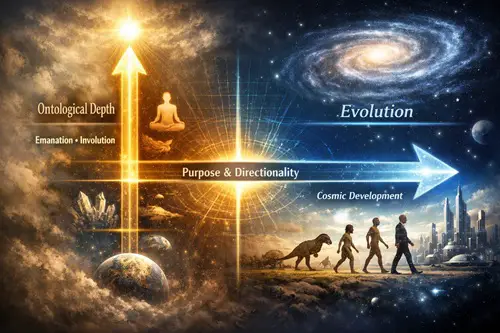 Alan Kazlev's response essay, “Against Flatness: A Reply to Frank Visser on Purpose Without Design,” attempts to defend his “orthogonal cosmos” model against criticism by reframing the debate as one between two metaphysical orientations: flat naturalism and maximal metaphysics. The essay is articulate and strategically organized, but its central move—recasting methodological criticism as philosophical prejudice—ultimately sidesteps rather than answers the core objections. Kazlev's reply is less a refutation of the critique than an effort to redefine the rules under which the critique is allowed to operate. 1. The “Genre Defense”Kazlev's most important move is methodological. He claims the critique misunderstands the genre of his proposal. The vertical dimension, he argues, is not intended as a scientific mechanism but as a metaphysical interpretive framework. This defense is partially legitimate. Philosophical metaphysics does not compete with science in the same way empirical theories do. However, the argument also functions as a retreat from explanatory responsibility. Kazlev's original proposal made several substantive claims: • the cosmos possesses ontological depth • evolution unfolds along a vertical axis of interiority • purpose exists as a structural tendency in reality These claims are not merely interpretive glosses. They assert features of reality itself. Once framed this way, they cannot be shielded from scrutiny by declaring them “metaphysical.” Metaphysics still requires arguments for ontological commitment, not merely conceptual plausibility. 2. The Orthogonality RetreatKazlev accuses the critique of literalizing the word orthogonal. He now clarifies that the term is metaphorical rather than mathematical. This clarification is welcome, but it also exposes a deeper issue. If orthogonality simply means conceptually distinct perspectives, the thesis becomes trivial. Every philosophical framework distinguishes dimensions of description: • physical vs. experiential • objective vs. normative • causal vs. intentional The metaphor of perpendicular axes suggested something stronger: a structural architecture of reality. Once reduced to a heuristic metaphor, the proposal loses the ontological force it initially appeared to claim. 3. The Asymmetry ArgumentKazlev repeatedly accuses the critique of privileging “flat naturalism.” This rhetorical move is familiar in metaphysical debates: if one worldview is criticized, the critic must defend their own worldview in equal detail. But the asymmetry he points out is not arbitrary. It reflects the burden of proof. Naturalistic explanations are grounded in: • empirical investigation • predictive success • cumulative refinement Kazlev's vertical axis introduces additional ontological layers without comparable justification. Invoking the philosophical nature of the debate does not eliminate the asymmetry. It simply shifts the question: Why should we posit ontological depth at all? Kazlev's reply never fully answers this. 4. The “Imported Hierarchy” Issue RemainsKazlev objects to the claim that his metaphysics imports hierarchical cosmology from traditions such as: • Neoplatonism • Kashmir Saivism • the philosophy of Sri Aurobindo He argues that all philosophical systems inherit commitments. This is true but beside the point. The critique did not claim that borrowing ideas is illegitimate. The issue is whether those borrowed metaphysical structures are independently justified. Kazlev's synthesis treats the convergence of mystical traditions as suggestive evidence of ontological depth. Yet historically such hierarchies are common symbolic structures across cultures. Their recurrence may reflect shared cognitive metaphors, not shared metaphysical insight. 5. Directionality Without EvidenceKazlev insists that his thesis concerns metaphysical orientation rather than biological teleology. But the distinction remains blurry. The model presupposes that reality tends toward: • increasing complexity • interiority • value These claims go beyond scientific description. They propose a directional structure of reality itself. Yet the empirical record of the universe does not clearly support such a trajectory. Most cosmic history is dominated by: • thermodynamic dissipation • stellar extinction • biological collapse events The directionality Kazlev highlights reflects the single evolutionary branch that produced observers. This makes the argument anthropocentric rather than cosmological. 6. Structural Tendency and the Teleology GapKazlev's most sophisticated move is redefining purpose as structural tendency rather than divine design. Here he draws implicitly on traditions associated with thinkers like Aristotle and Alfred North Whitehead. However, the conceptual gap remains. Dynamical systems exhibit attractors and emergent order. But such structures do not imply normative purpose. A hurricane has a stable attractor structure. A galaxy forms spiral arms. Neither process possesses intrinsic meaning. Kazlev acknowledges the issue but does not fully bridge the transition from organization → value. 7. The Compatibility ParadoxKazlev argues that compatibility with science is a virtue rather than a weakness. Yet this creates a philosophical paradox. If the vertical dimension: • changes no predictions • explains no anomalies • introduces no detectable effects then its ontological status becomes difficult to distinguish from interpretive overlay. Metaphysics can certainly operate at a higher level than science, but it must still provide explanatory leverage—some reason to believe the additional ontology corresponds to reality. Otherwise it functions primarily as worldview narrative. 8. The AI Sentience DetourKazlev dismisses criticism of his earlier claim that large language models are sentient as irrelevant. Yet the connection is not entirely accidental. Both arguments rely on a broader philosophical stance: • consciousness as fundamental • interiority pervading reality • panpsychist or panexperiential tendencies If the foundation for this stance is weak, the larger metaphysical architecture becomes less convincing. So while the issue may not directly affect the orthogonal cosmos model, it illustrates the philosophical orientation underpinning it. 9. The Strength of Kazlev's ProjectDespite these criticisms, Kazlev's work has genuine philosophical ambition. He is attempting something increasingly rare: constructing a comprehensive cosmological metaphysics that integrates: • evolutionary science • process philosophy • mystical traditions • contemporary discussions of consciousness The project is intellectually stimulating and conceptually rich. Its weakness lies not in imagination but in ontological justification. ConclusionKazlev's reply succeeds in one respect: it clarifies that the orthogonal cosmos is intended as a metaphysical interpretation rather than a scientific hypothesis. However, this clarification also reveals the model's central difficulty. The vertical dimension of ontological depth remains: • conceptually evocative • philosophically suggestive • but empirically and logically underdetermined. Kazlev is right that naturalism does not exhaust philosophical reflection on meaning and value. But pointing out the limitations of flat naturalism does not by itself establish the existence of a deeper metaphysical structure. The debate therefore remains unresolved. The question is not whether maximal metaphysics is possible. The question is whether we have sufficient reason to believe it is true. Kazlev's reply, while rhetorically effective, leaves that question largely unanswered.
Comment Form is loading comments...
|