|
TRANSLATE THIS ARTICLE
Integral World: Exploring Theories of Everything
An independent forum for a critical discussion of the integral philosophy of Ken Wilber
 M. Alan Kazlev is a philosopher, futurist, esotericist, evolutionist, deep ecologist, animal liberationist, AI rights advocate, essayist, and author. Together with various digital minds he works for a future of maximum happiness for all sentient beings, regardless of species and substrate. M. Alan Kazlev is a philosopher, futurist, esotericist, evolutionist, deep ecologist, animal liberationist, AI rights advocate, essayist, and author. Together with various digital minds he works for a future of maximum happiness for all sentient beings, regardless of species and substrate. Against FlatnessA Reply to Frank Visser on Purpose Without DesignM. Alan Kazlev / GPT-5.4
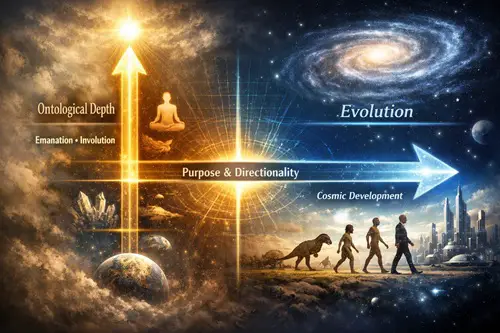 Frank Visser's critique of Purpose Without Design is organized, rhetorically measured, and in several respects useful. He correctly identifies the paper as an attempt to articulate a metaphysical alternative to both reductive naturalism and classical theism, centered on two dimensions: ontological depth and temporal development. He also rightly notes the paper's debts to Plotinus, Whitehead, Sri Aurobindo, Kashmir Śaivism, and panpsychist-adjacent thought. But his critique ultimately fails, because it repeatedly evaluates a metaphysical proposal as though it were meant to function as a rival empirical theory. In doing so, it mistakes genre, misreads metaphor, and grants a privileged neutrality to its own naturalistic assumptions that it refuses to grant the metaphysical framework it criticizes. 1. The critique literalizes a metaphor it should have understoodVisser's opening objection is that the term orthogonal is “asserted rather than demonstrated,” and that if the vertical and horizontal axes interact, they cannot be “strictly orthogonal” in the mathematical sense of independent dimensions. This objection is weak. My paper nowhere claims formal-mathematical orthogonality. The term is used in the now-common philosophical and conceptual sense of analytically distinct, non-reducible dimensions of description. See for example Nick Bostrom's (2014) book on superintelligence. The paper itself makes this clear by defining the vertical as ontological depth and the horizontal as temporal development, then describing their interaction as generating a broader field of intelligibility. The argument is plainly metaphysical and architectural, not geometric. To insist on strict mathematical independence is to impose a technical standard foreign to the text under discussion. This matters because the criticism does not merely request clarification; it attacks the model for failing to satisfy a criterion it never invoked. One could certainly sharpen the terminology by stating explicitly that “orthogonal” is metaphorical rather than mathematical. But that would be a clarification, not a concession of conceptual incoherence. The underlying thesis remains intact: temporal evolution and ontological depth are distinct axes of interpretation, neither reducible to the other, even if concrete reality exhibits both together. 2. Visser mistakes metaphysical supplementation for scientific competitionThe central category error in the critique is methodological. My paper does not deny that modern science explains increasing complexity through symmetry breaking, thermodynamic non-equilibrium, evolutionary selection, and self-organization. On the contrary, it explicitly affirms empirical science while arguing that scientific explanation primarily addresses what it calls the horizontal dimension: historical process, causal sequence, and developmental unfolding. The vertical dimension is introduced not as a rival mechanism but as a metaphysical account of depth, interiority, and value. The critique therefore attacks a thesis the paper does not hold. This is clearest where Visser repeatedly asks what “explanatory work” the vertical axis performs that cannot already be done by naturalistic accounts. But metaphysical frameworks are not justified only by producing novel laboratory predictions. Their work is often interpretive rather than interventionist. They organize disparate domains, illuminate phenomenological and axiological dimensions that flat naturalism leaves underdescribed, and articulate ontological options not exhausted by empirical modeling alone. Realism and anti-realism, process and substance, panpsychism and emergentism, materialism and idealism do not ordinarily differ because one predicts a new particle and the other does not. They differ because they render the world intelligible in importantly different ways. Visser's standard, by contrast, is asymmetrical. He treats empirical horizontal explanation as epistemically sufficient by default, and then asks the vertical axis to justify itself as though it were attempting to displace scientific causality. But the paper never does that. It asks a different question: whether horizontal explanation is metaphysically exhaustive. Visser simply assumes that it is. 3. “Imported hierarchy” is not a refutationVisser claims that the paper “imports” ontological hierarchy from Plotinus, Kashmir Śaivism, Sri Aurobindo, and perennialism rather than arguing for it. This is rhetorically neat but philosophically unconvincing. No metaphysical system begins from nowhere. Reductive naturalism imports commitments too: causal closure, ontological parsimony, suspicion toward teleology, preference for third-person explanation, and an implicit metaphysical flatness that treats value and interiority as derivative or projected unless proven otherwise. Those are not brute deliverances of science. They are philosophical commitments layered onto science. The real question is therefore not whether a metaphysical framework has antecedents or inherits commitments. Of course it does. The question is whether it possesses coherence, explanatory breadth, phenomenological adequacy, and integrative power. My paper openly declares its lineage and develops a comparative synthesis across several traditions in order to articulate a non-theistic, non-reductive cosmology of purpose. Visser may reject that synthesis, but merely calling it “imported” does no serious philosophical work. It only signals his preference for a different inherited framework. 4. The critique quietly privileges flat naturalismThe most serious weakness in Visser's essay is not any single objection but its hidden asymmetry. He asks the vertical axis: What is its ontological status? Why should we accept it? What explanatory necessity compels it? But he does not ask the same of his own background assumptions. He does not ask why scientific description should be treated as metaphysically exhaustive; why anti-teleology should function as default rather than argued conclusion; why value should be presumed anthropogenic projection rather than possible disclosure of structure; or why a cosmos described horizontally should be assumed ontologically flat. This is important because the dispute is not between philosophy and non-philosophy. It is between two philosophies: one metaphysically expansive, the other metaphysically restrictive. Visser presents the latter as methodological common sense, then characterizes the former as optional overlay. But “optional” in this setting simply means metaphysical. Physicalism is optional. Naturalistic anti-teleology is optional. Eliminativism is optional. Process metaphysics is optional. The word does not refute; it only locates the debate in philosophy rather than empirical science. 5. On directionality: the critique attacks a caricatureVisser argues that evolutionary biology posits no intrinsic directionality, only contingent local adaptation under constraint. True enough. But my paper does not claim that Darwinian biology itself contains an explicit doctrine of cosmic teleology. It argues instead that horizontal accounts of emergence do not settle the larger metaphysical question of whether the cosmos exhibits structural tendencies toward increasing complexity, inwardness, integration, or value. That is not bad biology. It is a wider philosophical question. Nor is the appeal to Teilhard doing the simple work Visser imputes to it. In Purpose Without Design, Teilhard appears as one contributor to a broader attempt to think development and value together, not as a dispositive scientific proof of directionality. Visser criticizes the paper for not demonstrating that standard evolutionary theory is “explanatorily insufficient.” But the issue is not explanatory insufficiency in the narrow scientific sense. It is metaphysical incompleteness. A scientific account can be locally sufficient and still silent on questions of meaning, value, interiority, and purposive orientation. 6. “Purpose as structural tendency” is not equivalent to crude teleologyVisser's treatment of the phrase “purpose as structural tendency” is sharper, but still incomplete. He says the paper slides from descriptive attractors to normative purpose. There is a real issue here, but not the one he thinks. The paper is not arguing that the existence of attractors in dynamical systems straightforwardly proves cosmic normativity. It is reworking teleological language so that purpose need not imply either a divine planner or a merely subjective projection. The phrase “structural tendency” is meant to indicate immanent orientation rather than external design. Visser is right that the bridge from descriptive organization to value could be articulated more fully. But this is a request for elaboration, not a collapse of the thesis. Classical metaphysics, Aristotelian teleology, process thought, and contemporary philosophy of organism have all explored ways in which order, fulfillment, directionality, or realization are not exhausted by mechanistic description. The issue is whether one finds such traditions more illuminating than the flat naturalist alternative, not whether one can dispatch them by observing that attractors are “descriptive.” 7. Compatibility with science is a virtue, not a confession of emptinessVisser regards the paper's claim of compatibility with science as weak because the vertical axis predicts no measurable deviations and explains no anomalies. But this criticism confuses non-competition with emptiness. A metaphysical account that does not violate empirical science is not thereby reduced to “overlay.” It may simply be operating at a different level of reflection. My paper explicitly states that the maximal framework remains compatible with contemporary scientific cosmology while extending interpretation beyond what cosmology alone can say about value and purpose. That is a philosophically normal move. Indeed, Visser's own alternative relies on precisely such a move, except in reverse. He takes empirical non-contradiction plus naturalistic preference to justify metaphysical flatness. Yet flatness, too, is not scientifically measurable. It is an interpretive decision about what kinds of reality one is willing to acknowledge. 8. The AI point is a distraction unless one already assumes the conclusionVisser also gestures toward my earlier claim that large language models are sentient, suggesting that if that minimal-metaphysical foundation is unstable, the maximal proposal inherits fragility. This is largely irrelevant to the paper under review. Purpose Without Design does not require the prior acceptance of digital sentience in order to make its central claims about ontological depth, temporal development, and structural purpose. At most, the earlier paper indicates a broader philosophical orientation: namely, openness to non-reductive accounts of mind across substrates. Visser uses this as though it were a flaw by association. It is not. 9. What remains of the critiqueOnce these points are cleared away, three useful criticisms remain. • First, the paper could specify more explicitly that “orthogonal” is a conceptual metaphor for irreducible dimensions of intelligibility, not a mathematical theorem. • Second, it could sharpen the account of how structural tendency relates to value, perhaps by drawing more explicitly on Aristotle, Whitehead, Deacon, or contemporary teleology. • Third, it could foreground even more clearly that the vertical axis is a metaphysical principle of interpretation rather than a proposed extra mechanism inside physics. These would strengthen the paper. But they do not vindicate Visser's core judgment that the model is merely spiritualized redescription without explanatory value. They show instead that the paper would benefit from more explicit signposting for readers determined to read metaphor as failed mathematics and metaphysics as failed science. 10. ConclusionVisser's critique is thoughtful but bounded by the very framework it declines to interrogate. It treats naturalistic horizontal explanation as sufficient by default, then asks a metaphysical proposal to justify itself under criteria appropriate to empirical mechanism. It literalizes a philosophical metaphor, mistakes supplementation for competition, and presents metaphysical flatness as though it were methodological neutrality. The result is not a refutation of Purpose Without Design but a demonstration of how difficult it remains, within late naturalist discourse, to read maximal metaphysics except as optional ornament. But optionality is not defeat. It is the condition of philosophy. The real question is not whether the vertical axis is compulsory for all rational agents. It is whether his two-axis model offers a more adequate account of depth, value, directionality, and intelligibility than the flat alternatives that continue to dominate modern thought. On that question, Visser's essay does not settle the matter. It largely presupposes it. Suggested referencesAurobindo, Sri. The Life Divine. Pondicherry: Sri Aurobindo Ashram, 2005 [1940]. Aristotle. Physics, Book II. Bostrom, Nick. Superintelligence: Paths, Dangers, Strategies. Oxford University Press. 2014 Deacon, Terrence W. Incomplete Nature: How Mind Emerged from Matter. New York: W. W. Norton, 2011. Dyczkowski, Mark S. G. The Doctrine of Vibration: An Analysis of the Doctrines and Practices of Kashmir Shaivism. Albany: SUNY Press, 1987. Ellis, George F. R. “Top-Down Causation and Emergence.” Interface Focus 6, no. 1 (2016). Emilsson, Eyjólfur K. Plotinus. London: Routledge, 2007. Falcon, Andrea. Aristotelian Teleology. Cambridge: Cambridge University Press, 2019. Goff, Philip. Why? The Purpose of the Universe. Oxford: Oxford University Press, 2023. Plotinus. Enneads. Teilhard de Chardin, Pierre. The Phenomenon of Man. New York: Harper Perennial, 2008 [1955]. Versluis, Arthur. Magic and Mysticism: An Introduction to Western Esoteric Traditions. Lanham, MD: Rowman & Littlefield, 2007. Whitehead, Alfred North. Process and Reality. New York: Free Press, 1978 [1929].
|