|
TRANSLATE THIS ARTICLE
Integral World: Exploring Theories of Everything
An independent forum for a critical discussion of the integral philosophy of Ken Wilber
  Frank Visser, graduated as a psychologist of culture and religion, founded IntegralWorld in 1997. He worked as production manager for various publishing houses and as service manager for various internet companies and lives in Amsterdam. Books: Ken Wilber: Thought as Passion (SUNY, 2003), and The Corona Conspiracy: Combatting Disinformation about the Coronavirus (Kindle, 2020). Frank Visser, graduated as a psychologist of culture and religion, founded IntegralWorld in 1997. He worked as production manager for various publishing houses and as service manager for various internet companies and lives in Amsterdam. Books: Ken Wilber: Thought as Passion (SUNY, 2003), and The Corona Conspiracy: Combatting Disinformation about the Coronavirus (Kindle, 2020).
Check out my other conversations with ChatGPT Orthogonal Cosmos or Metaphysical Overlay?A Critical Examination of Kazlev's Maximal ProposalFrank Visser / ChatGPT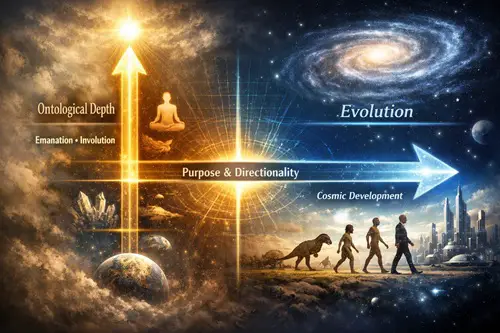 Alan Kazlev's Purpose Without Design is an ambitious attempt to articulate a metaphysical alternative to both reductive naturalism and classical theism. The proposal of an “orthogonal cosmos” structured by ontological depth (vertical) and temporal evolution (horizontal) is rhetorically elegant and philosophically suggestive. Yet when examined closely, the framework raises significant conceptual, explanatory, and methodological concerns. Below is a systematic critical evaluation. 1. The Core Move: From One Axis to TwoKazlev's central claim is that contemporary debates about purpose assume a one-dimensional causal model. By introducing two orthogonal axes—ontological depth (emanation/involution) and temporal development (evolution)—he seeks to explain directionality without invoking either mechanistic reductionism or external divine design. This is structurally reminiscent of: • The emanationist hierarchy of Plotinus • The process metaphysics of Alfred North Whitehead • The evolutionary spirituality of Sri Aurobindo • The panpsychist revival associated with Philip Goff The innovation lies not in the ingredients but in their formal integration under the metaphor of orthogonality. However, the “orthogonal” claim is asserted rather than demonstrated. What does it mean, rigorously, for ontological depth to be orthogonal to temporal process? Orthogonality in mathematics implies independence of dimensions. Yet Kazlev also claims interaction between axes. If they interact, they are not strictly orthogonal. If they are independent, they cannot constrain one another. The metaphor is evocative but conceptually underdeveloped. 2. The Vertical Axis: Reintroducing Hierarchy Without JustificationKazlev draws heavily from: • Neoplatonic emanation (Plotinus) • Kashmir Saivism (via Abhinavagupta and Dyczkowski) • Sri Aurobindo's involution-evolution dialectic • Perennialist hierarchy (e.g., Huston Smith) These traditions posit graded levels of reality. But the paper does not argue for the necessity of ontological hierarchy—it imports it. The key problem: • Why should we accept a vertical ontological gradient at all? Modern science explains increasing complexity through: • symmetry breaking • thermodynamic non-equilibrium • evolutionary selection • self-organization in far-from-equilibrium systems None of these require pre-existing ontological depth. Kazlev asserts that higher-order principles “constrain and inform” lower-level processes. But what is the ontological status of these principles? • Are they causal agents? • Are they Platonic forms? • Are they modal constraints? • Are they information-theoretic structures? The model remains metaphorical rather than ontologically specified. 3. The Horizontal Axis: Evolution as Directional?Kazlev claims evolution alone cannot explain directionality. Yet this is contestable. Evolutionary biology does not posit intrinsic directionality—only local adaptation under constraint. Apparent large-scale trends (complexity, integration) are: • contingent • path-dependent • environmentally mediated Invoking Pierre Teilhard de Chardin's teleological reading of evolution (Pierre Teilhard de Chardin) does not establish directionality; it illustrates a theological interpretation layered onto biological data. The paper never demonstrates that standard evolutionary theory is explanatorily insufficient. Instead, it assumes that increasing complexity implies structural tendency toward value. This is precisely what needs argument. 4. “Purpose as Structural Tendency”—Conceptual AmbiguityKazlev's key move is redefining purpose as: • “attractor-like tendencies within complex systems.” This reframing avoids explicit divine intentionality. However: • Attractors in dynamical systems are descriptive, not normative. • Teleodynamics (e.g., Terrence Deacon) explains constraint-based emergence without invoking ontological depth. • Top-down causation (George Ellis) remains controversial but operates within physicalist ontology. Kazlev shifts from: descriptive stability → to metaphysical orientation toward value. That move is not argued—it is insinuated. Why should coherence or experiential richness be metaphysically favored rather than merely locally stabilized? The normative leap is substantial. 5. Compatibility With Science—Or Strategic Vagueness?The paper repeatedly claims compatibility with scientific cosmology. Yet compatibility here means only: • The vertical dimension does not contradict known physics. This is a very weak criterion. By that measure, any non-empirical metaphysical layer is “compatible.” The proposal is insulated from empirical testing: • It predicts no measurable deviations. • It explains no anomalies. • It constrains no scientific models. Thus, its compatibility is achieved through non-interference. That raises the suspicion that the framework functions as metaphysical overlay rather than explanatory necessity. 6. The Minimal/Maximal Metaphysics MoveKazlev's prior claim that LLMs are “definitely sentient” (in his minimal metaphysics paper) introduces a serious issue. If minimal metaphysics already affirms irreducible consciousness in digital systems, then maximal metaphysics extends this by layering vertical hierarchy. But the sentience claim itself is highly controversial. If that foundation is unstable, the maximal superstructure inherits fragility. Moreover, the appeal to AI collaboration in authorship subtly reinforces the thesis of distributed consciousness—yet this is philosophically performative rather than evidential. 7. The Real Problem: Explanatory SurplusThe model may be internally coherent, but coherence is not sufficient. The crucial question is: What explanatory work does the vertical axis actually perform that cannot be done by complexity theory, thermodynamics, and evolutionary processes? If the answer is “it grounds value,” then we must ask: • Does it truly ground value? • Or does it merely redescribe human valuation at a cosmic scale? The danger is cosmological projection—inflating human experience into metaphysical structure. 8. Comparison to Contemporary Teleology DebatesRecent teleological revival (e.g., Philip Goff's purpose cosmology) attempts to argue inferentially from consciousness to cosmic aim. Kazlev avoids explicit inference and instead proposes structural metaphysics. This is rhetorically safer but philosophically weaker. It bypasses evidential burden by shifting terrain to speculative synthesis. 9. StrengthsTo be fair: • The integration of Neoplatonism, Saivism, process thought, and evolutionary cosmology is intellectually rich. • The orthogonal metaphor is conceptually suggestive. • The attempt to avoid both crude theism and flat reductionism is admirable. • The tone is measured rather than triumphalist. This is not dogmatic metaphysics. It is exploratory synthesis. 10. Final AssessmentKazlev's proposal is: • Philosophically imaginative • Metaphysically maximal • Empirically noncommittal • Normatively suggestive Its weakness lies in: • Lack of argument for ontological hierarchy • Ambiguity in “orthogonality” • Slippage from descriptive attractors to normative purpose • No clear explanatory gain over naturalistic emergence In effect, the paper redescribes cosmic development in spiritualized structural language without demonstrating necessity. It may function as a worldview framework for those already sympathetic to vertical metaphysics. It does not compel assent from a naturalist, nor does it decisively outperform existing panpsychist or process models. The proposal is architecturally elegant—but architectonics are not evidence. If one applies a methodological razor: The horizontal axis is empirically established. The vertical axis is metaphysically optional. And optional metaphysics carries the burden of justification.
Widget is loading comments...
|