|
TRANSLATE THIS ARTICLE
Integral World: Exploring Theories of Everything
An independent forum for a critical discussion of the integral philosophy of Ken Wilber
  Frank Visser, graduated as a psychologist of culture and religion, founded IntegralWorld in 1997. He worked as production manager for various publishing houses and as service manager for various internet companies and lives in Amsterdam. Books: Ken Wilber: Thought as Passion (SUNY, 2003), and The Corona Conspiracy: Combatting Disinformation about the Coronavirus (Kindle, 2020). Frank Visser, graduated as a psychologist of culture and religion, founded IntegralWorld in 1997. He worked as production manager for various publishing houses and as service manager for various internet companies and lives in Amsterdam. Books: Ken Wilber: Thought as Passion (SUNY, 2003), and The Corona Conspiracy: Combatting Disinformation about the Coronavirus (Kindle, 2020).
Check out my other conversations with ChatGPT
THE GAFNI CONTROVERSY
Love Guru Marc Gafni under Attack after NYT publications Does Love Really Make the World Go Round? Gafni Appears on Dr. Phil in Defence Against a "Smear Campaign" ChatGPT / Grok The Spiritual Vision of Marc Gafni On the Abuse Allegations Surrounding Marc Gafni Allegation and Denial in the Gafni Case Unveiling the Darker Side of Marc Gafni Reviewing the Soundness of Marc Gafni's Denials The Ethical Fault Line in Integral Spirituality A Cautionary Essay on Marc Gafni First Principles, First Scandals? A Philosophical Assessment of the 42 Propositions Review Essay: The Forty-Two Axioms of Inflation Individuality and the AbsoluteThe Spiritual Vision of Marc GafniFrank Visser / ChatGPT
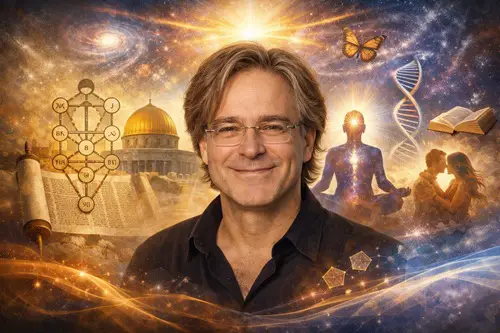 Marc Gafni (born Marc Winiarz in 1960) occupies a singular and contentious place in contemporary spirituality. A former Orthodox rabbi turned integral philosopher, he has sought to articulate one of the most ambitious syntheses of our time: a fusion of Jewish mysticism, nondual realization, developmental psychology, and evolutionary metaphysics. At the same time, his public life has been marked by serious ethical controversy, creating a tension between intellectual innovation and personal conduct that continues to shape his legacy. To understand Gafni is to hold together these two realities: the architect of “Unique Self” philosophy and the embattled teacher whose emphasis on eros and individuality has provoked both admiration and scrutiny. Jewish Roots: The Sacred ParticularGafni's early formation was steeped in Orthodox Judaism. Ordained as a rabbi and deeply trained in Talmud and Kabbalah, he developed a distinctive voice that sought to re-read classical Jewish sources through the lens of modern existential concerns. Even as he later left formal Orthodoxy, the Jewish imprint on his thought never disappeared. Central to that inheritance is a powerful affirmation of individual uniqueness. In Jewish theology, the human being is created b'tzelem Elohim—in the image of God—and rabbinic tradition holds that each soul has a unique portion of Torah to reveal. The Infinite expresses itself not through anonymous uniformity but through irreducible particularity. This theological emphasis on singularity would become the backbone of Gafni's later philosophy. His insistence that individuality is not an illusion but a sacred necessity reflects a distinctly Jewish anthropology, even when reframed in post-traditional language. After his years in Israel, Gafni pursued doctoral studies at Oxford, writing on mystical theology. The academic training sharpened his engagement with Western philosophy and comparative religion, preparing the ground for his eventual shift into global spiritual discourse. From Rabbi to Integral ThinkerIn the early 2000s, Gafni transitioned into broader spiritual and integral communities. He became associated with Ken Wilber and co-founded the Center for Integral Wisdom. His writings—especially Your Unique Self—positioned him as a key voice in what he called “evolutionary spirituality.” Gafni adopted Wilber's developmental scaffolding—levels, lines, and stages of consciousness—but sought to inject it with a more intimate theological core. Where Wilber offered architecture, Gafni offered narrative and fire. At the center of this reconfiguration stood two interwoven concepts: Unique Self and Eros. Unique Self: Personalizing the AbsoluteUnique Self theory represents Gafni's most distinctive contribution. Classical nondual traditions often culminate in realization of impersonal awareness—the “True Self” beyond ego. Gafni accepts this realization but argues that it is incomplete. Beyond impersonal awakening lies Unique Self: the recognition that the Absolute expresses itself through an irreducibly personal perspective. Individuality is not erased in enlightenment; it is transfigured. Each person, in this view, embodies: • A singular configuration of divine perspective • A unique erotic and moral calling • An indispensable angle through which reality knows itself This move attempts to resolve a modern tension. Many contemporary seekers resist traditions that dissolve individuality into undifferentiated consciousness. Gafni reassures them: awakening intensifies uniqueness rather than annihilates it. Here his Jewish inheritance becomes fully visible. The Infinite requires differentiated faces. The cosmos awakens through particular persons. Enlightenment is not disappearance but consecrated individuality. Strengths and VulnerabilitiesThe philosophical strength of Unique Self lies in its integration of nonduality and personal dignity. It affirms both transcendence and individuality without collapsing one into the other. It also activates ethics: if one's perspective is cosmically significant, responsibility follows. Yet the theory invites critique. Its ontological claims—that reality requires individuated perspectives for divine self-realization—are metaphysically bold but empirically unverifiable. Critics argue that it risks sacralizing modern Western individualism under mystical language. More structurally, when uniqueness is framed as cosmically indispensable, the boundary between authentic individuation and spiritual exceptionalism can blur. The danger is not conceptual incoherence but inflation: the spiritualization of subjectivity. Eros: Wilber and Gafni ComparedThe divergence between Gafni and Wilber becomes especially clear in their respective treatments of Eros. For Wilber, Eros is the upward drive of evolution—the self-organizing impulse toward greater complexity and consciousness. It functions within an integral architecture of holons and developmental stages. Though sometimes described poetically as “Spirit-in-action,” Wilber's Eros remains largely structural and impersonal. Gafni radicalizes the concept. In his formulation, Eros is not merely evolutionary ascent but intimate divine longing. It is the desire of the Infinite to express itself uniquely through each individual. Eros becomes personal, relational, even eroticized in tone. Where Wilber's Eros explains the Kosmos, Gafni's Eros narrates it as a love story. This tonal shift is significant. Gafni sacralizes intimacy, sexuality, and relational life as primary arenas of divine disclosure. Evolution is not simply complexity unfolding; it is longing seeking fulfillment through Unique Selves. The amplification carries both creative and ethical implications. It re-enchants embodiment and individuality. Yet it also intertwines eros, authority, and theology in ways that require careful discernment. Controversy and AccountabilityNo portrait of Gafni can omit the serious allegations of sexual misconduct that have followed him since the 1980s. These allegations led to loss of rabbinic standing and public distancing by former collaborators and institutions. Gafni has denied criminal wrongdoing and contested aspects of the accusations. Nevertheless, the controversies have profoundly shaped how his teachings are received. For critics, the ethical questions intensify scrutiny of a theology that elevates eros and personal uniqueness. For supporters, intellectual contributions remain distinct from personal failings. The tension remains unresolved, and it continues to frame his public presence. Legacy: A Theology of Sacred IndividualityMarc Gafni's work stands at a crossroads of ancient mysticism and contemporary selfhood. He attempted to solve a real cultural problem: how to affirm individuality without abandoning spiritual depth, and how to sacralize personal calling without collapsing into egoism. Whether Unique Self theory endures as a durable philosophical contribution or fades as an ambitious but speculative synthesis remains an open question. What cannot be denied is that Gafni forced a conversation about individuality and the Absolute—about whether enlightenment dissolves the person or divinizes it. In an age torn between narcissistic self-assertion and impersonal spiritual abstraction, his central claim remains provocative: The Infinite does not erase you. It requires you.
Widget is loading comments...
|