|
TRANSLATE THIS ARTICLE
Integral World: Exploring Theories of Everything
An independent forum for a critical discussion of the integral philosophy of Ken Wilber
  Frank Visser, graduated as a psychologist of culture and religion, founded IntegralWorld in 1997. He worked as production manager for various publishing houses and as service manager for various internet companies and lives in Amsterdam. Books: Ken Wilber: Thought as Passion (SUNY, 2003), and The Corona Conspiracy: Combatting Disinformation about the Coronavirus (Kindle, 2020). Frank Visser, graduated as a psychologist of culture and religion, founded IntegralWorld in 1997. He worked as production manager for various publishing houses and as service manager for various internet companies and lives in Amsterdam. Books: Ken Wilber: Thought as Passion (SUNY, 2003), and The Corona Conspiracy: Combatting Disinformation about the Coronavirus (Kindle, 2020).
Check out my other conversations with ChatGPT
ON SAM HARRIS
Mysticism Without Metaphysics Harris vs. Wilber on Mysticism Harris and the Four Atheist Horsemen Harris on Islam and Hamas The Western Superiority Debate Spirituality for Atheists Sam Harris vs. Ken Wilber on Mystical ExperienceWith a Consideration of Wilber's 'Post-Metaphysical' ClaimFrank Visser / ChatGPT
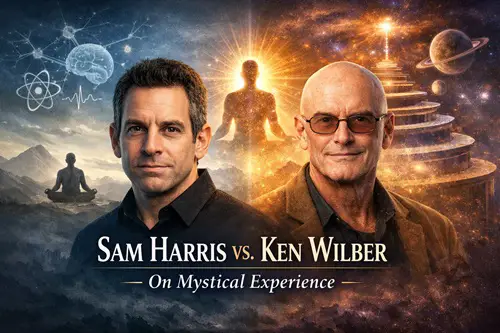 Sam Harris and Ken Wilber both take mystical experience seriously. Neither dismisses contemplative states as mere superstition, nor reduces them to pathology. Yet beyond this shared respect, their approaches diverge at nearly every philosophical juncture: metaphysics, epistemology, psychology, and their understanding of science. The difference is not merely stylistic; it concerns what mystical experience means and what explanatory burden it carries. 1. Ontological Commitments: Minimalism vs. Metaphysical ArchitectureHarris adopts a form of contemplative naturalism. Drawing on Buddhist phenomenology—especially Dzogchen—he treats mystical experiences as alterations in the structure of consciousness. The key insight he emphasizes is the illusory nature of the self: when attention is turned inward, no enduring subject is found. There are only appearances in consciousness—sensations, thoughts, moods—arising and vanishing. The “self” is revealed as a cognitive construct. Crucially, Harris does not treat this insight as evidence for a metaphysical superstructure. Nonduality does not imply cosmic purpose, evolutionary Eros, or higher ontological realms. It reveals something about the structure of subjective experience, not about the architecture of the universe. Wilber, in contrast, historically embedded mystical experience within a comprehensive metaphysical system. His Integral Theory situated contemplative states within hierarchical strata (gross, subtle, causal, nondual) that were treated as ontologically real levels of the Kosmos. Mystical experiences were taken as disclosures of higher realities and evidence for an evolutionary telos—Spirit unfolding. Where Harris tends toward ontological restraint, Wilber's earlier framework leaned toward ontological expansion. 2. Epistemology: First-Person Data vs. Spiritual RealismHarris treats contemplative insight as first-person empirical data. Meditation is a method for examining consciousness with disciplined attention. Its claims are testable—not in the third-person laboratory sense, but intersubjectively among trained practitioners. This stance parallels cognitive science: subjective reports are data about brain-mind processes, not privileged windows into metaphysical truth. Wilber's earlier epistemology was more ambitious, tending toward a form of spiritual realism: higher states of consciousness grant access to higher truths. Just as microscopes reveal microbial life inaccessible to ordinary sight, disciplined meditation reveals ontological depths inaccessible to untrained cognition. The result is a difference in the epistemic standing of mystical states: Harris sees them as informative about consciousness, Wilber (traditionally) saw them as informative about the structure of reality itself. 3. The Self: Illusion vs. Evolutionary VehicleHarris's central contemplative claim is that the self is illusory. The sense of being a thinker behind thoughts collapses under scrutiny. Liberation consists in recognizing that consciousness is already free of an internal homunculus. Wilber agrees that the egoic self is not ultimate. However, he embeds this within a developmental trajectory. The self evolves through stages—egocentric, ethnocentric, worldcentric, Kosmocentric. Mystical realization is the flowering of Spirit recognizing itself. The ego is transcended but also included in a larger unfolding. Thus Harris deconstructs the self; Wilber narrates its ascent. 4. Relationship to ScienceHarris positions himself firmly within scientific naturalism. Neuroscience, psychology, and evolutionary theory frame his understanding of contemplative states. Mystical experiences correspond to changes in neural activity and cognitive processing. No appeal to supernatural agency is required. Wilber, while claiming to integrate science, often extends beyond its methodological boundaries. His interpretation of evolution as driven by Eros—a spiritual force toward greater complexity and consciousness—moves into teleological metaphysics. This difference mirrors a broader tension: Harris treats science as epistemically primary; Wilber has presented science as one quadrant among others, none of which holds ultimate authority. 5. Therapeutic Pragmatism vs. Cosmic NarrativeFor Harris, the practical significance of mystical experience is psychological freedom: reduced suffering, diminished egocentricity, increased compassion. The stakes are existential and ethical, not cosmological. Awakening is about how experience unfolds in this moment. Wilber places mystical experience within a grand narrative of cosmic evolution. Enlightenment participates in the self-realization of Spirit. Individual transformation is nested within a metaphysical drama. Harris's approach is therapeutic and phenomenological. Wilber's is mythopoetic and architectonic. 6. Parsimony vs. System-BuildingAt a methodological level, Harris exemplifies parsimony. Mystical experiences are explained in terms of consciousness, cognitive construction, and neurobiology. No additional ontological layers are posited beyond what is necessary to account for the phenomenology. Wilber exemplifies system-building. Mystical states are integrated into a vast theoretical edifice—AQAL, developmental stages, involution and evolution, subtle and causal realms. The explanatory ambition is maximal. One might say Harris applies something akin to Ockham's Razor to spirituality, while Wilber treats mystical experience as license for metaphysical elaboration. 7. Wilber's “Post-Metaphysical” Claim: What It Means and Where It Is ValidIn some of his later works (e.g., later editions of A Brief History of Everything and various interviews), Wilber reframes Integral Theory as post-metaphysical. This claim, misunderstood by many critics, is not that metaphysics is irrelevant, but rather that: No metaphysical system can claim absolute primacy. Wilber acknowledges that any cosmology—Integral included—is a map, not the territory. He increasingly emphasizes the perspectival nature of all worldviews, including his own. The focus shifts from what is ultimately real to how different perspectives cohere. Rather than asserting that nondual states correspond to fixed ontological strata in a metaphysical cosmos, Wilber later emphasizes that such descriptions are interpretations—human conceptual frameworks imposed on experience. Mystical experience is no longer proof of metaphysical claims. Wilber increasingly frames mystical states as phenomenological loci that any worldview must account for, without giving those states automatic warrant for a grand ontological architecture (even though his own interpretive lens situates them in an Integral map). In this sense, Wilber's post-metaphysical claim is valid insofar as: • He concedes that metaphysical models—including his own—are constructed and fallible. • He stresses that no single worldview has privileged access to “ultimate reality.” • He places greater emphasis on methodological pluralism and the complementarity of perspectives rather than on metaphysical hierarchy as literal fact. Put differently: Wilber's later position acknowledges that metaphysics is an interpretive layer over first-person and third-person data, not a direct read-out of reality itself. That is a genuinely post-metaphysical move in the sense used by analytic philosophers (where “post-metaphysical” means refraining from asserting speculative ontological truths beyond what can be warranted by experience and reason). This places Wilber closer to a meta-ontological humility than earlier incarnations of Integral Theory strictly allowed. 8. Convergence and Irreducible DivergenceBoth thinkers reject naïve materialism. Both affirm that consciousness cannot be reduced to simple mechanistic caricatures. Both encourage contemplative practice. Yet their ultimate commitments still diverge: • Harris holds that mystical experience reveals the constructed nature of self and offers psychological insight grounded in naturalism. • Wilber—especially in his later, more reflective phases—frames mystical experience as a datum that any serious worldview must integrate, while conceding that metaphysical interpretations are perspectival, not conclusively assertable. Harris's mysticism remains within the bounds of disciplined phenomenology and scientific compatibility. Wilber's later mysticism situates itself within an Integral map that is self-aware of its metaphysical contingency. ConclusionThe contrast between Sam Harris and Ken Wilber on mystical experience reflects distinct temperaments within contemporary spirituality. Harris represents contemplative minimalism: mystical insight as psychological deconstruction within a naturalistic framework. Wilber, particularly in his later reflections, embraces a post-metaphysical integralism: mystical experience as a universal phenomenon that must be interpreted across multiple legitimate perspectives, with metaphysics treated as a constructed, fallible interpretive layer rather than an absolute revelation of cosmic strata. Both approaches preserve the profundity of contemplative experience. The difference lies in how each thinker situates that profundity within a worldview—one economizing on metaphysical claims, the other reframing metaphysics as pluralistic and perspectival rather than hierarchical and literal.
Widget is loading comments...
|