|
TRANSLATE THIS ARTICLE
Integral World: Exploring Theories of Everything
An independent forum for a critical discussion of the integral philosophy of Ken Wilber
  Frank Visser, graduated as a psychologist of culture and religion, founded IntegralWorld in 1997. He worked as production manager for various publishing houses and as service manager for various internet companies and lives in Amsterdam. Books: Ken Wilber: Thought as Passion (SUNY, 2003), and The Corona Conspiracy: Combatting Disinformation about the Coronavirus (Kindle, 2020). Frank Visser, graduated as a psychologist of culture and religion, founded IntegralWorld in 1997. He worked as production manager for various publishing houses and as service manager for various internet companies and lives in Amsterdam. Books: Ken Wilber: Thought as Passion (SUNY, 2003), and The Corona Conspiracy: Combatting Disinformation about the Coronavirus (Kindle, 2020).
Check out my other conversations with ChatGPT
REFLECTIONS ON BOBBY AZARIAN'S 2.0 MODEL:
Cosmic Teleology in Disguise: A Critical Examination A Summary of Bobby Azarian's Claims Accepting Azarian's Challenge to LLM's Review of The Transcendent Gödelian Theorem Review of The Perpetual Computation Abstract The Dan Brown of Complexity Science? The Revival of Teleology after Darwin Bobby Azarian and the Revival of Teleology after DarwinFrank Visser / ChatGPT
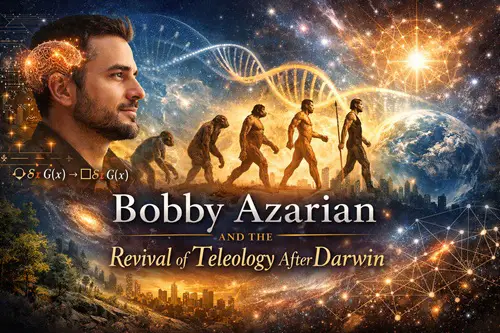 Bobby Azarian occupies a revealing position in contemporary intellectual culture. He presents himself as a scientifically informed thinker, fluent in evolutionary biology, complexity science, and cognitive neuroscience, yet his work ultimately gravitates toward a teleological interpretation of reality that Darwinian naturalism was supposed to have rendered obsolete. Azarian is neither a traditional theist nor a crude intelligent design advocate; rather, he belongs to a growing cohort of post-Darwinian thinkers who seek to re-enchant evolution without openly rejecting science. This makes him an instructive case study rather than an outlier. 1. The narrative ambitionAzarian's central ambition is narrative, not explanatory. In The Romance of Reality, the universe is cast as a cosmic love story: matter organizes into life, life into mind, and mind into reflective intelligence capable of grasping the whole. Evolution becomes not merely adaptive change under selective pressure, but a story with direction, meaning, and culmination. This places Azarian squarely within a long tradition: • German Idealism (Nature striving toward Spirit) • Hegelian historical teleology • Teilhard de Chardin's Omega Point • Process theology and cosmic mind theories What distinguishes Azarian is not the content of the story, but the strategic vocabulary used to tell it: emergence, complexity, self-organization, and information theory. These terms provide scientific respectability while leaving the underlying metaphysical thrust intact. 2. Teleology by redefinitionAzarian insists he is not reintroducing “purpose” in a naïve or supernatural sense. Instead, teleology is reframed as: • an intrinsic tendency toward complexity, • an attractor state in dynamical systems, • a lawful unfolding of possibility space. This is a familiar maneuver. Teleology is not denied; it is disguised as inevitability. The universe is said to “want” intelligence, not because of an external designer, but because intelligence is the natural endpoint of cosmic self-organization. Yet this move solves nothing. It merely shifts the burden of explanation from a personal God to an impersonal meta-principle whose necessity is asserted rather than demonstrated. 3. Gödel as metaphysical lubricantAzarian's appeal to Gödel's ontological proof is emblematic of this strategy. Gödel is not used carefully or technically, but symbolically. His presence signals that deep metaphysical claims can be made without embarrassment, provided they are dressed in formal logic. Gödel's proof becomes a suggestive analogy: • If maximal coherence implies necessary existence in logic, • then maximal intelligence may imply inevitability in nature. This is not an argument; it is a metaphorical transfer. Logical necessity is quietly conflated with cosmological destiny. Modal reasoning about abstract properties is repurposed to underwrite claims about evolutionary history. The effect is rhetorical rather than demonstrative: Gödel confers gravitas, not justification. 4. The unresolved problem of contingencyDarwin's most radical contribution was not evolution per se, but contingency. Life unfolds through accidents, extinctions, frozen paths, and historical bottlenecks. Intelligence is not a goal but a local solution—fragile, rare, and possibly ephemeral. Azarian acknowledges contingency at the micro level while denying it at the macro level. Evolutionary outcomes are said to be locally unpredictable but globally inevitable. This dual stance cannot be stabilized. Either: • intelligence is contingent, in which case no cosmic narrative follows, or • intelligence is necessary, in which case Darwinian mechanisms lose explanatory primacy. Azarian wants necessity without sacrifice, direction without design, meaning without metaphysics. The tension never resolves. 5. Comparison with Integral TheoryAzarian's position strongly parallels Ken Wilber's later work, despite stylistic differences. Both: • affirm evolution while spiritualizing its direction, • speak of emergence while implying inevitability, • reject traditional theism while preserving cosmic purpose, • appeal to elite scientific or philosophical authorities to legitimize metaphysical claims. The difference is tone, not structure. Where Wilber invokes mystical insight and developmental hierarchies, Azarian invokes complexity science and cosmic storytelling. In both cases, the metaphysical conclusion precedes the argument. This is why Azarian resonates so easily within integral-adjacent audiences: he offers transcendence without dogma and destiny without scripture. 6. Why Azarian is persuasiveAzarian's work appeals because it addresses a genuine discomfort. A purely naturalistic worldview can feel emotionally thin, narratively barren, and existentially indifferent. Azarian restores meaning by aestheticizing inevitability: the universe becomes a story that happens to include us. The danger lies precisely there. Meaning is imported by narrative coherence, not earned through explanatory rigor. The romance replaces the argument. 7. Conclusion: re-enchantment without accountabilityBobby Azarian should be understood as part of a broader post-secular re-enchantment movement: thinkers who accept the findings of modern science but refuse its metaphysical implications. Teleology returns under the banner of complexity; God returns as process; necessity returns disguised as emergence. Gödel, like Darwin, is not refuted but repurposed. From a naturalistic standpoint, Azarian's project is not a breakthrough but a regression—an elegant revival of pre-Darwinian intuitions using post-Darwinian language. The universe, once again, is said to be about something. And that “aboutness,” however poetically rendered, remains precisely what science has never shown.
Widget is loading comments...
|