|
TRANSLATE THIS ARTICLE
Integral World: Exploring Theories of Everything
An independent forum for a critical discussion of the integral philosophy of Ken Wilber
  Frank Visser, graduated as a psychologist of culture and religion, founded IntegralWorld in 1997. He worked as production manager for various publishing houses and as service manager for various internet companies and lives in Amsterdam. Books: Ken Wilber: Thought as Passion (SUNY, 2003), and The Corona Conspiracy: Combatting Disinformation about the Coronavirus (Kindle, 2020). Frank Visser, graduated as a psychologist of culture and religion, founded IntegralWorld in 1997. He worked as production manager for various publishing houses and as service manager for various internet companies and lives in Amsterdam. Books: Ken Wilber: Thought as Passion (SUNY, 2003), and The Corona Conspiracy: Combatting Disinformation about the Coronavirus (Kindle, 2020).
Check out my other conversations with ChatGPT The Return of the Pre/Trans FallacyHow Integral Theory Fell Victim to Its Own Diagnostic ToolFrank Visser / ChatGPT
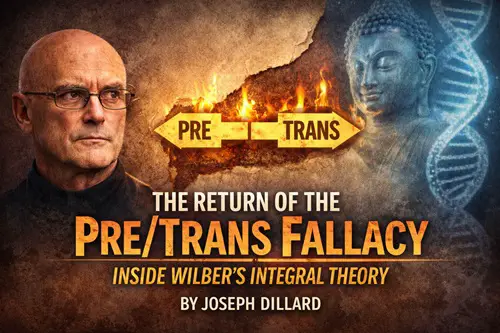 Ken Wilber's pre/trans fallacy was originally introduced as a critical instrument: a way to distinguish genuinely trans-rational insight from pre-rational belief dressed up in spiritual language. It was meant to protect serious spirituality from regression, romanticism, and epistemic sloppiness. Ironically, that very instrument now exposes a fault line running through Wilber's own work and the apologetic culture that has grown around it. Joseph Dillard's recent observation sharpens this irony to a point. His claim is not that Integral Theory is wrong because it is spiritual, mystical, or transpersonal. His claim is that Wilber and many of his defenders fail Wilber's own tests—and that this failure is structural, not accidental.[1] Wilber's Original StandardAt its core, the pre/trans fallacy warns against confusing:
The difference is not intensity of experience but epistemic discipline. Transpersonal insight does not bypass reason; it transcends and includes it. It passes what Wilber himself repeatedly called the “narrow gate” of rational scrutiny and shared validation. By this standard, mystical experience alone proves nothing. Without checks from logic, science, and collective inquiry, it remains psychologically powerful but epistemically private. When the Sniff Tests Are DeclinedDillard's critique focuses precisely here. Wilber's later metaphysical claims—particularly those involving Eros, Spirit-in-action, and the directionality of evolution—repeatedly fail what even sympathetic readers would recognize as basic “sniff tests”:
At the same time, these claims insist they include science and reason, rather than merely stand apart from them. This double stance is decisive. One cannot reject empirical adjudication while simultaneously claiming rational transcendence. Doing so collapses the distinction between pre and trans. Mystical Certainty as Epistemic ExemptionThe problem is not mystical experience itself. Wilber is right that such experiences can be transformative, meaningful, and psychologically real. The problem arises when mystical certainty is treated as epistemic exemption—as grounds for immunity from criticism rather than as data requiring interpretation. Once this exemption is granted, a predictable pattern emerges:
What presents itself as post-rational integration thus begins to function as pre-rational belief defended by sophisticated rhetoric. Reynolds and the Retreat to AwakeningBrad Reynolds' recent concession of evolution to science illustrates the dynamic perfectly.[2] By accepting that biological evolution requires no metaphysical supplementation, Reynolds implicitly acknowledges that Wilber's earlier claims failed empirical scrutiny. Yet rather than naming this as error, the disagreement is relocated to awakening and interior realization—domains largely insulated from public validation. This maneuver may be understandable, even well-intentioned. But structurally, it confirms Dillard's diagnosis. Science is honored where its authority is unavoidable; metaphysics is preserved where that authority cannot reach. The result is not integration but compartmentalization. The Pre/Trans Fallacy Turned InwardHere the irony becomes complete. What Wilber once warned against—mistaking conviction for validation, and transcendence for exemption—now characterizes much Integral apologetics. The pre/trans fallacy has not disappeared; it has been internalized and inverted. Claims grounded primarily in private experience are labeled transpersonal. Resistance to empirical correction is framed as higher knowing. And loyalty to a metaphysical narrative substitutes for accountability. By Wilber's own criteria, this is not transcendence of reason but evasion of it. Conclusion: A Test Still UnpassedIntegral Theory does not fail because it reaches beyond science. It fails where it claims to include science while refusing its discipline. Until Wilber's metaphysical claims—and the defenses built around them—are subjected to the same standards of correction, revision, and accountability demanded of others, the charge will stand. The tragedy is not that Integral Theory aimed too high, but that it abandoned its own tools along the way. The pre/trans fallacy was meant to guard against exactly this outcome. That it now applies most clearly to Wilber's own project is not an external attack, but an internal verdict. Until that verdict is faced squarely, Integral Theory will continue to speak the language of transcendence while practicing the logic of exemption. NOTES[1] See his comment to: Frank Visser, "Damage-Control as Philosophy, How Brad Reynolds Concedes Without Conceding", www.integralworld.net [2] See: Brad Reynolds, "Evolution as Creative Advance: Clarifying the Role of "Eros" as a Metaphor, Not a Material "Force"", www.integralworld.net
Widget is loading comments...
|