|
TRANSLATE THIS ARTICLE
Integral World: Exploring Theories of Everything
An independent forum for a critical discussion of the integral philosophy of Ken Wilber
 Brad Reynolds did graduate work at the California Institute of Integral Studies (CIIS) before leaving to study under Ken Wilber for a decade, and published two books reviewing Wilber's work: Embracing Reality: The Integral Vision of Ken Wilber (Tarcher, 2004), Where's Wilber At?: Ken Wilber's Integral Vision in the New Millennium (Paragon House, 2006) and God's Great Tradition of Global Wisdom: Guru Yoga-Satsang in the Integral Age (Bright Alliance, 2021). Visit: http://integralartandstudies.com Brad Reynolds did graduate work at the California Institute of Integral Studies (CIIS) before leaving to study under Ken Wilber for a decade, and published two books reviewing Wilber's work: Embracing Reality: The Integral Vision of Ken Wilber (Tarcher, 2004), Where's Wilber At?: Ken Wilber's Integral Vision in the New Millennium (Paragon House, 2006) and God's Great Tradition of Global Wisdom: Guru Yoga-Satsang in the Integral Age (Bright Alliance, 2021). Visit: http://integralartandstudies.com
ON KOSMIC CREATIVITY
Evolution as Creative Advance When Creativity Becomes Fundamental Kosmic Creativity, Register Integrity, and Modal Fidelity When Modal Pluralism Breaks Its Own Rules Creativity, Cosmos, and Confusion The Trial of Eros: Why It Fails The Cosmic Court Proceedings Evolution as Creative AdvanceClarifying the Role of "Eros" as a Metaphor, Not a Material "Force"Bradley Keith Reynolds
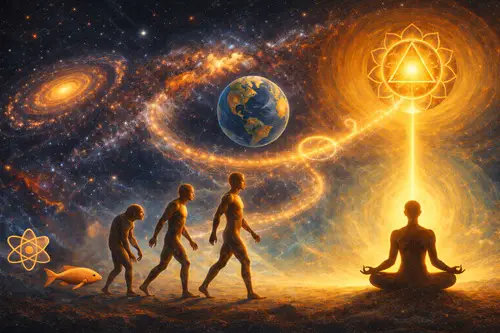 A chapter excerpt from my forthcoming book, Meta-Perennial Philosophia: Transcending (and Including) Integral Evolution (2026) by Bradley Keith Reynolds The question of whether evolution reveals an intrinsic spiritual direction—or whether such interpretations merely impose metaphysical narratives onto scientific processes—has been a central point of debate within the integral community. Ken Wilber's influential proposal that evolution expresses “Spirit-in-action,” often referred to as Eros, sought to reconcile modern cosmology with a spiritually meaningful universe. In this view, the cosmos is not merely a random, indifferent rearrangement of matter but a patterned unfolding toward greater depth, interiority, and complexity. For Wilber, Eros is not a mythic deity or interventionist cause but explicitly framed as a metaphor for the universe's inherent tendency to transcend and include its previous forms. Yet this metaphor has frequently been misunderstood, leading to vigorous debate among supporters and critics alike. Frank Visser, writing extensively on Integral World, has argued forcefully that Wilber's use of Eros smuggles teleology back into science. According to Visser, framing evolution as Spirit-driven misrepresents biological theory and risks sliding into a form of “new creationism.” In his view, evolutionary science suffices without metaphysical embellishment; complexity emerges through natural selection, thermodynamics, and environmental interaction—not because Spirit is pushing matter toward consciousness. Visser warns that metaphors like Eros may conflate poetic interpretation with scientific explanation, thereby confusing rather than clarifying the evolutionary story. My contribution to this debate acknowledges the legitimacy of Visser's scientific caution while rejecting his broader reductionism. I argue that Visser correctly identifies the danger of reifying Eros into a literal cosmic force, but he misunderstands Wilber's deeper intent. “Eros” as a metaphor, properly interpreted, is not a mechanism but an orienting generalization—a way of naming the universe's demonstrable pattern of emergence. When Wilber speaks of Eros as “Spirit-in-action,” he is not proposing an alternative physics but offering a philosophical symbol for the creative advance that science itself describes. At the same time, Meta-Perennial Philosophy recognizes that Wilber's language occasionally overreaches its own stated intent, slipping toward metaphysical boldness and leaving room for misinterpretation—and thus providing Visser with easy targets. Meta-Perennial Philosophy reframes this entire controversy by clarifying the difference between structural evolution (Becoming) and nondual Recognition (Being). Evolution undeniably exhibits patterns of increasing complexity, depth, and interiority—patterns illuminated by Big History, complexity science, Whitehead's process philosophy, and contemporary cosmology. These patterns do not require a metaphysical driver to be meaningful; they are simply what the universe is actually doing. But such patterns do not—and cannot—account for Enlightenment, which is not a developmental endpoint but the always-present Divine Condition that is Recognized when the activity of the self-contraction (or ego-I) relaxes. Thus, Meta-Perennial Philosophy embraces evolution as the Arc of Becoming (the unfolding of relative phenomena) while simultaneously affirming that Awakening belongs to the Arc of Being (the transcendent, numinous Absolute), which is prior to, and untouched by, cosmic development. From this perspective, the Wilber-Visser debate reveals a deeper category error: both sides assume evolution and Enlightenment must belong to the same explanatory plane. Visser collapses everything into exterior mechanisms, while Wilber occasionally risks collapsing Enlightenment (or nondual awareness) into an upward-moving developmental Arc of Becoming. Meta-Perennial Philosophy resolves this not by compromising between them, but by differentiating the two arcs and emphasizing that only the Arc of Being—nondual Recognition—transcends the paradox by revealing that Becoming arises within (and as) Divine Being. Evolution expresses a real, empirically grounded tendency toward complexity; Enlightenment expresses the prior, non-developmental Divine Condition. Wilber's metaphor of Eros can be preserved only if it is understood as the universe's intrinsic creativity—not as the cause of Awakening or a force guiding evolution, but as a symbol for the emergent process intrinsic to the Kosmos itself. With Meta-Perennialism, I sharply diverge from Wilber by restoring the centrality of an Awakened Adept's Transmission of the Enlightened State. Initiation into higher states of transpersonal consciousness is not incidental but structurally decisive for Waking Up—quite simply, it is how Spirit-in-action becomes known directly, rather than inferred abstractly. Wilber's model downplays the radical significance of the Realizer in the process of Waking Up by rejecting or discouraging Guru-Yoga and Satsang (Reynolds, 2025). Neither evolution nor psychological development produces God-Realization, though developmental maturity may support the capacity to respond to Grace. The Adept-Realizer functions as a living bridge by revealing the Prior Condition directly—a dimension totally absent from Visser's scientific reductionism and insufficiently emphasized in Wilber's post-metaphysical synthesis. Meta-Perennial Philosophia clarifies the landscape: evolution can refine the practitioner, but only Recognition confers Realization of Reality in its wholeness. Viewed through this integrative lens, Eros becomes a metaphor—not for cosmic teleology but for the universe's undeniable creative dynamism. Evolution can be honored without teleology or a predesigned drive; Enlightenment can be affirmed without developmentalism. And both can be situated within a coherent, Meta-Perennial cosmology that honors scientific integrity, philosophical depth, and the living reality of Divine Recognition, as pointed to throughout the centuries and across cultures by the universal Perennial Philosophy. Recognizing Eros as a metaphor for the Kosmos's creative advance clarifies why evolution unfolds without appealing to a metaphysical force. To understand this creativity more fully, I now turn to the deeper question of how we know—how we acquire, validate, and integrate knowledge across various domains. In the next section, I examine Integral Theory's “Three Eyes of Knowing,” which establishes an epistemological pluralism capable of transcending scientific reductionism to reveal a truly holistic vision of reality—one that honors both empirical science and esoteric spirituality without collapsing one into the other.
|