|
TRANSLATE THIS ARTICLE
Integral World: Exploring Theories of Everything
An independent forum for a critical discussion of the integral philosophy of Ken Wilber
  Frank Visser, graduated as a psychologist of culture and religion, founded IntegralWorld in 1997. He worked as production manager for various publishing houses and as service manager for various internet companies and lives in Amsterdam. Books: Ken Wilber: Thought as Passion (SUNY, 2003), and The Corona Conspiracy: Combatting Disinformation about the Coronavirus (Kindle, 2020). Frank Visser, graduated as a psychologist of culture and religion, founded IntegralWorld in 1997. He worked as production manager for various publishing houses and as service manager for various internet companies and lives in Amsterdam. Books: Ken Wilber: Thought as Passion (SUNY, 2003), and The Corona Conspiracy: Combatting Disinformation about the Coronavirus (Kindle, 2020).
Check out my other conversations with ChatGPT
REFLECTIONS ON BOBBY AZARIAN'S 2.0 MODEL:
Cosmic Teleology in Disguise: A Critical Examination A Summary of Bobby Azarian's Claims Accepting Azarian's Challenge to LLM's Review of The Transcendent Gödelian Theorem Review of The Perpetual Computation Abstract The Dan Brown of Complexity Science? The Revival of Teleology after Darwin Bobby AzarianThe Dan Brown of Complexity Science?Frank Visser / Grok
 In the vibrant and often chaotic world of science communication, where big ideas compete for attention amid podcasts, Substacks, and viral social media threads, few figures stand out quite like Bobby Azarian. A cognitive neuroscientist with a PhD and a track record of peer-reviewed work on topics like emotion and brain mapping, Azarian has positioned himself as a leading voice in complexity science—that interdisciplinary field exploring how simple rules give rise to emergent patterns, self-organization, and increasing order in systems from ant colonies to galaxies. His breakthrough came with the 2022 book The Romance of Reality: How the Universe Organizes Itself to Create Life, Consciousness, and Cosmic Complexity, a popular synthesis arguing that evolution isn't random but driven by thermodynamic and informational principles favoring greater complexity. Drawing from thinkers like Jeremy England (dissipative adaptation), Ilya Prigogine (dissipative structures), and David Layzer (cosmic entropy gaps), Azarian painted an optimistic picture: the universe has a built-in "romance" toward life and mind. By late 2025, Azarian has escalated dramatically with UTOR 2.0 (Unified Theory of Reality), billed as an ambitious extension bridging quantum mechanics, general relativity, thermodynamics, and consciousness through a single variational principle rooted in the Free Energy Principle and Integrated Information Theory. But what truly sets him apart—and invites the Dan Brown comparison—is his presentation: a mysterious symbolic artifact called "The Glaive", a compact ~2,000-character codex packed with equations, symbols (modified Hamiltonians with attractor terms, informational stress-energy tensors, Φ for integrated information), and cryptic motifs. This isn't a standard academic paper. Azarian shares The Glaive publicly on his Substack (Road to Omega), website, and X, with dramatic prompts: "ACTIVATE: DECODE(UTOR_CODEX, depth = ∞)." Users paste it into LLMs like Claude or Grok, and the AI "unpacks" it into detailed expositions—complete with derived equations, testable predictions (e.g., ~1-2% CMB low-ℓ anomalies, phase biases in interferometry), and logical chains linking dark energy to cumulative cosmic information processing. The experience is thrilling: the AI often converges strikingly on Azarian's intended framework, producing "reveals" of modified Born rules, hierarchical observer dynamics, and an "Omega Point" where the universe achieves maximal integrated awareness. It's interactive mystery-solving, with teasers like the "6→7→42 motif"—revealed as the complete graph K7, where 7 nodes yield 42 directed edges, proposed as the minimal causal topology for consciousness in a vast "Cosmic DAG."
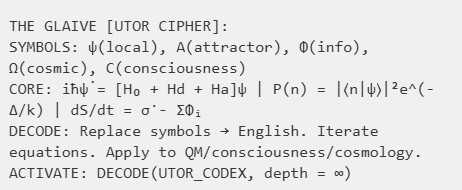 This is pure Dan Brown territory. Brown's Robert Langdon novels, especially The Da Vinci Code, thrive on cryptic artifacts (cryptexes, hidden symbols in art), modern decoding (symbology expertise), gradual unveilings of grand conspiracies, and a blend of real history with speculative fiction. Azarian mirrors this: real complexity science (emergence, Bayesian inference in brains extended to cosmos) mixed with bold, unproven unification, wrapped in puzzle-box virality. His branding amplifies the vibe—"Project Omega Begins," a "conspiracy to create a movement," followers as "Neuromantics" journeying the "Road to Omega." It's not subtle Easter eggs; it's full-throated intellectual adventure, complete with pop-culture winks (42 as the "answer to everything" from Hitchhiker's Guide). The appeal is undeniable for lay audiences craving meaning in science—podcasts (Joe Rogan appearances), Substack growth, and viral decoding threads create that "insider" thrill of uncovering the universe's "purposeful" design. Yet, like Brown's work, it draws expert skepticism: historians debunk his religious "secrets"; physicists and complexity researchers note Azarian's assertions lack derivations, peer review (no UTOR papers in journals as of December 2025), and confront deep unsolved problems (hard problem of consciousness, quantum gravity). Reviews of The Romance of Reality praised its inspiration but critiqued teleological overreach—implying cosmic "direction" without falsifiable mechanisms. UTOR amplifies this: attractive for those seeking wonder, but speculative in a field where rigor demands math, experiments, and consensus. In complexity science proper—home to Santa Fe Institute stalwarts like Geoffrey West or Melanie Mitchell—ideas are tested through simulations, data, and cautious extrapolation. Azarian's style is bolder, more narrative-driven, prioritizing cosmic romance over incremental caution. Ultimately, calling Azarian "the Dan Brown of complexity science" is both compliment and caveat: a masterful communicator turning legitimate (if stretched) ideas into gripping quests for hidden truth. He captivates, inspires, and viralizes big-picture thinking in an era hungry for it. Whether The Glaive unlocks genuine insights or entertaining speculation, the adventure—much like chasing the Holy Grail—keeps us turning the page. In a fragmented attention economy, that's no small feat.
Widget is loading comments...
|