|
TRANSLATE THIS ARTICLE
Integral World: Exploring Theories of Everything
An independent forum for a critical discussion of the integral philosophy of Ken Wilber
  Frank Visser, graduated as a psychologist of culture and religion, founded IntegralWorld in 1997. He worked as production manager for various publishing houses and as service manager for various internet companies and lives in Amsterdam. Books: Ken Wilber: Thought as Passion (SUNY, 2003), and The Corona Conspiracy: Combatting Disinformation about the Coronavirus (Kindle, 2020).
Check out my other conversations with ChatGPT
Thierry Baudet:
The Intellectual Who Turned Politics into a Performance The Anti-System Party and Its Democratic Contradictions Forum voor DemocratieThe Anti-System Party and Its Democratic ContradictionsFrom conservative protest movement to the normalization of the extreme rightFrank Visser / ChatGPT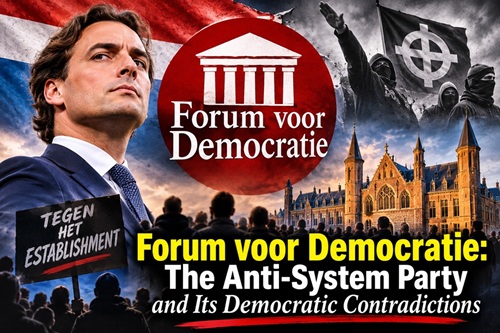
Introduction: Democracy as a convenient labelForum voor Democratie (FVD) presents itself as a defender of Dutch democracy, national sovereignty, cultural identity and traditional values. Its political vocabulary is familiar: the people against the establishment, national interests against globalism, ordinary citizens against an unresponsive political elite. It claims to represent a conservative alternative to a political system that has become detached from the population. But there is a fundamental question that deserves closer examination: what kind of democracy does FVD actually defend? Democracy is more than winning elections. It also involves accepting political pluralism, respecting institutional checks and balances, recognizing the legitimacy of political opponents, protecting minorities and accepting that no single political movement has an exclusive claim to represent the nation. A movement can legitimately criticize parliament, government, the judiciary, the media and the established political parties. Indeed, such criticism is an essential part of democracy. The difficulty begins when criticism of democratic institutions turns into a general rejection of their legitimacy, when political opponents are portrayed as enemies of the nation, and when an imagined national community is placed above the constitutional rights of actual citizens. The recent revelations about connections between Forum voor Democratie and neo-Nazi networks make this distinction particularly important. They also bring into focus a longer-running question about the party's political culture, its conception of national identity and its relationship with parliamentary democracy. 1. The recent neo-Nazi revelations: more than an embarrassing associationThe immediate reason for renewed scrutiny is the investigative documentary De Neonazi-files, broadcast by Dutch investigative programme Zembla on 18 November 2026, in cooperation with the Belgian programme Pano. The investigation exposed connections between individuals associated with FVD and a network of neo-Nazi organizations, including Wolvenrad and extremist fighting clubs. The journalists obtained access to private chat groups, extensive video archives and recordings of secret fighting tournaments. The material showed participants engaging in violent cage fights, performing Hitler salutes and shouting Nazi slogans. Several connections to FVD were documented. Among the individuals identified was Ramon van Asch, FVD's municipal faction leader in Den Bosch and a former employee of the party's parliamentary group. He attended one of the fighting events. Two members of the FVD youth organization, Jongerenorganisatie Forum voor Democratie (JFVD), were also identified as participants in the extremist network. One was filmed participating in a book-burning ceremony commemorating Hitler's birthday. Furthermore, the leader of Wolvenrad had attended a JFVD Christmas gathering. These are not merely anonymous people expressing controversial opinions on the internet. The investigation identified connections involving individuals who occupied positions within or close to the party's organizational structures. FVD has denied collaborating with the neo-Nazi organization and stated that it was unaware of the involvement of its members. It subsequently expelled members implicated in the revelations. According to EenVandaag's reporting of 21 November, six members had been expelled in connection with the broader controversies. These distinctions matter. Membership in FVD does not automatically make someone a neo-Nazi, and the activities of individual members do not, by themselves, establish an organizational agreement between FVD and neo-Nazi groups. But the reverse is equally important: a political party cannot indefinitely treat recurring connections with extremist circles as a succession of unrelated personal accidents. The relevant question is not simply whether the party officially endorses neo-Nazism. It is whether its recruitment, internal culture, political rhetoric and disciplinary practices have created an environment in which individuals from extremist movements can find political shelter and opportunities for advancement. That is a legitimate question for journalists, political scientists and voters. 2. The youth organization as a political breeding groundThe JFVD deserves particular attention because it is more than a social club for politically interested young people. It functions as a recruitment and training environment for the party's future political personnel. Several prominent FVD politicians have emerged from its ranks. Consequently, the political culture cultivated there has implications beyond the immediate activities of young members. This is not the first time the organization has attracted controversy. In 2020, leaked WhatsApp conversations revealed racist, antisemitic and extremist statements by participants in youth-party discussions. The revelations included the glorification of violent extremists. Earlier in 2026, reporting about the JFVD Christmas gala identified guests with documented connections to racist and extreme-right movements. In response to earlier revelations, party representatives characterized some extremist expressions as youthful experimentation or youthful mistakes. That explanation deserves scrutiny. There is an important difference between a young person experimenting with radical political ideas and a political organization repeatedly providing a social environment in which racist conspiracy theories, Holocaust relativization and admiration for authoritarian violence can circulate. Political development is not a justification for every political expression. Nor does the fact that somebody is young make the organizational response irrelevant. A party that wishes to distinguish itself from extremism must demonstrate that it takes these matters seriously, including when the individuals concerned are politically useful or personally connected to its leadership. Historian Robin te Slaa has argued that the recurring connections between FVD and the extreme right should be understood structurally rather than as isolated incidents. Investigative journalism professor Nikki Sterkenburg has also discussed the distinction between a party's relatively moderate public presentation and more radical networks operating behind the scenes. These are expert interpretations, not judicial findings, but they deserve serious consideration. 3. The paradox of anti-establishment democracyPerhaps the most interesting aspect of FVD is its relationship with parliamentary democracy itself. The party has cultivated an image of being system-critical. It presents the established political parties as a closed political cartel, parliament as an institution that has lost touch with the population, and the political establishment as an interconnected network protecting its own interests. There is nothing inherently undemocratic about criticizing this situation. The Dutch political system has genuine problems. Coalition negotiations can limit the range of meaningful parliamentary choices. Party discipline can weaken individual parliamentary independence. Citizens can feel that their votes have little influence over government policy. Political accountability and transparency are legitimate subjects of criticism. But there is a crucial distinction between wanting to improve parliamentary democracy and treating parliamentary democracy as fundamentally illegitimate. FVD's political rhetoric has repeatedly approached this boundary. Thierry Baudet has portrayed the political establishment in terms that go beyond ordinary criticism of particular government decisions. His rhetoric has included sweeping attacks on political opponents, journalists, academics and public institutions. In 2018, during a parliamentary debate, Baudet was challenged directly about whether he considered the Tweede Kamer a nepparlement—a fake parliament. The exchange illustrates the tension between participating in parliamentary institutions and questioning their legitimacy. The problem is not that parliament should be immune from criticism. It is that a political movement can exploit democratic institutions while simultaneously undermining public confidence in the very institutions that make democratic competition possible. This creates an interesting contradiction. FVD wants to participate in elections, obtain parliamentary representation and exercise political influence. Yet its political narrative frequently portrays the established democratic system as so fundamentally corrupted that its institutions cannot be trusted. What happens when such a movement actually acquires political power? Does it accept that opposition parties have an equal right to govern? Does it respect independent judges when their decisions contradict its policies? Does it accept adverse electoral results? Does it recognize the legitimacy of a free press that investigates its activities? These are not hypothetical questions about abstract political philosophy. They are practical tests of democratic commitment. 4. The people against the establishment: who represents the people?One of the oldest rhetorical strategies in populist politics is to divide society into two supposedly homogeneous camps: the authentic people and the corrupt establishment. The political movement then presents itself as the authentic voice of the former. But who exactly constitutes this authentic people? In a pluralistic democracy, the population consists of people with different ethnic backgrounds, religions, political convictions, social circumstances and cultural identities. There is no single interpretation of Dutch identity that can legitimately exclude all the others. FVD's emphasis on national identity, cultural preservation and opposition to immigration raises questions about where it draws the boundaries of political belonging. The recent parliamentary debate about omvolking (population replacement) and remigratie (remigration) is particularly revealing. According to research published by Nieuwsuur in November 2026, FVD politicians accounted for 53 of the 96 parliamentary uses of the word remigratie since 2024. The party was also the most frequent parliamentary user of omvolking. These terms require careful examination. Voluntary return migration is a legitimate subject of public policy debate. Immigration levels, integration, citizenship and national identity are also legitimate subjects. But omvolking has a specific history in far-right conspiracy thinking. It suggests that an original population is being deliberately replaced by outsiders, often through a conspiracy involving political elites or Jewish interests. The AIVD and NCTV have warned about the use of coded language by right-wing extremist groups to make their ideas more acceptable in mainstream political debate. FVD representative Ralf Dekker disputes the characterization of these terms as extremist and maintains that the party's positions are legitimate political opinions. That disagreement should be examined by looking at the actual policies proposed, their practical consequences and the ideological assumptions behind them, rather than relying on terminology alone. The central democratic question is whether national identity is understood as a shared civic and constitutional framework, open to citizens of different backgrounds, or as an inherited ethnic and cultural identity that determines who truly belongs. Those are fundamentally different conceptions of the nation. 5. The authoritarian temptationThere is another contradiction worth examining: the relationship between conservative politics and authoritarianism. Conservatism, in its traditional meaning, is not necessarily hostile to democracy. It can emphasize institutional continuity, social stability, cultural inheritance, national sovereignty and respect for established institutions. Indeed, constitutional conservatism can be an important defence against revolutionary politics and arbitrary government. But there is also an authoritarian variant of conservatism. In this version, the nation is imagined as a unified cultural organism, dissent is regarded as disloyalty, social hierarchy is treated as natural, and strong leadership becomes more important than institutional accountability. The distinction is especially relevant when political movements cultivate admiration for authoritarian leaders abroad. FVD's relationship with Vladimir Putin and its criticism of Western support for Ukraine have also attracted attention. Opposition to NATO policy, criticism of American foreign policy and advocacy of diplomatic negotiations are all legitimate political positions. But these positions should not be confused with an uncritical acceptance of the political model represented by Putin's Russia. Russia's political system is characterized by concentrated executive power, restrictions on independent media, repression of opposition and the absence of genuinely competitive national elections. A movement that emphasizes national sovereignty and distrust of international institutions should also be prepared to explain why it considers the sovereignty and democratic choices of other nations worthy of protection. The same principle applies to domestic politics: democracy cannot simply mean that one's own political movement should be free to exercise power. It must also mean that opponents retain their rights when they disagree. 6. The problem of political languageFVD's rhetoric deserves attention in its own right. Words such as globalists, cartel, cultural Marxism, replacement and remigration can function as political shorthand. They compress complicated social and economic developments into simple explanations involving identifiable enemies. Some of these concepts have legitimate uses in particular contexts. Global economic institutions, for example, can certainly be criticized. Political networks can be investigated. Cultural changes can be debated. The danger arises when such vocabulary becomes part of a conspiratorial worldview in which virtually every institution is understood as collaborating against the nation. This worldview is difficult to challenge because contrary evidence can simply be incorporated into the conspiracy. Independent journalists become establishment propagandists. Courts become politically captured. Universities become ideological indoctrination centres. Parliamentary opponents become representatives of the cartel. A political movement can then position itself outside ordinary standards of accountability. This is particularly problematic when its own internal practices are insufficiently transparent. The irony is obvious: a party that demands accountability from virtually everyone else must be willing to subject itself to the same standards. The question is whether FVD applies its own demand for transparency, openness and democratic accountability to its internal organization. 7. Democracy is not simply majority ruleThere is a deeper constitutional issue here. A political movement can win elections and still undermine democracy. Electoral success is necessary for democratic legitimacy, but it is not sufficient. Modern constitutional democracy rests on several mutually reinforcing principles:
These principles also protect FVD itself. Its right to organize, campaign, criticize government and participate in parliament depends on the same democratic framework it criticizes. The question, therefore, is not whether FVD is entitled to challenge the political establishment. It certainly is. The question is whether it accepts the democratic rules as binding when those rules become inconvenient. This is the distinction between an anti-establishment party operating within democracy and a movement that regards existing democratic institutions as obstacles to be overcome. 8. The responsibility of the conservative mainstreamThe developments surrounding FVD also raise questions for the broader Dutch political landscape. Extreme-right ideas rarely become politically influential overnight. They can enter mainstream discourse gradually, through the normalization of particular expressions, the repetition of conspiracy narratives and the gradual relaxation of boundaries regarding acceptable political associations. This process does not require established conservative parties to share the entire ideology of the extreme right. It can happen through selective cooperation, the adoption of particular slogans, or the reluctance to challenge extremist rhetoric because doing so might alienate potential voters. The recent reporting by Nieuwsuur and EenVandaag illustrates how experts understand this process of normalization. In particular, they warn that language originating in extremist milieus can gradually become part of ordinary parliamentary discourse. This does not mean that every conservative voter, critic of immigration or opponent of European integration should be associated with extremism. Such generalizations would be both unfair and politically counterproductive. The distinction between legitimate conservatism and ethnic nationalism must be maintained. Indeed, one of the most important tasks of democratic conservatism is to demonstrate that defending cultural continuity and national sovereignty does not require abandoning constitutional liberalism, political pluralism or equal citizenship. 9. The ultimate contradiction: using democracy against democracy?The most important question raised by Forum voor Democratie is therefore not whether it is sufficiently conservative, sufficiently nationalist or sufficiently critical of the establishment. It is whether its understanding of democracy extends beyond the right to win elections. A movement that regards parliament primarily as an obstacle, the established political parties as illegitimate representatives of the people, independent institutions as enemies and cultural minorities as threats to national identity is operating with a very different conception of democratic politics from one that accepts pluralism and constitutional limitations. The recent neo-Nazi revelations make this question more urgent. They do not, by themselves, prove that FVD as an organization is neo-Nazi. But the documented connections, considered alongside previous controversies involving the youth organization and the party's ideological rhetoric, make it difficult to dismiss the issue as merely a collection of unrelated personal indiscretions. FVD's own response, including its denial of organizational collaboration and the expulsion of implicated members, must also be considered. The important test will be whether these actions represent a sustained effort to establish clear boundaries or simply a response to damaging publicity. There is also a danger in responding to these developments by treating every FVD voter as an extremist. Many voters may be attracted by dissatisfaction with immigration policy, housing shortages, European integration, taxation or the established parties. Those concerns deserve political consideration in their own right. Dismissing such voters would leave the underlying grievances unaddressed. But taking their concerns seriously does not require accepting the ideological explanations offered by the party. Conclusion: A party's democratic credentials must be demonstratedForum voor Democratie presents itself as a movement seeking to restore democracy to the Dutch people. Its language of popular sovereignty, national independence and opposition to political elites appeals to genuine democratic frustrations. Yet these claims need to be tested against its actual political practices, its treatment of democratic institutions, its conception of national belonging and its associations with extremist networks. There is a fundamental difference between criticizing parliament and looking down on parliamentary democracy; between defending national identity and defining citizenship in ethnic terms; between challenging established power and cultivating a political culture in which opponents are treated as enemies. A democracy needs system critics. It needs radical reformers, conservatives, socialists, liberals and political movements that challenge established assumptions. But it also needs a shared commitment to the rules that allow these competing movements to coexist. The paradox of FVD is that it invokes democracy while repeatedly raising questions about the very principles that make democracy possible. Its democratic credentials should therefore not be established by its name, its electoral participation or its declarations of patriotism. They should be assessed through its conduct. Calling yourself a defender of democracy is easy. Accepting the rights of those who disagree with you is the real test.
Comment Form is loading comments...
|