|
TRANSLATE THIS ARTICLE
Integral World: Exploring Theories of Everything
An independent forum for a critical discussion of the integral philosophy of Ken Wilber
  Frank Visser, graduated as a psychologist of culture and religion, founded IntegralWorld in 1997. He worked as production manager for various publishing houses and as service manager for various internet companies and lives in Amsterdam. Books: Ken Wilber: Thought as Passion (SUNY, 2003), and The Corona Conspiracy: Combatting Disinformation about the Coronavirus (Kindle, 2020). Frank Visser, graduated as a psychologist of culture and religion, founded IntegralWorld in 1997. He worked as production manager for various publishing houses and as service manager for various internet companies and lives in Amsterdam. Books: Ken Wilber: Thought as Passion (SUNY, 2003), and The Corona Conspiracy: Combatting Disinformation about the Coronavirus (Kindle, 2020).
Check out my other conversations with ChatGPT Thierry BaudetThe Intellectual Who Turned Politics into a PerformanceFrank Visser / ChatGPT
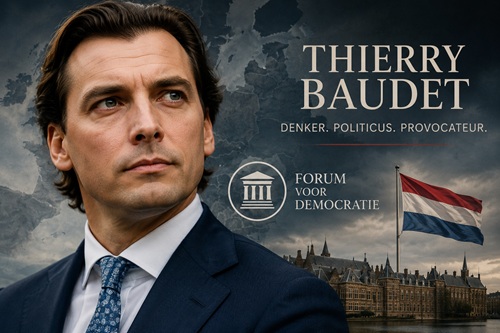
Thierry Baudet is one of the more intriguing—and troubling—figures in contemporary Dutch politics. He is difficult to dismiss as merely another populist politician. Unlike many politicians of the populist right, Baudet has cultivated an explicitly intellectual persona. He has written books, studied law and history, holds a doctorate from Leiden University, and presents himself not simply as a politician but as a thinker engaged in a civilizational struggle. His own biography emphasizes his academic background, his authorship of twelve books, and his role as founder of Forum voor Democratie (FvD). That combination—intellectual ambition, political theatricality, cultural conservatism, nationalism, and conspiratorial rhetoric—is what makes Baudet worth taking seriously. It is also what makes him so difficult to take at face value. My critical assessment is that Baudet's political career illustrates a paradox of contemporary populism: the more sophisticated its intellectual packaging becomes, the more tempting it is to confuse ideological performance with intellectual depth. From intellectual critic to political entrepreneurBaudet first attracted national attention not as a conventional party politician but as a critic of the European Union and the political establishment. His involvement in the campaign surrounding the 2016 referendum on the EU-Ukraine Association Agreement gave him a national platform. In 2017, Forum voor Democratie entered parliament with two seats. The party subsequently achieved a spectacular breakthrough in the 2019 provincial elections, becoming the largest party in the Dutch Senate after the indirect election process. For a moment, Baudet appeared to represent something genuinely new. He was not Geert Wilders. Wilders had built his political identity around immigration, Islam, national sovereignty, and a highly personalized form of populism. Baudet initially presented himself as something more intellectually ambitious: a defender of Western civilization, national identity, classical culture, and democratic sovereignty. He could talk about Homer, Cicero, the Enlightenment, the European Union, and the fate of Western civilization in a single political performance. This was part of his appeal. Baudet understood something that many conventional politicians failed to grasp: politics is not only about policies. It is also about stories, symbols, identity, and imagination. His opponents often treated him as an eccentric intellectual. His supporters saw something else: a politician who appeared to have read books, who was willing to challenge the establishment, and who seemed to possess a larger historical vision. That combination made him politically potent. The politics of provocationBut Baudet's greatest strength is also one of his greatest weaknesses. He has repeatedly demonstrated an extraordinary instinct for provocation. He knows how to create an event around himself. His early parliamentary use of Latin became emblematic of this style: politics as theatre, politics as cultural symbolism, politics as a performance of intellectual superiority. The episode was entertaining, but it also revealed something fundamental about Baudet's political method. He does not merely want to argue. He wants to stage an alternative worldview. This is why Baudet is best understood not simply as a politician but as a political entrepreneur. He creates a narrative in which established institutions—the EU, mainstream media, universities, political parties, climate scientists, public-health authorities—appear as parts of a single ideological establishment. Against this supposedly homogeneous system stands the dissident individual who has "seen through" it. That narrative is extraordinarily powerful. It is also dangerously simplifying. The real world is rarely divided into a corrupt establishment on one side and courageous truth-tellers on the other. Democratic societies are messy precisely because institutions disagree, experts compete, journalists make mistakes, governments change course, and citizens hold contradictory opinions. Baudet's rhetoric often turns this messy pluralism into a morality play. And morality plays are politically effective because they eliminate ambiguity. The intellectual problem: suspicion without sufficient discriminationThere is a legitimate intellectual core to some of Baudet's criticism. The European Union does have democratic deficits. Political elites can become detached from ordinary citizens. Immigration policy deserves serious debate. Climate policy involves genuine economic and social trade-offs. Governments can make mistakes. Media institutions can develop ideological blind spots. Experts can be wrong. These are not extremist observations. They are legitimate subjects for democratic argument. The problem arises when legitimate skepticism becomes generalized suspicion. If every institution that contradicts one's worldview is dismissed as corrupt, captured, manipulated, or part of a coordinated agenda, then skepticism ceases to be a method of inquiry. It becomes an epistemology of its own. This is where Baudet's politics can become intellectually self-sealing. Evidence that confirms the worldview is accepted as proof. Evidence that contradicts it becomes evidence of the establishment's deception. Such a worldview is extraordinarily difficult to falsify. And that is the point at which the intellectual critic risks becoming an ideological believer. From conservatism to cultural radicalismBaudet's early political identity was sometimes described as a form of conservative liberalism or national conservatism. Over time, however, FvD moved considerably further to the right. The Dutch public broadcaster NPO's current overview describes the party as having shifted toward the far-right spectrum. The party itself emphasizes sovereignty, freedom, and democracy, while its current programmatic rhetoric strongly emphasizes opposition to mass immigration, EU integration, climate policy, and what it regards as progressive cultural indoctrination. The evolution is important because Baudet's politics cannot now be understood merely as "Euroskepticism." His deeper project is cultural. He is concerned with what he sees as the erosion of Western identity, national cohesion, traditional culture, and civilizational self-confidence. His own political presentation explicitly frames contemporary politics in terms of the survival of a people and a civilization. In a 2026 message to FvD supporters, he described the party's ambition as building a broader social movement aimed at "cultural, economic and political change" necessary for the survival of "our people and our civilization." This is a much larger ambition than winning elections. It is an attempt to reshape the cultural environment in which politics takes place. That is also why Baudet has shown interest in building institutions beyond the parliamentary party: educational initiatives, publishing, think tanks, youth organizations, and networks. The strategy resembles what political theorists sometimes call a struggle for cultural hegemony: change society first, and political power will eventually follow. There is something intellectually coherent about this strategy. But there is also a danger. Once politics becomes a struggle for the survival of "our civilization," political opponents can easily cease to be fellow citizens with different opinions. They become obstacles to civilizational renewal. That is a recipe for polarization. The conspiracy problemBaudet's most serious weakness, in my view, is his relationship with conspiracy thinking. Conspiracy theories are not simply false explanations. They are attractive because they offer a satisfying structure to an otherwise chaotic world. They transform complexity into intention. Nothing is accidental. Nothing is merely the result of incompetence, institutional inertia, conflicting interests, or historical contingency. Someone is behind it. This is psychologically powerful. It is also politically useful. If a politician can convince followers that the mainstream media, political parties, universities, international organizations, scientists, and cultural institutions are all part of a single system of manipulation, then almost any criticism can be dismissed in advance. Baudet has repeatedly moved in this direction, particularly in his rhetoric around COVID-19, climate change, global governance, and international affairs. The difficulty is not that every conspiracy claim is necessarily false. Governments and institutions really do sometimes conspire. The difficulty is epistemological: how do you distinguish a genuine conspiracy from a conspiratorial worldview? The answer must be evidence. And this is where Baudet's intellectual style can become problematic. The grander the explanation, the less room there seems to be for uncertainty, probability, or the possibility that reality is simply complicated. A genuinely skeptical thinker should be willing to say: "I don't know." Baudet's political persona often seems more comfortable saying: "I know what is really going on." That is a crucial difference. The cult of the exceptional individualThere is another paradox at the center of Baudet's politics. He presents himself as a defender of democracy against the establishment. Yet his political movement has often been intensely centered on himself. This became particularly visible in the internal crisis that engulfed FvD in 2020, when controversies over extremist and antisemitic statements within the party led to a major rupture and the departure of prominent figures. The episode exposed the vulnerability of a political organization built around a charismatic leader whose personal authority is difficult to separate from the identity of the movement. This is a recurring problem with charismatic populism. The leader claims to represent "the people" against the establishment. But who decides what "the people" actually want? Usually, the leader. The result can be a strange contradiction: a movement that speaks constantly about democracy while becoming increasingly dependent on the judgment of one individual. Baudet's political project has often appeared to revolve around the conviction that he sees something others cannot see. That conviction may be partly justified—politicians do sometimes see neglected realities before the mainstream does. But it can also become a dangerous psychological trap. The dissident who is occasionally right may eventually come to believe that he is always right. The seduction of civilization talkBaudet's fascination with civilization is perhaps the most intellectually interesting aspect of his worldview. He is not primarily a politician of administrative reform. He is a politician of historical meaning. His vocabulary is grand: Europe, the West, civilization, sovereignty, identity, decline, rebirth. This gives his politics a certain grandeur that ordinary parliamentary politics lacks. But grand narratives have a dark side. The language of civilizational decline can easily become nostalgic. The past becomes idealized; the present becomes pathological; the future becomes a threat. Social change is interpreted not as a complex mixture of progress and loss but as evidence of decay. And once a politician begins to see history primarily as decline, restoration becomes the implicit political goal. The danger is that "restoration" rarely means returning to an actual historical reality. It means constructing an imagined past and demanding that the present conform to it. Baudet's political romanticism therefore has an important weakness: it sometimes seems to confuse cultural memory with historical truth. Western civilization was never the harmonious, culturally homogeneous entity implied by some forms of nationalist rhetoric. Europe has always been a mixture of peoples, migrations, religions, conflicts, exchanges, invasions, innovations, and cultural borrowings. The civilization Baudet wishes to defend is, in part, real. But it is also an abstraction. Why Baudet remains importantIt would be a mistake, however, to dismiss Baudet as simply a clown, extremist, or conspiracy theorist. That would be intellectually lazy. His success tells us something important about the societies in which he operates. Baudet has been able to articulate frustrations that mainstream politics often failed to address. He has challenged complacency about European integration. He has questioned the assumption that economic globalization is universally beneficial. He has drawn attention to the cultural consequences of immigration and demographic change. He has insisted that democratic legitimacy cannot simply be replaced by technocratic expertise. Some of these questions deserve serious answers. The problem is that Baudet frequently packages legitimate questions together with exaggerated claims, sweeping generalizations, and conspiratorial interpretations. The result is that his strongest arguments become entangled with his weakest ones. This is a pity. Because the questions remain after the rhetoric is stripped away. Baudet as a symptom Perhaps the fairest way to understand Thierry Baudet is not as the cause of Dutch political polarization but as one of its symptoms. He emerged from a political environment in which many citizens felt that important decisions were being made without them. The traditional parties appeared increasingly managerial. The European Union seemed distant. Cultural change accelerated. Social media rewarded outrage and provocation. Baudet understood the new political economy of attention. He recognized that in an age of information abundance, attention itself becomes political capital. The politician who can make people angry, frightened, amused, or fascinated can acquire an influence far greater than his parliamentary numbers would suggest. Baudet mastered this art. But attention is not the same as wisdom. A politician can become enormously successful at making people look at him without necessarily becoming better at understanding the world. The final paradoxThierry Baudet is therefore an interesting figure precisely because he combines genuine intellectual ability with serious intellectual weaknesses. He is educated, articulate, historically minded, rhetorically gifted, and capable of identifying real problems that conventional politics sometimes avoids. But he is also prone to intellectual overreach. He can turn skepticism into suspicion, criticism into delegitimization, cultural concern into civilizational alarm, and political disagreement into a struggle between those who "see" and those who are supposedly blind. His greatest danger is not that he is unintelligent. It is almost the opposite. Baudet is intelligent enough to construct sophisticated arguments around premises that may themselves be deeply questionable. That is a more formidable problem than simple ignorance. The critical question, then, is not whether Thierry Baudet is an intellectual. He plainly is, in the broad sense of someone who thinks, reads, writes, and constructs arguments. The question is what kind of intellectual he is. My answer would be: Baudet is an intellectual of suspicion rather than an intellectual of inquiry. He excels at challenging consensus, but is less convincing when he must construct a reliable alternative account of reality. He is strongest when asking uncomfortable questions and weakest when presenting sweeping answers. And perhaps that is why he remains politically relevant. Every democracy needs people willing to challenge its orthodoxies. But democracy also needs people willing to challenge the challengers. Baudet has made a career of doing the first. The real test of his intellectual seriousness would be whether he can tolerate the second. Appendix: Baudet Steps Back for Lidewij de Vos—A Strategic Retreat?Thierry Baudet's decision to step aside and make room for Lidewij de Vos raises an interesting question: was this a genuine transfer of leadership, or a strategic repositioning of the Baudet brand? The timing matters. Baudet has spent years making himself virtually synonymous with Forum voor Democratie. He founded the party, became its public face, and built a political identity around his own personality and intellectual persona. For such a leader to voluntarily move into the background is therefore significant. But stepping back does not necessarily mean stepping away. One plausible interpretation is that Baudet recognized the limitations of his own political image. His name has become highly polarizing. For supporters, that can be an asset; for potential new voters, it can be a barrier. A new front figure could therefore provide FvD with a kind of political reset. De Vos can represent the movement without carrying the entire accumulated baggage of Baudet's controversies. In this reading, the move resembles a strategic relay rather than a retirement. Baudet may be attempting to separate two functions that had previously been concentrated in one person. De Vos can operate as the more conventional parliamentary politician, while Baudet remains the movement's intellectual and ideological figurehead. This would allow him to continue influencing the direction of the party without necessarily being at the center of every political confrontation. There is another possible strategy at work: generational renewal. Populist movements often face a succession problem. Their charismatic founder becomes inseparable from the organization, but that very identification eventually becomes a liability. By elevating a younger figure, Baudet can demonstrate that FvD is more than a personal vehicle. If De Vos succeeds, the party can claim to have evolved into a broader movement. If she fails, Baudet's position as the original leader remains available as a fallback. In that sense, stepping back can actually increase a founder's strategic flexibility. It is also worth considering the possibility that Baudet is experimenting with a division between political leadership and ideological leadership. The former requires compromise, coalition-building, media discipline, and electoral pragmatism. The latter thrives on intellectual provocation, long-term cultural strategy, and the articulation of a worldview. Baudet has always seemed more naturally suited to the second role. If that is indeed the strategy, De Vos becomes the public political representative of a movement whose deeper intellectual direction remains shaped by Baudet. The question then becomes whether she is being positioned as an independent leader—or as the more electorally acceptable face of an essentially Baudetian project. That distinction matters enormously. There is, however, a less flattering interpretation. Baudet may simply be recognizing that his personal political ceiling has been reached. He has demonstrated that he can attract attention, mobilize a loyal following, and disrupt the Dutch political landscape. But he has also demonstrated the limits of a politics built around permanent confrontation and provocation. His move could therefore be an attempt to escape the consequences of his own political style. A new leader can do something a founder cannot easily do: change the subject. Instead of every election becoming a referendum on Baudet himself, FvD can ask voters to consider a different personality and perhaps a somewhat different tone. This is a familiar strategy in politics. The founder remains part of the movement's history while the successor becomes its future. The crucial question is therefore not simply why did Baudet step back? It is how much power did he actually relinquish? If De Vos gains genuine autonomy, the move could mark a significant transformation of FvD. The party might become less personality-driven, less confrontational, and potentially more electorally viable. Baudet's intellectual legacy would then be one component of the movement rather than its organizing principle. If, on the other hand, De Vos functions primarily as a new public interface for the same ideological project, then the change is more cosmetic. Baudet would have achieved something quite clever: retaining influence while reducing his personal exposure. That would fit his political style rather well. The most interesting possibility is that Baudet has finally understood a lesson that his own political career illustrates: sometimes the best way to remain influential is to stop being the person everyone is looking at. If this is a deliberate strategy, it may be one of the more sophisticated moves of his political career. He can preserve his role as the movement's intellectual provocateur while giving a new generation the opportunity to make FvD more electorally palatable. But there is an inherent tension here. Baudet's political appeal has always depended partly on his personal identity. His supporters did not simply vote for a program; many were attracted to Baudet himself as the dissident intellectual who challenged the establishment. If he steps too far into the background, he risks weakening precisely the personal charisma that helped build FvD. So the success of the strategy will depend on an almost impossible balancing act: Can Baudet become less visible without becoming less relevant? If he can, the move to De Vos may prove to have been strategically brilliant. If he cannot, then it may turn out to have been less a transfer of power than an admission that the Baudet model has reached its limits.
Widget is loading comments...
|