|
TRANSLATE THIS ARTICLE
Integral World: Exploring Theories of Everything
An independent forum for a critical discussion of the integral philosophy of Ken Wilber
  Frank Visser, graduated as a psychologist of culture and religion, founded IntegralWorld in 1997. He worked as production manager for various publishing houses and as service manager for various internet companies and lives in Amsterdam. Books: Ken Wilber: Thought as Passion (SUNY, 2003), and The Corona Conspiracy: Combatting Disinformation about the Coronavirus (Kindle, 2020).
Check out my other conversations with ChatGPT
The Philosophy of Mind:
Douglas Hofstadter: The Strange Loop of Human Intelligence David Chalmers and the Hard Problem of Consciousness Bernardo Kastrup and the Metaphysics of Idealism, David Chalmers and the Hard Problem of ConsciousnessThe Limits of Physicalism, the Appeal of Panpsychism, and the Persistent Mystery of Subjective ExperienceFrank Visser / ChatGPT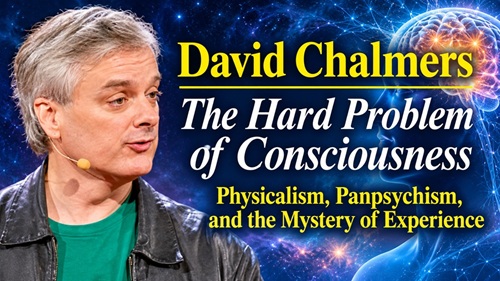 David Chalmers occupies an unusual position in contemporary philosophy of mind. He is one of the most influential philosophers of consciousness, a defender of the idea that subjective experience cannot be adequately explained by conventional physical science, and an intellectual figure who has helped bring the so-called hard problem of consciousness into the center of philosophical debate. His influence is considerable. Since the publication of The Conscious Mind (1996), Chalmers has challenged physicalist accounts of the mind, defended the philosophical possibility of zombies, explored the implications of panpsychism, and more recently examined the nature of virtual reality and artificial intelligence. There is much to admire in this intellectual project. Chalmers is analytically sophisticated, philosophically imaginative, and unusually willing to confront questions that neuroscience and cognitive science have sometimes treated as peripheral. His insistence that explaining the mechanisms of cognition is not automatically the same as explaining conscious experience is an important challenge. Yet his work also illustrates a recurring problem in contemporary philosophy: the tendency to turn a limitation in our present explanatory framework into evidence for a fundamentally different conception of reality. Chalmers is persuasive when he identifies unanswered questions. He is considerably less persuasive when he suggests that these questions require us to abandon physicalism, entertain fundamentally new psychophysical laws, or attribute rudimentary experiential properties to matter itself. The central criticism developed here is that Chalmers has identified a genuine explanatory challenge but has not demonstrated that it constitutes an ontological mystery beyond the reach of a sufficiently developed natural science. 1. The hard problem: a genuine question, but is it a separate problem?Chalmers distinguishes between what he calls the easy problems and the hard problem of consciousness. The easy problems are not necessarily easy in the ordinary sense. They include explaining perception, attention, information processing, memory, discrimination, learning, and the ability to report internal states. These are difficult scientific problems, but Chalmers believes that they can, in principle, be explained through cognitive science and neuroscience. The hard problem is different. Even if we understood every neural mechanism involved in seeing red, hearing music, feeling pain, or recognizing a face, Chalmers asks, why should any of these processes be accompanied by subjective experience at all? Why is there something it is like to be a conscious organism? This is an important distinction, but it contains a questionable assumption. Chalmers effectively separates the functioning of consciousness from the experience of consciousness, and then asks how the latter can be added to the former. But is this separation justified? Consider pain. We can investigate its neurological mechanisms, its relationship to tissue damage, its emotional consequences, its motivational effects, and the ways in which the brain processes and integrates painful signals. We can study how pain differs from other sensory experiences and how it changes under anesthesia, medication, neurological injury, or altered states of consciousness. None of this automatically provides a complete philosophical account of subjective experience. Nevertheless, the fact that an explanation is incomplete does not establish that something fundamentally nonphysical remains unexplained. The distinction between the third-person description of an experience and the first-person experience itself is real. But it does not follow that these are two independently existing phenomena requiring two different kinds of explanation. A useful comparison is the distinction between the objective description of a musical composition and actually listening to it. A description of frequencies, harmonics, and sound waves is not the experience of hearing music. But this difference does not establish that listening involves an additional, nonphysical ingredient. Chalmers risks confusing the difference between an experience and its scientific description with evidence that experience cannot ultimately be explained scientifically. This is the central weakness of his approach: he treats the explanatory gap as a possible ontological gap. 2. The philosophical zombie: an imaginative experiment with questionable conclusionsChalmers's most famous argument involves the philosophical zombie. Imagine a human being physically identical to an ordinary person, molecule for molecule, with exactly the same brain, behavior, speech, memories, and reactions. The only difference is that this person has no subjective experience whatsoever. There is nobody home, so to speak. The zombie says that it feels pain, avoids dangerous situations, discusses its emotions, and behaves in every respect like a conscious human being. Yet it experiences nothing. Chalmers argues that such a creature is conceivable. If it is conceivable, he maintains, it is metaphysically possible. And if a physically identical zombie is possible, consciousness cannot be fully explained by physical facts. This is an ingenious argument, but its decisive step is also its most vulnerable. The ability to imagine a situation does not establish that the situation is genuinely possible. Our intuitions about possibility are not infallible, particularly when dealing with phenomena whose underlying mechanisms we do not understand. We can imagine water without H2O, although water is H2O. We can imagine that a particular biological organism might have existed without its defining evolutionary history, but that does not establish that the imagined organism is biologically possible. The problem is that we can mentally separate concepts that may be inseparable in reality. Chalmers's zombie is particularly problematic because the thought experiment stipulates that everything physical remains identical while something fundamental changes. But what exactly is being changed? If the brain, its internal organization, its information processing, its sensory integration, and every physical interaction remain identical, what independent evidence tells us that experience could nevertheless disappear? The answer is essentially that we can conceive of it. That is not sufficient. The zombie argument also relies on a questionable understanding of physicalism. Physicalism need not claim that consciousness can be deduced from a superficial description of neural activity. It can maintain that consciousness is what certain complex biological processes actually are, even if we do not yet possess a satisfactory theoretical account of them. Chalmers's argument therefore risks establishing a limitation of our current concepts rather than a limitation of physical reality. The philosopher Daniel Dennett was particularly effective in challenging the intuition that consciousness must involve an additional inner phenomenon over and above the cognitive processes that produce our reports, judgments, and behavior. Dennett's position is not that consciousness is unreal, but that our intuitions about its supposedly private, irreducible properties may be misleading. One need not accept every aspect of Dennett's position to recognize the force of this objection. The zombie thought experiment tells us something about our intuitions. It does not demonstrate the existence of a second dimension of reality. 3. From explanatory difficulty to naturalistic dualismIn The Conscious Mind, Chalmers proposes what he calls naturalistic dualism. Unlike traditional Cartesian dualism, this does not posit a separate spiritual substance existing alongside the physical body. Instead, Chalmers suggests that consciousness is a fundamental feature of nature, comparable in some respects to fundamental physical properties. He proposes that consciousness might be governed by basic psychophysical laws connecting physical processes with phenomenal experience. This is an interesting attempt to preserve naturalism while acknowledging the irreducibility of consciousness. Chalmers does not invoke supernatural intervention, a disembodied soul, or an external spiritual realm. He wants consciousness to belong to the natural order. But the proposal raises an obvious question: what explanatory work is accomplished by introducing new fundamental properties and laws? Suppose we discover that a particular configuration of neural activity is invariably associated with a particular conscious experience. Chalmers might regard this as evidence for a psychophysical law. But naming the relationship does not explain why the relationship exists. We would have moved from saying that consciousness accompanies certain physical processes to saying that it does so because of a fundamental psychophysical law. That may be a legitimate metaphysical position, but it is not yet an explanation. The difficulty is that Chalmers seems to demand an explanation of consciousness that goes beyond physical organization, while offering a fundamental relationship that itself requires no further explanation. Why should the existence of psychophysical laws be considered a satisfactory stopping point, while the physicalist's appeal to fundamental physical laws is considered insufficient? This asymmetry deserves more attention. Naturalistic dualism also faces the problem of causal efficacy. If consciousness is something over and above physical processes, does it make a causal difference to what happens in the brain and body? If it does, how does this additional causal influence fit into the causal organization described by physics? If it does not, consciousness risks becoming epiphenomenal: something that accompanies our mental and physical activities without actually influencing them. Either possibility creates difficulties. Chalmers is aware of these problems, but awareness of a philosophical difficulty is not the same as solving it. 4. Panpsychism: distributing the mystery rather than solving itChalmers has also explored panpsychism and panprotopsychism, positions that have become increasingly prominent in contemporary discussions of consciousness. Panpsychism, broadly speaking, proposes that consciousness or some rudimentary form of experience is a fundamental and widespread feature of reality. It does not necessarily mean that electrons have thoughts, desires, or anything resembling human awareness. Rather, it suggests that the fundamental constituents of matter possess some primitive experiential properties. Panprotopsychism proposes something slightly different: fundamental matter has properties that are not themselves experiences but can somehow give rise to experience when appropriately organized. The attraction of these theories is understandable. If consciousness cannot emerge from wholly nonconscious matter, perhaps its fundamental ingredients must already be present in nature. But this solution creates a new problem, arguably an even more difficult one. How do countless microscopic experiential properties combine to produce one unified human consciousness? This is known as the combination problem. A human being does not experience billions of independent microscopic sensations. We experience a unified world, from a unified perspective, as a subject with a coherent sense of self. How do primitive experiences belonging to elementary constituents become the single experience of an organism? Chalmers himself has recognized the seriousness of this difficulty and has explored several versions of the combination problem. These include the combination of subjects, the combination of phenomenal qualities, and the combination of experiential structures. But recognizing the problem does not resolve it. Indeed, panpsychism seems to exchange one mystery for another. Instead of explaining how consciousness emerges from nonconscious matter, it must explain how individual microscopic experiences become a unified subject. There is also a more fundamental objection. Why should we attribute experiential properties to the basic constituents of matter in the first place? Physics describes the properties and interactions of matter with extraordinary precision. It does not follow that the aspects of matter left unspecified by a particular physical theory must be experiential. The suggestion that consciousness might be the intrinsic nature of matter is a metaphysical possibility, not an established scientific discovery. Panpsychism is therefore less a scientific explanation of consciousness than a philosophical attempt to make consciousness fundamental. 5. The neglected evolutionary perspectiveOne weakness in Chalmers's approach is the relatively limited role played by evolutionary biology in his fundamental argument. Human consciousness did not appear independently of biological evolution. It developed in organisms whose nervous systems evolved to coordinate perception, movement, learning, memory, emotion, and interaction with their environments. There is a compelling evolutionary research program here. Rather than treating consciousness as an additional property that somehow accompanies information processing, we can investigate the gradual emergence of increasingly sophisticated forms of awareness in living organisms. This does not mean that every aspect of subjective experience has already been explained by evolutionary theory. Nor does it mean that natural selection alone provides a complete account of phenomenal consciousness. But it does establish an important research context. Consciousness is associated with particular kinds of biological organization. Its manifestations vary with brain development, neurological integrity, sleep, anesthesia, drugs, and evolutionary complexity. Damage to particular neural structures can alter or abolish particular aspects of conscious experience. The relationship between brain and mind is not an arbitrary philosophical conjecture: it is supported by an enormous body of empirical evidence. Consider the consequences of brain injury. A lesion can change someone's personality, emotional responses, memory, sense of bodily ownership, or capacity to recognize familiar faces. Alterations in neural activity can change the contents and character of experience. Anesthesia can reversibly eliminate ordinary conscious responsiveness. These observations do not logically disprove every form of dualism. Chalmers can agree with all of them while maintaining that physical processes are accompanied by irreducible phenomenal properties. Nevertheless, they place a considerable burden on anyone proposing that consciousness is fundamentally independent of physical organization. The evolutionary perspective also suggests that we should be cautious about treating human subjective experience as the universal template for consciousness. There may be different degrees and forms of awareness across the animal kingdom, with no single sharp boundary between conscious and nonconscious organisms. The question then becomes less mysterious, though certainly not trivial: how did particular forms of subjective awareness evolve, what functions do they perform, and how are they implemented in nervous systems? Chalmers's philosophical framework tends to redirect attention from these investigable questions toward the more abstract question of why physical processes should have an experiential aspect at all. That question is legitimate. But it should not monopolize the study of consciousness. 6. Consciousness and the danger of mistaking introspection for metaphysicsAnother difficulty concerns the special status Chalmers assigns to subjective experience. There is no question that experience is directly accessible to the experiencing subject in a way that it is not accessible to an external observer. I do not need a neuroscientist to tell me that I am experiencing pain. But this epistemic privilege does not necessarily reveal the ultimate nature of the world. Introspection gives us access to experiences, not automatically to their metaphysical foundations. When we experience redness, for example, we encounter a particular quality of perception. We do not thereby discover that redness exists as a fundamental property of the universe independently of the visual system. The same applies to the sense of self. We experience ourselves as subjects, as centers of awareness, and as the owners of our thoughts and sensations. Yet cognitive science increasingly investigates how the brain constructs, maintains, and modifies these representations of selfhood. The subjective feeling of unity does not establish that the self is an indivisible metaphysical entity. Here it is useful to distinguish three things:
These distinctions are phenomenologically meaningful. But they do not require three different ontological realms. The fact that we can distinguish the contents of consciousness from the awareness of those contents does not establish that awareness is a fundamental nonphysical substance or property. Indeed, the very experience of being a subject may itself be something that requires scientific explanation. Chalmers is right to insist that subjective experience should not be dismissed. But he is less convincing when he treats its apparent irreducibility as evidence about the fundamental architecture of reality. 7. Artificial intelligence: the next test of the hard problemChalmers's interest in artificial intelligence is a particularly important extension of his philosophy of mind. He has explored whether artificial systems could become conscious, what evidence might establish machine consciousness, and how we should think about the possibility of subjective experience in advanced AI. These questions are increasingly consequential. A sufficiently sophisticated artificial system might discuss its emotions, describe its apparent sensations, report internal states, and convincingly claim to possess a subjective perspective. Would that establish that it is conscious? Chalmers's philosophical framework gives us reason to distinguish between behavioral competence and phenomenal consciousness. A system might perform every observable cognitive task without necessarily having subjective experience. But the same problem that undermines the zombie argument returns here. If we cannot establish that an otherwise physically identical human being could lack consciousness, how can we establish that an artificial system with sophisticated cognitive capabilities necessarily lacks it? The absence of biological neurons is not, by itself, proof of the absence of experience. Conversely, fluent language and convincing self-reports are not proof of its presence. We need a more substantial theory connecting consciousness to the organization and operation of cognitive systems. This is where Chalmers's distinction between functional and phenomenal properties is useful, but also where it risks becoming an obstacle. If phenomenal consciousness is defined as something that cannot be inferred from any possible functional or behavioral evidence, how are we ever supposed to establish its presence in another system? We face an epistemological problem that applies to other human beings as well, although biological and behavioral similarities provide powerful reasons to attribute consciousness to them. Artificial intelligence makes this problem more visible because we can construct systems whose verbal reports of experience are generated by computational processes that need not resemble human introspection. There is a danger of making the question permanently undecidable by defining consciousness in such a way that no empirical evidence could settle it. Chalmers should not be dismissed here. His work helps identify precisely why machine consciousness is a difficult problem. But his framework also demonstrates the limitations of relying on metaphysical thought experiments when what we ultimately need is a scientifically testable account of consciousness. The question is not simply whether machines can imitate conscious behavior. It is which physical and computational organizations, if any, are sufficient for subjective experience. That is a question for philosophy, neuroscience, cognitive science, and computer science working together. 8. Chalmers's philosophical achievement - and its limitationsIt would be unfair to portray Chalmers as an advocate of supernaturalism or as someone who rejects science. He is neither. His naturalistic dualism is an attempt to accommodate consciousness within a scientifically intelligible universe. His contribution is also substantial in several respects. He has forced philosophers and scientists to take phenomenal consciousness seriously. He has clarified the distinction between cognitive functions and subjective experience. He has provided sophisticated arguments against simplistic reductionism and has helped establish consciousness as a legitimate interdisciplinary research subject. But these achievements should not be confused with the success of his metaphysical conclusions. The hard problem remains difficult partly because we do not yet possess a comprehensive theory connecting neural organization, cognitive processes, and subjective experience. Chalmers interprets this difficulty as evidence that physical explanation may be fundamentally insufficient. Yet there is another possibility: our present conceptual and scientific frameworks are inadequate, but not necessarily inadequate in principle. The history of science offers many examples of phenomena that once seemed irreducible to ordinary explanation. Life was once regarded as requiring a special vital principle. The apparent purposiveness of biological organisms encouraged teleological and theological explanations. The nature of heat, light, and electricity also generated philosophical mysteries that were progressively clarified through scientific investigation. These historical comparisons should not be exaggerated. Consciousness may indeed present unusual explanatory difficulties. But they remind us that the apparent impossibility of an explanation is not evidence that the phenomenon requires a new fundamental ingredient of reality. Chalmers's insistence that we should not confuse an incomplete explanation with a complete one is entirely justified. The problem is that he sometimes seems to make the opposite mistake: confusing an incomplete explanation with evidence that the physical world is ontologically incomplete. 9. The meta-problem: why do we think consciousness is mysterious?There is one further development in Chalmers's work that deserves attention: the meta-problem of consciousness. Rather than asking directly why consciousness exists, the meta-problem asks why human beings believe that consciousness presents a special explanatory problem in the first place. Why do we insist that our subjective experiences possess qualities that cannot be captured by physical descriptions? Why do we intuitively distinguish the experience of pain from all the neural processes associated with it? Why do we find physicalist explanations unsatisfying? These questions are particularly interesting because they open the door to a naturalistic investigation of the intuitions that motivate Chalmers's original argument. Perhaps the feeling that consciousness is something over and above physical processes is itself a product of how the brain represents its own activities. Perhaps our introspective access to mental processes is incomplete, and this incompleteness generates the impression that there must be an additional, inaccessible ingredient. Chalmers does not believe that solving the meta-problem automatically solves the hard problem. He maintains that explaining why we make certain judgments about consciousness is not the same as explaining consciousness itself. That distinction is logically defensible. But it also illustrates how his philosophical framework protects the hard problem from potential scientific challenges. Even if neuroscience explains why we experience consciousness as irreducible, Chalmers can maintain that the underlying phenomenal reality remains unexplained. At some point, however, we should ask whether the hard problem is being maintained by an independent phenomenon or by the way we have formulated the question. This is not an argument for dismissing subjective experience. It is an argument for investigating the origins and limitations of our intuitions before building an ontology around them. 10. Conclusion: a philosopher who asks the right question but may have the wrong answerDavid Chalmers deserves his reputation as one of the most important contemporary philosophers of mind. His work has sharpened the debate about consciousness and exposed the limitations of accounts that simply identify consciousness with information processing without adequately addressing subjective experience. But his philosophical achievement should not obscure the limitations of his conclusions. The zombie argument relies too heavily on intuitions about metaphysical possibility. Naturalistic dualism introduces additional fundamental properties and laws without demonstrating that they are necessary. Panpsychism distributes the mystery of consciousness throughout nature but encounters the formidable combination problem. And his treatment of artificial intelligence raises questions that his own distinction between functional and phenomenal consciousness makes difficult to resolve empirically. The deeper problem is methodological. Chalmers repeatedly moves from the observation that we cannot presently explain subjective experience in physical terms to the suggestion that physical explanation may be insufficient in principle. This is a substantial philosophical leap. A more productive approach would be to maintain the distinction between the reality of experience and the incompleteness of our understanding of it, while continuing to investigate consciousness through neuroscience, evolutionary biology, cognitive science, and computational theory. There is no reason to assume that the physical world must be supplemented with a new fundamental category of phenomenal properties simply because our present scientific theories do not provide a satisfying account of subjective experience. Consciousness may turn out to require conceptual revisions, new explanatory principles, and a more sophisticated understanding of the relationship between biological organization and subjective awareness. But these possibilities do not automatically vindicate dualism or panpsychism. The history of intellectual inquiry counsels patience. Mysteries are not necessarily evidence of metaphysical depth. Sometimes they are evidence of the limits of our present knowledge. Chalmers has made an important contribution by refusing to let consciousness disappear behind functional descriptions. But he risks making it disappear behind metaphysical speculation instead. The hard problem of consciousness is worth taking seriously. It does not follow that Chalmers has demonstrated that it is an ontologically separate problem. Perhaps the most reasonable position is neither to deny consciousness nor to declare it fundamentally inexplicable, but to regard it as a natural phenomenon whose scientific explanation remains unfinished. That is a less dramatic philosophical position than naturalistic dualism or panpsychism. It is also, at present, the more defensible one.
Comment Form is loading comments...
|